
BAS-230 · Lesson 11 of 12 · 21 min
High-performance sequences and ASHRAE Guideline 36
▶ Video coming soon A video version of this lesson is on the way.
On Saturday, November 14, Sophie's morning workshop had ended with her draft dual-maximum program for room 108's box at Tilden, and with Callie's report of fourteen points still overridden at priority 8. When the others had gone, Sophie stayed on with Callie and opened a thick document on her laptop. "Half of what we've talked about on Wednesdays comes from this," she said. "Trim and respond, dual maximum, requests, importance multipliers, zone groups. It's ASHRAE Guideline 36. Most of the sequences I write now either use it or borrow from it, and the proposal to Gus in January will point to it."
What Guideline 36 is
ASHRAE Guideline 36, High-Performance Sequences of Operation for HVAC Systems, is a library of complete, detailed sequences for common HVAC systems. It was first published in 2018 and has been revised since; the current edition at the time of writing is the 2024 edition, with addenda published after it. Unlike a typical engineer's sequence, which leaves many details to the programmer, Guideline 36 specifies its sequences precisely enough to be programmed the same way by different contractors: every mode, every setpoint, every delay, every request and every alarm, with defaults for the adjustable values. The sequences were developed and tested through research projects, including simulation and field trials, with the aim of saving energy while improving comfort and reliability.
Because it is a guideline, not a standard, Guideline 36 does not apply to a project unless the project's specification says so. An engineer can specify that the controls be programmed to Guideline 36 for certain systems, which saves writing a sequence from scratch and gives the owner sequences that have been checked by many people. The engineer still has to choose the options that fit the project, provide the points the sequences need, and fill in the project-specific values.
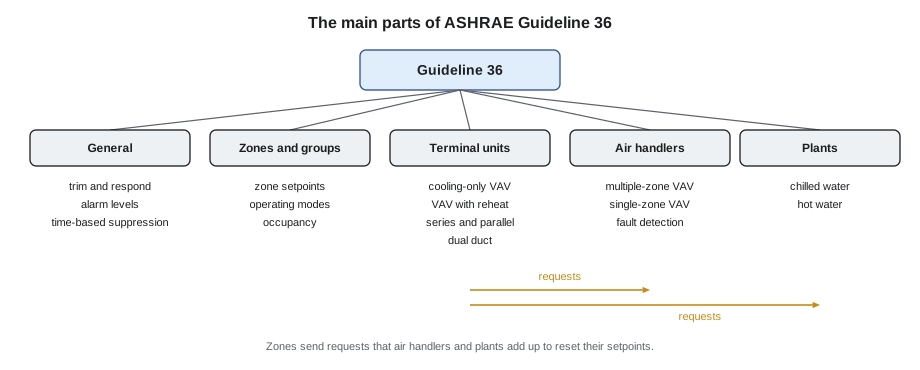
| Part | What it covers |
|---|---|
| General | Definitions, generic logic such as trim and respond, alarm levels and suppression, and how adjustable values are handled |
| Zones and zone groups | Zone setpoints, occupancy, modes chosen for groups of zones, window switches and local overrides |
| Terminal units | Cooling-only, reheat, fan-powered series and parallel, dual-duct, with their requests and alarms |
| Air handlers | Multiple-zone and single-zone VAV: start, fans, economizer, minimum outdoor air, resets, fault detection |
| Plants | Chilled water and hot water plants, added in later editions, with staging, resets and pumps |
| Points lists | The inputs and outputs each sequence needs |
Zone groups and modes
Guideline 36 does not set modes for an air handler directly. It defines zone groups, sets of zones that share a schedule, and chooses a mode for each group from the state of its zones. The modes include occupied, cool-down, setup, warm-up, setback, freeze protection and unoccupied. For example, a group goes into warm-up before its scheduled occupancy when its zones are below their occupied heating setpoints by enough that they need a head start, and into setback during unoccupied hours when enough of its zones fall below their unoccupied heating setpoints. The air handler serving the group runs or stops according to the group's mode.
Lesson 1's state diagram for AHU-1 had four modes and some missing transitions. Guideline 36 defines every transition explicitly, including what happens when the schedule's occupancy time arrives while a group is still in warm-up. That precision is one of its main benefits. Sophie said that a programmer following it has far fewer decisions to make alone, and far fewer to remember to write down.
Requests and importance multipliers
Requests are the backbone of Guideline 36. Each zone generates several kinds of request according to defined rules: cooling requests and static pressure requests for its air handler, heating hot water and chilled water requests for the plants, and sometimes others. A zone generates more requests the further it is from satisfaction: for example, one request when its cooling loop has been high for a few minutes, and two or three when the zone is several degrees above its cooling setpoint for some minutes. The air handlers and plants add up the requests and use them to reset their setpoints by trim and respond, as lessons 4 and 9 described.
Each zone also has an importance multiplier, adjustable by the operator, by which its requests are multiplied before they are added. A critical zone, such as a server room or a lab, can be given a multiplier of 2 so that its requests count double; a zone known to be faulty, or a zone that is permanently unhappy because of an envelope problem such as BAS-130's room 214, can be given a multiplier of 0 so that it no longer drives the system. The multiplier is a quick, visible fix that does not require editing the program.
Worked problem
Counting requests with importance multipliers
Four zones on one air handler send cooling requests this time step: zone A sends 1 with an importance multiplier of 1, zone B sends 2 with a multiplier of 1, zone C, a server room, sends 1 with a multiplier of 2, and zone D, a corner office with a known window problem, sends 3 with a multiplier of 0. The supply air reset ignores 2 requests. How many requests does the reset respond to?
Show solution
- Weighted requests: A 1 × 1 = 1; B 2 × 1 = 2; C 1 × 2 = 2; D 3 × 0 = 0.
- Total: 1 + 2 + 2 + 0 = 5.
- Beyond the ignored number: 5 − 2 = 3.
Answer: The reset responds to 3 requests. Without the multipliers, zone D's 3 requests would have pushed the total to 7 and the reset would have cooled the whole air handler for one office with a bad window.
Alarms, suppression and fault detection
Guideline 36 assigns every alarm a level, from life safety down to maintenance, and defines how each level is annunciated. It also defines time-based suppression: after a setpoint change, or when a system starts, alarms that compare a value with its setpoint are suppressed for a time proportional to the size of the change, so that a large setpoint change does not raise alarms simply because the system takes time to respond. BAS-220's alarm flood at Ninefield, and its restart inhibit in the retro-commissioning draft, were examples of the problem this solves.
Its air handler sequences also include automated fault detection: rules that compare the unit's temperatures, positions and modes and raise a fault when the combination is physically implausible. For example, the supply air should not be much warmer than the mixed air when the heating valve is closed, and the mixed air should lie between the outdoor and return air temperatures. These rules found their origins in research on air handler performance assessment, and they catch leaking valves, stuck dampers and failed sensors that ordinary alarms miss. BAS-110's room 108 case, with a reheat valve stuck open and commanded closed, was exactly the kind of fault the terminal unit version of such a rule detects, which is why Sophie's draft program for that box included three fault rules.
| Example fault rule | What it detects |
|---|---|
| Supply air much warmer than mixed air with heating closed | A leaking heating valve or a failed sensor |
| Mixed air outside the range between outdoor and return air | A failed temperature sensor |
| Supply air temperature far from setpoint with the cooling valve fully open | Insufficient cooling or a failed valve |
| Box discharge air much warmer than supply air with reheat closed | A reheat valve stuck open |
| Outdoor air fraction far from what the damper position implies | A stuck or broken outdoor damper |
Ventilation and economizers in Guideline 36
Guideline 36's multiple-zone air handler sequence calculates the minimum outdoor air continuously from the zones' current ventilation needs, using the ventilation standard's procedure or an energy code method, and controls a separate minimum outdoor air damper or an outdoor airflow measurement to hold it. This is the dynamic outdoor air reset that lesson 10 mentioned. Its economizer logic includes high limits by climate zone and a sequence for moving smoothly from minimum outdoor air to full economizer without the outdoor airflow dipping below minimum, which lesson 3 showed can happen with a single damper and a fixed minimum position.
These features need points that many older systems do not have: outdoor airflow measurement or a dedicated minimum outdoor air damper with a differential pressure sensor, discharge air sensors on reheat boxes, and reliable relief or return fan control. Applying Guideline 36 to an existing building therefore starts with a points survey. Sophie said that was the most common mistake she saw: specifying the guideline for a retrofit without checking that the building has the sensors it assumes.
Control description language and OpenBuildingControl
A sequence written in words still has to be translated into each manufacturer's programming tool, and that translation is where errors creep in. Researchers at Lawrence Berkeley National Laboratory, through the OpenBuildingControl project, developed a Control Description Language, CDL, which describes control logic as connected blocks in a form that can be simulated and then translated automatically into vendors' tools. Guideline 36's sequences have been implemented in CDL and published as part of an open library, so that an engineer can simulate a sequence with a model of the building before it is built, and a contractor can compare the installed program with the reference logic.
CDL is being standardized as ASHRAE Standard 231P, which was still a proposed standard going through public review when this course was written; readers should check its current status. Sophie did not expect Quillon's programming tools to accept CDL directly for some years, but she used the published reference logic when writing her own programs, as a check that her blocks did what the guideline meant.
Using Guideline 36 well
By the time they left, Sophie and Callie had written a short list for the January proposal to Gus. It recommended trialling Guideline 36's reheat box sequence on one Tilden box first, room 108's, since its draft program already followed the dual-maximum pattern; adding the discharge air sensors it needs; using importance multipliers to remove room 214 from the air handler's requests until its window was fixed; and specifying the guideline for AHU-2's replacement in 2027, where the new design already included an outdoor airflow station. Each item was written as a plan for Gus to approve.
| Do | Avoid |
|---|---|
| Specify the guideline by section for the systems it fits | Specifying it for systems it does not cover |
| Survey points and add the sensors the sequences assume | Applying it to a building that lacks the sensors |
| Fill in every project-specific value | Leaving defaults that do not suit the building |
| Trial on one unit before rolling out | Changing every box in a building at once |
| Record the edition and addenda used | Saying only "per Guideline 36" |
Fallbacks when the network fails
Guideline 36's sequences depend on data moving between controllers: zone requests travel to the air handler, air handler requests travel to the plant, and the outdoor air temperature is often shared from a single sensor. A guideline-based design therefore has to say what each controller does when that data stops arriving. The general principle is that every controller should keep its own equipment running safely on its last good information and then on fixed, conservative values, and that the loss of communication should itself raise an alarm.
| Lost data | Reasonable fallback |
|---|---|
| Zone requests at the air handler | Hold the static pressure and supply air setpoints at their design values |
| Shared outdoor air temperature | Use a local sensor if there is one; otherwise disable the economizer and hold design setpoints |
| Air handler requests at the plant | Hold the plant setpoints at their design values |
| Zone setpoints from the front end | Keep the last setpoints received and the local schedule |
These fallbacks cost energy while they last, but they keep the building comfortable and safe until the network is repaired. A designer applying the guideline must check that each fallback is achievable with the hardware actually specified, for example that the air handler controller has its own outdoor air sensor or a defined replacement, and must write the result into the project's sequence rather than assume the programmer will think of it.
Common mistakes
MistakeSpecifying Guideline 36 for a retrofit without a points survey.
InsteadCheck that the building has the outdoor airflow, discharge air and other sensors the sequences assume.
MistakeSaying only "per Guideline 36".
InsteadName the edition, addenda and sections used, and record the project values.
MistakeEditing the program to silence a permanently unhappy zone.
InsteadSet its importance multiplier to 0 and fix the underlying problem.
MistakeRaising setpoint deviation alarms during every start and setpoint change.
InsteadUse time-based suppression in proportion to the change.
MistakeTreating fault detection as optional extras.
InsteadInclude fault rules; they catch leaking valves, stuck dampers and failed sensors that alarms miss.
Summary and key terms
- Guideline 36 is a library of detailed, tested sequences for common HVAC systems, applied when a specification calls for it.
- It defines zone groups and chooses modes for each group from the state of its zones.
- Zones send defined requests, weighted by importance multipliers, that drive air handler and plant resets.
- Alarms have levels and time-based suppression; air handlers include automated fault detection rules.
- Its air handler sequences reset minimum outdoor air dynamically and need points many old systems lack.
- CDL, being standardized as proposed ASHRAE Standard 231P, describes control logic for simulation and translation.
- Use it by section, with a points survey, project values, a trial and a recorded edition.
- Guideline 36
- ASHRAE's library of high-performance sequences of operation for HVAC systems.
- Zone group
- A set of zones that share a schedule and an operating mode.
- Importance multiplier
- An adjustable factor applied to a zone's requests before they are added.
- Time-based suppression
- Delaying setpoint deviation alarms after a change in proportion to its size.
- Automated fault detection
- Rules that flag physically implausible combinations of readings and positions.
- Control Description Language
- A block-based language for describing control logic so it can be simulated and translated.
- OpenBuildingControl
- A research project that developed CDL and reference implementations of Guideline 36.
- Points survey
- A check of which sensors and outputs a building has before applying a sequence.
Practice problems
Work each problem on paper first, then reveal the answer to check.
Zones send 2 requests at multiplier 1, 1 at multiplier 3 and 4 at multiplier 0. Ignored requests 2. How many does the reset respond to?
Show answer
2 + 3 + 0 = 5; 5 − 2 = 3.
What does an importance multiplier of 0 do?
Show answer
It removes that zone's requests from the total.
Name two sensors that Guideline 36 air handler and box sequences often assume.
Show answer
Any two of outdoor airflow measurement, minimum outdoor air damper pressure, box discharge air temperature, reliable building or relief pressure.
Why does Guideline 36 suppress alarms after a setpoint change?
Show answer
So the system's normal response time does not raise false alarms.
What is CDL for?
Show answer
Describing control logic in blocks so that it can be simulated and translated into vendors' tools.
Lesson quiz · 5 questions
Score 60% or more to complete this lesson.
Create a free account to save your progress, take quizzes and earn a certificate.