
BAS-230 · Lesson 10 of 12 · 24 min
Demand control ventilation
▶ Video coming soon A video version of this lesson is on the way.
A week after Callie had installed the second carbon dioxide sensor in Tilden Hall's lecture hall T-120, Sophie's session on Wednesday, October 28 was about the paragraphs that sensor served. "Ventilation is the one part of a sequence that's about people's health, not their comfort," she said. "The minimum outdoor air is there because people breathe. Demand control ventilation lets us bring in less when fewer people are there. That saves a lot of energy in a room like T-120, which seats 120 and is empty half the day. But it has to be done honestly, because the cost of getting it wrong isn't a warm room. It's a stuffy one."
What demand control ventilation is
Ventilation standards set outdoor air rates for each kind of space, based on the number of people the space is designed for and its floor area. An air handler designed for full occupancy brings in that much outdoor air all through occupied hours unless something tells it otherwise. Demand control ventilation, or DCV, reduces the outdoor air when the space has fewer people than the design assumes, using a measurement of actual occupancy: carbon dioxide concentration, an occupancy sensor, a people counter or a schedule from a booking system. Energy codes require DCV for spaces above a certain size and design occupant density, such as lecture halls, auditoriums and large meeting rooms, with exceptions that the code lists.
ASHRAE Standard 62.1, which the Ontario Building Code references for ventilation, calculates the outdoor air needed in the breathing zone from two parts: a rate per person and a rate per unit floor area. The area part covers pollutants from the building and its furnishings, which are there whether or not anyone is; the people part covers pollutants from people. DCV can reduce only the people part. The area part is always needed while the space is in use.
Worked problem
Breathing zone outdoor air for T-120
T-120 seats 120 and has a floor area of 140 m². For a lecture classroom the standard's rates are 3.8 L/s per person and 0.3 L/s per square metre. What is the breathing zone outdoor airflow at full occupancy? What is the area part alone?
Show solution
- People part: 3.8 × 120 = 456 L/s.
- Area part: 0.3 × 140 = 42 L/s.
- Total: 456 + 42 = 498 L/s.
Answer: At full occupancy the hall needs 498 L/s in the breathing zone, the figure BAS-110 used. With nobody in it during occupied hours it still needs the 42 L/s area part. DCV works in the range between the two.
Carbon dioxide as a measure of occupancy
People breathe out carbon dioxide at a fairly steady rate for a given activity, so the concentration of CO2 in a room rises with the number of people and falls with the outdoor airflow. That makes CO2 a useful proxy for occupancy per unit of ventilation. It is not a measure of air quality as such. ASHRAE's own position is that indoor CO2 does not give an overall indication of indoor air quality, that its ventilation standard does not set a CO2 limit for health or comfort, and that the CO2 setpoints used for DCV are control settings, not air quality criteria. A sequence should therefore never describe its CO2 setpoint as a health limit.
Outdoor air has CO2 too, currently a little above 420 ppm and rising slowly, as BAS-120 noted. What the room's people add is the difference between indoor and outdoor concentration. At steady state, that difference equals the CO2 generation of the occupants divided by the outdoor airflow per person.
Worked problem
Steady-state CO2 at design ventilation
Using about 0.0052 L/s of CO2 per person for adults at light activity, what is the steady-state difference between indoor and outdoor CO2 in T-120 when it is full and receiving its design 498 L/s?
Show solution
- Outdoor air per person: 498 ÷ 120 = 4.15 L/s.
- Difference: 0.0052 ÷ 4.15 = 0.00125, which is 1,253 ppm.
- Indoor CO2 with outdoor air at 420 ppm: about 420 + 1,253 = 1,673 ppm.
Answer: A full lecture hall at its design ventilation rate can settle well above 1,000 ppm. That is not a failure of ventilation: the standard's rates for lecture rooms are lower per person than for offices, and its CO2 setpoints are control settings. It does mean that a DCV sequence should reach full design outdoor air at or before the CO2 level the full room would produce, and never treat a reading above 1,000 ppm as an alarm on its own.
A CO2 DCV sequence for a single zone
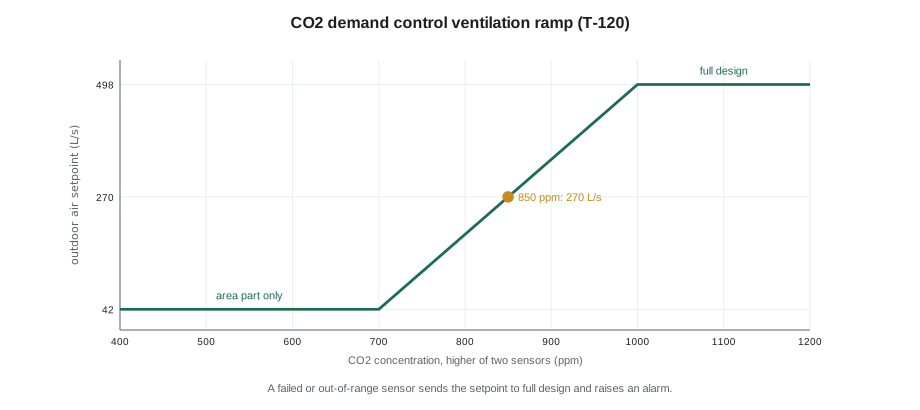
T-120 is served by AHU-2, which serves the lecture wing, and its sequence controls the hall's own outdoor air through the box serving it and the air handler's outdoor air minimum. The 2009 sequence, which BAS-110 described, used a proportional ramp: below 700 ppm the hall's ventilation sat at its minimum, at 1,000 ppm it reached full design, and between the two it rose in proportion. Since October 22 the sequence has used the higher of the two sensors in the hall, the original return sensor and the new one on the side wall.
Worked problem
Reading the DCV ramp
With the ramp from 42 L/s at 700 ppm to 498 L/s at 1,000 ppm, what is the outdoor air setpoint when the higher sensor reads 850 ppm?
Show solution
- Fraction along the ramp: (850 − 700) ÷ (1,000 − 700) = 150 ÷ 300 = 0.5.
- Setpoint: 42 + 0.5 × (498 − 42) = 42 + 228 = 270 L/s.
Answer: At 850 ppm the hall receives 270 L/s of outdoor air, a little over half its design. With 30 students in an evening class, the people part would be only 3.8 × 30 = 114 L/s plus the 42 L/s area part, so the ramp is generous at low occupancy, which is the safe direction to err.
The simple ramp is not the only method. Ventilation standards and high-performance sequences describe ways to calculate a CO2 setpoint that corresponds exactly to the required outdoor air per person at the current occupancy, and to let the zone controller reset its ventilation minimum accordingly. The details vary between editions of the standard, and Sophie said that any new DCV sequence should be checked against the edition the local code references. For T-120 she left the 2009 ramp in place, because it errs toward more air.
Sensors, location and calibration
A DCV sequence is only as good as its sensors. CO2 sensors drift, and BAS-110's return air sensor in T-120 had drifted to read 330 ppm low, so that the hall was under-ventilated without anyone knowing. Most modern sensors use an automatic baseline correction that assumes the room reaches outdoor concentration at some point every day or week; that works in a room like T-120 that empties every night, as BAS-120 noted when it left the feature on for the new sensor, but it fails in spaces that are never empty, where it must be turned off and the sensor calibrated by hand.
| Sensor question | Good practice |
|---|---|
| Where? | In the occupied space at breathing height, away from doors, windows, supply diffusers and people's faces; a return duct sensor only where the space is well mixed |
| How many? | Enough to represent large spaces; use the highest reading when there are several |
| Calibration | Automatic baseline correction only in spaces that are regularly empty; otherwise scheduled field checks |
| Failure | A failed or out-of-range sensor sends the space to full design ventilation and raises an alarm |
| Verification | Compare with a calibrated portable meter at commissioning and yearly |
DCV in multiple-zone systems
T-120 has its own sensors, but most air handlers serve many zones, and the outdoor air the unit must bring in depends on the needs of all of them. In a multiple-zone VAV system, the ventilation standard's calculation takes into account the zone that needs the largest fraction of outdoor air in its supply, which is often a small, densely occupied room. When DCV reduces one zone's requirement, the system's outdoor air can fall only as far as the other zones allow. High-performance sequences handle this by having each zone controller report its current ventilation need and the air handler recalculating its minimum outdoor air continuously, which is the dynamic reset of outdoor air that Guideline 36 includes and lesson 11 describes.
Occupancy sensors offer a simpler kind of DCV that suits many small rooms. When a room's occupancy sensor shows it empty during occupied hours, the zone goes to occupied standby, as lesson 5 described, and its people part of ventilation can be set to zero, leaving the area part, or in some cases nothing at all where the standard allows it. The air handler's minimum outdoor air falls with the sum of the zones' requirements.
Purge and the start of the day
Many sequences add a pre-occupancy purge: for a set time before the building opens, the air handler runs with outdoor air at least at its design minimum, flushing out pollutants that built up overnight from materials and furnishings. Purge is good practice in new buildings and after renovation, and some green building programs require it. It costs energy in cold weather, so sequences often limit it by outdoor temperature or shorten it in winter. Tilden's lecture wing did not have one; Sophie added it to the list of items for the AHU-2 replacement design, where the new sequence could include a 30-minute purge on mild mornings.
Occupancy-based ventilation and standby
CO2 is not the only way to match ventilation to people. Many energy codes and Standard 62.1 allow the people-related part of the ventilation rate to be cut when an occupancy sensor shows a zone is empty during occupied hours. The zone then needs only its area-based outdoor air, and in some cases, depending on the occupancy category and the standard in force, none at all for a short period. This is usually called occupied standby. It suits small rooms with irregular use, such as offices, meeting rooms and classrooms between classes, where a CO2 sensor in every room would cost more than it saves.
| Approach | Best for | Main weakness |
|---|---|---|
| CO2-based DCV | Large, densely occupied spaces with varying numbers of people | Sensor cost, calibration and placement |
| Occupancy sensor (occupied standby) | Small rooms that are often empty during the day | Only knows empty or occupied, not how many |
| Scheduled occupancy | Spaces with fixed, predictable use | Wrong whenever the schedule is wrong |
In occupied standby, the zone's ventilation drops to its area component, its heating and cooling setpoints widen by a small amount, and the box minimum can fall to match. When someone walks in, the occupancy sensor returns the zone to its occupied setpoints and ventilation. The sequence must say how long the room must be empty before standby begins, typically several minutes, so that a person sitting still does not get dropped. Guideline 36's zone sequences include this mode.
The occupancy sensor's location matters as much as the CO2 sensor's. A ceiling sensor that cannot see a person at a desk behind a bookshelf will put an occupied room into standby, and the complaint will be about stuffiness or temperature, not about the sensor. Testing therefore includes sitting still in the room for longer than the delay and checking that it stays occupied.
At Harcastle, Sophie suggested the small seminar rooms beside T-120 as candidates: each had an occupancy sensor already wired to the lighting, and sharing that signal with the VAV controller would cost a few hours of programming rather than new sensors.
Common mistakes
MistakeTreating a CO2 setpoint as a health limit.
InsteadDescribe it as a control setting; ASHRAE's ventilation standard sets no CO2 limit for health or comfort.
MistakeReducing ventilation below the area part during occupied hours.
InsteadDCV may reduce only the people part, except where the standard allows more in unoccupied standby.
MistakeLeaving automatic baseline correction on in a space that is never empty.
InsteadTurn it off there and calibrate by hand against a portable meter.
MistakeFailing a sensor to minimum ventilation.
InsteadSend the space to full design ventilation and alarm when a sensor fails.
MistakeApplying zone DCV without recalculating the air handler's minimum.
InsteadRecalculate system outdoor air from all zones' current needs.
Summary and key terms
- Demand control ventilation reduces outdoor air when a space has fewer people than its design.
- Breathing zone outdoor air is a rate per person times people plus a rate per area times area; DCV changes only the people part.
- CO2 is a proxy for occupancy per unit of ventilation, not an overall measure of air quality.
- At design ventilation a full lecture room can settle above 1,000 ppm without any failure.
- A simple DCV ramp raises outdoor air between two CO2 levels, using the higher of several sensors.
- Sensor location, calibration and failure behaviour decide whether DCV is safe.
- Multiple-zone systems must recalculate system outdoor air from all zones; purge flushes the building before occupancy.
- Demand control ventilation
- Reducing outdoor air according to the actual occupancy of a space.
- Breathing zone outdoor airflow
- The outdoor air required where people breathe, from people and area rates.
- People part
- The part of required outdoor air that depends on the number of occupants.
- Area part
- The part of required outdoor air that depends on floor area and is needed whenever the space is in use.
- Automatic baseline correction
- A CO2 sensor feature that recalibrates by assuming the space regularly reaches outdoor concentration.
- Pre-occupancy purge
- Running outdoor air before occupancy to flush pollutants that built up overnight.
- Dynamic outdoor air reset
- Continuously recalculating an air handler's minimum outdoor air from the zones' current needs.
- ppm
- Parts per million, the usual unit for CO2 concentration.
Practice problems
Work each problem on paper first, then reveal the answer to check.
A room for 40 people with 100 m², rates 2.5 L/s per person and 0.3 L/s per m². Breathing zone outdoor air at full occupancy?
Show answer
2.5 × 40 + 0.3 × 100 = 100 + 30 = 130 L/s.
Ramp from 42 L/s at 700 ppm to 498 L/s at 1,000 ppm. Setpoint at 760 ppm?
Show answer
(760 − 700) ÷ 300 = 0.2; 42 + 0.2 × 456 = 133.2 L/s.
Steady-state CO2 difference with 0.0052 L/s per person and 8 L/s per person of outdoor air?
Show answer
0.0052 ÷ 8 = 0.00065, or 650 ppm.
What should a DCV sequence do when its CO2 sensor fails?
Show answer
Go to full design ventilation and raise an alarm.
When is automatic baseline correction a poor choice?
Show answer
In a space that is never empty, so it never reaches outdoor concentration.
Lesson quiz · 5 questions
Score 60% or more to complete this lesson.
Create a free account to save your progress, take quizzes and earn a certificate.