
BAS-230 · Lesson 5 of 12 · 27 min
Variable air volume and terminal unit sequences
▶ Video coming soon A video version of this lesson is on the way.
On Wednesday evening, October 14, two weeks after BAS-120's airflow checks on Tilden Hall's VAV boxes, Sophie brought the sequences for the terminal units: the boxes, fan coils and radiation that deliver heating and cooling to each room. "An air handler has one sequence," she said. "A building has one terminal sequence used two hundred times. If it's wrong, it's wrong two hundred times." She laid out three documents: the 2009 sequence for Tilden's VAV boxes with hot water reheat, the 1998 sequence for Ninefield's interior cooling-only boxes, and the sequence for Ninefield's perimeter boxes, which are parallel fan-powered boxes with electric heat.
Zone setpoints, deadband and modes
Every terminal unit sequence starts with the zone's setpoints. Most use separate heating and cooling setpoints with a deadband between them, so that the zone is neither heated nor cooled when its temperature is comfortable. BAS-220's fan coil program used 21.0 °C for heating and 24.0 °C for cooling in occupied mode, a deadband of 3 K. A single setpoint with no deadband makes the zone swing between heating and cooling, which wastes energy and wears out valves and dampers.
| Zone mode | Typical heating setpoint | Typical cooling setpoint | Airflow |
|---|---|---|---|
| Occupied | 21 °C | 24 °C | Minimum to maximum as needed |
| Occupied standby (room empty during occupied hours) | 20 °C | 25 °C | Minimum may drop, sometimes to zero |
| Unoccupied | 15 °C | 30 °C | Off unless setback or setup is reached |
Occupied standby is the newer of these modes. It applies when the building is occupied but a particular room is empty, as an occupancy sensor reports. The setpoints widen a little and the ventilation minimum can be reduced or, where the ventilation standard allows, set to zero. Guideline 36 and recent energy codes encourage it for rooms such as classrooms and conference rooms that sit empty for much of the day.
Cooling-only VAV boxes
The simplest terminal unit is a cooling-only VAV box: a damper and an airflow sensor in the supply duct to the zone. The zone's cooling loop resets the box's airflow setpoint between a minimum and a maximum, and the box's own airflow loop moves the damper to deliver that airflow. The minimum is set by the zone's ventilation need or by the lowest airflow the sensor can measure reliably; the maximum is the design cooling airflow. When the zone is below its cooling setpoint the box sits at minimum, delivering cool air whether the zone wants it or not, which is why interior zones in cold weather can be overcooled if their minimums are set too high.
Ninefield's interior boxes followed this pattern. Their 1998 sequence also gave them a heating response of sorts: when the zone fell below its heating setpoint the box stayed at minimum and raised an alarm after an hour, because interior zones with cooling-only boxes have no way to heat. Sophie said a frequent cold-zone alarm on an interior box usually meant the minimum was too high or the supply air too cold, not that the zone needed heat.
VAV boxes with reheat
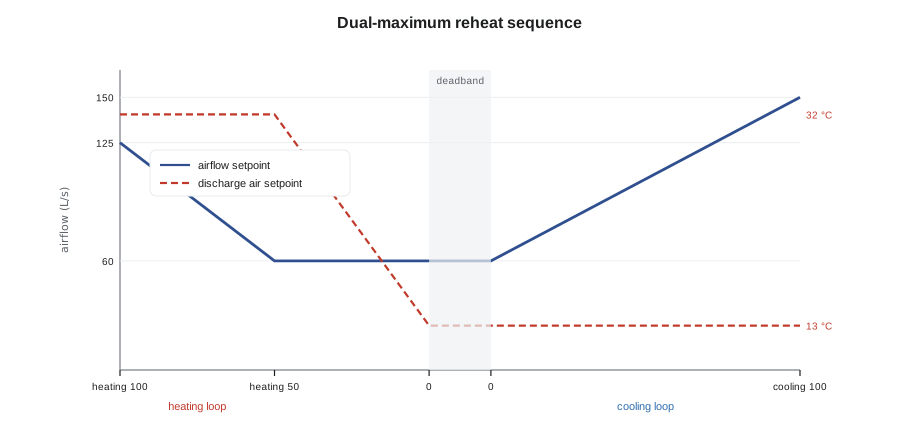
Perimeter and exposed zones need heat, so their boxes have reheat coils, either hot water or electric. The traditional single-maximum sequence runs the box at its cooling maximum on cooling demand, drops to its minimum in the deadband, and stays at that minimum while the reheat valve opens on heating demand. All the heat must be delivered by the small minimum airflow, so the discharge air gets very hot, rises to the ceiling and stratifies, and the heating works poorly.
The dual-maximum sequence fixes this. As heating demand rises, the reheat valve first raises the discharge air temperature from the supply temperature toward a maximum, typically limited to about 11 K above room temperature so that the warm air still mixes with the room. Once the discharge air is at its maximum, the airflow rises from minimum toward a heating maximum, which is larger than the minimum but smaller than the cooling maximum. More heat is delivered at a more useful temperature.
Worked problem
Dual-maximum setpoints at a given heating demand
A reheat box has a minimum of 60 L/s, a heating maximum of 125 L/s and a cooling maximum of 150 L/s. The supply air is 13 °C and the maximum discharge air temperature is 32 °C. Discharge temperature rises over the first half of heating demand and airflow over the second half. What are the airflow and discharge air setpoints at 40 heating demand? At 90?
Show solution
- At 40: within the first half, 40 ÷ 50 = 0.8 of the way. Discharge setpoint 13 + 0.8 × (32 − 13) = 13 + 15.2 = 28.2 °C. Airflow stays at the 60 L/s minimum.
- At 90: discharge setpoint at its 32 °C maximum. Airflow is (90 − 50) ÷ 50 = 0.8 of the way from minimum to heating maximum: 60 + 0.8 × (125 − 60) = 60 + 52 = 112 L/s.
Answer: At 40 heating demand: 60 L/s at 28.2 °C. At 90: 112 L/s at 32 °C.
The numbers in this example are the ones BAS-220 later used for room 108's box. At this October session, Tilden's boxes still ran the 2009 single-maximum program, and Sophie only sketched the dual-maximum curve on the whiteboard. She read the room 108 program in detail at her October 31 workshop and drafted its dual-maximum replacement on November 14. The dual-maximum sequence needs a discharge air temperature sensor on each box, which Tilden's boxes did not have, so the change became part of the proposal to Gus for January 2027.
The cost of reheat at minimum airflow
Reheat is cooling followed by heating, and it is the main reason terminal minimums matter. Every litre of cold air delivered to a zone that does not need it must either overcool the zone or be reheated. Lowering minimums to the true ventilation requirement, and using occupied standby to lower them further in empty rooms, saves reheat energy directly.
Worked problem
Heat needed to warm minimum airflow to room temperature
A Tilden box delivers its 60 L/s minimum of 13 °C supply air to a 21 °C room that needs neither heating nor cooling. How much heat does the room or the reheat coil have to supply just to bring that air to room temperature? Use 1.2 W per L/s per kelvin for air.
Show solution
- Temperature rise: 21 − 13 = 8 K.
- Heat: 1.2 × 60 × 8 = 576 W.
Answer: About 580 W per box, all day, just to offset the minimum airflow. Across 200 boxes that is more than 100 kW of heat to undo cooling that nobody needed, which is why minimums and supply air reset are worth getting right.
Fan-powered boxes
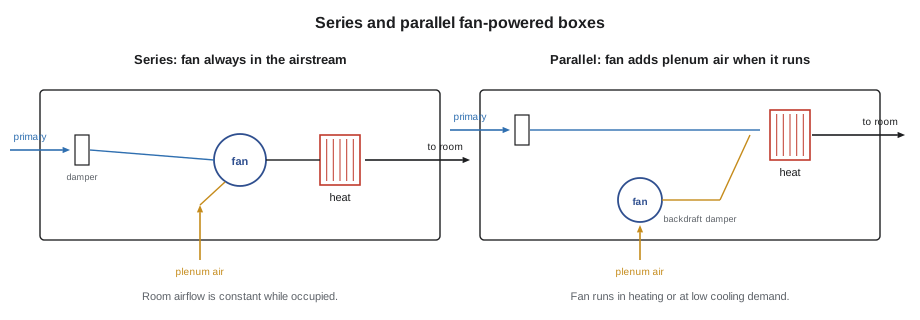
A fan-powered box adds a small fan that draws warm air from the ceiling plenum and mixes it with primary air from the air handler. In a series fan-powered box, the fan is in the airstream and runs continuously whenever the zone is occupied, so the room always gets the same total airflow; the primary air damper varies the cold air, and the fan makes up the rest from the plenum. In a parallel fan-powered box, the fan sits beside the primary airstream and runs only in heating or at low cooling demand, adding warm plenum air before the heating coil is used.
Worked problem
Mixed air from a series fan-powered box
A series fan-powered box in a typical office zone runs its fan at a constant 300 L/s. At part load the primary damper delivers 120 L/s of 13 °C air, and the fan draws the rest from a 24 °C plenum. What temperature air reaches the room, with the heating coil off?
Show solution
- Plenum air: 300 − 120 = 180 L/s.
- Mixed temperature: (120 × 13 + 180 × 24) ÷ 300 = (1,560 + 4,320) ÷ 300 = 19.6 °C.
Answer: The room receives 300 L/s at 19.6 °C. The steady airflow helps air distribution, and the warm plenum air is free heat recovered from lights and people above the ceiling.
Sequences for fan-powered boxes must say when the fan runs, how it is proven, and what happens to the primary air when the fan fails. For a series box, the fan must be proven before the primary damper opens, because primary air pushed into a box whose fan is stopped can blow back out of the plenum inlet. Ninefield's perimeter boxes were parallel boxes with electric heat. Their sequence started the fan when the zone's heating demand passed a small value and enabled the electric heat only after the fan proved, since electric heat with no airflow overheats and trips its high limits.
Fan coils and radiation
Fan coil units, with a fan, a coil or two and often a local outdoor air connection, are common in stair halls, entrances and older buildings. Their sequences are short: fan on in occupied mode or on demand, valves modulated or cycled to hold the zone setpoints, and a low temperature protection on any coil exposed to outdoor air. BAS-130's two-position fan coils in Tilden's east stair were an example, and BAS-220's Morrow House program another.
Perimeter radiation, such as Tilden's fin-tube, offsets the heat lost through walls and windows before the air system has to. Sequences usually reset the radiation's water temperature or valve position from outdoor air, so that it carries the envelope load, and let the VAV reheat handle the rest. The sequence must stop the radiation and the VAV cooling fighting each other: a zone with radiation fully on and its box at cooling maximum is heating and cooling at once. BAS-130's room 214, with its radiation at full output against a leaky single-glazed window, showed what happens when the envelope, not the controls, is the problem.
Requests from terminal units
Lesson 4 explained that air handler and plant resets depend on zone requests. The terminal unit sequence is where those requests are made, and Sophie's checklist for a terminal sequence included three questions about them: which requests the zone sends (cooling, static pressure, heating hot water), what thresholds trigger each one and for how long, and how the operator can exclude a zone that is known to be faulty. A terminal sequence that sends no requests forces the air handler and plants to run on fixed setpoints.
Minimum airflow and flow sensor accuracy
Lowering a box's minimum airflow saves fan energy and reheat, but there is a floor below which the box cannot control. A VAV box measures its airflow with a velocity pressure sensor at the inlet, and the velocity pressure falls with the square of the airflow. At half the design flow the signal is a quarter of its design value; at a fifth of the design flow it is one twenty-fifth. Somewhere down there the signal becomes too small for the transducer to read reliably, and the controller begins to chase noise.
The controllable minimum therefore depends on the inlet size, the flow sensor's amplification and the transducer's accuracy. Box and controller manufacturers publish the lowest velocity pressure their equipment can read, and the minimum airflow setpoint should be at or above the flow that produces it. Guideline 36 asks the designer to check this when setting zone minimums. A minimum that is lower than the box can measure may look good on paper and deliver nothing like it in the room.
Worked problem
Checking a minimum against the sensor
A box has a design flow of 250 L/s with a velocity pressure of 250 Pa at that flow. The controller can read about 6 Pa reliably (a typical value; check the product data). Is a minimum of 60 L/s controllable?
Show solution
- Velocity pressure scales with the square of flow: 250 × (60 ÷ 250)² = 250 × 0.0576 = 14.4 Pa.
- Lowest readable flow: 250 × √(6 ÷ 250) = 250 × 0.155 = 38.7 L/s.
Answer: Yes. 14.4 Pa is above the 6 Pa the controller can read, and the box can measure down to about 39 L/s.
During commissioning, the balancer checks the box's reading against a hood or traverse at both the minimum and the maximum. A box that is accurate at maximum but reads well off at minimum needs its flow coefficient adjusted, or a higher minimum.
Common mistakes
MistakeUsing one zone setpoint with no deadband.
InsteadUse separate heating and cooling setpoints with a deadband between them.
MistakeSetting box minimums higher than ventilation needs.
InsteadSet minimums to the true ventilation requirement and use occupied standby where allowed.
MistakeHeating with all the heat in the minimum airflow.
InsteadUse a dual-maximum sequence with a limit on discharge temperature.
MistakeOpening a series box's primary damper before its fan is proven.
InsteadProve the fan first so primary air cannot blow out of the plenum inlet.
MistakeLetting perimeter radiation and VAV cooling fight.
InsteadSequence radiation to carry the envelope load and prevent simultaneous heating and cooling.
Summary and key terms
- Terminal sequences use heating and cooling setpoints with a deadband, and occupied, standby and unoccupied modes.
- Cooling-only boxes vary airflow between a minimum and a maximum from the zone cooling loop.
- Dual-maximum reheat raises discharge temperature first, then airflow, giving better heating than single-maximum.
- Every unit of minimum airflow delivered cold to a zone that does not need it costs reheat energy.
- Series fan-powered boxes run their fans continuously; parallel boxes run them only for heating or low cooling demand.
- Fan coil and radiation sequences must avoid fighting the air system.
- Terminal sequences generate the requests that air handler and plant resets depend on.
- Deadband
- The range between a zone's heating and cooling setpoints in which neither acts.
- Occupied standby
- A mode for an empty room during occupied hours, with wider setpoints and lower minimums.
- Cooling-only VAV box
- A terminal unit that varies cool supply airflow with no heating coil.
- Single maximum
- A reheat sequence that heats with the minimum airflow only.
- Dual maximum
- A reheat sequence that raises discharge temperature and then airflow on heating demand.
- Series fan-powered box
- A box whose fan is in the airstream and runs whenever the zone is occupied.
- Parallel fan-powered box
- A box whose fan adds plenum air only when it runs, usually in heating.
- Reheat
- Heating air that was cooled at the air handler, at the terminal unit.
Practice problems
Work each problem on paper first, then reveal the answer to check.
Heating demand 25, discharge rising over the first half from 13 °C to 32 °C. What is the discharge setpoint?
Show answer
25 ÷ 50 = 0.5; 13 + 0.5 × 19 = 22.5 °C.
Minimum 60 L/s, heating maximum 125 L/s, airflow rising over the second half. Airflow at heating demand 70?
Show answer
(70 − 50) ÷ 50 = 0.4; 60 + 0.4 × 65 = 86 L/s.
A box delivers 80 L/s of 13 °C air to a 21 °C room. What heat offsets it?
Show answer
1.2 × 80 × 8 = 768 W.
Series box fan 400 L/s, primary 100 L/s at 13 °C, plenum 24 °C. Mixed temperature?
Show answer
(100 × 13 + 300 × 24) ÷ 400 = 21.25 °C.
Why must a parallel box's fan prove before its electric heat is enabled?
Show answer
Electric heat with no airflow overheats and trips its limits.
Lesson quiz · 5 questions
Score 60% or more to complete this lesson.
Create a free account to save your progress, take quizzes and earn a certificate.