
BAS-230 · Lesson 6 of 12 · 23 min
Heating plant and boiler sequences
▶ Video coming soon A video version of this lesson is on the way.
The day before Sophie's session on Wednesday, September 30, Callie had spent the afternoon in Harcastle College's central steam plant with Nell Nakagawa, the chief building operator, and then in Tilden Hall's basement, where the campus steam turns into hot water in the converter. So when Sophie put the heating sections of Tilden's sequence on the table that evening, Callie could picture every valve. Next to them Sophie laid a newer document: the sequence for the two condensing boilers that Quillon had connected in 2023 at Morrow House, the college's residence, when its old boiler was replaced. "Two kinds of heating plant," she said. "Steam from the campus, and a small hot water boiler plant of its own. The sequences look different, but they answer the same questions."
What a heating plant sequence covers
A heating plant sequence describes when the plant is enabled, how its boilers or heat exchangers are staged, what hot water temperature it supplies, how its pumps run, and how it is protected. It also describes the boundary between the building automation system and the boilers' own controls. That boundary matters, because boilers have burner management systems that handle ignition, flame safety and combustion, and the building automation system must never try to do their job.
| Sequence section | Questions it answers |
|---|---|
| Plant enable | When is heat available, and what turns it on and off? |
| Staging | How many boilers or exchangers run, and which one leads? |
| Supply temperature | What temperature does the plant supply, and how is it reset? |
| Pumps | Which pumps run, how are they proven, and what happens on failure? |
| Protection | Minimum flows, minimum return temperatures, high limits |
| Interface | What the automation system commands, and what the boiler controls do themselves |
| Alarms | Boiler lockout, pump failure, low or high water temperature |
The boundary with boiler controls
A boiler's burner management system starts the burner, proves the flame, purges the combustion chamber and shuts the fuel off when anything is unsafe. Its safety limits, such as low water cutoffs and high temperature or pressure limits, are hardwired and certified with the boiler. The building automation system usually sends only an enable signal and, on modulating boilers, a firing rate or a temperature setpoint, and it monitors the boiler's status and alarms. It does not bypass, reset or override the boiler's safety controls.
At Harcastle's central plant the boundary was firmer still. The two low-pressure steam boilers were operated by Nell's team of power engineers, as Ontario's regulations for a plant of that size require, and the automation system only monitored them. The plant's own controls held the steam pressure. Tilden's sequence started at the building's steam valve, where campus steam entered the converter.
Plant enable
A heating plant should run only when something needs heat. Older sequences enable it from outdoor air temperature alone: on below a set temperature, off above it. That is simple and predictable, but it runs the plant on cool summer nights when no zone needs heat and keeps it off on a mild day when a north room does. Newer sequences, including Guideline 36's plant sequences, enable the plant from heating requests sent by the air handlers, terminal units and radiation, with an outdoor air lockout above which the plant stays off regardless of requests.
| Enable method | Plant runs when | Weakness |
|---|---|---|
| Outdoor air only | Outdoor air below about 16 °C | Runs when no zone needs heat, or stays off when one does |
| Requests only | Enough zones request heat | One faulty request can run the plant all summer |
| Requests with outdoor air lockout | Enough requests, and outdoor air below the lockout | Needs reliable request logic in every zone |
Tilden's 2009 sequence enabled the converter and its pumps when the outdoor air fell below 16 °C or when the morning warm-up mode was active. Sophie's draft for Morrow House in 2023 used requests: the plant ran when at least two terminal units requested heat for five minutes, and it stayed off above 18 °C outdoors whatever the requests said. She explained that the number of requests needed, and the lockout, were adjustable values so that Nell could tune them after a season.
Hot water supply temperature reset
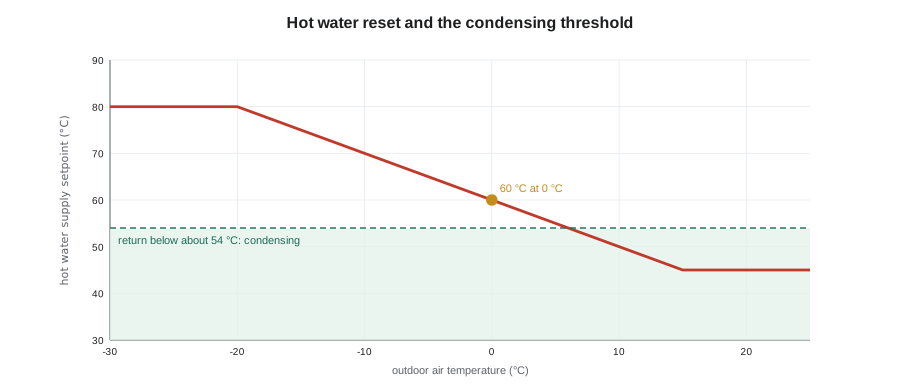
A hot water system designed for the coldest day is far hotter than it needs to be on a mild one. Resetting the supply temperature from outdoor air reduces pipe losses, makes valves control more smoothly because they open further, and, for condensing boilers, keeps the return water cool enough for the boilers to condense. BAS-130 and BAS-220 both used Tilden's reset: 80 °C at an outdoor temperature of −20 °C, falling in a straight line to 45 °C at 15 °C.
Worked problem
Reading a hot water reset
Using Tilden's reset, what is the hot water supply setpoint when the outdoor air is 0 °C? If the system's temperature drop is 11 K at that load, what is the return water temperature?
Show solution
- The setpoint falls by 80 − 45 = 35 K over 15 − (−20) = 35 K of outdoor temperature, 1 K per K.
- At 0 °C, 20 K above −20 °C: 80 − 20 × 1 = 60 °C.
- Return: 60 − 11 = 49 °C.
Answer: At 0 °C outdoors the plant supplies 60 °C and the water returns at about 49 °C. On a condensing plant that return temperature is cool enough for the boilers to condense, as the next section explains.
Outdoor air reset has one weakness: it knows nothing about the zones. BAS-130 described the demand override Nell approved for Tilden's north reheat coils, which raises the setpoint when several coils have their valves fully open. Request-based reset is the general form of the same idea. The plant starts from the outdoor air schedule and then trims down or responds up according to how many coils are asking for hotter water, just as lesson 4's air handler resets did.
Condensing boilers
A condensing boiler extracts extra heat by cooling its flue gases below their dew point, so that water vapour in the exhaust condenses and gives up its latent heat. It only condenses when the water returning to it is cool enough, below roughly 54 °C for natural gas, the exact figure depending on the boiler and the combustion. A condensing boiler fed with hot return water works like a non-condensing boiler, and much of the extra efficiency the owner paid for is lost. Its sequence should therefore keep supply temperatures as low as the building allows and avoid anything, such as bypass valves or constant-flow loops, that sends hot supply water straight back to the boilers.
Condensing boilers also turn down well, typically to a fifth of their full input or lower, and they are most efficient at low firing rates. For that reason many sequences for condensing plants run more boilers at lower firing rates rather than fewer boilers at high fire: two boilers at 40 in 100 are usually more efficient than one at 80 in 100. Non-condensing boilers are often staged the other way, filling one before starting the next.
Worked problem
Staging two condensing boilers
Morrow House has two condensing boilers of 250 kW each, with a turndown of 5 to 1. On a cold morning the residence needs 300 kW. Can one boiler carry the load? If both run sharing equally, at what fraction of full input does each fire? What is each boiler's minimum input?
Show solution
- One boiler: 300 kW is more than 250 kW, so no.
- Two boilers sharing: 300 ÷ 2 = 150 kW each; 150 ÷ 250 = 0.60, or 60 in 100.
- Minimum input: 250 ÷ 5 = 50 kW each.
Answer: Both boilers run at 60 in 100. On a mild day the plant can run one boiler down to 50 kW before it must cycle on and off, which is what a good turndown is for.
Lead, lag and staging
Plants with more than one boiler, heat exchanger or pump need lead-lag logic. The lead unit runs first; the lag unit starts when the lead cannot keep up, typically when the supply temperature stays below setpoint for some minutes with the lead at or near full input; it stops when the combined load falls below what one unit can carry, with a time delay and a margin so that the plant does not cycle. The lead role rotates on a schedule, such as weekly or by run hours, so that wear is shared, and the lag unit takes over automatically when the lead fails. BAS-220 showed the logic for equal-runtime rotation, and BAS-130 tested a pump failover.
| Staging rule | Sample setting |
|---|---|
| Start lag boiler | Lead above 80 in 100 input for 10 minutes, or supply below setpoint by 3 K for 10 minutes |
| Stop lag boiler | Both below 30 in 100 input for 15 minutes |
| Lead rotation | Weekly, Monday 8:00, if both boilers are available |
| Failover | Lag starts at once if the lead locks out or fails to prove |
| Minimum off time | 5 minutes before any boiler restarts |
Pumps and minimum flow
Hot water pumps are usually sequenced lead and standby. When the plant is enabled the lead pump starts, and the boilers or the steam valve are enabled only after the pump is proven, because heat added with no flow can overheat a boiler or a converter. If the lead pump fails to prove, the standby pump starts and an alarm is raised. BAS-130's failover test at Tilden took 20 seconds to detect the failure and 10 more to start the standby pump.
Many boilers need a minimum flow through them whenever they fire, and some need a minimum return temperature, especially non-condensing boilers that would corrode if their flue gases condensed. The sequence must meet these limits, which come from the boiler manufacturer, with boiler pumps, a bypass, or a mixing valve. A condensing plant and a non-condensing plant have opposite needs here, which is one reason sequences cannot simply be copied from one plant to another.
Steam-to-hot-water converters
Tilden's converter is a heat exchanger with campus steam on one side and the building's hot water on the other. A steam valve controlled by a hot water supply temperature loop admits steam as needed; BAS-130 tuned that loop after a step test with Nell. Its sequence adds three protections: the steam valve is closed whenever the hot water pump is not proven, a high limit closes it if the hot water exceeds a set temperature, and the condensate return must drain freely, since a converter that floods with condensate loses capacity and can produce water hammer. The last is a mechanical matter, not a control one, but Sophie said it was worth knowing because it often looks like a control problem: the valve is wide open and the water is still cold.
Failures and alarms in the heating plant
A heating plant sequence must say what happens when something stops working, because in a cold winter a silent failure can freeze a coil within hours. The automation system cannot reset a boiler's flame safeguard lockout, but it can see that the boiler is not making heat and bring on the next one.
| Failure | Typical sequence response |
|---|---|
| Lead boiler alarm or no heat within its proof time | Disable it, enable the lag boiler, alarm |
| Hot water pump fails to prove | Start the standby pump, alarm; boilers held off until flow is proven |
| Supply temperature sensor fails | Hold the last good setpoint, run the plant on the boiler controls, alarm |
| Outdoor air sensor fails | Use a shared or backup outdoor reading, or a fixed safe setpoint, and alarm |
| Controller loses power or network | Boilers fall back to their own operating controls at a safe fixed temperature |
The last line matters most. A good heating plant design leaves the boilers able to make heat on their own controls if the automation system is lost, so a dead controller turns into an alarm and a higher gas bill, not a frozen building. At Morrow House, Sophie pointed out, the 2023 condensing boilers each had their own operating setpoint as a fallback, and the sequence only had to hand control back cleanly.
Common mistakes
MistakeLetting the automation system reset or bypass boiler safety controls.
InsteadCommand only enable and firing rate or setpoint; leave safeties to the burner management system.
MistakeEnabling a plant from requests with no outdoor air lockout.
InsteadAdd a lockout so one faulty request cannot run the plant all summer.
MistakeRunning a condensing plant with high return water.
InsteadReset supply temperature down and avoid sending supply water straight back to the boilers.
MistakeFiring a boiler or opening a steam valve before the pump proves.
InsteadProve flow first, then enable the heat source.
MistakeCopying a sequence from a non-condensing plant to a condensing one.
InsteadCheck the manufacturer's minimum flow and return temperature limits for each plant.
Summary and key terms
- Heating plant sequences cover enable, staging, supply temperature, pumps, protection, interface and alarms.
- The automation system enables and monitors boilers; burner management handles flame safety and limits.
- Plants are best enabled from heating requests with an outdoor air lockout.
- Outdoor air reset lowers supply temperature in mild weather, and request-based reset refines it from the zones.
- Condensing boilers need cool return water and are most efficient at low fire, so they are often run together at low input.
- Lead-lag logic stages, rotates and fails over boilers, exchangers and pumps with delays and margins.
- Flow must be proven before heat is added, and manufacturers' minimum flow and return limits must be met.
- Plant enable
- The logic that decides when a heating or cooling plant may run.
- Outdoor air lockout
- An outdoor temperature above which a heating plant stays off regardless of requests.
- Hot water reset
- Changing the hot water supply setpoint according to outdoor air or demand.
- Condensing boiler
- A boiler that recovers extra heat by condensing water vapour from its flue gases.
- Turndown
- The ratio of a burner's full input to its minimum input.
- Lead-lag
- Logic in which a lead unit runs first and a lag unit is added when needed.
- Burner management system
- The boiler's own control for ignition, flame safety and fuel shutoff.
- Converter
- A heat exchanger that heats hot water with steam.
Practice problems
Work each problem on paper first, then reveal the answer to check.
Using Tilden's reset, what is the setpoint at 8 °C outdoors?
Show answer
8 °C is 28 K above −20 °C, so 80 − 28 = 52 °C.
A 200 kW boiler has a turndown of 5 to 1. What is its minimum input?
Show answer
200 ÷ 5 = 40 kW.
Two 250 kW boilers share a 200 kW load equally. At what fraction does each fire?
Show answer
100 ÷ 250 = 0.40, or 40 in 100.
Why must the hot water pump be proven before the steam valve opens?
Show answer
Steam with no water flow can overheat the converter and the water in it.
Why does a condensing boiler need cool return water?
Show answer
It condenses only when the water is cool enough to bring the flue gas below its dew point.
Lesson quiz · 5 questions
Score 60% or more to complete this lesson.
Create a free account to save your progress, take quizzes and earn a certificate.