
AWS-122 · Lesson 12 of 12 · 18 min
Case study: leading an enterprise AI rollout
▶ Video coming soon A video version of this lesson is on the way.
In the last session, Andre put the pieces together. The strategy course had produced the roadmap: which initiatives, in what order, with what budget and expected value. This course had produced everything the roadmap needed to work in a real organization of 420 people: an assessment of readiness, an operating model, a skills plan, a change plan, a responsible AI program, a risk register, rules for suppliers, governance with decision rights, measures and a plan for scaling. Graham wanted it in one document that the board could read alongside the roadmap at its December meeting. This lesson walks through that document, the transformation plan for 2027, and the reasoning behind it. Everything in it is a plan; none of the 2027 events have happened.
The starting point
The plan opened with the readiness scorecard from lesson 2. Cascade Ridge scored 2.85 out of 5, at stage 2 of the maturity ladder, experimenting. Leadership alignment and technology were strong at 4. Culture scored 3. Data, governance and skills each scored 2, and those three gaps would block the roadmap if they were not closed. The target for the end of 2027 was stage 3, operationalizing: three AI initiatives running in production with owners, monitoring and support, governed by an approved policy, with every member of staff trained in AI literacy.
Graham asked for the transformation's purpose in one sentence. Andre's draft read: "By the end of 2027, Cascade Ridge will use AI safely and visibly to fill more appointments, reduce paperwork and support overnight care, and will have the people, data and governance to adopt further AI faster and with confidence." The board would be asked to hold the program to both halves of that sentence: the business results and the capability.
The phases for 2027
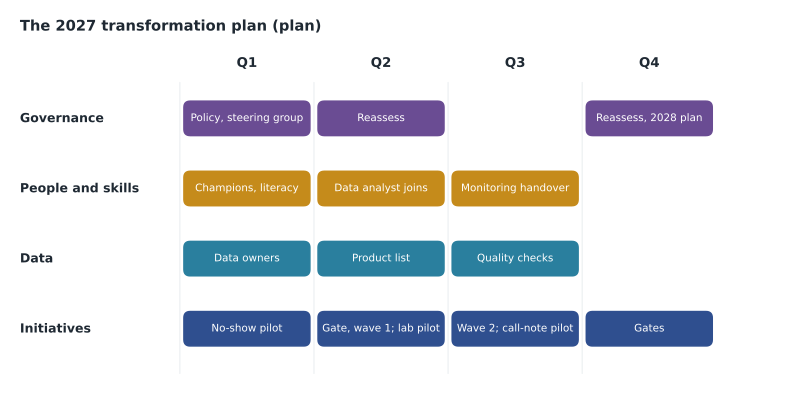
The plan sequenced the year using the four phases from lesson 1, with different initiatives in different phases at once.
| Quarter | Main transformation work | Initiatives |
|---|---|---|
| Before January | Board approval of policy, budget tranche 1 and the transformation plan; interim AI guideline already in force | Envision complete for the 2027 portfolio |
| First quarter | Steering group and CoE start; champions chosen and trained; AI literacy and responsible AI modules begin; data owners named | No-show pilot from February at three clinics; partner build of the assistant begins |
| Second quarter | Data analyst joins; first readiness reassessment; first quarterly pulse survey with AI questions | No-show gate and wave 1 in May; lab-report extraction pilot; assistant pilot |
| Third quarter | Monitoring moves to the data analyst; first stopped or paused initiative reviewed openly if any | No-show wave 2 in July; call-note summary pilot at the emergency hospital; lab-report extraction gate |
| Fourth quarter | Second readiness reassessment; plan for 2028; review of the operating model | Call-note summary gate; assistant gate; portfolio review for 2028 |
Operating model and governance
The operating model was the hub and spoke from lesson 3: a small, mostly part-time centre of excellence led by Andre, with Noor, Kwame, Hannah and the planned data analyst, supported by Dr. Kaur and Lorraine; business owners for each initiative; and a champion at every one of the twelve sites. Governance followed lesson 9: the board for policy, budget and risk appetite; the steering group, chaired by Andre with Graham as sponsor, for pilots, gates and tier 3 uses; and the centre of excellence for intake and tier 1 approvals. Decision rights were written down, and any owner or steering group member could switch off a system causing harm at once.
The responsible AI program from lesson 6 and the risk tiers from lesson 7 sat inside that structure. Every initiative had a completed responsible AI checklist and a tier before its pilot. The call-note summaries and the client-support assistant were tier 3; the no-show reminders and lab-report extraction were tier 2; the review-comment themes were tier 1.
People: skills and change
The skills plan from lesson 4 gave every member of staff the AI literacy and responsible AI modules, and gave each role a path matched to its work. The change plan from lesson 5 rested on Graham's three commitments as sponsor, the written statement on roles, the champion network and a staged plan for each pilot. Both carried a cost in staff time that the cash budget did not show.
Worked problem
Totalling the people-side commitment
Training takes about 1,707 staff hours worth about 71,694 dollars (lesson 4), and champion time about 1,104 hours worth about 41,952 dollars (lesson 3). Calculate the total staff time and its value, and compare it with the 50,000-dollar cash line for program management, governance and training.
Show solution
- Total hours: 1,707 + 1,104 = 2,811 hours.
- \[71{,}694 + 41{,}952 = 113{,}646 \text{ dollars}\]
- Compare with the cash line: 113,646 ÷ 50,000 = 2.27.
- Express it per member of staff: 2,811 hours ÷ 420 staff is about 6.7 hours each on average, although most of it falls on champions and the groups using the new tools.
Answer: The people side asks for about 2,800 hours of staff time, worth about 114,000 dollars, more than twice the cash line that pays for it. The board should see both figures. If site managers cannot release that time, the transformation will stall even with the cash fully funded.
The 50,000-dollar cash line itself was split four ways: about 22,000 dollars for the share of Andre's time spent leading the program; about 18,000 for designing and delivering training; about 6,000 for governance, including legal advice on the policy and the register of AI systems; and about 4,000 for communications such as clinic briefings and printed guides. Lorraine checked that the four parts added to 50,000, and they did.
Risks to the transformation
The roadmap already carried risks for individual initiatives. The transformation plan added risks to the program as a whole, with owners and responses.
| Risk to the transformation | Owner | Response |
|---|---|---|
| Site managers cannot release champion and training time | Graham | Time commitments agreed in each manager's goals; cover planned; progress reported monthly |
| Staff fear for jobs undermines adoption | Andre | Written role statement repeated at every briefing; pulse survey; champions include former sceptics |
| Governance becomes a bottleneck | Andre | Decision times reported to the board; fast path for tier 1 uses |
| Over-reliance on AI drafts | Dr. Kaur | Review time built into workflows; weekly audit sample; edit rates tracked |
| Key-person dependence on Noor and Kwame | Lorraine | Data analyst hire; documentation; partner knowledge transfer |
| Pilot purgatory | Andre | Tranche funding tied to gates; production checklist; named owners before each pilot |
Measures for the board
The board would receive a one-page report each quarter, combining the roadmap's value measures with the transformation's capability measures from lesson 10.
| Area | Measure | Target for end of 2027 |
|---|---|---|
| Business value | Realized value of initiatives in production, against expected | No-show reminders at all sites; value within the conservative-to-expected range |
| Adoption | Follow-up rate on flagged bookings; share of AI drafts reviewed and edited where needed | Follow-up rate at least 60 in 100; every draft reviewed |
| Readiness | Readiness scorecard | Data, governance and skills each at 3; overall at stage 3 |
| Skills | Staff who have completed AI literacy and responsible AI modules | All 420 staff |
| Governance | AI systems in the register with an owner, tier and monitoring plan; unapproved uses found | All of them; none found at year end |
| Speed | Time from intake to decision for tier 2 uses | Within one monthly cycle |
| Trust | Pulse survey: staff who say AI at Cascade Ridge is used responsibly | Rising each quarter |
| Safety | AI incidents and near misses, and actions taken | Every one reviewed with actions recorded |
Graham liked the speed measure most. "If the governance works, that number should go down every quarter," he said. "If it goes up, we've built a bureaucracy."
Decisions for the board
The plan ended with the decisions the board would be asked to make in December, alongside the roadmap's budget request.
- Approve the AI policy and principles.
- Approve the governance structure and decision rights, with the steering group's membership.
- Approve the transformation plan for 2027, including the people-side time commitments from each site.
- Approve the readiness targets and the quarterly board report.
- Release the first budget tranche for data foundations, the no-show pilot, the partner build of the assistant and the program line.
Andre also asked the board for something that cost nothing: permission to report bad news as plainly as good news. The first stopped initiative, the first incident and the first missed target would each be reported with what had been learned. Without that permission, he argued, the reports would slowly become optimistic, and the board would lose the ability to steer.
What the case shows
Read as a whole, the plan shows the main ideas of the course working together. Readiness came first, so investment went to the gaps that mattered. The operating model fitted the organization's maturity. Skills and change were planned role by role, with honest communication about jobs. Responsible AI and risk management were built in from the start and scaled to risk. Vendors were governed through contracts and shared responsibility. Governance had clear decision rights and a fast path. Adoption, outcomes and capability were all measured, with feedback loops that led to action. And scaling was planned in waves with production requirements, to avoid pilot purgatory.
Noor's last comment in the session was about time. "None of this is finished in 2027," she said. "If it works, at the end of the year you'll be at stage 3 with three tools running well and a team that knows how to do the next one. That's a transformation. It just doesn't look dramatic from the inside."
What happens if the board says no
Andre also prepared for the board approving less than he asked. If the board approved the roadmap but cut the program line, the plan named what would go first: the regional AI labs and some of the communications, not the literacy modules, the champions or governance, which protected safety and adoption. If the board delayed the client-support assistant, the partner contract would not be signed and the people-side plan would shrink by the hours for client services staff. If the board wanted to go faster, Andre's answer was that the constraint was not money but the time of a few people, and that adding initiatives before the data analyst joined would increase key-person risk. Thinking through these cases in advance meant the meeting could be about choices rather than surprises.
This kind of contingency planning is itself a mark of readiness. An organization that can explain what it will drop, protect and change under different decisions understands its own priorities. Exam scenarios that describe a budget cut or a change of direction usually reward answers that protect the foundations of safe adoption, such as governance, training and ownership, and trim the optional extras first.
Lessons for any organization
Cascade Ridge is a mid-sized veterinary group, but the shape of its plan applies widely. A hospital, a regional bank, a manufacturer or a government department would use different initiatives and different laws, and probably more committees. It would still need to know its readiness, choose an operating model suited to its maturity, train people by role, lead change honestly, build responsible AI and risk management into each use, govern its suppliers, give decisions clear owners, measure adoption and capability as well as value, and scale in steps with gates. The exam is written for leaders in many industries, and its scenarios test those same habits whatever the setting.
Preparing for the exam
Case questions on the exam combine several of these ideas in one scenario: an organization with a gap in readiness, a pilot that is stalling, a governance bottleneck, a workforce concern and a regulatory question, and an answer that must deal with the most important of them first. The habits from this course help: find the gap that blocks the goal, prefer answers that assign clear ownership and accountability, scale controls to risk, communicate honestly, measure adoption and outcomes, and move in phases with gates. The exam readiness course practises these scenarios in full.
Common mistakes
MistakePresenting a roadmap without a plan for people, governance and scaling.
InsteadPair the portfolio with a transformation plan covering readiness, operating model, skills, change, responsible AI, governance, measures and scaling.
MistakeShowing the board only the cash budget.
InsteadShow staff time commitments as well; they are often larger and decide whether the plan can run.
MistakeMeasuring only business value.
InsteadMeasure capability, adoption, governance, trust and safety too.
MistakeReporting only good news.
InsteadAgree in advance that stopped initiatives, incidents and missed targets are reported plainly with lessons.
Summary and key terms
- An enterprise AI rollout combines a portfolio of initiatives with a transformation plan.
- Cascade Ridge's plan starts from a readiness score of 2.85 (stage 2) and targets stage 3 by the end of 2027.
- It sequences the year through envision, experiment, launch and scale, uses a hub-and-spoke operating model and three-level governance with written decision rights, builds responsible AI and risk tiers into every initiative, and plans skills and change role by role.
- The people side needs about 2,800 hours of staff time, worth more than twice its cash budget line.
- The board receives quarterly measures of value, adoption, readiness, skills, governance, speed, trust and safety, and is asked to approve policy, structure, plan, targets and the first funding tranche.
- Transformation plan
- The plan for readiness, people, governance, measures and scaling that accompanies an AI roadmap.
- Stage 3, operationalizing
- The maturity stage where some AI runs in production with owners, monitoring and governance.
- Tranche funding
- Releasing budget in stages as gates are passed.
- People-side commitment
- The staff time needed for training, champions and change work.
- Capability measures
- Measures showing whether the organization is getting better at adopting AI.
- Board report
- A short quarterly summary of value, adoption, readiness, governance and risk.
Practice problems
Work each problem on paper first, then reveal the answer to check.
Training takes 1,200 hours and champions 800 hours at an average of 40 dollars an hour. What is the value of the staff time?
Show answer
(1,200 + 800) × 40 = 2,000 × 40 = 80,000 dollars.
Why does Graham want the time from intake to decision to fall each quarter?
Show answer
Because falling decision times show governance is enabling good uses quickly; rising times would show a bureaucracy.
Name three decisions the board is asked to make.
Show answer
Approve the AI policy, the governance structure and decision rights, the transformation plan, the readiness targets and report, and the first budget tranche (any three).
Lesson quiz · 5 questions
Score 60% or more to complete this lesson.
Create a free account to save your progress, take quizzes and earn a certificate.