
AWS-122 · Lesson 5 of 12 · 18 min
Change management for AI adoption
▶ Video coming soon A video version of this lesson is on the way.
The question from the reception lead in Lethbridge had stayed with Andre: did the no-show model mean fewer reception jobs? He had answered vaguely, and he could tell she had not believed him. In the fourth session he told Noor about it. "That's the most important conversation in the whole program," she said. "If you don't answer it honestly and early, people will answer it for themselves, and they'll assume the worst."
Why AI change is different
Every new system needs change management, but AI brings particular worries. It is often described in the news as replacing people. It works by probability, so it is sometimes wrong in ways that are hard to predict, which unsettles people used to software that does exactly what it is told. It can feel like being watched or judged, especially when it scores or ranks things. And it changes judgement work, not just clerical work, which touches people's sense of professional identity. A veterinarian who has written call notes for twenty years may feel that an AI draft questions her competence, even when it is meant to save her time.
The exam guide expects you to recognize cultural barriers to adoption, naming risk aversion, resistance to change and fear of failure, and to choose leadership responses to them. It also asks you to communicate transparently about workforce concerns, including timelines, expected outcomes and the effects on roles. These two skills, reading the barriers and talking about them honestly, are at the centre of this lesson.
Listening first
Andre added three questions to the readiness survey before writing any change plan: how people felt about AI being used at Cascade Ridge, what worried them most, and what they hoped it might help with. Of 420 staff, 260 answered.
| Main concern | Responses | Out of 100 respondents |
|---|---|---|
| Job security: AI will reduce jobs or hours | 104 | 40 |
| Errors: AI will make mistakes that harm patients or clients | 78 | 30 |
| Extra work: checking AI will take longer than doing the task | 52 | 20 |
| No particular concern | 26 | 10 |
| Total | 260 | 100 |
Worked problem
Reading the survey
Calculate the response rate and decide which concern the change plan should address first.
Show solution
- Response rate: 260 ÷ 420 = 0.619, or about 62 out of every 100 staff.
- Job security: 104 ÷ 260 = 0.40, so 40 out of 100 respondents.
- Errors: 78 ÷ 260 = 0.30; extra work: 52 ÷ 260 = 0.20; no concern: 26 ÷ 260 = 0.10.
- Check the shares add up: 40 + 30 + 20 + 10 = 100.
Answer: About 62 in 100 staff responded, a good rate for a voluntary survey. Job security is the largest concern, at 40 in 100 respondents, followed by errors at 30. The plan should address jobs first and most directly, and show how errors will be caught. The hopes question was encouraging: the most common hope, mentioned by more than half of respondents, was less paperwork.
The survey also revealed where concerns clustered. Reception staff worried most about jobs; veterinarians and technicians worried most about errors and extra work. One message for everyone would have missed both groups. The change plan would need to speak to each.
Sponsorship and leadership alignment
The exam guide places executive sponsorship and leadership alignment first in its task on leading change. People watch what leaders do more than what they say. If the chief executive talks about AI as a priority but never asks about it, staff conclude it is not one. If one director is openly sceptical, staff in that director's area slow down. An effective sponsor does several visible things: explains why the change matters in business terms, protects the time and budget it needs, resolves conflicts between departments, holds leaders accountable for adoption, and stays involved after the launch announcement.
Graham agreed to three commitments: to open each regional meeting in 2027 with a short update on the AI program, including what had gone wrong as well as right; to attend the first pilot review in person; and to make adoption of the agreed tools part of each site manager's goals for the year. He also agreed to say publicly, and in writing, what the program would and would not do to jobs.
Honest communication about roles
The honest answer to the reception lead's question needed facts. Andre and Noor worked through what the no-show reminders would actually change. The model would flag about 14,470 bookings a year as likely no-shows, about 11 in every 100 bookings. Staff would send an extra reminder and, for some flagged bookings, phone the client or offer the slot to the waitlist. Some reception time would be saved, because fewer slots would sit empty and need rebooking at short notice. But some would be added, because the flagged bookings would need follow-up. The net effect on reception hours was likely to be small, and the main benefit was revenue from kept appointments, not lower staffing.
From this, Andre drafted a statement for all staff. It said what the tools would do and when; that no jobs were planned to be cut as a result of the 2027 initiatives; that some tasks would change and everyone affected would be trained; that the main aims were fewer empty appointment slots, less paperwork and less overtime; and that any future change affecting jobs would be discussed with staff before decisions were made, not after. It gave dates, named the pilot clinics, and gave a contact for questions.
Noor pressed on one point: the statement must not promise more than the organization could keep. "No jobs planned to be cut as a result of these initiatives" was accurate for 2027. "AI will never affect anyone's job" would not have been, and staff would have known it. The exam guide's phrase about communicating effects on roles transparently is about exactly this: specific, honest, time-bound statements, repeated, rather than reassurances that cannot hold.
Champions
The exam guide asks you to identify and empower AI champions who keep the momentum going. Lesson 3 set up the champion network as part of the operating model; this is where it does its most important work. A champion is credible because they are a colleague, not a manager or a consultant. When a technician says to another technician that the AI draft saved her ten minutes but that she always checks the medication doses, it carries more weight than any training slide.
Andre chose champions with care. He asked site managers to nominate people who were respected by their peers, curious about new tools and willing to say when something did not work. He deliberately included two people who had expressed doubts in the survey. A champion who has been sceptical and is persuaded by evidence is more convincing than one who was enthusiastic from the start, and sceptics notice problems that enthusiasts miss.
Empowering champions means giving them more than a title. Cascade Ridge's champions would get early access to tools, the sixteen-hour training described in lesson 4, protected time, a direct line to the initiative teams, and a role in the pilot gate reviews, where their reports on how the tools were actually used would count as evidence.
Cultural barriers and leadership responses
Different barriers need different responses. Treating all resistance as people being difficult misses the information it often carries.
| Barrier | How it shows up | Leadership response |
|---|---|---|
| Fear for jobs | Quiet non-use, rumours, reluctance to share data | Specific, honest statements about roles and timelines; involve staff in redesigning tasks |
| Risk aversion | Insistence on perfect accuracy before any use; endless requests for review | Start with low-risk uses, show the controls, compare AI errors with today's error rate |
| Fear of failure | Teams hide problems in pilots; nobody wants to own an initiative | Treat stopped pilots as learning; reward reporting problems; leaders talk openly about what went wrong |
| Resistance to change | "We have always done it this way"; workarounds that bypass the new tool | Explain the reason for the change; let users shape the workflow; remove the old path once the new one works |
| Professional identity | Experts feel the tool questions their skill | Position AI as an assistant under their control; keep final judgement with them; ask them to set the guardrails |
| Distrust of management | Assumes hidden motives behind any change | Consistent actions over time; involve staff representatives; keep promises visibly |
Fear of failure deserves special mention because AI programs depend on learning from things that do not work. If a pilot that misses its target is treated as a failure for the team that ran it, teams will stop reporting honest results, and the decision gates from the strategy course will be fed with optimistic numbers. Graham's promise to talk about what had gone wrong at each regional meeting was aimed at this. So was the rule that every pilot gate review would record what had been learned, whatever the decision.
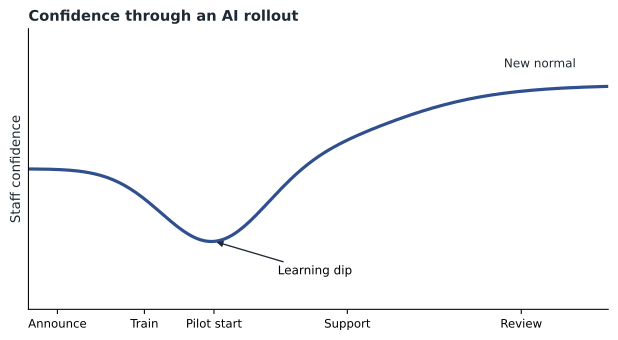
A change plan in stages
Many change models describe stages people pass through, such as becoming aware of the need for change, wanting to take part, knowing how, being able to do it in practice, and having the change reinforced so it lasts. The model's name matters less than the idea that each stage needs different actions, and that skipping one causes trouble later. Training people (knowing how) before they understand why the change matters (awareness and desire) tends to produce polite attendance and little adoption.
| Stage | What people need | Cascade Ridge actions for the no-show pilot |
|---|---|---|
| Awareness | Why the change, why now | Graham's statement; clinic briefings with the no-show figures from the business case |
| Desire | What is in it for them and what will not change | Honest role statement; the hope of fewer empty slots and last-minute rebookings |
| Knowledge | How the new workflow works | Four-hour reception training; one-page guide at each desk |
| Ability | Practice with support | Champion on each shift for the first two weeks; daily questions channel |
| Reinforcement | Signs the change is valued and here to stay | Weekly results shared with each clinic; recognition for useful feedback; old process retired after the gate |
The learning dip in the figure is normal. Even a good tool slows people down for the first weeks, while they learn the workflow and before they trust it. Leaders who expect the dip can plan extra support for it and resist the temptation to judge the tool on its first fortnight. Leaders who do not expect it may cancel a good initiative too early.
Measuring the human side
Change can be measured. Andre planned to track a few simple signals during each pilot: the share of flagged bookings that staff actually followed up, which is a leading indicator from the strategy course; the number of questions and complaints in the support channel each week; the answers to two pulse-survey questions on confidence and worry; and, after the pilot, whether staff wanted to keep the tool. A drop in follow-up rates, or a rise in worry, would trigger a conversation with the champion at that clinic before the numbers became a problem.
Change scenarios on the exam
Scenario questions about change usually describe a symptom: a tool that works but is not used, staff who bypass a new workflow, rumours about job cuts, or a pilot team that reports only good news. The best answers address the cause the scenario points to. Low use after training often signals a missing why, so the answer is sponsorship and clear communication. Bypassing points to a workflow that does not fit, so users should help reshape it. Rumours call for honest, specific statements about roles. Good-news-only reporting signals fear of failure, so leaders must make it safe to report problems. Answers that mandate use without explanation or punish non-adopters are rarely right.
Common mistakes
MistakeAnnouncing an AI tool and expecting adoption to follow.
InsteadPlan awareness, desire, knowledge, ability and reinforcement, with actions for each.
MistakeReassuring staff that AI will never affect any job.
InsteadMake specific, honest, time-bound statements about roles and repeat them.
MistakeChoosing only enthusiasts as champions.
InsteadInclude respected colleagues who started out sceptical; they spot problems and persuade others.
MistakeJudging a tool on its first weeks of use.
InsteadExpect a learning dip, support people through it and judge at the planned gate.
Summary and key terms
- AI change brings particular worries about jobs, errors, monitoring and professional identity.
- Listen first, for example with a survey, and expect different groups to have different concerns.
- Executive sponsors explain why, protect resources, resolve conflicts, hold leaders accountable and stay involved.
- Communicate transparently about timelines, outcomes and effects on roles, without promising more than can be kept.
- Champions are credible colleagues who need training, time and a real role.
- Respond to each cultural barrier, such as fear for jobs, risk aversion, fear of failure and resistance to change, in its own way.
- Plan change in stages, expect a learning dip and measure adoption and confidence.
- Change management
- The structured work of helping people adopt a new way of working.
- Executive sponsorship
- Visible, sustained support from a senior leader with authority over priorities and resources.
- Cultural barrier
- An attitude or habit, such as risk aversion or fear of failure, that slows adoption.
- Learning dip
- The temporary fall in performance and confidence when people first use a new tool.
- Reinforcement
- Actions that show a change is valued and here to stay.
- Pulse survey
- A short, frequent survey used to track sentiment over time.
Practice problems
Work each problem on paper first, then reveal the answer to check.
A survey of 300 staff gets 180 responses. What is the response rate out of 100?
Show answer
180 ÷ 300 = 0.60, so 60 out of 100.
Why is "AI will never affect anyone's job" a poor message?
Show answer
It cannot be kept, staff will not believe it, and breaking it destroys trust; specific, time-bound statements are better.
Give a leadership response to fear of failure in AI pilots.
Show answer
Treat stopped pilots as learning, record lessons at every gate, and have leaders talk openly about what went wrong.
Lesson quiz · 5 questions
Score 60% or more to complete this lesson.
Create a free account to save your progress, take quizzes and earn a certificate.