
AWS-122 · Lesson 8 of 12 · 18 min
Working with vendors and partners
▶ Video coming soon A video version of this lesson is on the way.
Almost nothing in Cascade Ridge's AI portfolio would be built entirely in-house. The models behind the call-note summaries and the client-support assistant would come from foundation model providers through Amazon Bedrock. The lab-report extraction would use a managed AWS document service. The assistant itself would be built by a partner firm. The practice management vendor was adding AI features to VetLedger whether Cascade Ridge asked for them or not. "We're going to be governed by our contracts as much as by our policies," Hannah said at the start of the seventh session. This session was about leading those relationships.
Why vendors matter to the transformation
The strategy course treated build, buy and partner as a sourcing decision for each initiative. This lesson looks at what happens after the decision: due diligence, contracts, shared responsibility, ongoing management and exit. The exam guide's governance tasks ask you to identify and address regulatory compliance risks in business processes that use AI and to choose appropriate access controls and data security for AI systems. When a third party provides part of the system, much of that work is done through the vendor relationship. An organization can outsource the work, but it cannot outsource accountability: if the assistant gives a client a wrong answer, the client blames Cascade Ridge, not the partner.
Kinds of AI suppliers
| Supplier type | What they provide | What to watch |
|---|---|---|
| Cloud and AI platform provider | Infrastructure, managed AI services, access to foundation models | Data use terms, Region and residency options, security controls, service availability |
| Foundation model provider | The model itself, often reached through a platform such as Amazon Bedrock | Model changes and retirement, acceptable use rules, intellectual property terms |
| Software vendor with built-in AI | AI features inside a product already in use, such as the practice management system | Whether features are on by default, what data they use, whether they can be turned off |
| Implementation partner | Design, build and integration work | Skills, references, knowledge transfer, ownership of what is built |
| Data provider | External data used to train or enrich models | Licence terms, quality, lawful collection |
Built-in AI deserves particular attention, because it can arrive without any decision. When VetLedger announced an AI feature that would suggest diagnosis codes from visit notes, Hannah found out from a vendor newsletter. Under Cascade Ridge's new policy, any AI feature in an existing product counted as a new AI use: it needed an owner, a risk tier and approval before it was switched on. Andre asked the vendor for documentation on what data the feature used, where it was processed and how its suggestions could be reviewed, and the feature stayed off until the steering group had seen it.
Due diligence
Due diligence is the work of checking a supplier before relying on it. For AI suppliers it covers the usual commercial and security questions and several AI-specific ones. Andre and Hannah built a short questionnaire that every AI supplier would answer, so responses could be compared side by side.
| Area | Questions to ask | Evidence to request |
|---|---|---|
| Data use | Is our data used to train or improve your models? Where is it processed and stored? How long is it kept? | Contract terms, data processing agreement, Region list |
| Security | How is data encrypted? Who can access it? How are incidents reported? | Independent audit reports such as SOC 2, penetration test summaries |
| Model behaviour | How was the model evaluated? What are its known limitations? How do you handle harmful outputs? | Model or service cards, evaluation results, guardrail options |
| Change management | How and when are we told about model changes or retirement? | Change notice terms, version policy |
| Responsible AI | What responsible AI practices do you follow? Can we test for bias on our own data? | Published policy, testing support |
| Ownership and exit | Who owns what is built? Can we export prompts, configurations, evaluation sets and data? | Contract terms, export formats |
Some of this evidence is easier to get from large providers than from small ones. AWS, for example, publishes AI Service Cards describing the intended uses, limitations and design choices of some of its AI services, and makes compliance reports available through AWS Artifact. Amazon Bedrock's terms state that customer inputs and outputs are not used to train the underlying foundation models and are not shared with model providers. A small implementation partner may have none of this documentation, which does not rule it out, but means more of the assurance has to come from the contract and from testing.
The shared responsibility model
Cloud providers describe security as a shared responsibility: the provider is responsible for the security of the cloud, such as the data centres, hardware and core services, and the customer is responsible for security in the cloud, such as who has access, how data is classified and how applications are configured. The same idea extends to AI. The model provider is responsible for how the model was built and the protections it offers. Cascade Ridge is responsible for which model it chooses, what data it sends, how it configures guardrails and access, how outputs are reviewed and how the system is monitored.
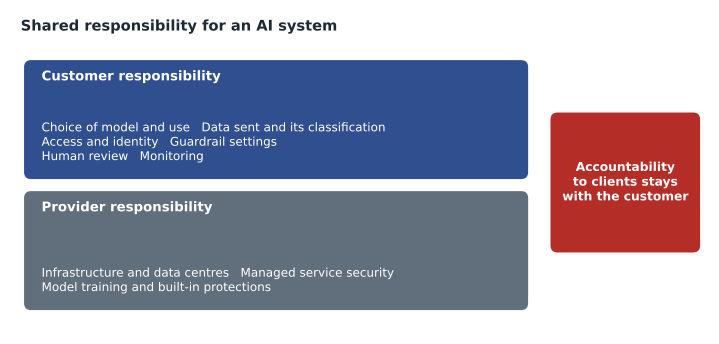
Getting this division wrong in either direction causes problems. Assuming the provider handles everything leads to systems with no guardrails, wide access and no monitoring. Assuming the provider handles nothing leads to duplicated effort and missed protections that are already available. Each AI contract should make the division explicit.
Contracts for AI
A good AI contract does more than set a price. Noor and Hannah listed the terms they wanted in every significant AI agreement, and Lorraine added the commercial ones.
- Data use and protection: no use of Cascade Ridge data to train the supplier's general models without explicit agreement; processing in named Regions; deletion on request and at contract end; breach notification within a set time.
- Service levels: availability targets, support response times and service credits if targets are missed.
- Model change notice: advance notice of model updates or retirement, with time to retest before a change takes effect where possible.
- Performance and acceptance: agreed evaluation tests that must pass before each stage is accepted and paid for.
- Ownership and knowledge transfer: Cascade Ridge owns prompts, configurations, evaluation sets and integration code built for it, and the partner documents and trains Kwame as it goes.
- Responsible AI and compliance: the supplier follows Cascade Ridge's AI policy for this work and helps with privacy reviews, audits and incident investigations.
- Exit: data and configurations exportable in usable formats; reasonable help with transition to another supplier.
Reading a service level
Service levels are often written as an availability figure, such as 99.9 or 99.5, meaning that the service should be available for that much of the time out of every 100. A service at 99.9 should be unavailable for no more than 0.1 out of every 100 minutes. A small difference in the figure can mean a large difference in downtime, and the strategist should translate it into terms the business understands.
Worked problem
Translating availability into downtime
The partner offers the client-support assistant with a monthly availability target of 99.9 out of 100, with a service credit if it is missed. How much downtime does that allow in a 30-day month? How does that compare with 99.5?
Show solution
- Minutes in a 30-day month: 30 × 24 × 60 = 43,200.
- Allowed unavailability at 99.9: 0.1 out of 100, or 0.001 of the month.
- \[43{,}200 \times 0.001 = 43.2 \text{ minutes}\]
- At 99.5 the allowance is 0.005 of the month: 43,200 × 0.005 = 216 minutes, or 3.6 hours.
- Consider the fallback: if the assistant is down, clients can still phone or use the website, so a short outage costs convenience rather than safety.
Answer: A target of 99.9 allows about 43 minutes of downtime a month; 99.5 allows about 3.6 hours. For a client-support assistant with a phone fallback, 99.9 was more than adequate. For a tool the emergency hospital relied on at night with no fallback, the same figure might not be. The right target depends on the consequence of an outage and on the fallback.
Managing the relationship
Signing the contract starts the relationship rather than ending it. Each significant AI supplier would have a named relationship owner at Cascade Ridge, who would meet the supplier each quarter to review performance against service levels and acceptance tests, incidents, model changes announced or planned, costs against budget, and progress on knowledge transfer. For the partner building the assistant, Kwame would join every working session for the first stage, and the partner would hand over documentation at each stage gate before the next payment was released.
Lock-in was the risk Lorraine raised most often. Some dependence on a supplier is the price of using its strengths, and avoiding all lock-in would mean building everything in-house, which Cascade Ridge could not afford. The aim was to keep the cost of switching reasonable. Portable evaluation sets, prompts and guardrail rules kept in Cascade Ridge's own systems, standard integration patterns, and an exit clause did most of the work. So did an annual check of at least one alternative for each major supplier, so that a switch, if needed, would not start from nothing.
Compliance through the supply chain
Regulatory duties do not stop at the organization's boundary. Under PIPEDA and the Alberta and British Columbia private-sector privacy laws, an organization remains responsible for personal information it transfers to a third party for processing and must use contracts or other means to provide comparable protection. Some provinces also have rules on public bodies storing data outside Canada, though those do not apply to a private veterinary group. For each supplier, Hannah recorded which obligations applied and which contract terms met them.
The interim AI guideline also had a supply chain dimension. Staff using a free public chat tool were, in effect, using an AI supplier with no contract at all. That was the strongest argument for providing an approved generative AI tool for everyday drafting, governed by Cascade Ridge's contract and settings, rather than simply banning the public ones. People who are given a safe tool use it; people who are only told no tend to find another unsafe one.
Working with AWS Partners and programs
Organizations building on AWS can draw on more than a single partner firm. AWS Partners with relevant specializations and competencies have been reviewed by AWS for experience in particular kinds of work, which gives a first filter when choosing an implementation partner. AWS Marketplace lists third-party models, data products and AI applications that can be bought through an existing AWS account, so that their costs appear on the same bill and some procurement steps are simplified. AWS also offers programs such as the AWS Generative AI Innovation Center, which works with customers on generative AI use cases. None of these removes the need for due diligence, but each can shorten it.
Andre used the partner specialization list to draw up the shortlist for the client-support assistant, and he asked each shortlisted firm to answer the same questionnaire. The firm chosen in the strategy course had relevant experience and references, but it was small, so Hannah asked for more evidence on security practices and wrote the knowledge-transfer obligations in detail. The choice of a reviewed partner did not change who was accountable; it changed how much evidence was already available.
Vendor scenarios on the exam
Exam questions on vendors often describe a supplier that is cheaper or faster but weak on one governance point, such as unclear data use terms, no change notice, or no way to export configurations. The best answer usually addresses that point through due diligence, contract terms or design, rather than either accepting the risk silently or rejecting the supplier outright. Questions about built-in AI features in existing software usually expect them to be treated as new AI uses with their own review. And questions about accountability expect the organization to remain accountable to its customers whoever supplies the technology.
Common mistakes
MistakeAssuming accountability moves to the vendor along with the work.
InsteadThe organization stays accountable to its clients; contracts and oversight manage the supplier's part.
MistakeLetting built-in AI features switch on by default.
InsteadTreat each new AI feature in existing software as a new AI use with an owner, risk tier and approval.
MistakeReading availability targets as almost the same.
InsteadTranslate them into downtime: 99.9 allows about 43 minutes a month, 99.5 about 3.6 hours.
MistakeTrying to avoid all lock-in.
InsteadAccept some dependence but keep switching costs reasonable with portable assets, standard patterns and exit terms.
Summary and key terms
- Most AI portfolios depend on suppliers: platform and model providers, software vendors with built-in AI, implementation partners and data providers.
- Due diligence covers data use, security, model behaviour, change management, responsible AI and ownership.
- Shared responsibility divides security and safety duties between provider and customer, but accountability to clients stays with the customer.
- AI contracts should cover data use, service levels, model change notice, acceptance tests, ownership, knowledge transfer, compliance and exit.
- Availability figures should be translated into downtime.
- Relationships need owners and regular reviews, lock-in should be managed rather than avoided, and compliance duties extend through the supply chain.
- Due diligence
- Checking a supplier's practices and evidence before relying on it.
- Shared responsibility
- The division of security and safety duties between a cloud provider and its customer.
- Service level
- A contractual target, such as availability or response time, often with credits if missed.
- Model change notice
- A contract term requiring advance warning of model updates or retirement.
- Knowledge transfer
- A partner documenting and teaching so that skills stay with the customer.
- Lock-in
- Dependence on a supplier that makes switching costly.
Practice problems
Work each problem on paper first, then reveal the answer to check.
How many minutes of downtime does 99.95 availability allow in a 30-day month?
Show answer
43,200 × 0.0005 = 21.6 minutes.
Who is accountable to clients when a partner-built assistant gives a wrong answer?
Show answer
The organization that deployed it; the partner's duties are managed through the contract.
Give two contract terms that reduce lock-in.
Show answer
Ownership and export of prompts, configurations and evaluation sets; exit assistance; standard integration patterns (any two).
Lesson quiz · 5 questions
Score 60% or more to complete this lesson.
Create a free account to save your progress, take quizzes and earn a certificate.