
AWS-122 · Lesson 6 of 12 · 19 min
Leading responsible AI programs
▶ Video coming soon A video version of this lesson is on the way.
Hannah Weiss joined the fifth session with a printout. It was a client email that a receptionist had drafted with a public chat tool before the interim guideline went out. It was friendly and well written, and it told a client that her dog's limp "is probably nothing to worry about" and that she could wait a week. No veterinarian had seen it. Nothing bad had happened; the dog was fine. "This is the reason we need a responsible AI program," Hannah said, "not a policy document that sits in a drawer."
What a responsible AI program is
Responsible AI means designing, building and using AI so that it is fair, explainable, private and secure, safe, transparent, robust and accountable, and so that its benefits are not bought at the cost of harm to people. A responsible AI program is the set of principles, roles, processes, tools and training that make this happen across an organization, consistently, for every AI system and not only the ones someone happens to worry about.
Domain 3 of the exam guide begins with applying responsible AI principles to business decisions. It asks you to apply dimensions such as fairness, explainability, privacy, safety, transparency and robustness to business scenarios; to manage trade-offs when business goals conflict with those principles; to decide when responsible AI practices should be built into planning from the start; and to recognize when a system needs human oversight and choose safeguards such as hallucination detection, guardrails and escalation criteria. AWS describes its own approach in similar terms, with dimensions that include fairness, explainability, privacy and security, safety, controllability, veracity and robustness, governance and transparency.
The dimensions in business terms
The dimensions can sound abstract. For a business leader, each one comes down to a question that can be asked about any AI use.
| Dimension | The business question | A Cascade Ridge example |
|---|---|---|
| Fairness | Does the system treat groups of people differently in ways that are unjustified or harmful? | Does the no-show model flag clients in some areas far more often than others? |
| Explainability | Can we say, in terms the affected person understands, why the system produced this output? | Can reception staff explain why a booking was flagged? |
| Privacy and security | Is personal data collected, used and protected lawfully and only as needed? | Do call transcripts with client details stay in approved systems? |
| Safety | Could the output cause physical, financial or other harm, and how is that prevented? | Could the assistant give clinical advice that delays care? |
| Transparency | Do people know when they are dealing with AI and what it does? | Are clients told when a reply comes from an automated assistant? |
| Robustness and veracity | Does the system behave reliably, including on unusual inputs, and avoid invented facts? | Does the summarizer invent a medication that was never mentioned? |
| Controllability and accountability | Can people override or stop the system, and is someone answerable for it? | Can a veterinarian correct or reject any AI draft, and who owns each tool? |
Not every dimension matters equally for every use. The review-comment themes tool summarizes anonymous public reviews into topics for managers; its main risks are robustness (missing an important theme) and privacy (a reviewer who names a staff member). The call-note summarizer touches clinical safety, privacy and robustness all at once. A responsible AI program applies all the dimensions to every use, but spends its effort in proportion to the risk, a theme lesson 7 develops with risk tiers.
Governance by design
The exam guide asks you to determine when responsible AI practices should be built into project planning from the start. The short answer is: always, for anything beyond trivial uses, and especially when the system affects people's health, money, rights or access to services. Building in responsibility from the start is cheaper, because a fairness problem found in the design costs a conversation, while the same problem found after launch may cost a redesign, a complaint, a regulator's inquiry and lost trust.
In practice, governance by design means a few concrete steps at the start of each initiative. Name the people affected and how. Identify the responsible AI dimensions that matter most. Decide what data may be used and on what legal basis. Set guardrails and the human oversight model. Choose the measures that will show whether the system is fair, safe and reliable in use, and agree what result would stop it. At Cascade Ridge these steps became a one-page responsible AI checklist attached to the initiative canvas from the strategy course, completed by the business owner with Hannah's help before any pilot was approved.
Trade-offs
Responsible AI is not free, and the exam guide expects you to manage trade-offs when business goals conflict with responsible AI principles. Typical tensions include accuracy against explainability, where a more complex model performs better but is harder to explain; personalization against privacy, where more data about a person improves predictions but intrudes; automation against safety, where answering more questions without a person saves time but raises the risk of a harmful answer; and speed against thoroughness, where a quick launch captures value sooner but with less testing.
The client-support assistant brought the automation and safety trade-off into focus. The partner estimated that the assistant could answer about 70 of every 100 routine client questions on its own, such as opening hours, prescription refill requests and appointment changes, and would hand the other 30 to staff. Some in the steering group asked whether it could also answer simple clinical questions, such as whether a pet could eat a particular food after surgery, which would raise automation and save more staff time.
Worked problem
Handling an automation and safety trade-off
The partner suggests allowing the assistant to answer simple clinical questions, which would raise the share answered without staff from 70 to 80 out of 100. How should the steering group decide?
Show solution
- Name the goal: more questions handled without staff, which saves reception time.
- Name the principle at risk: safety, because a wrong clinical answer could delay care or harm an animal, and controllability, because the answer would reach the client before any veterinarian saw it.
- Estimate the size of each side: going from 70 to 80 out of 100 adds 10 automated answers per 100 questions. At about 8,000 questions a month after launch, that is about 800 more automated answers a month, every one of them clinical.
- Look for a design that keeps most of the benefit with less risk: the assistant can recognize clinical questions and route them quickly to a technician with a suggested draft reply, instead of answering them itself.
- Decide and record: keep the clinical hand-off rule; measure the time staff spend on routed questions; revisit only with evidence from a supervised trial and Dr. Kaur's approval.
Answer: The group kept the rule that every clinical question goes to staff. It accepted a lower automation rate in exchange for safety, and it reduced the cost of that choice by making the hand-off fast and giving staff a draft. The decision and its reasons were written down, so that a later proposal could be judged against them.
The pattern in the example is worth remembering for exam scenarios. Name the business goal and the principle in tension. Estimate the size of each, rather than arguing in general. Look for a design that reduces the conflict. Then decide, record the reasons, and set a condition for revisiting. Answers that simply drop the principle for the business goal, or that refuse any use because some risk exists, are usually wrong.
Human oversight and safeguards
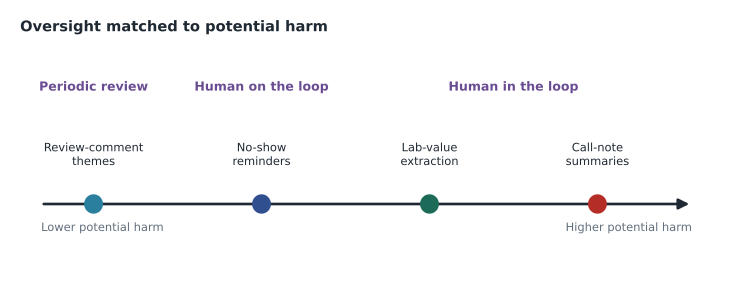
The exam guide asks you to recognize when AI systems need human oversight and to select safeguards such as hallucination detection, guardrails and escalation criteria. Human oversight ranges from a person approving every output before it takes effect (human in the loop), to people monitoring outputs and able to intervene (human on the loop), to periodic review of a system that otherwise runs on its own. The right level depends on the harm a wrong output could cause and how quickly it would be noticed.
| Safeguard | What it does | Example |
|---|---|---|
| Guardrails | Rules that block or filter inputs and outputs, such as denied topics, content filters and removal of personal details | Amazon Bedrock Guardrails configured so the assistant refuses clinical advice and masks phone numbers in logs |
| Grounding and hallucination checks | Requiring answers to come from approved sources and checking that they do | The assistant answers only from approved documents and cites which one; contextual grounding checks flag unsupported answers |
| Escalation criteria | Clear conditions under which the system hands over to a person | Any mention of symptoms, injury, medication or an emergency goes to a technician at once |
| Confidence thresholds | Act automatically only when the model is confident enough | Lab values outside the normal range, or read with low confidence, are highlighted for confirmation |
| Review and audit | People check a sample of outputs regularly | Dr. Kaur audits 20 call-note drafts a week against the transcripts |
| Kill switch and fallback | The ability to turn a system off and return to the old process | Reception can switch off extra reminders at any clinic and fall back to the standard reminder |
Safeguards work best in layers. The call-note summarizer, the highest-risk use in the 2027 portfolio, would have all of them: transcripts processed only in approved services; a summary format with fixed headings; a rule that every draft is approved by the technician or veterinarian who took the call; a weekly audit sample; and the ability to turn it off and go back to typing. Each layer catches some of what the others miss.
Transparency with clients and staff
People have a reasonable expectation to know when AI is involved in decisions or communications that affect them. Cascade Ridge decided on simple rules. Messages from the client-support assistant would say they came from an automated assistant and how to reach a person. Extra no-show reminders would read like ordinary reminders, because they were ordinary reminders, but the privacy notice would explain that appointment history is used to decide who receives an extra reminder. And staff would always know which outputs came from AI, because AI drafts would be labelled as drafts until a person approved them.
Privacy law shapes this as well. In Canada, PIPEDA and the provincial private-sector privacy laws in Alberta and British Columbia require organizations to be open about how they use personal information and to use it only for purposes a reasonable person would consider appropriate. A federal AI law was proposed as part of Bill C-27 but did not pass before Parliament was prorogued in January 2025, so there is no AI-specific federal statute for this sector; regulators and the voluntary code of conduct on generative AI still set expectations. Hannah kept a short register of the laws and guidance that applied, reviewed each quarter.
Making the program real
A responsible AI program fails when it lives only in documents. The test is whether it changes decisions. Andre listed what would make Cascade Ridge's program real: a short AI policy approved by the board; the responsible AI checklist required before any pilot; named owners for every AI system; a register of all AI systems in use, including approved third-party tools; the safeguards above, tested before launch; a simple way for staff and clients to report concerns; and a quarterly report to the steering group covering incidents, complaints, audit results and fairness checks. The receptionist's email became the opening example in the responsible AI training module, with her permission. It showed better than any principle what the program was for.
Responsible AI scenarios on the exam
Exam scenarios in this area often describe a business pressure, such as a deadline, a competitor's launch or a cost target, alongside a responsible AI concern. The best answer usually keeps the principle and finds a way to deliver the business goal with controls: a narrower first release, a human review step, a guardrail, or clearer disclosure. Watch for scenarios that describe a generative AI system giving confident wrong answers; the expected safeguards are grounding in approved sources, guardrails, escalation to a person and monitoring, not simply a more powerful model.
Common mistakes
MistakeTreating responsible AI as a final check before launch.
InsteadBuild it into planning from the start: name affected people, risks, data rules, guardrails and oversight early.
MistakeDropping a principle whenever it costs the business something.
InsteadSize both sides of the trade-off, look for a better design, decide, record the reasons and set a condition for revisiting.
MistakeUsing one level of oversight for every AI use.
InsteadMatch oversight to the potential harm and how quickly errors would be noticed.
MistakeRelying on a single safeguard.
InsteadLayer guardrails, grounding, escalation, review and a fallback.
Summary and key terms
- Responsible AI covers fairness, explainability, privacy and security, safety, transparency, robustness and veracity, and controllability and accountability.
- A responsible AI program applies these consistently through principles, roles, processes, tools and training.
- Governance by design builds them into planning from the start.
- Trade-offs between business goals and principles should be sized, reduced by design, decided and recorded.
- Human oversight ranges from approving every output to periodic review, matched to the potential harm.
- Safeguards include guardrails, grounding and hallucination checks, escalation criteria, confidence thresholds, audits and a fallback, best used in layers.
- Transparency and privacy law shape how AI use is disclosed.
- Responsible AI
- Designing and using AI so it is fair, explainable, private, safe, transparent, robust and accountable.
- Governance by design
- Building responsible AI practices into an initiative from its first planning step.
- Human in the loop
- A person approves each output before it takes effect.
- Human on the loop
- People monitor a system and can intervene when needed.
- Guardrail
- A rule that blocks or filters an AI system's inputs or outputs.
- Escalation criteria
- Conditions under which an AI system hands a case to a person.
Practice problems
Work each problem on paper first, then reveal the answer to check.
Name four responsible AI dimensions from the exam guide.
Show answer
Fairness, explainability, privacy, safety, transparency and robustness (any four).
A model gives slightly better predictions but cannot be explained. What trade-off is this?
Show answer
Accuracy against explainability.
Which level of oversight suits AI-drafted clinical notes?
Show answer
Human in the loop: a clinician approves every draft before it is filed.
Lesson quiz · 5 questions
Score 60% or more to complete this lesson.
Create a free account to save your progress, take quizzes and earn a certificate.