
AWS-122 · Lesson 1 of 12 · 21 min
What AI transformation means
▶ Video coming soon A video version of this lesson is on the way.
By the middle of November, Andre Leclerc had most of an AI roadmap on paper. The strategy sessions with Noor Siddiqui had produced a prioritized list of initiatives, business cases with conservative and expected values, and a 2027 budget of 450,000 dollars to put before the board of Cascade Ridge Veterinary Partners in December. The roadmap answered the question the board had asked: which AI ideas are worth money. It did not yet answer the question Graham Toews, the chief executive, asked when he read the draft. "I believe the numbers," he said. "What I don't see is how four hundred and twenty people start working differently. Who makes that happen?"
The answer, it turned out, was also Andre. Graham asked him to lead the people side of the program as well as the portfolio: readiness, change, skills, governance and the long work of turning pilots into the normal way the clinics run. Noor agreed to keep coaching him, and they added a second hour to their Thursday sessions, this time about leading transformation rather than choosing initiatives. This course follows those sessions. Everything planned for 2027, including the first pilot in February, is described as a plan, because none of it has happened yet.
This course and the exam
The AWS Certified AI Business Strategist exam (AIB-C01) has four domains. The strategy course covered Domain 2, AI Strategy and Business Value Creation. This course covers most of Domain 4, Business Readiness, Leadership, and AI Transformation, and the parts of Domain 3, AI Governance and Responsible AI Leadership, that a leader of a transformation must own: responsible AI programs, risk management, governance structures and decision rights.
| Exam domain | Weight (out of 100 scored points) | Lessons in this course |
|---|---|---|
| 3. AI Governance and Responsible AI Leadership | 24 | Lessons 6, 7, 8 and 9 |
| 4. Business Readiness, Leadership, and AI Transformation | 24 | Lessons 1 to 5 and 10 to 12 |
Domain 4 has four tasks in the exam guide: assessing business readiness and maturity; establishing data and infrastructure foundations; leading enterprise-wide change and building an AI-ready workforce; and scaling AI from pilots to enterprise-wide use. Domain 3 has three: applying responsible AI principles to business decisions; establishing governance structures and regulatory compliance; and identifying enterprise AI risks and directing their mitigation. The questions are scenario based and written for business leaders. They test judgment about people, process and accountability, not technical configuration.
Projects and transformations
Noor started by drawing a distinction that sounds simple and matters a great deal. An AI project delivers one capability: a no-show prediction model, a document extraction pipeline, an assistant that answers questions about opening hours. It has a start, an end, a budget and a team. An AI transformation changes how the organization works so that it can find, build, adopt and improve many such capabilities over time, and so that the value they promise is actually captured. It changes roles, decisions, skills, habits and governance, not just software.
"Most organizations are good at projects," Noor said. "They run a pilot, the pilot works, there's a celebration, and then nothing much changes. The model sits in one clinic. Nobody owns it. The staff who liked it move on. A year later someone asks why the AI money didn't pay off." Industry surveys have reported the same pattern for years: many organizations run AI pilots, and far fewer move them into everyday use at scale. The gap between the two is rarely the technology. It is usually readiness, ownership, change and governance.
| An AI project | An AI transformation | |
|---|---|---|
| Goal | Deliver one capability that works | Change how the organization works so AI value is created and captured repeatedly |
| Time frame | Months, with a clear end | Years, with no single finish line |
| Main work | Data, model, integration, testing | Leadership, roles, skills, processes, governance, culture, plus a portfolio of projects |
| Success measure | The capability meets its requirements | Business outcomes improve and the organization gets faster and safer at adopting AI |
| Typical failure | The model does not perform | The model performs but nobody uses it, or nobody owns it after launch |
The four phases: envision, experiment, launch, scale
The exam guide asks you to apply iterative approaches to transformation that move through phases such as envision, experiment, launch and scale. The names vary between frameworks, but the logic is the same: decide where you are going, test ideas cheaply, put the ones that work into real use, and then extend them across the organization while learning from each step.
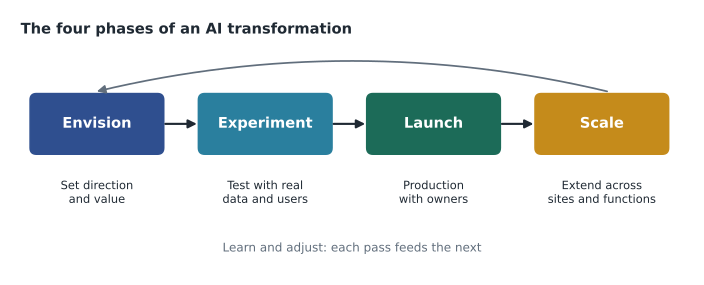
In the envision phase, leaders agree on business objectives, the role AI will play, the guiding principles and an initial portfolio. For Cascade Ridge this was the work of the strategy sessions and the roadmap. In the experiment phase, small teams test the most promising ideas with real data and real users, under controlled conditions, to learn whether the value is real and the risks are manageable. The no-show pilot at three clinics in February 2027 is planned as an experiment. In the launch phase, an idea that has passed its gate is put into production: it gets an owner, support arrangements, monitoring, documentation and a place in the governance process. In the scale phase, the capability spreads across sites and functions, and the organization builds the shared skills, platforms and processes that make the next launch faster.
Two points about the phases matter for exam scenarios. First, they repeat. Each initiative moves through them, and the organization as a whole goes round the cycle more than once, adjusting its direction as it learns. A transformation that tries to plan everything in the envision phase and then execute without learning is fragile. Second, different initiatives sit in different phases at the same time. In 2027 Cascade Ridge plans to have the no-show reminders scaling, lab-report extraction launching, the call-note summaries still experimenting and the pharmacy forecast waiting on data foundations. Leading a transformation means managing that whole portfolio, not one project at a time.
Short-term wins and the long game
The exam guide also expects you to use scaling methods that begin with short-term wins and progress toward enterprise-wide deployment. Early wins matter for three reasons. They prove to sceptical staff and directors that AI can deliver something useful here, not just in a vendor's slide deck. They fund later work, either directly through savings or indirectly through the board's confidence. And they teach the organization how to do the work: how to prepare data, how to train staff, how to hand a model over to an owner. A quick win is valuable partly for its own result and partly as practice.
Short-term wins can also mislead. A win chosen only because it is easy may not lead anywhere, and a string of small, unconnected tools can leave an organization with nothing that adds up to an advantage. Andre's roadmap tried to balance the two. The review-comment themes were a cheap, quick win with a modest result. The no-show reminders were both a near-term win and the first step in a longer path toward preventive wellness reminders. The data foundations work produced no visible result in 2027 at all, but every later initiative depended on it. "Wins buy you the right to do the slow work," Noor said.
The dimensions of readiness
A transformation succeeds or fails on things that are not models. The exam guide lists dimensions such as leadership alignment, data quality, cultural preparedness, technical infrastructure and governance frameworks, and it expects you to find capability gaps in people, process, technology and governance. Noor gave Andre a simple way to remember them: an organization is ready for AI when its leaders want the same thing, its data can be trusted and reached, its people are willing and able, its technology can run AI safely, and its governance can say yes or no quickly and for good reasons. Lesson 2 turns those dimensions into an assessment.
| Dimension | Question it asks | Cascade Ridge, first impression |
|---|---|---|
| Leadership alignment | Do leaders agree on why AI matters and what it is for? | Strong at the top; clinic managers not yet involved |
| Data | Is the data good enough, reachable and lawfully usable? | Appointment data good; pharmacy and lab data patchy |
| Culture and people | Are staff willing to change, and do they have the skills? | Interest mixed with worry about jobs and workload |
| Technology and infrastructure | Can systems support AI securely and at scale? | New AWS environment in place; integration skills thin |
| Governance | Can the organization decide, approve and oversee AI responsibly? | No AI policy or approval process yet |
Who leads a transformation
Graham's question, who makes this happen, has a standard answer in the exam guide: executive sponsorship, cross-functional teams with clear accountability, and AI champions who keep momentum going in the places where the work actually happens. A transformation needs an executive sponsor with the authority to set priorities, protect budgets and resolve conflicts between departments. Graham agreed to be that sponsor. It needs a program lead who coordinates the portfolio, the change work and the governance process day to day. That was Andre. It needs owners for each initiative in the business, not in IT: the reception manager for the no-show reminders, Dr. Kaur for the call-note summaries. And it needs champions: respected people on the front line who try new tools early, help colleagues, and carry feedback back to the program.
"Look at what's missing from that list," Noor said. "Nobody whose title says AI." She did not mean that technical skill was unimportant; her own role and Kwame Asante's were essential. She meant that a transformation led only by technical people tends to optimize models and neglect adoption, while one led by business owners, with technical people beside them, tends to ask whether anything changed for clients and staff.
What changes for people
AI transformation changes work. Some tasks shrink: typing lab values into records, writing up routine phone calls, phoning every client the day before an appointment. Others grow: checking an AI draft before it is filed, deciding which flagged booking deserves a personal call, explaining to a client why a reminder arrived. The exam guide asks you to identify where human roles can shift from manual work to oversight and collaboration with AI, balancing human strengths such as critical thinking, empathy and creativity against what AI does well. Lesson 4 treats this in detail. The important point at the start is that staff notice these changes long before any business case mentions them, and they will form a view about the transformation from what happens to their own day.
Andre had already heard that view in the clinics. A reception lead in Lethbridge had asked him directly whether the no-show model meant fewer reception jobs. He had not had a good answer. By the end of the course he would have one, and lesson 5 shows how it was built: honest, specific, and given before the pilot rather than after.
Responsible AI is part of the transformation, not an add-on
Domain 3 of the exam is about governance and responsible AI, and it is tempting to treat those as a separate workstream that checks projects at the end. Noor argued the opposite. Fairness, privacy, transparency, safety and accountability are much cheaper to build in at the start than to bolt on at the end, and the exam guide asks you to recognize when responsible AI practices should be built into planning from the start, which it calls governance by design. In a transformation, governance is also what lets the organization move faster: if everyone knows the approval path, the risk tiers and the guardrails, a good idea can go from proposal to pilot in weeks instead of months.
For Cascade Ridge, this meant that Hannah Weiss, the privacy and security lead, and Dr. Kaur would sit in the steering group from the first meeting, not join when something went wrong. It also meant that the transformation plan, not just the project plans, would include an AI policy, a risk classification for AI uses and a simple process for approving new tools. Lessons 6 to 9 build those pieces.
A first sketch of the transformation
At the end of the first session, Andre wrote a one-page sketch of what the transformation would need beyond the initiatives already on the roadmap. It became the outline for this course.
- A readiness assessment, so the plan starts from where the organization really is (lesson 2).
- An operating model that says who does AI work, where, and with what support, including a small centre of excellence (lesson 3).
- A skills plan for every group of staff, from AI literacy for everyone to deeper training for champions and owners (lesson 4).
- A change plan with a sponsor, champions and honest communication about roles (lesson 5).
- A responsible AI program, a risk register and rules for working with vendors (lessons 6 to 8).
- Governance with clear decision rights (lesson 9).
- Measures of adoption and outcomes, and a plan for keeping momentum after the first pilots (lessons 10 and 11).
- A complete rollout plan that brings everything together (lesson 12).
Worked problem
Placing initiatives in the four phases
Using the 2027 roadmap, place each initiative in the phase it is planned to reach by the end of June 2027: no-show reminders (pilot from February, waves from May), lab-report extraction (pilot in spring), call-note summaries (pilot in summer), client-support assistant (partner build, pilot in the second quarter), pharmacy forecast (data foundations in 2027, model in 2028).
Show solution
- No-show reminders: the pilot ends and the first wave of other clinics begins in May, so by the end of June it is in the scale phase.
- Lab-report extraction: a spring pilot at three clinics means it is in the experiment phase, moving to launch if it passes its gate.
- Call-note summaries: the pilot does not start until summer, so in June it is still being prepared for its experiment, after envisioning is complete.
- Client-support assistant: a pilot in the second quarter puts it in the experiment phase.
- Pharmacy forecast: only data foundations are under way, so the model itself is still in the envision phase.
Answer: By the end of June 2027 the portfolio is planned to span all four phases: one initiative scaling, two experimenting, one preparing its experiment and one still being envisioned. Leading the transformation means managing all of them at once, with different questions for each phase.
Common mistakes
MistakeTreating a successful pilot as the end of the work.
InsteadA pilot is the experiment phase. Value arrives only after launch with an owner and scaling across the organization.
MistakeLeaving transformation to the technical team.
InsteadBusiness owners, an executive sponsor and front-line champions lead; technical specialists work beside them.
MistakeChoosing quick wins only because they are easy.
InsteadPrefer wins that also build skills, data or trust that later initiatives need.
MistakeAdding governance after the first incident.
InsteadBuild responsible AI and approval processes in from the start; they speed up good decisions as well as preventing bad ones.
Summary and key terms
- An AI project delivers one capability; an AI transformation changes how the organization works so that AI value is created and captured repeatedly.
- Transformations move through envision, experiment, launch and scale, repeatedly, with different initiatives in different phases at once.
- Short-term wins build confidence, funding and skills but should lead somewhere.
- Readiness covers leadership alignment, data, culture and people, technology and governance.
- Transformations need an executive sponsor, a program lead, business owners for each initiative and front-line champions.
- Responsible AI and governance belong in the plan from the start.
- AI transformation
- Lasting change in how an organization finds, adopts and improves AI so that value is captured repeatedly.
- Envision, experiment, launch, scale
- The iterative phases through which initiatives and the organization move.
- Executive sponsor
- A senior leader with authority to set priorities, protect budgets and resolve conflicts.
- Program lead
- The person who coordinates the portfolio, change and governance day to day.
- AI champion
- A respected front-line person who adopts early, helps colleagues and carries feedback.
- Governance by design
- Building responsible AI practices into planning from the start.
Practice problems
Work each problem on paper first, then reveal the answer to check.
Name the four phases of an AI transformation in order.
Show answer
Envision, experiment, launch and scale, repeated as the organization learns.
Why might a successful pilot still fail to produce business value?
Show answer
Because nobody owns it after launch, staff do not adopt it, or it never scales beyond the pilot sites.
Give two reasons short-term wins matter.
Show answer
They build confidence among staff and leaders, and they teach the organization how to do AI work; they can also free up money for later initiatives.
Lesson quiz · 5 questions
Score 60% or more to complete this lesson.
Create a free account to save your progress, take quizzes and earn a certificate.