
AWS-122 · Lesson 4 of 12 · 18 min
Roles, skills and upskilling
▶ Video coming soon A video version of this lesson is on the way.
The skills gap on Andre's scorecard was not really one gap. The board needed enough understanding to ask good questions about AI proposals. Site managers needed to know how to judge whether a tool was working in their clinic. Reception staff needed to know what the no-show flag meant and what to do with it. Emergency technicians needed to know how to check an AI-drafted call note. And a handful of people, the champions and initiative owners, needed much more. "One course for everybody will bore half of them and lose the other half," Noor said. The third Thursday session was about matching skills to roles.
AI literacy for everyone
The exam guide asks you to select workforce development approaches that build AI literacy across the whole enterprise, and it names examples: proofs of concept, hackathons, training programs and responsible AI training. AI literacy is the basic understanding everyone in an AI-using organization needs: what AI can and cannot do, why it sometimes gives wrong or invented answers, how to use approved tools safely, what data must never be entered into them, and how to raise a concern. It is not technical training. It is closer to the safety briefing every new employee gets.
Literacy has a practical purpose beyond awareness. The most common AI failures in everyday work come from people trusting outputs they should check, entering data they should protect, or using tools nobody approved. A short literacy program aimed at those three behaviours reduces real risk. It also reduces fear, because people tend to fear most what they do not understand.
| Literacy topic | What staff should be able to do afterwards |
|---|---|
| What AI is and is not | Explain in plain words what a prediction model and a generative assistant do, and give an example of each at Cascade Ridge |
| Why AI makes mistakes | Recognize that outputs can be wrong, invented or biased, and say when to check them |
| Approved tools and data rules | Name the approved tools and the information that must never be entered into public tools |
| Human oversight | Describe who reviews which AI outputs before they reach clients or records |
| Raising concerns | Report a problem or a near miss, and know that doing so is expected |
| What changes in their own job | Describe how the planned tools will affect their tasks, in their own words |
Role-based learning paths
Beyond literacy, each group needs a path matched to what it will actually do. Andre and Noor sorted Cascade Ridge's 420 staff into five groups and gave each a different mix of learning.
| Group | Approx. number | Learning | Hours each |
|---|---|---|---|
| All staff | 420 | AI literacy module (1.5 h) and responsible AI module (1 h) | 2.5 |
| Reception and client services staff using the no-show reminders and the assistant | 60 | Hands-on training on the new workflow, flags and hand-off rules | 4 |
| Veterinarians and technicians using call-note summaries and lab extraction | 45 | Reviewing AI drafts, recording corrections, clinical guardrails | 3 |
| Site champions | 12 | Champion program: deeper training, testing, coaching colleagues | 16 |
| Leaders: board, executives and site managers | 15 | AI for leaders: judging proposals, value, risk and governance | 6 |
Worked problem
Estimating the training effort
Using the table, estimate the total hours of staff time for 2027 training and its cost, if the average loaded cost of staff time across these groups is about 42 dollars an hour.
Show solution
- All staff: 420 × 2.5 hours = 1,050 hours.
- Reception and client services: 60 × 4 = 240 hours.
- Veterinarians and technicians: 45 × 3 = 135 hours.
- Champions: 12 × 16 = 192 hours.
- Leaders: 15 × 6 = 90 hours.
- \[1{,}050 + 240 + 135 + 192 + 90 = 1{,}707 \text{ hours}\]
- \[1{,}707 \times 42 = 71{,}694 \text{ dollars}\]
Answer: About 1,700 hours of staff time, worth roughly 72,000 dollars. That is staff time rather than cash, but like champion time it has to be scheduled and covered, especially for clinical staff whose hours are booked with patients. The cash cost of course design and delivery sits inside the 50,000-dollar program line of the 2027 budget.
Lorraine pointed out that 1,050 of the 1,707 hours came from the all-staff modules. Could they be shorter? Noor's view was that 2.5 hours across a year was already lean for something that would change how everyone worked, and that the responsible AI hour in particular was not optional: it covered the data rules and the duty to report problems. They agreed to deliver both modules in short pieces, of no more than twenty minutes each, during existing team meetings, so that clinics would not have to close appointment slots.
Learning by doing
Courses build understanding; doing builds confidence. The exam guide's examples of proofs of concept and hackathons are ways of letting people learn by building or trying something real in a safe setting. A proof of concept (POC) is a small, quick test of whether an idea can work at all, usually with sample data and no expectation that it will go into production. A hackathon is a short event, often a day or two, where mixed teams build rough prototypes of ideas. Both are useful mainly for learning and for generating ideas; neither is a substitute for a properly designed pilot.
Cascade Ridge planned a half-day "AI lab" at each regional meeting in 2027. Mixed groups of reception staff, technicians and managers would use an approved generative AI tool on invented examples: drafting an aftercare sheet from bullet points and then finding its mistakes, summarizing a fake call transcript and comparing it with a technician's note, or asking the assistant questions it should refuse. The aim was to give people hands-on experience of what the tools do well and badly, in a setting where mistakes cost nothing. Ideas that came out of the labs would go through the normal intake form.
Responsible AI training
Responsible AI training is named separately in the exam guide because it is easy to leave out. It covers the organization's AI policy, the data rules, the reasons for human review, how bias and errors arise, and what to do when something goes wrong. For most staff it is part of the one-hour module. For initiative owners, champions and members of the steering group it goes deeper: how to read a model's documentation, how to set and check guardrails, how to handle a complaint, and how to decide whether a new use needs a full risk review. Lessons 6 and 7 cover the content they need.
From doing the task to overseeing it
The exam guide asks you to identify where human roles can shift from manual work to oversight of AI and collaboration with it, balancing human strengths such as critical thinking, empathy and creativity against what AI does well. This is where the transformation becomes personal for staff. A good way to think about it is task by task, not job by job. Most jobs contain some tasks AI can take over, some it can help with and some it should not touch.
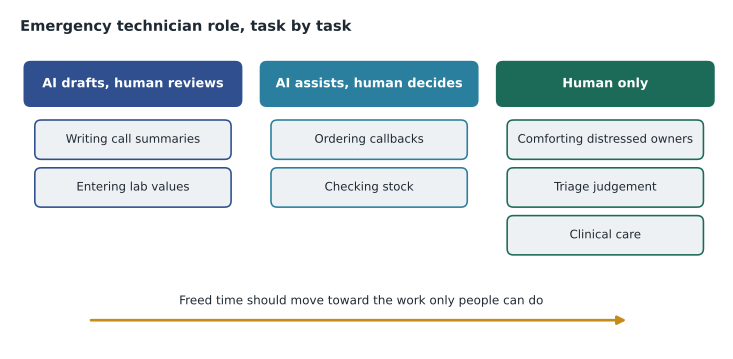
| Task in the emergency technician role | Today | With AI | Human strength involved |
|---|---|---|---|
| Writing up after-hours phone calls | About 6 minutes per call, typed by hand | AI drafts a note from the transcript; technician checks and approves it | Critical thinking: spotting what the draft got wrong or left out |
| Entering lab values into records | Typed from PDF reports | Values extracted automatically; technician confirms flagged values | Attention to clinically important outliers |
| Deciding which owner to call back first | Judgement from the call log | Unchanged; AI may highlight keywords in summaries | Clinical judgement |
| Talking to a distressed owner | Technician or veterinarian | Unchanged | Empathy and trust |
| Triage of arriving patients | Technician with veterinarian | Unchanged | Clinical judgement and hands-on assessment |
Two things matter in this kind of redesign. First, oversight is real work and needs time, skill and authority. If technicians are expected to check AI drafts but are given no time to do it, they will approve them without reading, and the human review becomes a formality. The exam guide's interest in human oversight, covered in lesson 6, depends on oversight being designed into the job. Second, freed time has to go somewhere deliberate. If the six minutes saved per call note simply disappear into a busy shift, the organization has gained a little slack but not the value in the business case, which counted reduced overtime. Andre planned to track overtime hours and time spent with patients as measures for the emergency hospital.
Hiring, partnering and growing skills
Some skills are better hired or bought than grown. Cascade Ridge's plan for 2027 combined all three. It would grow AI literacy and oversight skills in its own staff, because those must sit with the people doing the work. It would hire one data analyst, because data foundations and dashboards needed a permanent person rather than a contractor. And it would rely on a partner for the client-support assistant, as decided in the strategy course, with an explicit plan for Kwame to work alongside the partner so that knowledge transferred rather than leaving with the contract.
Key-person risk ran through the whole plan. Noor was a contractor, and Kwame was the only developer. Andre added two protections: every initiative would keep its documentation and evaluation sets in a shared place, and the data analyst's job description would include learning to run the monitoring Noor set up, so that a single departure would slow the program rather than stop it.
Measuring whether learning worked
Training is easy to count and hard to evaluate. Completion rates show that people attended, not that anything changed. Andre chose measures at three levels: completion of the modules by each group; a short scenario check at the end of the literacy module, such as spotting which of three example prompts breaks the data rules; and behaviour in the work, such as the share of AI-drafted call notes that technicians edited before approving, the number of concerns reported, and the number of unapproved tools found in the six-monthly review. A rising number of reported concerns in the first months would be read as a good sign: it would show that people knew how and felt safe to report.
Skills for leaders
Leaders need a different kind of AI skill. They do not need to know how a model is trained, but they do need to ask the right questions of any proposal: what business objective it serves, what the baseline is, what could go wrong and for whom, who owns it after launch, what it costs over its whole life, and what result would stop it. The six-hour leaders' session at Cascade Ridge was built around those questions, using the business cases and risk reviews from the 2027 portfolio as practice material. Board members would review one real proposal in the session and say whether they would approve it, and why.
Site managers also needed the skill of reading a dashboard honestly. A manager who sees no-shows fall at her clinic in the first month of the pilot needs to know whether that is the reminders working, a seasonal pattern or chance, and to know that the comparison with non-pilot clinics is what answers the question. Without that skill, early numbers are either celebrated or dismissed too quickly.
Workforce questions on the exam
Exam scenarios on workforce development often describe an organization that has bought AI tools but sees little use of them, or one where a single expert team does all the AI work and everyone else waits. The best answers usually combine broad literacy with targeted, hands-on learning for the people who will use or oversee the tools, and they treat responsible AI training as part of the package. When a scenario asks how roles should change, look for answers that redesign tasks, keep humans in charge of judgement and empathy, and give oversight real time and authority. Answers that train everyone in model building, or that remove human review to save time, are usually distractors.
Common mistakes
MistakeGiving everyone the same AI course.
InsteadProvide literacy for all, then role-based paths matched to what each group will actually do.
MistakeTreating hackathons and proofs of concept as pilots.
InsteadThey are for learning and ideas; promising ideas still need a properly designed pilot.
MistakeExpecting staff to review AI outputs without time to do it.
InsteadDesign oversight into the job, with time, skill and authority.
MistakeMeasuring training only by completion.
InsteadAlso check understanding and changes in behaviour at work.
Summary and key terms
- AI literacy gives every employee a basic, practical understanding of what AI can and cannot do, the data rules and how to raise concerns.
- Role-based paths go further for staff who use, oversee, champion or lead AI.
- Proofs of concept, hackathons and hands-on labs build confidence and ideas but are not pilots.
- Responsible AI training belongs in every path.
- Redesigning work task by task shows where AI drafts and humans review, where AI assists and where people alone should act; oversight needs time and authority, and freed time must be directed deliberately.
- Combine growing, hiring and partnering for skills, reduce key-person risk, and measure learning by behaviour as well as completion.
- AI literacy
- The basic understanding of AI that everyone in an AI-using organization needs.
- Learning path
- A sequence of learning matched to a role's responsibilities.
- Proof of concept (POC)
- A small, quick test of whether an idea can work at all.
- Hackathon
- A short event where mixed teams build rough prototypes.
- Human oversight
- People reviewing, correcting and taking responsibility for AI outputs.
- Key-person risk
- Dependence on one or two people whose departure would stop the work.
Practice problems
Work each problem on paper first, then reveal the answer to check.
Thirty staff each take 4 hours of training and 10 managers take 6 hours. How many hours in total?
Show answer
30 × 4 + 10 × 6 = 120 + 60 = 180 hours.
Why can human review of AI drafts become a formality?
Show answer
If reviewers have no time, skill or authority, they approve drafts without checking them.
Name three workforce development approaches the exam guide mentions.
Show answer
Proofs of concept, hackathons, training programs and responsible AI training (any three).
Lesson quiz · 5 questions
Score 60% or more to complete this lesson.
Create a free account to save your progress, take quizzes and earn a certificate.