
ARCH-100 · Lesson 5 of 12 · 21 min
Light and shadow
On a bright day in early winter, Visser takes the studio to Kestrel Point at noon and asks each student to stand a metre stick upright in the snow and trace its shadow. The shadows are astonishingly long, longer than the sticks are tall. 'That is our latitude talking,' she says. 'At this time of year the sun at noon is only about 17 degrees above the horizon. In June it will be nearly 64. If you design a window, a roof overhang or a bench here without knowing that, you are designing blind.' Light is the first material of architecture. It reveals form, gives rooms their mood, tells us the time of day and the season, and connects the inside of a building to the sky. This lesson covers how light behaves, how the sun moves, and how architects shape light and shadow deliberately.
Light reveals form
We see form only because of light and shadow. A white cube lit evenly from all sides looks flat, almost like a hexagon drawn on paper. Lit from one side, it suddenly has depth: one face bright, one face in half-light, and a crisp shadow on the ground. Architects learn to see three kinds of shade: the lit surface, the shade on a surface turned away from the light (called form shadow), and the cast shadow that the object throws onto other surfaces. Strong, low sunlight produces sharp cast shadows and dramatic contrast; the even light of an overcast sky produces soft shadows and calm.
The texture of a surface is revealed by light that skims across it. A rough stone wall lit straight on looks flat; lit by the low sun from the side, every bump casts a shadow and the wall comes alive. This raking light is why masonry buildings look richest early and late in the day, and why architects pay attention to which way their textured walls face.
How the sun moves
The sun rises roughly in the east and sets roughly in the west, and at noon it is due south for anyone living north of the tropics, as everyone in Canada and the continental United States does. Its height above the horizon, called its altitude, depends on the latitude, the time of day and the season. Its direction, called its azimuth, is measured as a compass angle from north. At the equinoxes, around 20 March and 22 September, the noon altitude is 90 degrees minus the latitude. At the summer solstice, around 21 June, it is about 23.4 degrees higher; at the winter solstice, around 21 December, about 23.4 degrees lower. In summer the sun also rises north of east and sets north of west, so it can shine on north-facing walls early and late in the day.
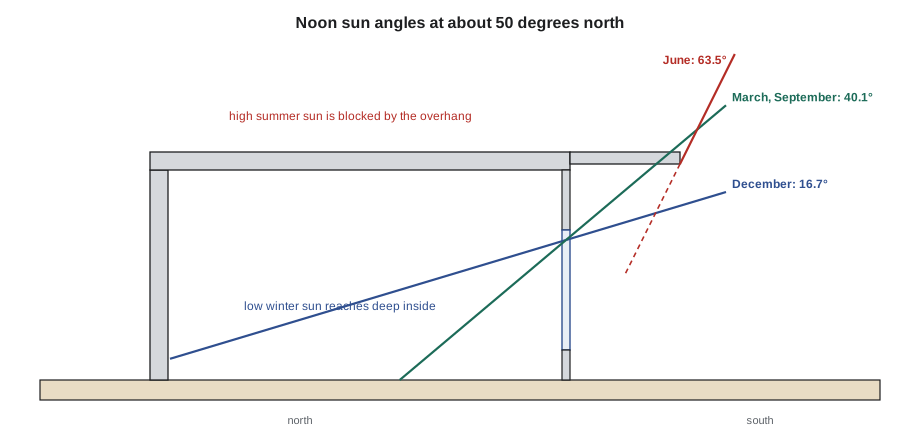
Winnipeg sits at about 49.9 degrees north. Its noon sun is about 16.7 degrees high at the winter solstice, 40.1 at the equinoxes and 63.5 at the summer solstice. Toronto, at about 43.7 degrees, gets a higher sun, and Iqaluit, at about 63.7 degrees, a much lower one.
# Sun position at solar time for a given latitude, and shadow length of a post.
import math
lat = 49.9        # degrees north (Winnipeg)
post = 3.0      # height of a post, m
def sun(day_of_year, solar_hour):
    decl = 23.44 * math.sin(math.radians(360 / 365 * (day_of_year - 81)))
    h = 15 * (solar_hour - 12)                      # hour angle in degrees
    la, de, ha = map(math.radians, (lat, decl, h))
    alt = math.asin(math.sin(la) * math.sin(de) + math.cos(la) * math.cos(de) * math.cos(ha))
    az = math.atan2(math.sin(ha), math.cos(ha) * math.sin(la) - math.tan(de) * math.cos(la))
    return math.degrees(alt), (math.degrees(az) + 180) % 360   # azimuth from north, clockwise
for name, day in (("21 Dec", 355), ("20 Mar", 79), ("21 Jun", 172)):
    for hour in (9, 12, 15):
        alt, az = sun(day, hour)
        shadow = post / math.tan(math.radians(alt)) if alt > 0 else float("inf")
print(f"{name} {hour:>2}:00 altitude {alt:5.1f} deg azimuth {az:5.1f} deg shadow {shadow:6.1f} m")21 Dec 9:00 altitude 6.5 deg azimuth 139.2 deg shadow 26.2 m 21 Dec 12:00 altitude 16.7 deg azimuth 180.0 deg shadow 10.0 m 21 Dec 15:00 altitude 6.5 deg azimuth 220.8 deg shadow 26.2 m 20 Mar 9:00 altitude 26.4 deg azimuth 127.9 deg shadow 6.0 m 20 Mar 12:00 altitude 39.3 deg azimuth 180.0 deg shadow 3.7 m 20 Mar 15:00 altitude 26.4 deg azimuth 232.1 deg shadow 6.0 m 21 Jun 9:00 altitude 46.2 deg azimuth 110.3 deg shadow 2.9 m 21 Jun 12:00 altitude 63.5 deg azimuth 180.0 deg shadow 1.5 m 21 Jun 15:00 altitude 46.2 deg azimuth 249.7 deg shadow 2.9 m
The output shows the numbers behind the shadows at Kestrel Point. In December a post casts a shadow several times its own height even at noon; in June the noon shadow is short. Note too that the azimuth at 9:00 and 15:00 is much further round toward the north in June than in December, because the summer sun traces a much longer path across the sky. The formula uses solar time, in which noon is the moment the sun is due south; clock time differs because of time zones and daylight saving, sometimes by more than an hour.
Shaping daylight
Architects shape daylight in four main ways. The first is orientation: which way the windows face. South-facing windows get strong sun, easy to shade with a horizontal overhang because the sun is high when it is hot. East and west windows get low morning and evening sun that comes in nearly horizontally and is hard to shade, so they need vertical fins, screens, trees or smaller openings. North-facing windows get soft, even light with little direct sun, which is why artists' studios traditionally face north.
The second is the size and position of openings. A high window throws light deep into a room and onto the ceiling; a low window lights the floor and connects you to the ground outside. A window in a corner washes the adjoining wall with light and makes the room feel larger. A skylight brings light from above, the brightest part of the sky. The third is the surfaces that receive light: light-coloured walls and ceilings reflect daylight further into a room, while dark surfaces absorb it. The fourth is filtering: screens, louvres, perforated panels, curtains and trees break up light and cast patterns.
A rule of thumb used by many designers is that useful daylight reaches about two to two and a half times the height of the window head into a room from a side window. A window whose top is at 2.4 metres (about 8 feet) will light a room well for about 5 to 6 metres (16 to 20 feet) from the wall. Beyond that, light from a second side or from above is needed.
Shadow as a design material
Shadow is as important as light. Deep shade under a porch or a canopy is a refuge on a hot day and a frame for the bright view beyond. A recessed window, set back deep in a thick wall, casts a shadow that gives a facade depth and rhythm. The Japanese novelist Jun'ichirō Tanizaki, in his 1933 essay In Praise of Shadows, argued that traditional Japanese rooms gained their beauty from dimness and the gentle gleam of lacquer and gold in half-light. Many architects have taken from him the idea that a building should not be uniformly bright: contrast between light and dark is what makes light meaningful.
Precedents in light
The Pantheon in Rome, completed around AD 125, has a single opening at the top of its dome, the oculus, about 8 to 9 metres (27 to 30 feet) across. Through the day a disc of sunlight moves slowly across the coffered dome and walls like the hand of a sundial, and on cloudy days the whole interior glows softly. Rain falls through it onto a gently sloped floor with drains.
In Winnipeg, Étienne Gaboury's Precious Blood Church in Saint-Boniface (1968) gathers its walls into a spiralling, shingle-clad cone that rises to an opening at the peak. Light enters from above and slides down the inside of the cone, so the congregation gathers in a pool of light from the sky, an idea that recalls both the Pantheon and the tipi.
Tadao Ando's Church of the Light in Ibaraki, near Osaka (1989), is a plain concrete box with one wall cut through by a cross-shaped slot. The slot is the only decoration. Behind the altar, the cross is made of light itself, brightest against the dark concrete in the morning sun.
Worked problem
Sizing an overhang for a south window
Joon-ho's pavilion has a south-facing window whose top is 2.4 m above the floor and whose sill is 0.6 m above the floor. At Winnipeg's latitude, how deep should a roof overhang at the window head be to shade the whole window at noon in late June, and will winter sun still get in?
Show solution
- The window is 2.4 − 0.6 = 1.8 m tall.
- June noon altitude at 49.9 degrees north is about 63.5 degrees.
- For the shadow of the overhang to reach the sill, depth = 1.8 / tan(63.5°) = 1.8 / 2.01 ≈ 0.90 m.
- In December the noon altitude is about 16.7 degrees: the overhang's shadow drops only 0.90 × tan(16.7°) ≈ 0.27 m, so almost the whole window is in sun.
Answer: A south overhang works because the sun is high in summer and low in winter. Shading east and west windows needs different devices, because the morning and evening sun is low in every season.
Exercise 5: a light diary and a light box
This exercise takes about six hours spread over at least one full day.
- Part A, the light diary: choose one room. At four times on the same day (early morning, mid-morning, noon and late afternoon) sketch the patches of sunlight on the floor and walls, and write one line on how the room feels.
- Part B, the shadow study: at your site, trace or photograph the shadow of a post or tree at 9:00, 12:00 and 15:00. Compare the lengths with the code's predictions for today's date.
- Part C, the light box: build a closed card box about 30 cm (12 in) on each side. Cut three openings of the same total area but different kinds: a high slot, a low window and a small skylight. Photograph the inside with a phone lens through a peephole, lighting the box with a desk lamp at a low and then a high angle.
- Deliverable: the light diary page, the shadow comparison and six photographs of the light box with a paragraph on which opening made the best room.
Self-critique checklist
- Have I recorded actual light, not what I expected?
- Do my shadow measurements roughly match the calculation, and can I explain any difference?
- In my light box, did I change only one thing at a time?
- Can I describe the mood each opening created, not just its brightness?
Studying light with a light box
Light is hard to predict on paper, so many studios keep a simple tool for testing it: a light box, or heliodon. In its simplest form it is a lamp that can be moved around a model to stand for the sun at different times and seasons. More elaborate versions tilt the model on a table set to the site's latitude, so that a fixed lamp traces the true path of the sun as the table turns. Even without special equipment you can do the same thing outdoors: put the model on a board, point the board's north arrow due north and tilt it until the shadow of a small vertical pin matches the shadow length your calculation predicts for the month you want to study.
Photograph the inside of the model through a small hole in a wall, at the eye height of a scale figure. Take a photograph at the same moment for each option you are comparing. You will see things no drawing can show: a patch of sun that lands exactly on a bench in winter, a skylight that floods a wall with light, a high window that throws a bright bar across the floor, or glare from a window placed at the end of a long, dark room. Record the date, time and latitude you simulated with every photograph, so the comparison is fair and you can repeat it.
Pay attention to colour and surface as well as openings. A white wall next to a window spreads light deep into a room; a dark floor absorbs it. A rough plaster wall grazed by low sun shows every bump; a polished one reflects a bright spot. Choosing the finishes is part of designing the light.
Common mistakes
MistakeThinking more glass always means a better room.
InsteadToo much glass brings glare, overheating and heat loss; the position and shape of openings matter more than their size.
MistakeShading east and west windows with horizontal overhangs.
InsteadLow morning and evening sun gets under overhangs; use vertical fins, screens or planting instead.
MistakeUsing clock time in sun calculations.
InsteadSun-angle formulas use solar time, which can differ from clock time by an hour or more.
MistakeIgnoring shadow.
InsteadContrast and shade give light its meaning; design the dark places as carefully as the bright ones.
Summary and key terms
- Light and shadow reveal form; raking light reveals texture.
- The noon sun is about 90° minus latitude at the equinoxes, 23.4° higher in June and 23.4° lower in December.
- South windows are easy to shade with overhangs; east and west windows need vertical shading.
- Side windows usefully light about two to two and a half times the window head height into a room.
- Precedents such as the Pantheon and the Church of the Light make light itself the focus of the space.
- Altitude (sun)
- The angle of the sun above the horizon.
- Azimuth
- The compass direction of the sun, measured from north.
- Cast shadow
- The shadow an object throws onto another surface.
- Oculus
- A round opening at the top of a dome.
- Raking light
- Light that strikes a surface at a low angle, revealing its texture.
Practice problems
Work each problem on paper first, then reveal the answer to check.
What is the noon sun altitude in Winnipeg at the equinox?
Show answer
About 40 degrees (90 − 49.9).
Which window orientation gets soft, even light with little direct sun in Canada and the US?
Show answer
North.
Why do east and west windows need vertical shading?
Show answer
Because the morning and evening sun is low and comes in nearly horizontally under overhangs.
A window head is at 2.5 m. Roughly how far into the room will it light well?
Show answer
About 5 to 6 metres, two to two and a half times the head height.
What is the oculus of the Pantheon?
Show answer
The round opening at the top of its dome, the only source of daylight inside.
Lesson quiz · 5 questions
Score 60% or more to complete this lesson.
Create a free account to save your progress, take quizzes and earn a certificate.