
APT-130 · Lesson 9 of 12 · 25 min
Warranty claims and policies
▶ Video coming soon A video version of this lesson is on the way.
On Monday, November 2, a retail customer named Brenna Coultish came back to the front counter with the remanufactured Tessaro alternator she had bought for her 2018 Arden in October. The battery warning light had come on twice, and the battery kept going flat. Talia checked the sale in the DMS: bought October 13, installed by Brenna's brother at home, within the parts warranty. She asked how it had failed, attached a warranty tag, and sent it to the service department's bench tester. The test confirmed an internal fault. Brenna left with a replacement alternator, no charge, and a printed copy of the warranty claim. "She came in ready for an argument," Imani said. "She got a clear process instead."
Every part sold comes with some kind of warranty, and the counter is where most warranty claims begin. This lesson explains the kinds of parts warranties, what they usually cover and exclude, how the difference between a parts warranty and a labour warranty affects customers, how a warranty claim is handled at the counter, and how claims are documented so the department can recover the cost from the supplier.
Kinds of warranty
APT-120 introduced the main kinds of parts warranty. At the counter, it helps to sort them by who gives the promise and what it covers:
- Manufacturer's parts warranty on genuine parts sold over the counter, set by the vehicle manufacturer. It often covers the part for a set time or distance, and may be longer when the part is installed by a dealer.
- Supplier's warranty on aftermarket parts, set by the brand. It ranges from months to a "limited lifetime" that usually covers the part for as long as the original buyer owns the vehicle, but not the labour.
- Remanufacturer's warranty on reman units, with its own time limit and conditions.
- Repair warranty given by a repair shop on the parts and labour of a repair. In Ontario, the Consumer Protection Act, 2002 requires repairers to warrant new or reconditioned parts and the labour to install them for at least 90 days or 5,000 km, whichever comes first, with exceptions such as fluids, filters, lights, tires and batteries.
Parts warranty and labour
The most common misunderstanding at the counter is the difference between a parts-only warranty and one that also covers labour. A retail customer who installs a part at home and has it fail usually receives a replacement part, but not payment for their time or for a shop's labour to replace it again. A part installed by the dealership's service department may carry a warranty that covers both parts and labour, because the dealership did the work.
| Situation | Part replaced? | Labour covered? | Usually handled by |
|---|---|---|---|
| Genuine part bought over the counter, installed by the customer | Yes, within the warranty period | Usually no | The parts counter |
| Genuine part installed by the dealer's service department | Yes | Usually yes, under the dealer's repair warranty | The service department |
| Aftermarket part with a limited lifetime warranty | Yes, for the original buyer | Usually no | The counter, with the supplier's claim process |
| Reman unit, core returned | Yes, within the warranty period | Depends on the remanufacturer | The counter, with the remanufacturer |
| Part installed by another shop | The shop handles it with its own supplier | Under that shop's repair warranty | The installing shop |
The parts technician explains this at the sale, not only at the claim. "This alternator has a two-year parts warranty from us. If you install it yourself and it fails, we replace the part; the labour is yours. If our service department installs it, the repair is covered by their warranty too." Customers who hear this first are rarely surprised later.
Worked problem
What a warranty is worth to a home mechanic
A customer is choosing between an aftermarket alternator at 245 dollars with a one-year parts warranty and a genuine reman alternator at 312 dollars with a three-year parts warranty, both plus a refundable core. A shop would charge about 1.4 hours at 165 dollars per hour to install either. If the alternator fails after 18 months, what would each choice cost the customer to have a shop replace it?
Show solution
- Labour at the shop:
- \[1.4 \times 165 = 231\ \text{dollars}\]
- Aftermarket, out of warranty at 18 months:
- \[245 + 231 = 476\ \text{dollars}\]
- Genuine reman, part still covered:
- \[0 + 231 = 231\ \text{dollars}\]
Answer: Even with a parts-only warranty, the longer coverage saves the price of the part after 18 months, though the labour is paid either way. The prices, labour time and failure timing are sample values; parts do not fail on a schedule.
What warranties usually exclude
Warranty terms list what is not covered, and the counter should know the common exclusions:
- Wear: brake pads, wiper blades, clutches and filters wear out in normal use, and normal wear is not a defect.
- Improper installation: a part installed incorrectly, without the required related parts, or with the wrong fluid.
- Damage from another fault: a new alternator destroyed by a shorted battery, or a reman starter damaged by a broken ring gear.
- Misuse, accident or modification, such as racing, off-road damage, or a part used on a different vehicle from the one it was sold for.
- Commercial or fleet use, which some retail warranties exclude or limit.
- Missing proof of purchase, although the DMS can often find the sale from the customer's name, phone number or the part's serial number.
Exclusions are applied fairly and with evidence. The parts technician does not decide on the spot that a failure was the customer's fault. Many claims are decided by testing the part, by the supplier's inspection, or by the service department's diagnosis.
Handling a warranty claim at the counter
A good warranty process is consistent and calm. Linmore Tessaro's counter followed these steps, which are typical:
- Find the original sale in the DMS: date, part number, price, customer, and the vehicle the part was sold for.
- Check the warranty terms for that part and that the claim falls within them.
- Ask how it failed and when, and write down the customer's description. Avoid suggesting causes.
- Inspect the part for signs of installation errors, physical damage or another fault, and note them without accusing the customer.
- Test the part where possible, using the service department's bench tester or the supplier's procedure. Many electrical parts can be tested in minutes.
- Tag and record the returned part with a warranty tag showing the claim number, customer, date and failure description.
- Resolve: replace the part, refund it, or explain why the claim is not accepted and what the customer can do next.
- Submit the claim to the manufacturer or supplier, and store or ship the failed part as their procedure requires.
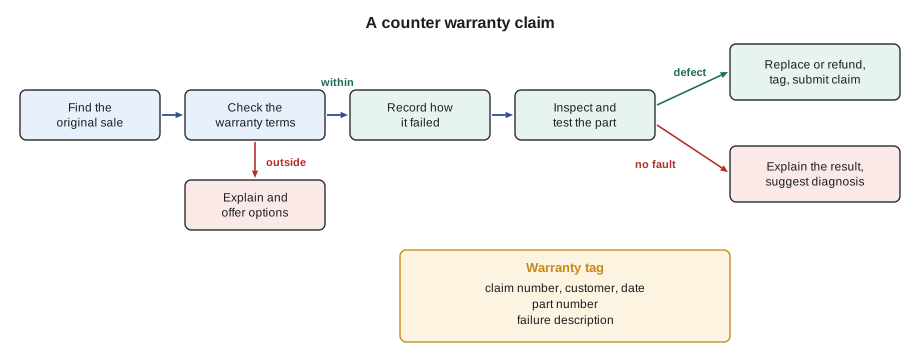
When a part tests good, as the ignition coil did in lesson 8, the honest result is that the part is not defective. The parts technician shows the customer the result, explains that the part may not have been the cause, and suggests a diagnosis by a technician. This disappoints some customers, but it is fairer than replacing a good part with another good part that will not fix the problem either.
When a claim is accepted, the replacement is usually given right away from stock, as Brenna's was, so the customer does not wait for the supplier. The department then recovers the cost from the supplier through the claim. Where the supplier requires the failed part, it must be kept, tagged and returned as instructed; a lost failed part can mean a rejected claim and a loss to the department.
Warranty on service repairs
The dealership's service department makes its own warranty repairs, and the parts department supplies them. When the manufacturer pays for a repair under the vehicle's new-vehicle warranty, the parts are charged to a warranty repair order line (lesson 6), and the manufacturer reimburses the dealer by its own rules. These rules are strict: the right part numbers, the failed parts kept for a set period or returned, and the claim filed within a deadline. The back counter helps by tagging failed warranty parts as they come out of vehicles and storing them in a secure warranty area until the manufacturer's representative inspects them or asks for them to be returned or scrapped.
Worked problem
Counting warranty returns
In October the counter sold 46 reman starters and alternators. Five came back under warranty. Testing confirmed a defect in 3 of them; 2 tested good. What fraction of the units sold had a confirmed defect, and what fraction of the warranty returns tested good?
Show solution
- Confirmed defects out of units sold:
- \[3 \div 46 \approx 0.065,\ \text{about 7 in 100}\]
- Returns that tested good:
- \[2 \div 5 = 0.40,\ \text{or 40 in 100}\]
Answer: About 7 in 100 of the units sold had a confirmed defect, and 40 in 100 of the warranty returns turned out to be good parts. A high share of good parts coming back points to diagnosis problems, not part quality, and is useful information for the manager. The counts are sample values.
Documentation
Warranty claims depend on records. A complete claim has the original invoice, the customer's description of the failure, the test result, the warranty tag on the part, and the replacement invoice. Missing any one of them can make the supplier reject the claim, and the department then bears the cost. The DMS stores most of this, but the counter must enter it accurately at the time; reconstructing a claim weeks later rarely works.
Good records also protect customers. A customer whose part fails a second time can show a history, and a part that fails repeatedly on the same vehicle may point to another fault that a technician should look at.
Explaining a warranty at the sale
The best time to explain a warranty is when the customer buys the part, not when it fails. A one-sentence explanation at the sale prevents most warranty disputes later. Good warranty explanations cover four points:
- How long: the time or distance the warranty lasts.
- What it covers: the part only, or the part and labour.
- What the customer needs to keep: usually the invoice, and sometimes the packaging.
- What to do if it fails: bring the part and the receipt back to the counter.
For example: "This pump has a two-year parts warranty from today. If it fails, bring it back with your receipt and we'll test it and replace it. If you have it installed by a shop, the labour is under their warranty." Many departments print the warranty terms on the invoice, and the parts technician can point to them as well as saying them.
When a claim is refused
Some claims are not accepted: the warranty period has ended, the part was damaged by another fault, or the supplier's inspection found misuse. A refused claim is a disappointment, and the way it is explained matters. The parts technician explains the reason plainly, shows any evidence, and tells the customer what choices remain. These may include a goodwill discount if the manager approves one, a review by the supplier, or a diagnosis to find the real cause. Customers who disagree should know how to take the matter further, usually through the parts manager.
Goodwill is a decision, not a habit. A manager may approve a goodwill replacement for a long-standing customer whose part failed just outside the warranty period, especially if the failure looks like a defect. The decision is recorded with the reason, so the counter can be consistent and the department can see how much goodwill it gives.
Worked problem
Warranty on a pro-rated basis
Some batteries carry a free-replacement period followed by a pro-rated period, in which the customer pays part of the price of a new battery depending on age. A battery has a 36-month warranty with 24 months of free replacement and 12 months pro-rated. It fails at month 30, and a new battery costs 210 dollars. If the pro-rated credit is the share of the pro-rated period remaining, what does the customer pay?
Show solution
- Months remaining in the pro-rated period:
- \[36 - 30 = 6\]
- Credit share:
- \[6 \div 12 = 0.50\]
- Credit:
- \[210 \times 0.50 = 105\ \text{dollars}\]
- Customer pays:
- \[210 - 105 = 105\ \text{dollars}\]
Answer: The customer pays 105 dollars for the new battery, before tax and fees. Pro-rating methods vary between brands; this method and the prices are sample values.
Common mistakes
MistakePromising labour coverage on a part the customer installed.
InsteadExplain at the sale that most counter-sale warranties cover the part, not the labour.
MistakeDeciding on the spot that a failure was the customer's fault.
InsteadInspect, test and record the evidence before deciding.
MistakeReplacing a part that tests good.
InsteadShow the test result and suggest a diagnosis.
MistakeLosing the failed part before the claim is settled.
InsteadTag it and keep or return it as the supplier requires.
MistakeFiling a claim without the customer's failure description.
InsteadWrite down how and when it failed at the counter.
Summary and key terms
- Warranties come from manufacturers, suppliers, remanufacturers and repairers, each with their own terms.
- Most counter-sale warranties cover the part, not the labour; dealer-installed parts may carry a repair warranty that covers both.
- Common exclusions are wear, improper installation, damage from another fault, misuse and missing proof of purchase.
- Handle claims consistently: find the sale, check the terms, record, inspect, test, tag, resolve and submit.
- A part that tests good is not defective; suggest a diagnosis instead of a replacement.
- Complete records let the department recover the cost from the supplier.
- Parts warranty
- A promise to replace or refund a part that fails because of a defect within a set period.
- Labour warranty
- A promise to pay for the work of replacing a failed part.
- Limited lifetime warranty
- A warranty that usually covers the part for the original buyer as long as they own the vehicle, often excluding labour.
- Warranty tag
- A tag attached to a failed part showing the claim number, customer, date and failure.
- Exclusion
- Something a warranty does not cover, such as normal wear or misuse.
- Warranty claim
- A request to the supplier or manufacturer to reimburse the cost of a failed part.
Practice problems
Work each problem on paper first, then reveal the answer to check.
A shop charges 1.2 hours at 150 dollars to install a part. What is the labour cost?
Show answer
180 dollars.
Name two common warranty exclusions.
Show answer
Any two of: normal wear, improper installation, damage from another fault, misuse, missing proof of purchase.
A returned part tests good. What do you tell the customer?
Show answer
That it is not defective, show the result, and suggest a technician diagnose the cause.
Of 40 units sold, 2 had confirmed defects. What fraction is that?
Show answer
2 ÷ 40 = 0.05, or 5 in 100.
What details go on a warranty tag?
Show answer
Claim number, customer, date, part number and the failure description.
Lesson quiz · 5 questions
Score 60% or more to complete this lesson.
Create a free account to save your progress, take quizzes and earn a certificate.