
APT-130 · Lesson 1 of 12 · 21 min
The parts counter and its customers
▶ Video coming soon A video version of this lesson is on the way.
On Monday, September 21, a week after she started at Linmore Tessaro, Talia Brankovic spent her first full day on the front counter. Imani Grantham stood beside her for the morning and stepped back after lunch. By closing time Talia had served a do-it-yourself customer looking for wiper blades, a technician from the service department waiting on a water pump, a driver from an independent repair shop picking up a wholesale order, and a caller who wanted to know whether a mirror glass was in stock. "Four customers, four different jobs," Imani said as they closed the till. "Same counter, same catalogue, but each one needs something different from you."
APT-110 and APT-120 taught the warehouse, the safety rules and the lookup routine. This course is about the other half of the job: the people on the other side of the counter. It begins with who those customers are, what each kind of customer expects, how the counter is organized to serve them, and what good service looks like before any part is looked up. The rest of the course follows the sale from the first question to the receipt, and then on to returns, warranty, difficult moments and payment.
What the parts counter does
The parts counter is where the parts department meets its customers. Almost every part that leaves the building passes over a counter, whether a customer walks up to it, a technician comes to the back window, a driver picks up an order, or a box is packed for an online sale. The counter staff answer questions, identify the part, check stock, quote a price and an arrival date, record the sale, and hand the part over or arrange delivery. They also take the parts back: returns, cores and warranty failures all come through the counter.
The counter is also where the department earns its reputation. A customer who is served quickly, gets the right part the first time and understands what they bought will come back. One who waits twenty minutes, takes home the wrong part or feels talked down to will tell others. Rolf Ingvaldsen, the parts manager, put it this way in Talia's first week: "The warehouse keeps the parts. The counter keeps the customers."
Most dealership parts departments have two counters. The front counter, or retail counter, faces the public and serves walk-in customers and phone callers. The back counter, or service counter, faces the service department and serves the dealership's own technicians through a window or a door near the shop. Larger departments also have a wholesale desk that handles orders from other repair shops and body shops, often by phone and online, with a delivery van such as the one Gideon Achebe drives. At Linmore Tessaro the same staff rotate through all three, so Talia would learn each one in turn.
The main kinds of counter customers
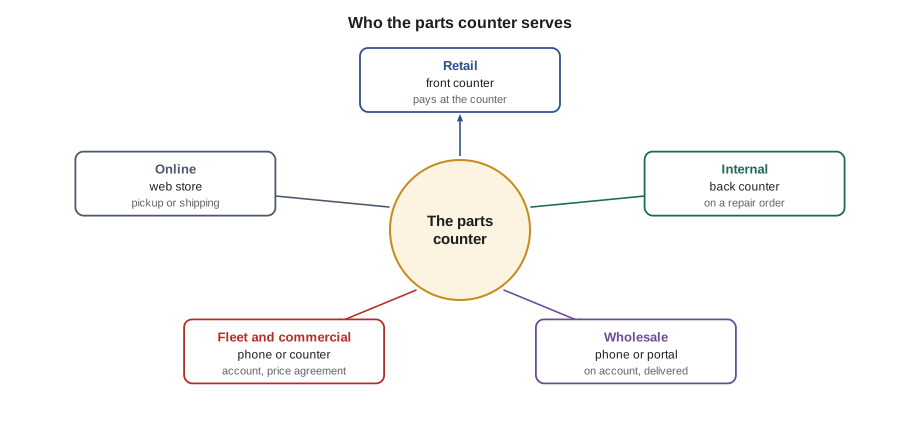
Parts departments group their customers by how they buy, because each group has different needs, prices and paperwork. The names vary from shop to shop, but most departments recognize five groups.
- Retail customers are members of the public buying parts for their own vehicles, often called do-it-yourself or DIY customers. Some are experienced home mechanics; others are trying their first repair. They usually pay list price or a posted retail price, pay at the counter, and may need the most explanation.
- Internal customers are the dealership's own service and body shop technicians. Their parts go onto a repair order, not a sales receipt, and the customer's bill comes later from the service department. What they need most is speed and accuracy, because every minute a technician waits is a minute the shop cannot bill.
- Wholesale customers are independent repair shops, body shops and other dealers who buy parts to install in their own customers' vehicles. They buy on account at a wholesale discount, expect delivery, and often order by phone or through an online parts ordering system.
- Fleet and commercial customers are businesses and public bodies that maintain their own vehicles: delivery companies, utilities, rental companies, police services and municipalities. They buy on account, often under a negotiated price agreement, and value consistency and reporting.
- Online customers order through the dealership's or the manufacturer's online parts store and either pick up at the counter or have the part shipped. They may be retail customers in every other way, but the sale happens without a conversation until something goes wrong.
| Customer group | How they usually order | How they usually pay | What they value most |
|---|---|---|---|
| Retail (DIY) | Front counter, phone | At the counter | Clear advice, the right part, a fair price |
| Internal (service, body shop) | Back counter, repair order | Charged to the repair order | Speed and accuracy |
| Wholesale (other shops) | Phone, online ordering system | On account, monthly statement | Discount, delivery, fill rate |
| Fleet and commercial | Phone, account contact | On account under an agreement | Consistency, reporting, uptime |
| Online | Web store | Card online | Easy ordering, accurate fit, quick pickup or shipping |
The groups overlap. A fleet manager may also buy a part for her own car as a retail customer, and a repair shop may order online. The point of the groups is not to label people but to know which prices, paperwork and questions apply to each sale.
How the groups add up
Sales figures show why each group matters. APT-110 gave Linmore Tessaro's parts sales for one month as 412 thousand dollars: 188 thousand internal, 147 thousand wholesale and 77 thousand retail, with fleet and online sales counted inside the wholesale and retail figures. These are sample values, but the pattern is typical of a dealership parts department.
Worked problem
Linmore Tessaro's sales mix
Using the sample monthly sales of 412 thousand dollars, of which 188 thousand were internal, 147 thousand wholesale and 77 thousand retail, what fraction of sales did each group provide?
Show solution
- Internal:
- \[188 \div 412 \approx 0.456,\ \text{about 46 in 100}\]
- Wholesale:
- \[147 \div 412 \approx 0.357,\ \text{about 36 in 100}\]
- Retail:
- \[77 \div 412 \approx 0.187,\ \text{about 19 in 100}\]
- Check:
- \[188 + 147 + 77 = 412\]
Answer: Internal sales were nearly half of the total, wholesale more than a third, and retail about a fifth. The retail counter brings in the smallest share of sales, but it often earns a higher margin per part and is where the public forms its view of the dealership. Every group deserves good service. The figures are sample values.
What good service looks like
Every customer group wants the same four things, in different proportions: the right part, as soon as possible, at a fair price, with clear information about what they are buying. Good counter service delivers all four. Most service failures come from missing one of them, such as the right part tomorrow when it was needed today, or the right part fast but at a price that was never explained.
Good service also has a manner. Imani taught Talia a short routine for the moment a customer arrives:
- Acknowledge every customer within a few seconds, even when you are busy: eye contact, a greeting, and "I'll be right with you" if you are with someone else.
- Serve in order, and do not let the phone jump the line without telling the person in front of you.
- Introduce yourself to new customers and use their name once you know it.
- Listen first, then look up. Lesson 2 covers the questions that get the right part.
- Explain the choices, the price and the arrival date in plain words.
- Close the sale clearly: confirm what they are taking, how they are paying, and what to do if anything is wrong.
None of this is complicated, but it has to happen every time. The customer who waits at an empty counter while two staff talk behind it remembers that more than anything said afterwards.
The tools of the counter
The counter has its own tools, most of them on the computer. The dealer management system (DMS), introduced in APT-110, records every sale, return and stock movement. The electronic parts catalogue (EPC) from APT-120 identifies the part. Most counters also use a phone system with hold and transfer, an online ordering portal for wholesale customers, a printer for invoices and pick tickets, a card terminal, and a till or cash drawer for retail sales.
Two counter screens matter most in this course. The sales screen builds the invoice: customer, part numbers, quantities, prices, taxes and payment. The inventory screen shows what is on hand, on order, on hold for another customer, and available at other stores or at the manufacturer's warehouse. Lesson 4 shows how to read the inventory screen to give an honest arrival date.
The counter is also where parts records are kept for each customer. Wholesale and fleet customers have accounts with credit limits and price levels. Retail customers who agree to it can be recorded by name and phone number so a part can be traced later, which helps with warranty claims and recalls. Personal information collected at the counter is protected by privacy law: in Canada, the Personal Information Protection and Electronic Documents Act (PIPEDA) applies to businesses that collect personal information in commercial activity. Collect only what you need and never read a customer's information aloud for others to hear.
Professional conduct at the counter
APT-110 covered professional conduct in general. At the counter it shows in small ways: a clean, uncluttered counter top; old parts and cores bagged and out of sight; a uniform and name badge; no personal phone calls in front of customers; and no criticism of other stores, other technicians or other customers. Talia found the last one hardest at first. "When a customer says the last place sold him junk, you just say you'll help him get the right part this time," Imani said. "You weren't there, and running them down makes us look worse, not better."
Counter staff are also expected to be honest about what they do not know. A parts technician who is unsure whether a part fits says so and checks, rather than guessing to keep the customer happy. A wrong part sold confidently costs far more trust than a few minutes spent confirming the right one. APT-120 showed how expensive a wrong part can be for a technician and a shop; at the counter, the cost is the customer's confidence.
Finally, counter staff treat every customer with equal respect. Ontario's Human Rights Code prohibit discrimination in services on grounds such as race, sex, age, disability and religion, and the Accessibility for Ontarians with Disabilities Act sets customer service standards for serving people with disabilities. In practice that means patience, speaking to the customer rather than to a companion, and offering help such as carrying a heavy part to the car.
First impressions and the counter itself
Customers judge a parts counter in the first few seconds, before anyone has looked up a part. A clean, uncluttered counter, a clear queue, visible prices on display stock and staff who look up and greet people all say that the department is organised and will treat them fairly. A counter covered in old invoices, empty boxes and a parts book left open from the morning says the opposite, even when the staff are skilled.
Linmore Tessaro's counter rules were short and practical:
- Clear the counter after every sale. Old parts, boxes and invoices go away before the next customer steps up.
- Keep personal phones out of sight while serving, and never finish a personal call or message while a customer waits.
- Wear the uniform and name badge, so customers know who works there and can ask for someone by name later.
- Keep the display stock faced and priced, with wiper blades, bulbs and fluids in their places.
- Watch the door. Greet each customer who comes in, even if only with "I'll be right with you."
None of these takes long, and together they make the counter easier to work at as well as more welcoming. On her first full day, Talia noticed that Imani tidied the counter between customers almost without thinking. By the end of the week, she was doing the same.
Common mistakes
MistakeTreating every customer the same way regardless of how they buy.
InsteadIdentify the customer group first so the right prices, paperwork and questions apply.
MistakeIgnoring a waiting customer while finishing another task.
InsteadAcknowledge every customer within a few seconds, even if you cannot serve them yet.
MistakeLetting the phone jump ahead of the person at the counter.
InsteadAsk the caller to hold or take a number, and serve customers in order.
MistakeGuessing that a part fits to avoid making the customer wait.
InsteadSay you need to check, and check. A wrong part costs more than a short wait.
MistakeCriticizing another store or technician.
InsteadFocus on getting the customer the right part this time.
Summary and key terms
- The parts counter identifies, quotes, sells and takes back parts, and it is where the department earns its reputation.
- Dealerships usually have a front counter for retail customers, a back counter for technicians and a wholesale desk for other shops.
- The main customer groups are retail, internal, wholesale, fleet and commercial, and online, each with its own prices and paperwork.
- Every customer wants the right part, as soon as possible, at a fair price, with clear information.
- Good service follows a routine: acknowledge, serve in order, listen, explain and close clearly.
- The DMS, EPC, inventory screen and customer accounts are the counter's main tools, and customer information is protected by privacy law.
- Professional conduct includes honesty about what you do not know and equal respect for every customer.
- Front counter
- The counter that serves walk-in retail customers and phone callers.
- Back counter
- The counter that serves the dealership's own service and body shop technicians.
- Wholesale desk
- The part of the department that sells to other repair shops, usually on account with delivery.
- Retail customer
- A member of the public buying parts for their own vehicle.
- Internal customer
- A technician or department of the same dealership whose parts are charged to a repair order.
- Fleet customer
- A business or public body that maintains its own vehicles and buys parts on account.
- Sales mix
- The share of total sales that comes from each customer group.
Practice problems
Work each problem on paper first, then reveal the answer to check.
Name the counter that serves the dealership's own technicians.
Show answer
The back counter, or service counter.
A department sells 300 thousand dollars in a month, 120 thousand of it wholesale. What share is wholesale?
Show answer
120 ÷ 300 = 0.40, or 40 in 100.
What four things does every customer want?
Show answer
The right part, as soon as possible, at a fair price, with clear information.
A customer says the store down the road sold him a bad part. What do you say?
Show answer
That you will help him get the right part this time, without criticizing the other store.
Why record a retail customer's name and phone number, with their agreement?
Show answer
So the part can be traced later for warranty claims and recalls.
Lesson quiz · 5 questions
Score 60% or more to complete this lesson.
Create a free account to save your progress, take quizzes and earn a certificate.