
APT-130 · Lesson 6 of 12 · 23 min
Serving shop technicians
▶ Video coming soon A video version of this lesson is on the way.
On Tuesday, October 27, Talia worked her first full day on the back counter. By 9 a.m. there were four technicians at the window. Dario Pellicano needed a set of front pads and rotors for a Vela on the hoist; Wen Okafor-Lund needed a coolant temperature sensor and a clip; a third technician wanted to know if a transmission filter kit had arrived; and a fourth wanted a litre of oil and a drain plug gasket. Talia started with the first in line, then noticed Imani filling the oil and gasket for the fourth technician while she looked up the pads. "Quick ones go quickly," Imani said. "Nobody should wait five minutes for a gasket."
The dealership's own technicians are the parts department's largest customer group. At Linmore Tessaro, internal sales were nearly half of all parts sales (lesson 1). Technicians are paid, and the shop bills customers, for the time spent repairing vehicles, so every minute a technician spends waiting at the parts window costs the technician, the service department and the customer. This lesson covers how the back counter works: repair orders, parts requests, internal pricing, special orders, speed and the working relationship between the parts and service departments.
How the service department works
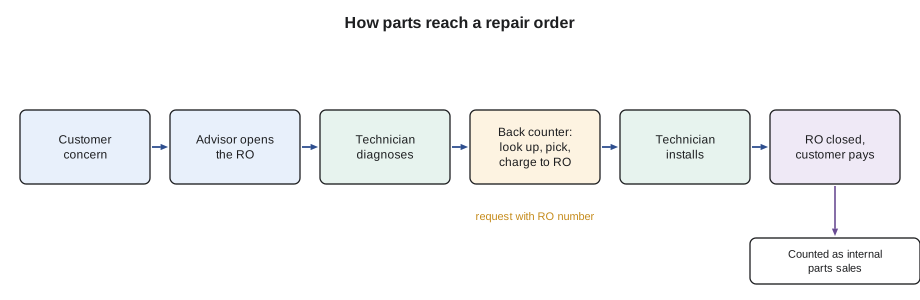
A vehicle comes into the service department with a repair order (RO), opened by a service advisor who records the customer's concern and the vehicle details. A technician is assigned to diagnose and repair the vehicle, and the parts used are charged to the repair order. The customer pays the repair order at the end, including parts, labour and shop supplies, and the dealership's accounting divides the revenue between the service and parts departments.
Technicians at many dealerships are paid by flat rate: each repair has a set number of hours from a labour time guide, and the technician is paid those hours whether the job takes more or less time. A technician who waits at the parts window for twenty minutes during a one-hour job has lost a third of the time they can earn on it. The same delay holds up the service bay, which cannot take the next vehicle, and the customer, who is waiting for the car. Fast, accurate back-counter service is therefore a direct contribution to the dealership's earnings.
Taking a parts request
A technician's request should include the repair order number, the line or operation on the RO, the vehicle VIN (usually already on the RO), and the parts needed. Many shops use electronic parts requests from the technician's tablet, which arrive at the back counter as a queue. Others use a paper or verbal request at the window. Either way, the parts technician does three things before handing over the part:
- Looks up the part from the VIN on the RO, not from the technician's memory of the part number.
- Charges the part to the correct RO and line in the DMS, so the customer is billed and the stock is updated.
- Checks the part with the technician at the window, especially for side, quantity and any related items.
Charging parts to the wrong RO is a common and costly error. It bills one customer for another's parts, leaves the second RO short, and causes an inventory mismatch that someone has to find later. The parts technician reads the RO number back to the technician, especially when several ROs are open on similar vehicles.
Technicians are experts in their own work, and they often know the part they need. They are also busy, and they make mistakes like anyone. A good back-counter parts technician respects the technician's knowledge and still checks the lookup. Talia found that technicians appreciated a quick "This is the one with the extra sensor port, is that right?" more than a part that did not fit.
Speed at the window
Back-counter speed comes from preparation as much as quick hands. Departments speed up the window in several ways:
- Prepare the parts before the technician arrives. Many ROs for maintenance and common repairs can be filled in advance when the service advisor writes them up, so the parts are bagged and waiting.
- Keep fast-moving parts near the window, such as oil filters, drain plug gaskets, wiper blades and common clips.
- Serve quick requests quickly. As Imani showed, a gasket should not wait behind a long lookup; a second staff member or a quick-request lane helps.
- Use a parts runner or delivery to the bay when the shop is busy, so technicians stay at their work.
- Tell the technician honestly when a part is not available, and when it will arrive, so they can move to another job.
Worked problem
What waiting costs
On a busy morning, six technicians each wait an average of 12 minutes at the parts window. The shop's labour rate is 165 dollars per hour. How many technician hours were spent waiting, and what is the value of that time at the labour rate?
Show solution
- Total waiting time:
- \[6 \times 12 = 72\ \text{min} = 1.2\ \text{h}\]
- Value at the labour rate:
- \[1.2 \times 165 = 198\ \text{dollars}\]
Answer: The waiting time on one morning equals 1.2 billable hours, worth about 198 dollars at the labour rate. Over a month of such mornings it adds up to thousands of dollars of lost capacity. The rate and times are sample values.
Internal pricing
Internal parts are priced by the dealership's own rules, which may differ from retail and wholesale prices. Customer-paid repairs are usually charged at list price or a set price matrix (lesson 4). Warranty repairs are priced by the manufacturer's warranty reimbursement rules, which the dealer must follow exactly to be paid (lesson 9). Internal work on the dealership's own used vehicles, called reconditioning or internal ROs, is often charged at cost or at a small markup, because the dealership is effectively paying itself.
The DMS usually sets the price from the RO's pay type: customer pay, warranty, internal or service contract. The parts technician's job is to make sure the pay type is right before charging, and to ask the service advisor when it is unclear. A part charged as warranty on a customer-pay job, or the reverse, causes billing problems that are hard to fix after the vehicle has gone.
| RO pay type | Who pays | How parts are usually priced |
|---|---|---|
| Customer pay | The vehicle owner | List or the department's matrix |
| Warranty | The manufacturer | The manufacturer's warranty reimbursement rules |
| Internal | The dealership itself | Cost or a small markup |
| Service contract | The extended warranty or service contract company | The contract company's rules |
Special orders for the shop
When a part is not in stock, the back counter places a special order for the RO. The order is linked to the RO number and the customer's name, so the part is set aside when it arrives and the service advisor can tell the customer the date. Special orders for the shop follow the same honesty rule as retail quotes: give a real arrival date and update it if it changes.
The parts technician also watches for special-order parts that arrive and are never collected. A part ordered for a customer who then declined the repair sits on a shelf unless someone returns it. Most departments review the special-order shelf weekly, contact the service advisor about anything older than a set number of days, and return what can be returned before the supplier's return window closes (lesson 8 and APT-210).
Sometimes a technician needs a part that the dealership does not stock and the manufacturer cannot supply quickly, such as a fastener or a bulk hose. The parts technician can source it from a local aftermarket supplier, a sister store such as Linmore Parts Supply, or a hardware or industrial supplier, and charge it to the RO as a sublet or outside purchase according to the dealership's rules.
Working relationship with service
Parts and service depend on each other, and the relationship is not always easy. Service wants parts immediately; parts wants accurate requests and ROs. The best departments agree on a few working rules: requests always include the RO number; parts staff tell technicians about delays early; technicians return unused parts promptly so they are credited; and disputes are settled by the managers, not at the window.
Priyanka Rautela, the service manager, met Rolf every Monday to review the week's back orders, special orders waiting for collection, and any problems at the window. Talia sat in on one meeting in late October. "Most of what they talked about was small," she said afterwards. "A late part, a wrong RO, a technician who kept forgetting to bring the old part back. But fixing the small things is what makes the window fast."
Returning unused parts
Technicians sometimes take a part that turns out not to be needed: a second sensor in case the first diagnosis was wrong, or a gasket that was not damaged. Unused parts must come back to the counter promptly, undamaged and in their packaging, so they can be credited to the RO and returned to stock. A part left in a toolbox for a month is lost money. The back counter credits the RO, checks the part's condition, and puts it back in its bin location.
Parts for diagnosis and comebacks
Technicians sometimes need parts to confirm a diagnosis, such as a sensor to swap in and see whether a fault clears. Departments have different rules for this. Some allow a known-good part to be signed out for testing and returned to stock if it does not fix the fault, as long as it is undamaged and has not been installed in a way that would make it unsellable, such as an electrical part connected to a faulty circuit. Others do not allow test parts at all. The parts technician follows the department's rule, records any test part against the RO, and checks it carefully when it comes back.
A comeback is a vehicle that returns because a repair did not fix the problem or a part failed soon after. Comebacks are expensive for the service department, because the second repair is often unpaid. The back counter helps by keeping clear records: which part was supplied, from which supplier, with which part number. If a part was faulty, the parts department can make a warranty claim to the supplier (lesson 9). If the wrong part was supplied, the record shows how the error happened, so it can be prevented.
Communication at the window
Technicians and parts staff work side by side every day, and small courtesies matter. Saying a technician's name, letting them know when a part has arrived, and asking whether they need anything else for the job all help. So does respecting their time: if a lookup will take several minutes, say so and offer to bring the part to the bay.
Problems are best raised directly and privately. If a technician regularly forgets RO numbers or does not return unused parts, the parts technician mentions it once, politely, and then passes it to the parts manager if it continues. Arguments at the window, in front of other technicians or customers, help nobody.
Worked problem
Preparing parts in advance
On a typical morning the service department has 14 maintenance ROs written up before 8 a.m. Preparing the parts in advance takes the back counter about 4 minutes per RO. Without preparation, each technician would wait about 6 minutes at the window for the same parts. How much technician time does preparation save, and how much back-counter time does it use?
Show solution
- Back-counter time to prepare:
- \[14 \times 4 = 56\ \text{min}\]
- Technician waiting time saved:
- \[14 \times 6 = 84\ \text{min}\]
Answer: Preparation uses 56 minutes of back-counter time, usually before the window gets busy, and saves 84 minutes of technician time when it matters most. The numbers are sample values.
After her first week on the back counter, Talia said the biggest surprise was how much of the job happened before technicians arrived. "If the parts are bagged and on the shelf when they walk up, the window stays quiet. If they're not, it's chaos by 8:30."
Common mistakes
MistakeLooking up a part from the technician's memory of the number.
InsteadLook up from the VIN on the repair order.
MistakeCharging parts to the wrong repair order.
InsteadRead the RO number back and check the vehicle before charging.
MistakeMaking a technician wait behind a long lookup for a gasket.
InsteadServe quick requests quickly or use a second staff member.
MistakeCharging warranty parts as customer pay, or the reverse.
InsteadCheck the RO pay type and ask the advisor when unclear.
MistakeLeaving uncollected special orders on the shelf.
InsteadReview the special-order shelf weekly and return parts before the window closes.
Summary and key terms
- Internal sales to the dealership's technicians are the department's largest customer group.
- Parts are charged to repair orders, and the customer pays when the RO is closed.
- Flat-rate technicians lose earning time while they wait, so back-counter speed matters.
- Every request needs an RO number; look up from the RO's VIN and charge the right RO and line.
- Internal pricing follows the RO pay type: customer pay, warranty, internal or service contract.
- Special orders are linked to ROs, given real arrival dates, and reviewed weekly.
- Unused parts come back promptly to be credited and restocked.
- Repair order (RO)
- The document that records a customer's repair, the labour and the parts charged to it.
- Service advisor
- The person who writes up the customer's concern and manages the repair order.
- Flat rate
- A pay system in which technicians are paid set hours for each repair from a labour time guide.
- Pay type
- The category of a repair order line that shows who pays, such as customer pay or warranty.
- Special order
- A part ordered for a particular customer or repair order because it is not in stock.
- Reconditioning
- Repairs a dealership makes to its own used vehicles before selling them.
Practice problems
Work each problem on paper first, then reveal the answer to check.
What three things does the parts technician do before handing over a part to a technician?
Show answer
Look it up from the RO's VIN, charge it to the right RO and line, and check it with the technician.
Four technicians wait 15 minutes each at a labour rate of 150 dollars per hour. What is the value of the waiting time?
Show answer
60 min = 1 h, so 150 dollars.
Who usually pays for parts on a warranty repair order?
Show answer
The manufacturer.
A technician brings back an unused sensor. What happens?
Show answer
Check its condition, credit the RO and return it to stock.
What should every parts request from the shop include?
Show answer
The repair order number, and the line or operation.
Lesson quiz · 5 questions
Score 60% or more to complete this lesson.
Create a free account to save your progress, take quizzes and earn a certificate.