
APT-130 · Lesson 3 of 12 · 25 min
Selling, upselling and related sales
▶ Video coming soon A video version of this lesson is on the way.
On Thursday, October 8, Talia sold a front brake pad set to a retail customer and watched him leave. An hour later he was back: the old pads had worn through to the backing plates, the rotors were scored, and the caliper slide pins were seized. He needed rotors, a hardware kit and brake fluid, and he was not pleased to have made two trips. "That one's on us," Imani said quietly. "Not because we should have sold him more. Because we should have asked what condition the brakes were in and told him what a full job usually needs. Then he decides."
Selling is part of every counter job, and many parts technicians are uneasy with the word. This lesson explains what good selling at a parts counter means: helping the customer buy everything the job needs, offering better choices where they exist, and never pushing parts the customer does not need. It covers related sales, upselling, kits, and the ethics and law that keep selling honest.
Selling as service
At a parts counter, selling means matching the customer with the parts and supplies that will let them finish the job safely and properly. A customer who goes home with the main part but without the gasket, the bolts or the fluid has been poorly served, even if the main part was right. They lose time on a second trip, and some will finish the job without the missing item and create a safety problem.
Good counter selling therefore starts with knowing the job, not the price list. A parts technician who knows that a water pump usually needs a gasket and coolant, that front struts are often replaced with mounts and bearing plates, and that brake pads often need hardware and sometimes rotors can ask the right questions. The customer decides; the parts technician makes sure they decide with the full picture.
Related sales
A related sale is an additional item the job requires or commonly needs, sold with the main part. Related items fall into three groups:
- Required items the job cannot be done without, such as a new gasket with a water pump, new fluid after a drain, or one-time-use torque-to-yield bolts (APT-120).
- Commonly needed items that depend on the condition of the vehicle, such as rotors with pads, a thermostat with a radiator hose, or a serpentine belt with a tensioner.
- Helpful supplies that make the job easier, such as brake cleaner, thread locker, gloves, shop towels or a wire brush.
The electronic parts catalogue often lists related parts in the notes or on the same illustration, and many DMS systems suggest related items at the point of sale. These prompts help, but they are not a substitute for knowing the job. Talia started keeping a notebook of common jobs and what each usually needed, checked with the service department's technicians.
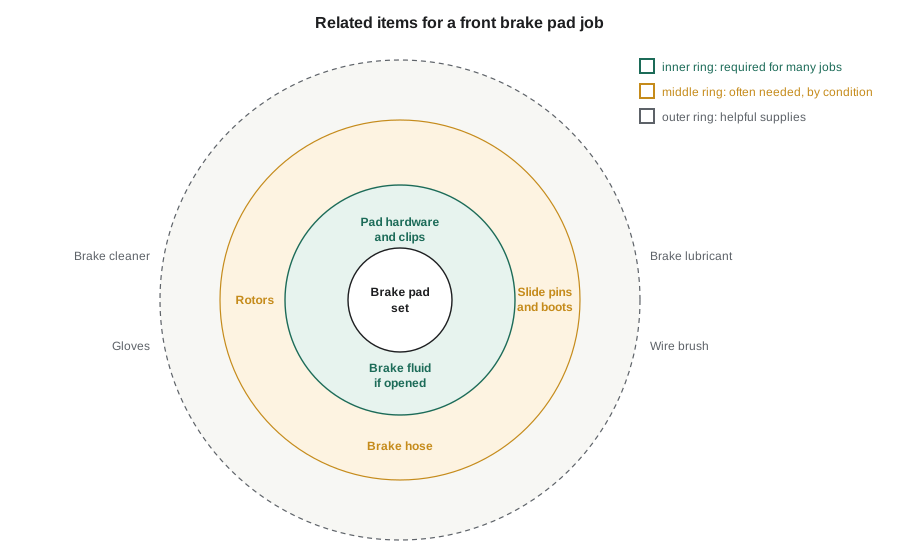
| Main part | Often required | Often needed, depending on condition | Helpful supplies |
|---|---|---|---|
| Front brake pads | Hardware kit, clips | Rotors, slide pins and boots | Brake cleaner, brake lubricant |
| Water pump | Gasket or seal, coolant | Thermostat, hoses, drive belt | Gasket scraper, rags |
| Front struts | Mounting nuts | Strut mounts, bearing plates, boots | Penetrating oil |
| Spark plugs | None beyond the plugs | Ignition coil boots | Anti-seize, dielectric grease |
| Oil change | Oil filter, drain plug washer | Air filter, cabin filter | Funnel, drain pan |
Asking about related items
The way related items are offered matters. Compare two counter lines for the same brake job:
- "Do you want rotors too?" This sounds like a sales push, and many customers say no by reflex.
- "When you have the wheels off, check the rotors for grooves or a lip at the edge. If they're worn, they usually need replacing with the pads. Do you know what condition they're in?" This gives the customer information and a reason, and lets them decide.
The second approach takes a few seconds longer and sells more of what the customer actually needs, because it is about the job, not the sale. If the customer does not know the condition, a fair option is to sell the pads and hardware now and note that rotors are in stock if needed, so they can come back without waiting.
Upselling and better choices
Upselling means offering a higher-grade version of the part the customer asked for. APT-120 explained that many parts come in economy, standard and premium lines, as genuine parts, or as remanufactured units. Telling a customer about a better choice is good service when the better choice suits their needs: longer life, a longer warranty, quieter operation, or better fit for how they use the vehicle.
Upselling becomes a problem when it ignores the customer. A customer selling the vehicle next month may be well served by the economy part. A delivery driver who puts 60 thousand kilometres a year on a van may be better served by the premium part. The questions from lesson 2 tell you which.
Worked problem
Comparing two wiper blade choices
A customer is choosing between standard wiper blades at 22 dollars a pair, which usually last about 6 months, and premium beam blades at 48 dollars a pair, which usually last about 12 months. Compare the cost per month of use.
Show solution
- Standard:
- \[22 \div 6 \approx 3.67\ \text{dollars per month}\]
- Premium:
- \[48 \div 12 = 4.00\ \text{dollars per month}\]
Answer: Here the premium blades cost slightly more per month, so the honest advice is about performance in snow and ice, not savings. Some customers will pay for that; others will not. The prices and blade life are sample values; actual life depends on the climate and how the vehicle is used.
That example matters because it shows that the better choice is not always the cheaper one in the long run, and the parts technician should say so. Customers trust a counter that tells them when the expensive option is not worth it for them.
Kits and packages
Many parts are sold as kits that bundle the main part with its related items: a timing belt kit with the belt, tensioner and idler pulleys; a brake kit with pads, hardware and sometimes rotors; a strut assembly with the spring, mount and boot already assembled. Kits save the customer time, reduce the chance of a missing part, and are often priced below the total of the separate parts.
Kits also have limits. A kit may include parts the customer does not need, or leave out one they do. The parts technician reads what the kit contains, compares it with the job, and tells the customer what is and is not included. A complete strut assembly, for example, is much quicker to install than a bare strut, but it costs more and the customer may not need a new spring.
Never selling what is not needed
The limit of selling is simple: never sell a part the customer does not need, and never use fear to make a sale. Statements such as "You'll have no brakes if you don't replace the rotors" are not acceptable unless they are true for that vehicle, and the parts technician, who has not inspected the vehicle, rarely knows that they are.
This is not only ethics; it is the law. Ontario's Consumer Protection Act, 2002 makes it an unfair practice to make a false, misleading or deceptive representation to a consumer, including saying that a part or repair is needed when it is not. A dealership that uses pressure sales can face complaints and penalties, and it will lose customers who find out.
Safety is the one area where the parts technician must speak up. If a customer says they plan to reuse a one-time-use bolt, skip a required gasket, or install brake parts on one side only, the parts technician explains why that is unsafe or will not work, and records that the advice was given. The customer still decides, but they decide knowing the risk.
Measuring counter sales
Parts managers often track items per ticket, the average number of different items on each sale, and the attachment rate for common jobs, such as the share of pad sales that include a hardware kit. These measures help a department see whether customers are leaving without parts they need. Used well, they guide training; used badly, they push staff to sell unneeded items, which hurts the business in the end.
Worked problem
Hardware kit attachment rate
In September, the retail counter sold 80 front brake pad sets. Of those sales, 52 included a hardware kit. In October, after Imani coached the counter staff to explain why hardware matters, 70 of 84 pad sales included a kit. What was the attachment rate each month?
Show solution
- September:
- \[52 \div 80 = 0.65,\ \text{or 65 in 100}\]
- October:
- \[70 \div 84 \approx 0.833,\ \text{about 83 in 100}\]
Answer: The attachment rate rose from 65 to about 83 in 100. The point is not the number: it means fewer customers reused worn clips that cause noise and uneven wear. The counts are sample values.
Selling to different customers
The same related-item suggestion sounds different to different customers, and the parts technician adjusts the approach:
- Do-it-yourself customers often appreciate practical advice, such as the special tool, the fluid or the hardware kit that makes the job easier. They may not know what they will find when they take something apart, so mentioning the commonly needed items is a genuine help.
- Repair shops usually know exactly what they need and dislike being sold to. With shops, related items are best offered as a quick check: "Do you need the bolts as well? They're single-use on this one."
- Fleet customers care about uptime and cost per vehicle. Suggesting a complete kit that avoids a second repair visit fits their goals better than an upgrade for its own sake.
- Collectors and enthusiasts often want original parts and appreciate knowing about genuine accessories or service kits.
In every case the basis is the same: suggest what the job needs, explain why in a sentence, and accept the customer's answer.
Handling a no
Customers decline suggestions often, and that is normal. A good response to a no is simple: "No problem." There is no need to repeat the suggestion, explain it again or sound disappointed. A customer who feels free to say no is more likely to say yes next time, and more likely to come back. Pressure, by contrast, turns a helpful suggestion into a sales pitch, and customers notice.
Some no answers deserve one clear sentence of information before the customer leaves, because the consequence is a safety or reliability issue rather than a sales opportunity. If a customer declines new single-use bolts on a brake caliper bracket, the parts technician may say once, "The manufacturer says those bolts must be replaced. If you reuse them, have them checked." Then the decision is the customer's.
Worked problem
The value of a related item to the customer
A customer replacing a thermostat declines a new coolant at 22 dollars, planning to reuse the old coolant. If the old coolant is contaminated and the customer has to drain and refill the system again a week later, they buy the coolant then, plus spend about an hour of their own time and possibly a second gasket at 9 dollars. What does declining cost if this happens?
Show solution
- Coolant bought later anyway:
- 22 dollars
- Second gasket:
- 9 dollars
- Extra cost compared with buying the coolant first:
- \[9\ \text{dollars plus about 1 hour of time}\]
Answer: Declining saves nothing if the job has to be redone, and costs a gasket and an hour. The parts technician explains this once; the customer decides. The prices are sample values.
Talia found that explaining why mattered more than the words she used. "When I say the reason, people decide quickly," she told Imani. "When I just say 'do you want coolant too?', they think I'm selling."
Related sales also help the department's numbers, but that is the result, not the goal. A department that sells customers what their jobs need earns more over time than one that pushes extras, because customers come back to the counter that helped them finish the job the first time.
Common mistakes
MistakeSelling only the part the customer named.
InsteadAsk about the job and offer the required and commonly needed items.
MistakeAsking "Do you want rotors too?" as a sales reflex.
InsteadExplain what to check and why, and let the customer decide.
MistakeUpselling every customer to the premium line.
InsteadMatch the choice to the customer's plans and use of the vehicle.
MistakeUsing fear to sell a part.
InsteadState facts only; never say a part is needed unless it is.
MistakeAssuming a kit contains everything.
InsteadRead the kit contents and tell the customer what is and is not included.
Summary and key terms
- Selling at the counter means helping the customer buy everything the job needs, and only what it needs.
- Related items are required, commonly needed depending on condition, or helpful supplies.
- Offer related items with information and a reason, not as a sales reflex.
- Upselling is good service when the better choice suits the customer's needs; say so when it does not.
- Kits save time and missed parts, but check what they include.
- Consumer protection law forbids saying a part is needed when it is not; speak up when a customer's plan is unsafe.
- Related sale
- An additional item the job requires or commonly needs, sold with the main part.
- Upselling
- Offering a higher-grade version of the part the customer asked for.
- Kit
- A package that bundles a main part with the related parts usually needed for the job.
- Items per ticket
- The average number of different items on each sale.
- Attachment rate
- The share of sales of a main part that also include a given related item.
- Unfair practice
- A false, misleading or deceptive representation to a consumer, prohibited by consumer protection law.
Practice problems
Work each problem on paper first, then reveal the answer to check.
Name one required item for a water pump replacement.
Show answer
A gasket or seal, and usually coolant.
Blades at 30 dollars last 6 months; blades at 54 dollars last 12 months. Which is cheaper per month?
Show answer
30 ÷ 6 = 5.00 and 54 ÷ 12 = 4.50 dollars per month, so the 54 dollar blades.
Of 60 pad sales, 45 included hardware. What is the attachment rate?
Show answer
45 ÷ 60 = 0.75, or 75 in 100.
A customer plans to reuse a torque-to-yield bolt. What do you do?
Show answer
Explain that it is a one-time-use bolt and must be replaced, and record that you advised them.
Why might the economy part be the right choice?
Show answer
If the customer plans to sell the vehicle soon or uses it lightly.
Lesson quiz · 5 questions
Score 60% or more to complete this lesson.
Create a free account to save your progress, take quizzes and earn a certificate.