
APT-130 · Lesson 10 of 12 · 25 min
Handling difficult customers
▶ Video coming soon A video version of this lesson is on the way.
On Thursday, November 5, a customer named Hugo Wexcombe came to the front counter just after 11 a.m., set a bag on the counter hard enough to rattle the display, and said, "This is the second time you people have sold me the wrong part." Inside was a thermostat housing for his 2016 Arden. Talia felt her face go hot. Imani stepped beside her but let her lead. Talia said, "I'm sorry, that's frustrating. Let me see what happened so we can fix it today." The invoice showed the housing had been ordered for a 1.8 L engine; Hugo's VIN showed the 2.0 L. The first lookup had used the model and year only. Twenty minutes later Hugo left with the right housing and a gasket, and on his way out he said, "Thanks for not arguing with me."
Most customers are pleasant, and most difficult moments come from ordinary people having a bad day: a car that broke down, a repair bill they did not expect, a part that did not fit. Handling these moments well is a skill that can be learned. This lesson covers why customers become upset, a practical method for calming a conversation, apologies and solutions, the limits of what the counter can offer, and what to do when a customer's behaviour becomes abusive or threatening.
Why customers become upset
A customer at the parts counter is often under pressure the parts technician cannot see. Their vehicle may be off the road, they may have lost a day's pay, or they may already have been to two other stores. Common triggers include:
- A wrong or failed part, especially after the customer has spent time installing it.
- Waiting, at the counter, on hold or for a part that was promised.
- Price surprises, such as a core charge, an environmental fee or a restocking fee they were not told about.
- Feeling dismissed, when the customer believes nobody is listening or that they are being blamed.
- Policies that seem unfair, such as no returns on electrical parts or a warranty that excludes labour.
Many of these triggers are prevented by the habits of earlier lessons: confirming the VIN, quoting the full price with fees, explaining warranty and return terms at the sale, and giving honest arrival times. Hugo's problem began with a lookup from year and model alone.
Stay calm first
When a customer is angry, the parts technician's own reaction comes first. Anger often sounds personal, but it is usually directed at the situation. A few habits help:
- Breathe and slow down. A slower, lower voice calms both people.
- Do not take it personally. The customer is upset about the part, the car or the day.
- Do not argue about who was at fault while the customer is still upset. Facts can be checked once the conversation is calm.
- Keep an open posture: face the customer, keep your hands visible and avoid crossing your arms.
Talia admitted afterwards that her first thought was to say the wrong part was not her fault, which was true. She did not say it, because it would not have helped Hugo and would have made the conversation about her.
A method for calming a conversation
Many customer service programs teach a simple sequence. One version used at Linmore Tessaro is LAST: Listen, Acknowledge, Solve, Thank.
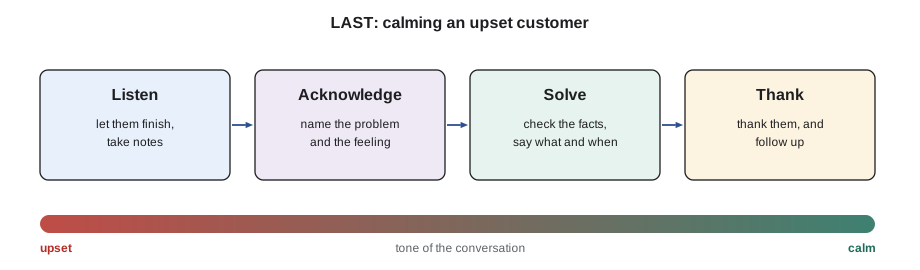
- Listen fully before speaking. Let the customer explain without interruption, take notes, and use the active listening skills of lesson 2. Many customers calm down once they have been heard.
- Acknowledge the problem and the feeling: "You've installed it once already and it doesn't fit. I understand why you're frustrated." Acknowledging is not admitting fault; it shows you understand.
- Solve by checking the facts and offering what you can do: the right part, a refund, a time it will arrive. Be specific about what happens next and when.
- Thank the customer for bringing the problem to you, and follow up if you promised to.
| Instead of | Try |
|---|---|
| "That's not my fault." | "Let me find out what happened." |
| "Calm down." | "I can see this has been a hard day. Let's sort it out." |
| "That's our policy." | "Here's what our policy allows, and here's what I can do." |
| "You must have installed it wrong." | "Can you tell me how it failed? I'll have it tested." |
| "I can't do anything." | "I can't do that, but I can do this." |
Apologies and solutions
A good apology is short and sincere. "I'm sorry this happened" or "I'm sorry you've had to come back" acknowledges the customer's experience without arguing about blame. Where the department did make an error, such as Hugo's lookup, say so plainly: "The first lookup missed your engine size. That was our mistake." Customers usually respect a clear admission more than a defence.
The solution matters more than the apology. A customer who receives a sincere apology and no solution is still upset. Offer what is within your authority first, and know what that is: most counter staff can replace a wrong part, accept returns within policy and give an honest date. Bigger remedies, such as covering a shop's labour for a wrong part or waiving a restocking fee, are usually the manager's decision. When a remedy is beyond your authority, say so and bring in the person who can decide: "I can't approve that myself, but Imani can. Let me get her."
Worked problem
The cost of a quick fix and a lost customer
Hugo buys parts about six times a year, spending about 85 dollars each visit, and he has said he will go elsewhere if the problem is not fixed. Fixing it today costs the department a second thermostat housing at a cost of 38 dollars, because the first one has been installed and cannot be resold. What is the yearly value of Hugo's purchases, and how does it compare with the cost of the fix?
Show solution
- Yearly purchases:
- \[6 \times 85 = 510\ \text{dollars}\]
- Cost of the fix:
- 38 dollars, once
- Ratio:
- \[510 \div 38 \approx 13.4\]
Answer: One year of Hugo's purchases is worth about 13 times the cost of fixing his problem, before counting the friends and family he might tell. The purchases and costs are sample values; the point is that fixing problems fairly is usually good business.
Knowing the limits
Some customers ask for things the department cannot give: a refund on a part that is clearly damaged, a warranty claim far outside the period, or a price lower than cost. The parts technician still treats them respectfully, explains the reason honestly, and offers any choices that remain, such as a test of the part, a manager's review, or the supplier's own claim process. Saying no clearly and politely is better than a vague answer that leads to a second argument later.
Be consistent. A rule applied to one customer and not another creates unfairness and, over time, more disputes. When a manager makes an exception, record it in the DMS with the reason, so the next person at the counter knows what was agreed.
Customers sometimes post complaints online or threaten to. The response is the same: fix what can be fixed, explain what cannot, and pass the matter to the manager, who decides how the dealership responds in public. Counter staff do not respond to online reviews themselves unless that is part of their job.
When behaviour crosses a line
Frustration is normal; abuse is not. Shouting, swearing at staff, insults, threats and any physical aggression cross a line that the parts technician does not have to accept. Workplaces have rules for this. In Ontario, the Occupational Health and Safety Act requires employers to have written workplace violence and workplace harassment policies, reviewed at least once a year, and a program to put them into practice, including how workers report incidents and how the employer investigates them.
Linmore Tessaro's policy, typical of many, gave counter staff these steps:
- Set a calm limit: "I want to help, but I can't continue if you swear at me."
- Get help early. Call the counter lead or manager as soon as a conversation stops being productive.
- Keep the counter between you and do not follow an angry customer outside.
- Leave and call for help if you feel unsafe; in an emergency, call 911.
- Report the incident afterwards to the manager in writing, even if nothing happened, as the policy requires.
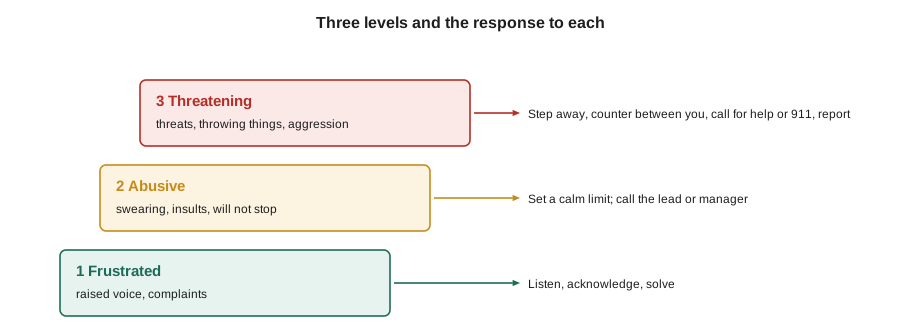
Hugo's visit stayed at the first level. He was angry but not abusive, and he calmed down once he was heard and the problem was fixed. Talia reported the wrong-part error to Rolf afterwards, not as a complaint about Hugo but so the lookup error could be traced. Rolf found that a new staff member had looked up the original order by year and model, and he used it as a reminder at the next morning meeting.
Looking after yourself
A difficult conversation leaves a mark. After one, take a minute before serving the next customer if you can, and talk to a colleague or the manager about it later. Imani's advice to Talia was practical: "Write down what happened while it's fresh, then let it go. The next customer didn't do anything to you." Employers may also offer employee assistance programs or other support, and using them is part of staying well in a customer-facing job.
Worked problem
Tracking complaints
In October the front counter served about 1,240 customers and recorded 9 complaints. Of these, 5 involved a wrong part, 2 a price surprise and 2 a wait. What is the complaint rate per 1,000 customers, and what fraction of complaints involved a wrong part?
Show solution
- Complaint rate:
- \[9 \div 1240 \times 1000 \approx 7.3\ \text{per 1,000}\]
- Wrong-part share:
- \[5 \div 9 \approx 0.56,\ \text{about 56 in 100}\]
Answer: About 7 customers in 1,000 complained, and more than half the complaints came from wrong parts. That points the manager to lookup and confirmation habits, which are covered in lessons 2 and 4 and in APT-120. The counts are sample values.
Difficult customers on the phone
Phone calls bring their own challenges. Without faces, both people rely on tone, and an upset caller can sound angrier than they are. The LAST method still works, with a few adjustments:
- Let the caller finish without talking over them; pauses on the phone feel longer than they are, so wait a moment before answering.
- Show you are listening with short responses such as "I see" or "I understand," because the caller cannot see you nodding.
- Summarise the problem before offering a solution: "So the part arrived but it's the wrong side, and your car is on the hoist."
- Give a specific next step and time, and keep it: "I'll call you back by 2 p.m. with a delivery time."
If a caller becomes abusive, the same limits apply as at the counter. Say calmly that you want to help but cannot continue if the abuse goes on. If it does, end the call politely and tell the manager. A record of the call, with the time and what was said, helps the manager decide what to do next.
Customers with different needs
Some conversations are difficult not because the customer is upset, but because communication is harder. A customer may have limited English, a hearing or speech difficulty, or a disability that affects how they communicate or move. Patience, plain words and a willingness to try another way solve most of these situations: writing things down, showing the part or the catalogue illustration, speaking clearly without shouting, or offering a seat while the lookup runs. Ontario's accessibility standards for customer service require businesses to serve customers with disabilities in a way that respects their dignity and independence, and the department's own policies say how.
A customer who brings a support person or a service animal should be served the same way as anyone else. Speak to the customer, not to the support person, unless the customer asks you to.
Worked problem
Callback promises kept
In a week, the counter promised 42 callbacks at a stated time. Thirty-six were made on time, 4 were late and 2 were missed. What fraction were made on time, and what fraction were late or missed?
Show solution
- On time:
- \[36 \div 42 \approx 0.857,\ \text{about 86 in 100}\]
- Late or missed:
- \[(4 + 2) \div 42 = 6 \div 42 \approx 0.143,\ \text{about 14 in 100}\]
Answer: About 86 in 100 callbacks were on time. Each late or missed callback is a small broken promise, and broken promises are a common cause of the next complaint. The counts are sample values.
Common mistakes
MistakeArguing about fault while the customer is still upset.
InsteadListen and acknowledge first; check the facts once things are calm.
MistakeTelling an angry customer to calm down.
InsteadAcknowledge the problem and offer a specific next step.
MistakePromising a remedy beyond your authority.
InsteadBring in the person who can approve it.
MistakeMaking exceptions without recording them.
InsteadRecord any exception and the reason in the DMS.
MistakeStaying in an unsafe situation to finish a sale.
InsteadStep away, call for help, and report the incident.
Summary and key terms
- Most difficult customers are ordinary people under pressure; many triggers are prevented by good counter habits.
- Stay calm and do not take anger personally.
- Listen, acknowledge, solve and thank.
- Apologise sincerely, admit real errors plainly, and offer a specific solution.
- Know the limits of your authority and bring in the manager for bigger remedies.
- Abuse and threats cross a line: set a limit, get help, step away if unsafe, and report.
- Look after yourself after a hard conversation.
- De-escalation
- Calming a tense conversation by listening, acknowledging and offering solutions.
- LAST
- Listen, acknowledge, solve and thank: a method for handling an upset customer.
- Acknowledgement
- Showing that you understand the customer's problem and feelings, without arguing about blame.
- Workplace violence policy
- An employer's written rules for preventing and responding to violence and threats at work.
- Escalation
- Passing a problem to someone with more authority, or a conversation becoming more heated.
Practice problems
Work each problem on paper first, then reveal the answer to check.
What does LAST stand for?
Show answer
Listen, acknowledge, solve, thank.
Rephrase "That's our policy" more helpfully.
Show answer
"Here's what our policy allows, and here's what I can do."
A customer spends 60 dollars a visit, eight times a year. What is the yearly value?
Show answer
480 dollars.
A customer starts swearing at you. What is your first step?
Show answer
Set a calm limit and call the lead or manager if it continues.
The counter has 6 complaints from 1,500 customers. What is the rate per 1,000?
Show answer
6 ÷ 1,500 × 1,000 = 4 per 1,000.
Lesson quiz · 5 questions
Score 60% or more to complete this lesson.
Create a free account to save your progress, take quizzes and earn a certificate.