
APT-130 · Lesson 4 of 12 · 26 min
Quoting price and availability
▶ Video coming soon A video version of this lesson is on the way.
On Thursday, October 15, a man phoned the counter for a price on a front wheel bearing hub for a 2021 Vela. Talia found it, read the price off the screen and said, "We have one." The caller drove across the city, only to find that the one on the shelf had been put on hold that morning for a technician in the service department. Rolf took Talia aside afterwards, not angry but firm. "A quote has two halves," he said. "The price, and when they can have it. You gave him half a quote, and the half you gave him was wrong."
Quoting is a promise. When a parts technician tells a customer a price and an availability date, the customer plans around it: they book time off, borrow a car, or tell their own customer when the job will be done. This lesson explains the prices on the parts screen, the difference between margin and markup, how price levels and matrix pricing work, how to read stock and give honest arrival times, and how to write a quote the customer can rely on.
The prices on the screen
A parts screen shows several prices for the same part, and each has a purpose:
- List price, also called the manufacturer's suggested retail price (MSRP), is the price the manufacturer or supplier suggests for retail sale. It is the starting point for most other prices.
- Cost is what the department pays the manufacturer or supplier for the part. Cost is confidential and is never quoted to a customer.
- Selling price is what this customer pays. It may be list, or a discount from list for wholesale, fleet or internal customers, or a price set by the department's own pricing rules.
- Core charge, for remanufactured parts, is the refundable amount added to the selling price (APT-120 and lesson 8).
The difference between selling price and cost is the gross profit on the sale. It pays for the department's wages, rent, delivery van, computer systems and everything else, and what is left is the department's profit. A parts department that sells below cost or gives away too much discount cannot pay its staff.
Margin and markup
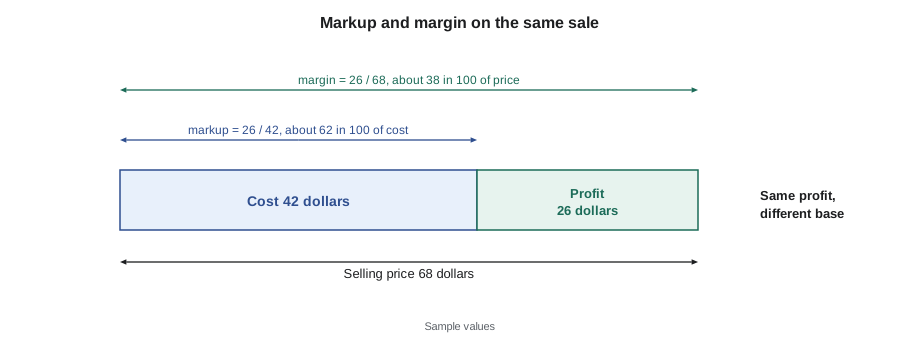
Two numbers describe the profit on a part, and they are easily confused. Markup compares the gross profit with the cost. Margin, or gross margin, compares the gross profit with the selling price. Both are usually expressed as a fraction or as so many in 100.
Because cost is smaller than price, markup is always larger than margin for the same sale. A part that costs 50 dollars and sells for 100 has a markup of 100 in 100 (it doubled) but a margin of 50 in 100 (half the price is profit). Mixing the two up is one of the most common pricing errors, and it always errs in the same direction: a department that marks up by the margin it wants will earn less than it planned.
Worked problem
Margin and markup on one part
A hub assembly costs the department 42.00 dollars and sells at a list price of 68.00 dollars. What are the gross profit, the markup and the margin?
Show solution
- Gross profit:
- \[68.00 - 42.00 = 26.00\ \text{dollars}\]
- Markup:
- \[26.00 \div 42.00 \approx 0.619,\ \text{about 62 in 100}\]
- Margin:
- \[26.00 \div 68.00 \approx 0.382,\ \text{about 38 in 100}\]
Answer: The same sale has a markup of about 62 in 100 and a margin of about 38 in 100. The prices are sample values.
When the department sets a price from a target margin, it divides the cost by one minus the margin. A target margin of 35 in 100 on a 42 dollar part gives a price of 42 ÷ 0.65.
Worked problem
Pricing from a target margin
A part costs 42.00 dollars. The department wants a margin of 35 in 100. What price gives that margin? What price would a staff member get by wrongly adding 35 in 100 to the cost?
Show solution
- Correct price:
- \[42.00 \div (1 - 0.35) = 42.00 \div 0.65 \approx 64.62\ \text{dollars}\]
- Check the margin:
- \[(64.62 - 42.00) \div 64.62 \approx 0.350\]
- Wrong method, adding 35 in 100 to cost:
- \[42.00 \times 1.35 = 56.70\ \text{dollars}\]
- Margin at the wrong price:
- \[(56.70 - 42.00) \div 56.70 \approx 0.259\]
Answer: The correct price is about 64.62 dollars. Adding 35 in 100 to the cost gives 56.70 dollars, which is only about a 26 in 100 margin. Dividing by one minus the margin is the right method. The figures are sample values.
Price levels and matrix pricing
Most DMS systems store several price levels for each customer type. A retail customer pays list, a wholesale account might pay list less 25 in 100, a fleet account might have its own negotiated level, and internal sales are priced by the dealership's own rules for repair orders. The customer's account sets the level automatically, which is one reason the counter must pick the right customer before starting the sale.
Many departments also use matrix pricing, a set of rules that sets the selling price from the cost, with a different markup for each cost band. Cheap parts get a high markup because the handling cost of a 2 dollar clip is the same as for a 200 dollar module, and expensive parts get a lower markup so they stay competitive.
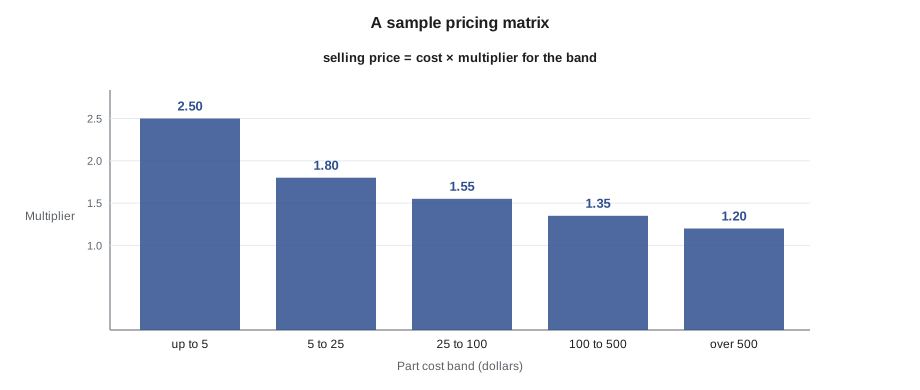
| Cost band | Multiplier on cost | Example cost | Selling price |
|---|---|---|---|
| Up to 5 dollars | 2.50 | 2.40 | 6.00 |
| Over 5 to 25 dollars | 1.80 | 18.00 | 32.40 |
| Over 25 to 100 dollars | 1.55 | 42.00 | 65.10 |
| Over 100 to 500 dollars | 1.35 | 210.00 | 283.50 |
| Over 500 dollars | 1.20 | 640.00 | 768.00 |
Matrix pricing is mostly used for parts without a manufacturer's list price, for aftermarket lines, and for internal repair-order pricing. Where a list price exists, retail customers usually pay list. Counter staff do not change matrix prices; they follow the system and refer exceptions to the parts manager.
Discounts and price matching
Discounts are a business decision, not a counter-staff favour. Most departments allow counter staff a small discretionary discount, such as matching a posted competitor's price on an identical part, and require the manager's approval for anything more. Unauthorized discounts cut the margin the department needs and are unfair to customers who paid the full price. When a customer asks for a better price, the parts technician can explain the choices (lesson 3), check whether a price match policy applies, and ask the manager if the request is outside their authority.
Reading availability honestly
The second half of a quote is availability. The inventory screen usually shows several quantities for each part, and the difference between them is exactly where Talia went wrong on October 15:
- On hand: the number physically in the building.
- On hold or allocated: units already reserved for a repair order, a special order or another customer.
- Available: on hand minus on hold. This is what can be sold now.
- On order: units ordered from the supplier, with an expected arrival date.
- Network stock: units at other dealers in the group or at the manufacturer's parts distribution centre, with typical transfer or delivery times.
The honest answer to "Do you have it?" comes from the available quantity, not the on-hand quantity. If the available quantity is zero, the parts technician tells the customer when the part can arrive and from where: the next stock order, a transfer from another dealer, or an emergency order. For a walk-in or phone customer who intends to drive in, the parts technician can offer to put the part on hold with the customer's name, for a set time, so it is still there when they arrive.
Worked problem
Giving an arrival time
A customer asks on Thursday afternoon for a part with 2 on hand, 2 on hold and 0 available. The next stock order from the parts distribution centre arrives on Saturday morning if ordered by 4 p.m. Thursday, and a sister dealer has 1 available with a same-day transfer by van at 2 p.m. Friday. What can Talia tell the customer?
Show solution
- Available now:
- \[2 - 2 = 0\]
- Fastest source:
- the sister dealer, by van, Friday afternoon
- Next source:
- the distribution centre, Saturday morning, if ordered by 4 p.m. today
Answer: Talia can offer the part on Friday afternoon from the sister dealer, or Saturday morning from the next stock order, and should not say "we have it." The schedule is a sample for this course.
Writing a quote
A quote that the customer can rely on states the part, the price and the availability clearly, and, for anything that is not a quick counter sale, puts them in writing. A good written quote includes the part number and description, the quantity, the unit and total price, any core charge, the taxes and fees that will apply, the arrival date and source, whether the part can be returned, and how long the price is good for.
Special-order parts, those not normally stocked, often require a deposit or full payment in advance because the department may not be able to return them to the supplier. The quote should say so, along with any restocking fee if the customer cancels. Lesson 8 covers returns, and lesson 11 covers deposits and payment.
Finally, a quote is only as good as the follow-through. If an arrival date slips, the parts technician calls the customer before the customer has to call the counter. Customers forgive a delay they were told about far more readily than one they discover.
Comparing quotes honestly
Customers often arrive with a price from somewhere else, as Gordon did with his alternator in APT-120. The parts technician's job is to compare like with like, not to argue that the other price is wrong. Useful questions are:
- Is it the same part? New, remanufactured or used; genuine or aftermarket; the same specification and options.
- What is included? A core charge, a gasket, hardware or a fluid may be included in one price and extra in another.
- What warranty comes with it? A longer warranty may be worth more than a small price difference (lesson 9).
- When is it available? A cheaper part that arrives next week may cost more in lost use of the vehicle.
Once the comparison is clear, the customer decides. Some departments have a price-match policy for identical parts; others do not. The parts technician follows the policy and does not promise a match that the manager has not approved.
Worked problem
Comparing two quotes
A customer has a quote elsewhere for an aftermarket control arm at 118 dollars plus 12 dollars shipping, arriving in 4 days. The dealership's genuine control arm is 146 dollars, in stock today, and includes the new bolts the job needs, which the other quote does not; the customer would have to buy those bolts separately at about 16 dollars. What is the price difference once both quotes include the bolts?
Show solution
- Other quote with bolts:
- \[118 + 12 + 16 = 146\ \text{dollars}\]
- Dealership quote:
- 146 dollars, bolts included
- Difference:
- \[146 - 146 = 0\ \text{dollars}\]
Answer: With the bolts and shipping included, the two quotes cost the same, and the dealership's part is in stock today. The prices are sample values; real comparisons depend on the parts and policies involved.
Prices that change
Parts prices change. Manufacturers update list prices, suppliers change costs, and the DMS updates the matrix. A price quoted on Monday may be different on Friday. Good practice is to state how long a quote is valid, usually on the written quote itself, and to honour a quoted price within that time even if the system price has gone up. When a customer returns after the quote has expired, explain the new price before ringing it up, so they are not surprised at the till.
Prices shown on display stock and online must match what the customer is charged at the counter. When a shelf label or website price is wrong, the department follows its policy and the law for advertised prices, and fixes the label as soon as it is found. Telling a customer "the computer says it's more" without explanation is a quick way to lose trust.
Common mistakes
MistakeSaying "We have it" from the on-hand quantity.
InsteadQuote from the available quantity and give a real arrival time.
MistakeConfusing margin and markup.
InsteadMarkup compares profit with cost; margin compares profit with price.
MistakePricing from a target margin by adding it to the cost.
InsteadDivide the cost by one minus the target margin.
MistakeGiving discounts outside your authority.
InsteadFollow the price levels and ask the manager for exceptions.
MistakeQuoting a special-order part without its return terms.
InsteadState deposits, return limits and restocking fees in the quote.
Summary and key terms
- A quote has two halves: the price and the availability.
- List price, cost, selling price and core charge each have a purpose; cost is never quoted to customers.
- Markup is gross profit divided by cost; margin is gross profit divided by price. Price from a target margin by dividing cost by one minus the margin.
- Customer accounts set price levels, and matrix pricing sets prices from cost bands.
- Quote from the available quantity: on hand minus on hold.
- Written quotes state the part, price, core, taxes, arrival date, return terms and how long the price holds.
- List price
- The price the manufacturer or supplier suggests for retail sale, also called MSRP.
- Cost
- What the department pays for a part; confidential.
- Gross profit
- Selling price minus cost.
- Markup
- Gross profit divided by cost.
- Margin
- Gross profit divided by selling price, also called gross margin.
- Matrix pricing
- A pricing rule that sets the selling price from cost, with a different multiplier for each cost band.
- Available quantity
- On-hand stock minus units already on hold.
Practice problems
Work each problem on paper first, then reveal the answer to check.
A part costs 30 dollars and sells for 45. What are the markup and margin?
Show answer
Markup 15 ÷ 30 = 0.50; margin 15 ÷ 45 ≈ 0.333.
What price gives a 40 in 100 margin on a 30 dollar part?
Show answer
30 ÷ 0.60 = 50 dollars.
A part has 3 on hand and 3 on hold. What is available?
Show answer
0.
Using the sample matrix, what is the price of a part costing 18 dollars?
Show answer
18 × 1.80 = 32.40 dollars.
Name four things a written quote should include.
Show answer
Any four of: part number and description, quantity, price, core charge, taxes and fees, arrival date, return terms, how long the price holds.
Lesson quiz · 5 questions
Score 60% or more to complete this lesson.
Create a free account to save your progress, take quizzes and earn a certificate.