
APT-130 · Lesson 7 of 12 · 27 min
Commercial and fleet accounts
▶ Video coming soon A video version of this lesson is on the way.
On Thursday, October 29, Rolf asked Talia to sit in on a meeting with Ewan Tullis, the fleet manager for Orland Courier Co., which ran 34 Tessaro vans out of a depot near the airport. Orland had been buying parts by credit card at the counter for two years and wanted an account. Rolf walked Ewan through the credit application, the price agreement and the monthly statement, and promised that the wholesale desk would hold a short list of Orland's most common parts in stock. Afterwards he showed Talia the numbers. "Thirty-four vans that each need brakes, filters and wipers every year," he said. "That's a customer worth looking after. But only if they pay."
Commercial and fleet customers buy regularly and in volume, usually on account rather than at the counter. They include independent repair shops and body shops (the wholesale customers of lesson 1) and businesses or public bodies that maintain their own vehicles, such as courier companies, utilities, rental agencies, municipalities and police services. This lesson explains how accounts are opened, what price agreements and credit terms mean, how statements and collections work, and how the counter serves these customers day to day.
Why accounts matter
A commercial account lets a business buy parts without paying for each sale at the counter. The department sends one invoice per sale, and a statement each month listing all unpaid invoices, and the business pays by the due date. For the customer, an account saves time and paperwork and gives them a record of all their parts purchases. For the department, accounts bring regular, predictable sales and close relationships with customers who buy often.
Accounts also carry risk. Every account is a loan of parts until the customer pays. A business that pays slowly ties up the department's cash, and one that never pays turns sales into losses. That is why accounts are opened carefully, given credit limits, and watched.
Opening an account
A business that wants an account completes a credit application, which usually asks for:
- the business's legal name, address and type of business, and how long it has operated;
- the owner's or officers' names, and sometimes a personal guarantee from the owner of a small business;
- trade references from other suppliers, and a bank reference;
- the people authorized to order, and how orders will be placed, such as by purchase order number;
- tax information: the business number for HST purposes.
The accounting office or the parts manager checks the references, sometimes orders a credit report, and sets a credit limit, the maximum amount the account may owe at any time. New accounts usually start with a modest limit that is raised as the customer builds a payment history. Counter staff do not open accounts or change limits; they direct the customer to the manager and follow the account settings in the DMS.
Tax handling differs between the two countries. In Ontario, HST is charged on parts sold to businesses as well as to consumers, and a registered business recovers the HST it paid through input tax credits. A repair shop therefore pays HST on its parts and charges HST to its own customer. The DMS records the account's tax status, and the counter checks it when an invoice looks wrong.
Price agreements
Most commercial accounts have a price level or a price agreement that sets what they pay. A typical wholesale level is a fixed discount from list price, such as list less 25 in 100 on most parts. Larger fleets may negotiate a contract with fixed prices on their most-used parts for a year, a discount by part category, or a rebate if their annual purchases pass a target.
Worked problem
A wholesale discount
A front pad set has a list price of 96.00 dollars. Bramhall Auto Service, a wholesale account, buys at list less 25 in 100. Orland Courier has a contract price of 69.50 dollars for the same set. What does each pay before tax?
Show solution
- Bramhall at list less 25 in 100:
- \[96.00 \times (1 - 0.25) = 96.00 \times 0.75 = 72.00\ \text{dollars}\]
- Orland at its contract price:
- \[69.50\ \text{dollars}\]
- Difference:
- \[72.00 - 69.50 = 2.50\ \text{dollars}\]
Answer: Bramhall pays 72.00 dollars and Orland pays 69.50 dollars. Orland's contract price is lower because it commits to buying the part in volume all year. The prices are sample values.
The account's price level is set in the DMS, so the correct price appears automatically when the counter selects the account. The parts technician's job is to select the right account, check that the price looks right, and never override an agreement price without the manager's approval. Price agreements are confidential: one customer's contract prices are never shown to another.
Credit terms
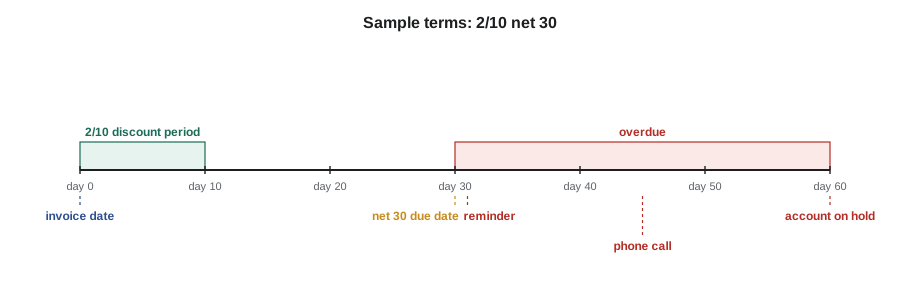
Credit terms state when payment is due. The most common is net 30: the full amount is due 30 days after the invoice date, or 30 days after the statement date, depending on the department's policy. Some departments offer an early-payment discount, such as 2/10 net 30, meaning the customer may deduct 2 in 100 if they pay within 10 days, and otherwise pays the full amount within 30. Overdue amounts may carry a late charge, if the terms say so and the law allows it.
Worked problem
Early payment and due dates
Orland's terms are 2/10 net 30. An invoice for 1,840.00 dollars is dated October 5. What does Orland pay if it pays on October 13, and what is the last day to pay the full amount on time?
Show solution
- Days after the invoice on October 13:
- \[13 - 5 = 8\ \text{days, within 10}\]
- Discount:
- \[1{,}840.00 \times 0.02 = 36.80\ \text{dollars}\]
- Amount paid:
- \[1{,}840.00 - 36.80 = 1{,}803.20\ \text{dollars}\]
- Net due date:
- October 5 plus 30 days is November 4
Answer: Paying on October 13 earns the discount, so Orland pays 1,803.20 dollars. Otherwise the full 1,840.00 dollars is due by November 4. The amounts are sample values.
Statements and collections
At the end of each month, the DMS produces a statement for every account, listing invoices and credits for the month, payments received, and the balance owing, often with an aging summary that shows how much is current, 30 days overdue, 60 days overdue and so on. The accounting office sends statements and follows up overdue balances.
When an account falls behind, the department usually reminds the customer, then calls, and may place the account on hold, so that the counter cannot charge new sales to it until the balance is paid. A held account shows a warning in the DMS. The parts technician does not argue with the customer about it; they explain politely that the account is on hold, offer to take payment for today's sale another way, and refer the customer to the accounting office or the parts manager.
Counter staff can help collections in small ways: by charging sales to the right account, attaching purchase order numbers when the customer requires them, and giving the customer a clear invoice for every sale. Many payment delays come from invoices that the customer's own accounts office cannot match to an order.
Serving fleet customers
Fleet customers value uptime: every day a van is off the road costs them deliveries. Good fleet service includes stocking the parts they use most, so they are always available; delivering on the scheduled runs; giving the fleet a single contact at the counter; and reporting, such as a monthly summary of parts purchased by vehicle, which helps the fleet manage maintenance.
Fleet vehicles may also carry warranty coverage, extended service contracts or recall campaigns. A parts technician serving a fleet should check the VIN for open recalls and warranty status where the DMS allows, and tell the fleet manager, because a part paid for out of pocket may have been covered.
Worked problem
Stocking for a fleet
Orland runs 34 vans. Each van uses about 2 front pad sets and 3 cabin air filters a year. About how many of each will Orland buy in a year, and on average per month?
Show solution
- Pad sets per year:
- \[34 \times 2 = 68\]
- Pad sets per month:
- \[68 \div 12 \approx 5.7\]
- Filters per year:
- \[34 \times 3 = 102\]
- Filters per month:
- \[102 \div 12 = 8.5\]
Answer: Orland will need roughly 6 pad sets and 8 or 9 cabin filters a month. Rolf set the stocking levels for those parts to cover a month of Orland's use plus the department's other sales. APT-210 covers stocking levels. The usage figures are sample values.
Wholesale repair shops
Independent repair shops such as Bramhall Auto Service, owned by Corinne Ferraby, buy a mix of genuine and aftermarket parts and compare dealers with aftermarket suppliers on price, availability and delivery. What keeps them buying from a dealer is a high fill rate (APT-110), accurate parts the first time, fast delivery, and easy returns. Shops also value technical help, such as a dealer parts technician who can confirm which part a VIN needs when the shop's own catalogue is unclear.
Wholesale customers often call with a technician waiting beside a vehicle on a hoist, just like the dealership's own technicians. The same urgency applies, and the same honesty about availability. A shop told the part will be on the 2 p.m. run can plan its day; a shop told "soon" cannot.
Serving the people behind an account
An account is a business relationship, but it is served one person at a time: the shop's service writer who phones in orders, the technician who collects parts, the fleet manager who negotiates prices and the office manager who pays the statements. Each needs something slightly different from the counter.
- Service writers want fast, accurate quotes and honest arrival times, so they can promise their own customers a time.
- Technicians and drivers collecting parts want the order ready, checked and correctly labelled.
- Fleet and shop managers want consistent pricing, reliable supply and someone to call when something goes wrong.
- Office and accounts staff want invoices that match the orders, statements that are easy to reconcile and credits issued promptly.
Knowing these people by name, and knowing what each of them cares about, is a large part of keeping an account. Corinne Ferraby at Bramhall Auto Service, for example, preferred a text message when a back-ordered part arrived; Ewan Tullis at Orland Courier wanted a weekly summary of open orders. Imani kept these preferences in the account notes in the DMS, so whoever was at the counter could follow them.
When an account goes wrong
Accounts are lost more often through repeated small problems than through one big one: a wrong part delivered twice, invoices that do not match quotes, credits that take months. The parts technician can prevent most of these by checking orders before they leave, by issuing credits as soon as returns are approved, and by passing pricing or billing questions to the right person instead of guessing.
When an account customer complains, the same methods as lesson 10 apply, with one addition: the account manager or parts manager should hear about it the same day. A pattern of small complaints from one account is often the first sign that a customer is about to move to another supplier.
Worked problem
What an account is worth
Bramhall Auto Service buys about 4,200 dollars of parts a month from Linmore Tessaro, at an average margin of 24 in 100. What is the yearly gross profit from the account?
Show solution
- Yearly sales:
- \[4200 \times 12 = 50\,400\ \text{dollars}\]
- Yearly gross profit:
- \[50\,400 \times 0.24 = 12\,096\ \text{dollars}\]
Answer: The account brings in about 12,096 dollars of gross profit a year, which is why a few wrong deliveries are worth fixing quickly. The sales and margin are sample values.
Talia had assumed that wholesale customers were the least personal part of the job. After a week of shadowing the wholesale desk, she changed her mind. "It's all relationships," she said. "They don't just buy parts from us, they buy from Imani."
Account customers also notice consistency. If one staff member gives a shop its agreed price and another forgets the price level, the shop's office will find the difference on the statement and lose confidence in every invoice. Checking the account and price level on every order, not only the first one of the day, prevents this.
Common mistakes
MistakeCharging a sale to an account without checking the account name.
InsteadConfirm the account and the authorized buyer before charging.
MistakeOverriding a price agreement to close a sale.
InsteadFollow the account's price level and refer exceptions to the manager.
MistakeArguing with a customer whose account is on hold.
InsteadExplain politely, offer another payment method and refer them to accounting.
MistakeLeaving out the customer's purchase order number.
InsteadAttach the PO number when the account requires it, so invoices can be matched and paid.
MistakeShowing one customer another customer's contract prices.
InsteadKeep price agreements confidential.
Summary and key terms
- Commercial and fleet customers buy regularly on account and receive monthly statements.
- Accounts are opened with a credit application, references and a credit limit set by the manager.
- Price levels and agreements set what each account pays and are applied automatically by the DMS.
- Net 30 means payment is due 30 days after the invoice or statement; 2/10 net 30 offers a discount for paying within 10 days.
- Statements and aging reports track what is owed; overdue accounts may be placed on hold.
- Fleets value uptime, stocked parts, delivery, a single contact and reporting.
- Sales tax on business purchases is handled differently in each country; check the account's tax status.
- Credit application
- A form a business completes to request an account, with references and authorized buyers.
- Credit limit
- The most an account may owe at any time.
- Net 30
- Credit terms requiring full payment 30 days after the invoice or statement date.
- Statement
- A monthly summary of an account's invoices, credits, payments and balance.
- Aging
- A breakdown of an account balance by how long each amount has been owing.
- Price agreement
- A negotiated set of prices or discounts for one customer.
- Uptime
- The time a vehicle is available for work rather than off the road for repair.
Practice problems
Work each problem on paper first, then reveal the answer to check.
A part lists at 120 dollars. What does an account at list less 25 in 100 pay?
Show answer
120 × 0.75 = 90 dollars.
Terms are 2/10 net 30. What is the discount on a 500 dollar invoice paid in 7 days?
Show answer
500 × 0.02 = 10 dollars, so 490 dollars is paid.
An invoice is dated March 10 on net 30 terms. When is it due?
Show answer
April 9.
A fleet of 20 vans uses 4 wiper blades each a year. About how many per month?
Show answer
80 ÷ 12 ≈ 6.7, so about 7 a month.
A customer's account is on hold. What do you offer?
Show answer
To take payment for today's sale another way, and refer them to accounting.
Lesson quiz · 5 questions
Score 60% or more to complete this lesson.
Create a free account to save your progress, take quizzes and earn a certificate.