
APP-410 · Lesson 9 of 12 · 23 min
Working in customers' homes safely and respectfully
▶ Video coming soon A video version of this lesson is on the way.
On Wednesday, August 12, 2026, Dee arrived at Mavis Ruthven's home in Corman for a washer that would not spin. A large dog barked behind the door, and a boy of about eight opened it. Dee did not step inside. She smiled, asked him to fetch a grown-up, and waited on the step. When Mrs. Ruthven came, Dee asked whether the dog could be put in another room while she worked, and Mrs. Ruthven shut it in the bedroom. Partway through the repair Dee wanted a photo of the washer's wiring diagram, which was taped inside the cabinet, and of a scorched connector. She asked first, and took the photos so that nothing but the washer was in the frame. When she left, the boy asked whether he could watch the washer spin. Dee said yes, with his mother there, and showed them both the new lid lock working.
This lesson is about working safely and respectfully in other people's homes: protecting the home, dealing with pets and children, recognizing customers who may be vulnerable, respecting privacy, keeping the technician safe, and the policies on harassment and conduct that apply to everyone at Penfold.
A home is not a workplace, but it is your workplace
A technician works in hundreds of homes a year. Each is someone's private space, and the customer has let a stranger in. Everything about the visit, from where the van is parked to how the floor is left, tells the customer whether that trust was deserved. At the same time, the home is the technician's workplace, with all the hazards of a workplace and few of the controls: no safety officer, no guarded machines, and people, animals and objects that the technician did not choose. Both views lead to the same habits: be careful, ask before acting, and leave if it is not safe.
Penfold's in-home conduct rules were written by Harriet's father, Gus, in the 1990s and are reviewed every September. At the staff morning on Saturday, September 12, 2026, Harriet went through them with every technician, and with Fenna and Ade, who take the calls when something goes wrong.
Protecting the home
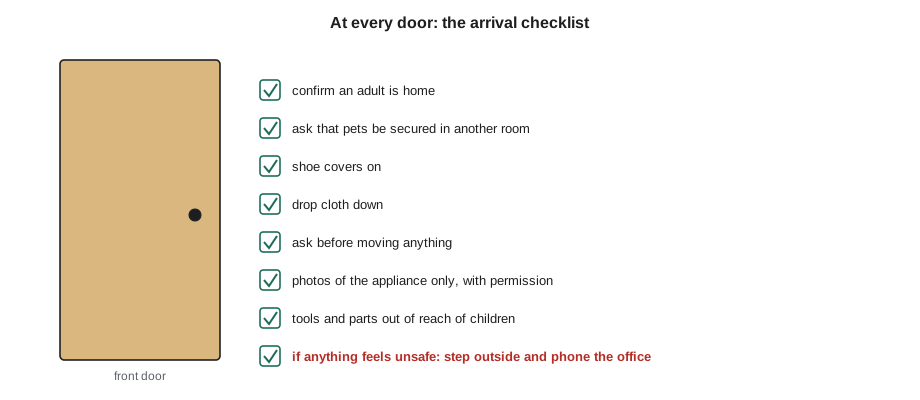
- Shoe covers on, or shoes off if the customer prefers, every time.
- A drop cloth under the work area, and cardboard or hardboard under any appliance that is slid out. Appliance feet and rollers scratch vinyl and hardwood and can tear linoleum.
- Towels and a wet vacuum for any job involving water. A dishwasher or washer can hold several litres of water in its sump and hoses.
- Tools in a tool bag or on a mat, never on counters, tables or the customer's furniture.
- Nothing moved without asking, and everything put back.
- A final check before leaving: no water on the floor, no parts or screws left behind, the appliance pushed back square, and the area cleaner than it was.
Worked problem
What the protection routine costs and saves
Laying out and packing up shoe covers, drop cloth and floor protection takes about 6 minutes a call. At Penfold's labour rate of 110 dollars an hour, what does that time cost per call? How many calls' worth of that time equals a sample 2,500 dollar insurance deductible for one damaged floor?
Show solution
- Time cost per call:
- \[\frac{6}{60} \times 110 = 11\]
- Calls equal to one deductible:
- \[2{,}500 \div 11 \approx 227\]
Answer: About 11 dollars a call, so one damaged floor costs the deductible alone as much as the routine on about 227 calls, before the customer's anger, the bad review and the higher premium. The routine is cheap.
Pets and children
Dogs are the most common hazard in homes, and even a friendly dog can bite a stranger who reaches into its space or startles it. Penfold's rule is to ask, when booking and again at the door, that pets be secured in another room for the whole visit. Cats can slip into open appliances, cabinets and vans, so technicians check before closing anything. If a pet cannot be secured and the technician does not feel safe, the visit is rescheduled; nobody is expected to work with an anxious or aggressive animal nearby.
Children deserve the same care. Penfold requires an adult, 18 or older, to be home for the whole visit, and Fenna asks when booking. A technician never stays in the home with only children present, does not go into children's rooms, and does not give children treats or anything else without a parent's agreement. Tools, parts, cleaning chemicals and open appliances are kept out of children's reach, and a running appliance with its panels off is never left unattended. Showing an interested child how something works, with a parent there, is a kind thing to do, as Dee did; being alone with a child is not.
Vulnerable customers
Some customers need extra care: older people living alone, people with dementia or disabilities, people who do not speak English well, and people in a crisis. Technicians should speak clearly and patiently, explain choices slowly and in writing, and be prepared to phone a family member or come back when someone can help, if the customer wishes.
Older customers are common targets of scams, including fake repair companies that charge large sums for unnecessary work. A trustworthy technician protects them simply by being honest: clear estimates, no pressure, no unnecessary work, payment only on an invoice, and the office's phone number left behind. If a technician sees something worrying, such as a customer who seems confused and unsafe at home, or signs that someone is being taken advantage of, the right action is to tell Harriet or Fenna. The office can contact the customer's emergency contact, if one is on file, or the local community services for older adults.
Privacy and photos
A service company learns a lot about its customers: names, addresses, phone numbers, sometimes access codes and when the home is empty, and what is inside the home. In Ontario, the federal Personal Information Protection and Electronic Documents Act (PIPEDA) applies to private businesses that collect personal information in the course of commercial activity. It requires the company to collect only what it needs for a stated purpose, get consent, protect the information, keep it only as long as needed and let customers see what is held about them. Penfold's privacy policy is on its website and its booking confirmations.
For technicians, privacy comes down to a few rules:
- Take photos only of the appliance, its plate, its parts and the installation, with the customer's permission, and keep family photos, mail, documents and people out of the frame.
- Use photos only for the work order, warranty claims and training, never on personal social media, and never post anything that identifies a customer or their home.
- Keep work orders, door codes and customer lists on the company tablet, locked when not in use, and never in personal phones or notebooks.
- Do not discuss one customer's home or appliance with another customer, or with anyone outside the company.
The technician's own safety
Technicians are sometimes the only outsider to see inside a home, and sometimes they find conditions that are not safe to work in: extreme clutter that blocks exits and access, insect or rodent infestation, mould, signs of drug manufacture, exposed wiring, a smell of gas, or a person who is aggressive or intoxicated. Penfold's rule is that the technician may stop at any time, step outside, and phone the office; the call is rescheduled or referred, and no one is criticized for leaving. A smell of gas or a CO alarm means everyone leaves and the gas utility or emergency services are called, as earlier courses explained.
Fenna's booking script helps: it asks about pets, access and who will be home, and flags addresses with a history of problems. Technicians tell the office before entering a home where they feel uneasy, and Fenna checks in by text if a call runs much longer than expected.
Harassment, conduct and respect
Ontario's Occupational Health and Safety Act requires employers to have written policies on workplace violence and workplace harassment, including sexual harassment, with a program for reporting and investigating incidents. A technician's workplace includes customers' homes, so harassment by a customer is covered as well as harassment by a co-worker. The Ontario Human Rights Code also forbids discrimination in services and employment.
Penfold's policy works in both directions. Technicians must never make comments about a customer's appearance, background, beliefs or home, and must treat every customer with the same courtesy. If a customer harasses or threatens a technician, the technician may leave immediately and report it; Harriet decides whether Penfold will serve that customer again. Every report is taken seriously and handled privately.
Respect for every household
Technicians enter homes of every culture, faith, language and way of life. Respect means following the household's customs where they are reasonable, such as removing shoes, avoiding certain rooms, or working while family members are at prayer, and never commenting on them. It means speaking plainly and patiently with customers whose first language is not English, using simple words, writing down prices and numbers, and offering to phone a family member who can translate if the customer wishes. Penfold keeps a short list of staff who speak other languages, and Fenna notes a customer's preferred language when booking.
Some customers have disabilities that affect the visit: a customer who uses a wheelchair may need the technician to show findings at a lower height, a customer who is deaf may prefer written explanations or texts, and a customer with low vision may need numbers read aloud. Asking "Is there anything that would make this easier for you?" is usually enough. Technicians should never assume what a customer can or cannot do.
Presentation
Customers judge the company by the technician who arrives. Penfold provides uniforms with the company name, and expects them to be clean at the start of each day. Technicians carry identification and show it if asked. The van is kept tidy inside and out, because customers see into it when tools are fetched. These details tell a customer, before a word is spoken, that the company is organized and professional.
Worked problem
Planning a two-person call
A built-in refrigerator weighs about 180 kg. Penfold's lifting rule uses a benchmark of about 23 kg per person for an unaided lift, and requires a second technician and moving equipment for any appliance that must be lifted or tipped beyond what one person can do with a dolly. How many people would it take to lift the refrigerator by hand within the benchmark, and what does Penfold do instead?
Show solution
- People needed by hand:
- \[180 \div 23 \approx 7.8\]
Answer: About 8 people, which is not practical or safe in a kitchen. Instead Fenna books two technicians with an appliance dolly and floor protection, and the refrigerator is rolled and walked out on its rollers, never carried. Planning this when booking protects both the technicians and the customer's floor.
When a job needs two people, the customer is told when booking, so they are not surprised by two technicians at the door, and the extra time is on the estimate. A technician should never ask a customer to help lift an appliance; if a customer is injured helping, the company may be responsible.
None of these rules is complicated, and most are simple courtesy. They matter because a technician works alone, in private homes, often with no one from the company nearby, and the customer trusts that person completely. Keeping that trust, call after call, is what lets the company send its technicians into thousands of homes a year.
When something is damaged
Accidents happen even with care: a scratched floor, a cracked tile, a chipped countertop, a leak that spreads under a cabinet. The technician tells the customer at once, before they find it themselves, photographs it, makes the area safe, and phones the office before leaving, as lesson 8 explains for insurance claims. Hiding damage, or hoping the customer will not notice, turns an accident into a breach of trust, and customers nearly always notice.
Common mistakes
MistakeEntering the home when only a child answers the door.
InsteadWait outside and ask for an adult; an adult must be home for the whole visit.
MistakeWorking with a dog loose in the room.
InsteadAsk for pets to be secured; reschedule if they cannot be.
MistakePhotographing the kitchen to show the customer's renovation to a friend.
InsteadPhotograph only the appliance and installation, for the work order, with permission.
MistakeStaying in an unsafe home to finish the job.
InsteadStep outside, phone the office, and reschedule or refer.
MistakeIgnoring signs that an older customer is being taken advantage of.
InsteadTell the office, which can contact family or community services.
Summary and key terms
- The home is private space and also the technician's workplace: be careful, ask first, and leave if unsafe.
- Shoe covers, drop cloths, floor protection and a final check protect the home; the routine costs little compared with one claim.
- Pets are secured for the whole visit, an adult must be home, and technicians are never alone with children.
- Vulnerable customers get patience, written choices and honest prices; concerns go to the office.
- PIPEDA governs customers' personal information in Ontario; photos show only the appliance and are never posted.
- Technicians may stop work and leave any unsafe situation.
- Harassment by customers or co-workers is reported and handled; technicians treat every customer with the same courtesy.
- Drop cloth
- A cloth or mat laid under the work area to protect the floor.
- Vulnerable customer
- A customer who may need extra care, such as an older person living alone or someone with a disability.
- Personal information
- Information about an identifiable person, such as a name, address, phone number or access code.
- Consent
- A customer's agreement, for example to having photos taken.
- Workplace harassment
- Unwelcome comments or conduct against a worker in the workplace, including in customers' homes.
- Incident report
- A written record of an injury, damage or unsafe event, made the same day.
Practice problems
Work each problem on paper first, then reveal the answer to check.
What should a technician do if a child answers the door?
Show answer
Wait outside and ask the child to fetch an adult; an adult must be home for the whole visit.
When may a technician photograph something in a customer's home?
Show answer
When it is the appliance, plate, parts or installation, for the work order, with the customer's permission.
What does a 6-minute protection routine cost per call at 110 dollars an hour?
Show answer
About 11 dollars.
What may a technician do if a home feels unsafe?
Show answer
Stop, step outside and phone the office; the call is rescheduled or referred.
Who should hear about signs that an older customer is being taken advantage of?
Show answer
Harriet or Fenna, who can contact family or community services.
Lesson quiz · 5 questions
Score 60% or more to complete this lesson.
Create a free account to save your progress, take quizzes and earn a certificate.