
APP-410 · Lesson 4 of 12 · 25 min
Warranty and extended service work
▶ Video coming soon A video version of this lesson is on the way.
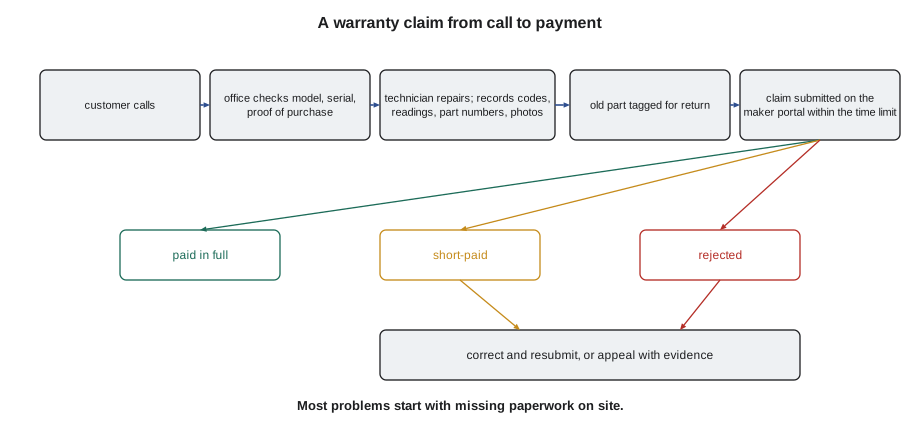
On Thursday, October 1, 2026, Ade Oyelowo submitted Penfold's September batch of warranty claims to the three brands for which Penfold is a factory-authorized servicer. There were 62 claims. Ade checked each one before sending it: the model and serial number, the customer's proof of purchase, the date of failure, the fault code and the technician's notes, the part numbers, and photos where the brand asks for them. By the end of October, 58 claims had been paid in full, three had been paid short because a part had been listed under the wrong revision number, and one had been rejected because the customer's proof of purchase was a photo of a box rather than a receipt. Ade corrected the three, appealed the fourth with a copy of the receipt that the customer found later, and added a line to the technicians' checklist: photograph the receipt, not the box.
This lesson explains the kinds of warranty that cover appliances, how warranty service works for an authorized servicer, how extended service plans differ, what the law says about warranties in Ontario and Canada, and how Penfold's own labour warranty works.
Kinds of warranty
Four kinds of promise can cover a repaired or new appliance, and customers often confuse them:
- The manufacturer's warranty comes with a new appliance. A typical warranty covers parts and labour for one year, with longer coverage on some parts: sealed-system parts of refrigerators, direct-drive washer motors and some compressors are often covered for five or ten years, sometimes for the part only (typical; each brand's warranty card governs).
- An extended service plan (often called an extended warranty) is a separate contract the customer buys from a retailer, a maker or a third-party company. It is really a service contract: the plan's administrator pays for covered repairs during the plan period, under its own rules.
- The repair warranty is the promise a service company makes about its own work. Penfold's is a 90-day labour warranty on every repair, plus whatever warranty the part's maker gives on the part.
- Statutory or implied warranties are rights given by law rather than by a written promise, discussed below.
Explaining which promise applies, and what it covers, prevents many arguments. A customer whose new dishwasher fails in month eleven is covered by the maker; the same customer whose six-year-old dishwasher fails a month after Penfold replaced its pump is covered by Penfold only if the pump repair is the cause.
Warranty service as an authorized servicer
A factory-authorized servicer has an agreement with a maker to do warranty repairs on its products in a territory. The maker pays the servicer for each covered repair, supplies warranty parts, and sets the rules for claims. Penfold is authorized for three brands, which brings it steady work, training (such as the electronics day with Ines Quillfeather in APP-320), access to the makers' service portals, and customers who later call Penfold back for out-of-warranty work.
Warranty work has strict paperwork. The maker usually needs:
- the model and serial number, which also prove the build date;
- proof of purchase showing the date and the seller, because the warranty runs from the purchase or installation date, not the build date;
- the fault as the customer described it, the technician's diagnosis, fault codes and any test readings;
- the parts used, by the maker's part number and revision, and the return of the old parts if the maker asks for them;
- photos of the model plate, the failed part or the installation, when the maker's rules call for them;
- the claim submitted within the maker's time limit, often a few weeks after the repair.
Makers pay a labour allowance for each kind of repair, set in their own rate schedule, rather than the servicer's normal prices. The allowance is often lower than what the servicer would charge a paying customer, which servicers accept because of the volume, the training and the parts support. A claim with a missing serial number, a wrong part revision or no proof of purchase may be short-paid or rejected, so the technician's paperwork on site directly affects what the company is paid.
Worked problem
What a warranty repair pays
A maker pays Penfold a sample labour allowance of 75 dollars plus a 40 dollar trip allowance for replacing a refrigerator evaporator fan motor under warranty; the part is supplied free. For the same repair on a paying customer, Penfold would charge its 95 dollar service call plus its 110 dollar flat rate for a fan motor, plus the part. How much less does Penfold receive for its time on the warranty job?
Show solution
- Warranty payment for labour and travel:
- \[75 + 40 = 115\]
- Normal charge for the same visit and labour:
- \[95 + 110 = 205\]
- Difference:
- \[205 - 115 = 90\]
Answer: Penfold receives 90 dollars less for its time on the warranty job (sample figures). That is why accurate paperwork matters: a rejected claim turns a low-paying job into an unpaid one.
Worked problem
A month of claims
Of 62 claims Ade submitted for September, 58 were paid in full. What share was paid in full, and what share needed follow-up?
Show solution
- Paid in full:
- \[58 \div 62 \approx 0.935\]
- Needing follow-up:
- \[4 \div 62 \approx 0.065\]
Answer: About 93.5 in 100 were paid in full and about 6.5 in 100 needed follow-up. Ade tracks the reasons each month; most come from missing or unclear paperwork on site.
Extended service plans
Extended service plans work differently from manufacturer warranties. Each plan is run by an administrator, which decides whether a repair is covered, which servicers it uses and what it pays. Penfold accepts work from several administrators. The rules that matter most on site are:
- Authorization first. Most plans require the servicer to call or log the repair and receive an authorization number before doing covered work; work done without one may not be paid.
- Deductibles and exclusions. Some plans charge the customer a deductible per visit, and most exclude damage, cosmetic parts, consumables such as filters and bulbs, and faults caused by installation or misuse.
- Plan rates. The administrator pays its own rates, which are often below Penfold's normal prices.
- The customer's contract. The customer holds the plan contract, and the details vary; when in doubt, Fenna asks the customer to read the coverage section or calls the administrator.
Technicians should never promise that a plan will pay. The honest answer is "I'll do the diagnosis and the office will confirm coverage with your plan before we do the repair."
What the law says in Canada and Ontario
In Ontario, the Sale of Goods Act implies conditions into sales of goods, such as that goods sold by a dealer are of merchantable quality and reasonably fit for a purpose the buyer made known. The Consumer Protection Act, 2002 makes these implied conditions apply to consumer sales and leases and says they cannot be waived. The same Act also deems a business to warrant that services it supplies, including repairs, are of a reasonably acceptable quality. A written warranty from a maker or service company adds to these rights; it does not take them away.
These laws are mostly about the seller and the maker, but they affect the service technician in two ways. First, customers sometimes have rights beyond the written warranty, and a technician should never tell a customer they have no rights just because the warranty card has expired; the office handles those questions. Second, a service company's own work must be of acceptable quality, whatever its written repair warranty says.
Penfold's labour warranty and callbacks
Penfold guarantees its labour for 90 days on every repair. If the same fault returns within 90 days because of the repair, the return visit and the labour are free, and the part is replaced under its maker's warranty. If a different part fails, the visit is a new call, though Harriet often waives the service call for a customer seen recently. A return visit within the warranty is called a callback, and Penfold counts callbacks for each technician each month as a measure of repair quality.
Callbacks are expensive: an unpaid trip, an unhappy customer and a van that could have been earning elsewhere. Most can be prevented by finding the cause as well as the failed part (a burned terminal and the loose connection that burned it, as in APP-120), running the appliance through a full cycle before leaving, and explaining to the customer what to watch for.
Recalls and service bulletins
Makers and regulators issue recalls when a product has a safety defect, and makers issue service bulletins for known problems and approved fixes. A recall usually means the maker will repair or replace the product free, sometimes through authorized servicers such as Penfold. A service bulletin may extend coverage for a known fault, or simply tell technicians the cause and the updated part, as the dishwasher door latch bulletin in APP-110 did.
In Canada, Health Canada publishes consumer product recalls on its recalls and safety alerts website, and makers notify registered owners. Technicians should check the model and serial against current recalls when an appliance has a safety-related fault and tell the customer if a recall applies.
A recalled appliance is not repaired outside the recall program. The technician explains the recall, gives the customer the maker's contact details or registers the claim if Penfold is authorized, and, if the appliance is unsafe, leaves it disconnected and records the advice.
Explaining coverage to customers
Customers often assume that any fault on an appliance less than a few years old is covered, or that an extended plan pays for everything. A short, clear explanation at the start of the visit avoids disappointment:
- "Your dishwasher is ten months old, so it's under the maker's one-year warranty. If the fault is covered, the maker pays for the parts and my time."
- "Your plan covers repairs to the refrigerator itself, but not food loss or the water filter. I'll confirm the coverage with them before doing the repair."
- "The maker covers the compressor itself for ten years, but not the labour after the first year, so there would be a labour charge."
When something is not covered, the technician explains why, in plain words, and the office handles any disagreement with the maker or plan.
Worked problem
A plan with a deductible
An extended plan pays Penfold a sample 165 dollars for a covered washer repair and requires the customer to pay a 75 dollar deductible. Penfold's normal price for the same visit and repair would be 95 dollars for the service call plus 160 dollars, or 255 dollars. How much does Penfold receive in all, and how does it compare with the normal price?
Show solution
- Received from the plan and the customer:
- \[165 + 75 = 240\]
- Normal price:
- \[95 + 160 = 255\]
- Difference:
- \[255 - 240 = 15\]
Answer: Penfold receives 240 dollars, 15 dollars less than its normal price (sample figures). The customer pays only the 75 dollar deductible instead of 255 dollars, which is what the plan was for.
Penfold's warranty records
Every warranty and plan job leaves a trail that Ade keeps for as long as the makers' agreements and the tax rules require: the claim, the maker's payment advice, the return shipping record for parts sent back, and any appeal. Those records answer the questions that come up months later, such as a customer who says a repair was promised free, a maker that audits a servicer's claims, or a part that fails again under its own parts warranty.
Makers do audit their servicers. An audit compares claims with the parts returned, the photos, and the patterns across many claims, looking for repairs that were not needed, parts claimed but not fitted, or labour claimed twice. A servicer with poor records can lose its authorization, and a dishonest claim is fraud. Penfold's rule is simple: claim exactly what was done, with the evidence, and nothing else.
The same honesty applies to the customer. A technician should never suggest that a customer describe an out-of-warranty fault, or damage, as something it was not, to get it covered. If a maker or plan refuses a claim that Penfold believes is covered, the office appeals with the evidence; if the refusal stands, Fenna tells the customer the outcome and their choices, including paying for the repair themselves at Penfold's normal price.
Common mistakes
MistakeAccepting a photo of the appliance's box as proof of purchase.
InsteadPhotograph or copy a receipt or invoice showing the date and seller.
MistakeDoing an extended-plan repair before receiving an authorization number.
InsteadLog the repair and get authorization first, or the plan may not pay.
MistakeListing a part without its revision number on a warranty claim.
InsteadRecord the exact part number and revision used.
MistakeTelling a customer they have no rights because the warranty card has expired.
InsteadRefer warranty and rights questions to the office.
MistakeTreating every return visit as free.
InsteadThe labour warranty covers the same fault caused by the repair; a different failure is a new call.
Summary and key terms
- Manufacturer warranties, extended service plans, repair warranties and statutory warranties are different promises.
- Authorized servicers do warranty repairs under the maker's rules and receive its labour allowances, often below normal prices.
- Warranty claims need the model, serial, proof of purchase, fault details, exact part numbers and photos, within a time limit.
- Extended service plans are run by administrators that require authorization, set their own rates and exclusions, and may charge deductibles.
- Ontario law implies quality conditions into consumer sales and deems services to be of reasonably acceptable quality.
- Penfold's 90-day labour warranty covers the same fault caused by its repair; callbacks are counted as a quality measure.
- Factory-authorized servicer
- A service company that does warranty repairs for a maker under an agreement.
- Labour allowance
- The amount a maker or plan pays for a covered repair, set in its own rate schedule.
- Proof of purchase
- A receipt or invoice showing the date and seller of the appliance.
- Extended service plan
- A separately purchased contract that pays for covered repairs after or beyond the maker's warranty.
- Authorization number
- The approval code an administrator issues before a covered repair is done.
- Callback
- A return visit for the same fault within the repair warranty.
- Short-paid claim
- A warranty claim paid for less than the amount claimed.
Practice problems
Work each problem on paper first, then reveal the answer to check.
What does a maker's warranty usually run from?
Show answer
The purchase or installation date, shown by proof of purchase.
Why do authorized servicers accept labour allowances below their normal prices?
Show answer
For the volume of work, training, parts support and future customers.
What must a technician get before an extended-plan repair?
Show answer
An authorization number from the plan administrator.
If 58 of 62 claims are paid in full, what share is that?
Show answer
About 93.5 in 100.
What does Penfold's 90-day labour warranty cover?
Show answer
A return of the same fault caused by the repair: the visit and labour are free.
Lesson quiz · 5 questions
Score 60% or more to complete this lesson.
Create a free account to save your progress, take quizzes and earn a certificate.