
APP-410 · Lesson 11 of 12 · 25 min
Starting your own service business
▶ Video coming soon A video version of this lesson is on the way.
On Thursday, October 8, 2026, Harriet met Bastien Rennick for coffee. Bastien had worked at Penfold for twelve years, became a journeyperson there, and in April 2024 left to start Rennick Appliance Repair, a one-van business working the west end of the city. Harriet had helped him plan it, and Penfold now sends him laundry calls in his area when its own board is full. He brought his first two years of figures. In his first six months he had nearly run out of money: he had underpriced his service call, spent too much on tools he rarely used, and forgotten that the sales tax he collected was not his to spend. By the end of 2025 he was steady, averaging about four calls a day, and he had just hired his first part-time helper. "The repairs were never the hard part," he told her. "Everything else was."
This lesson is for technicians who may one day want to run their own appliance service business. It covers the choices of business structure, the registrations, licences and insurance needed in Ontario, the costs of starting, how to work out a break-even point and a price, and the habits that keep a small business alive in its first years.
Is it the right move?
Running a service business is a different job from being a technician. The owner of a one-van business still does the repairs, but also answers the phone, books and routes calls, orders parts, prices work, chases unpaid bills, keeps the books, files taxes, buys insurance, markets the business and handles every complaint personally. The rewards can be good: independence, the full profit of the work, and a business that may be worth something one day. The risks are real: irregular income, long hours, no paid holidays, and personal savings at stake.
Bastien's advice to anyone thinking about it was to work for a good company first, long enough to learn how it runs its office as well as its repairs, to save at least six months of living costs, and to write the plan down before spending anything.
Choosing a business structure
The main structures in Ontario are:
- A sole proprietorship: the simplest. The owner and the business are the same legal person, profits are taxed as the owner's income, and the owner is personally responsible for the business's debts.
- A partnership: two or more owners sharing profits and responsibility, ideally under a written partnership agreement.
- A corporation: a separate legal person, incorporated provincially under Ontario's Business Corporations Act or federally under the Canada Business Corporations Act. It can limit the owner's personal responsibility for business debts and may have tax advantages as profits grow, but it costs more to set up and requires more record-keeping and separate tax returns.
Limited liability does not protect an owner from responsibility for their own careless work, and banks often ask small-business owners for personal guarantees anyway, so insurance remains essential. Bastien started as a sole proprietor and plans to change structure once his profits grow; an accountant's advice at the start costs little and avoids expensive mistakes.
Registrations and licences
A new appliance service business in Ontario typically needs:
- Business name registration: a sole proprietor who trades under any name other than their own legal name registers it under Ontario's Business Names Act, through the Ontario Business Registry.
- A business number from the Canada Revenue Agency, with a GST/HST account once taxable sales pass 30,000 dollars (lesson 8), or earlier by choice so that input tax credits can be claimed; and payroll accounts once the first employee is hired.
- WSIB registration before hiring workers; sole proprietors without workers can often choose whether to buy coverage for themselves, depending on the industry.
- Trade credentials: Ontario's appliance service technician trade is voluntary, but customers, makers and insurers value the Certificate of Qualification. An ODP card is needed to handle halocarbon refrigerants, and gas work needs the appropriate TSSA certificate; Bastien does no gas work and refers it to a gas technician.
- Local rules: Hamilton licenses a number of trades and businesses under its licensing by-laws. Bastien checked with the city's licensing office whether his business needed a licence before opening, and anyone starting should do the same, because the categories change.
- Brand authorization, if wanted, applied for with each maker once the business can meet its training, parts and claim requirements.
Insurance and banking
A new business needs the same core insurance as Penfold (lesson 8): general liability, commercial auto for the van, coverage for tools and parts, and coverage for customers' goods if bench repairs are done. Many customers, property managers and makers will not hire a business without proof of liability insurance. Disability insurance is worth considering for an owner-operator, because the business stops if the owner cannot work.
A separate business bank account, from the first day, keeps business and personal money apart, makes the books far easier, and shows lenders and tax authorities a clean record. A second account for sales tax collected, as Celia advises Penfold, prevents the mistake Bastien made in his first year.
Start-up costs and the money to survive
Worked problem
Start-up costs
Bastien's sample start-up costs were: van down payment 6,000 dollars, tools and meters 7,500, first truck stock 5,000, software, phone and website 1,500, first insurance payment 1,200, and launch marketing 1,000. What was the total?
Show solution
- Total:
- \[6{,}000 + 7{,}500 + 5{,}000 + 1{,}500 + 1{,}200 + 1{,}000 = 22{,}200\]
Answer: About 22,200 dollars before the first call (sample figures), plus a reserve for living costs while the business builds up. Bastien's regret was the tools: he bought specialist tools he used twice in a year and could have borrowed or bought later.
The reserve matters more than most new owners expect. Work builds slowly, customers pay after the work is done, makers pay warranty claims weeks later, and the first months bring unexpected costs. A business can be profitable on paper and still fail because it runs out of cash.
Break-even and pricing
The break-even point is the amount of work needed to cover all the costs, including a living wage for the owner. It starts from two figures: the fixed costs each month, which do not change with the number of calls, and the contribution of each call, the money left from the average invoice after the costs that rise with each call, such as parts, card fees and fuel.
Worked problem
How many calls to break even
Bastien's sample monthly fixed costs are: van lease 650 dollars, insurance 310, phone and software 180, tool replacement 150, accounting 120 and marketing 400. He wants to pay himself 4,500 dollars a month. His average invoice is 215 dollars before tax, of which parts cost 55, card fees 5 and fuel 12. How many calls a month must he complete to break even, and how many is that per working day in a 21-day month?
Show solution
- Fixed costs:
- \[650 + 310 + 180 + 150 + 120 + 400 = 1{,}810\]
- With the owner's pay:
- \[1{,}810 + 4{,}500 = 6{,}310\]
- Contribution per call:
- \[215 - 55 - 5 - 12 = 143\]
- Break-even calls per month:
- \[6{,}310 \div 143 \approx 44.1\]
- Per working day:
- \[45 \div 21 \approx 2.1\]
Answer: About 45 calls a month, or just over 2 a day (sample figures). At his current four a day, about 84 calls a month, Bastien covers his costs and his pay with roughly 5,700 dollars to spare before income tax, which pays for slow months, van replacement and growth.
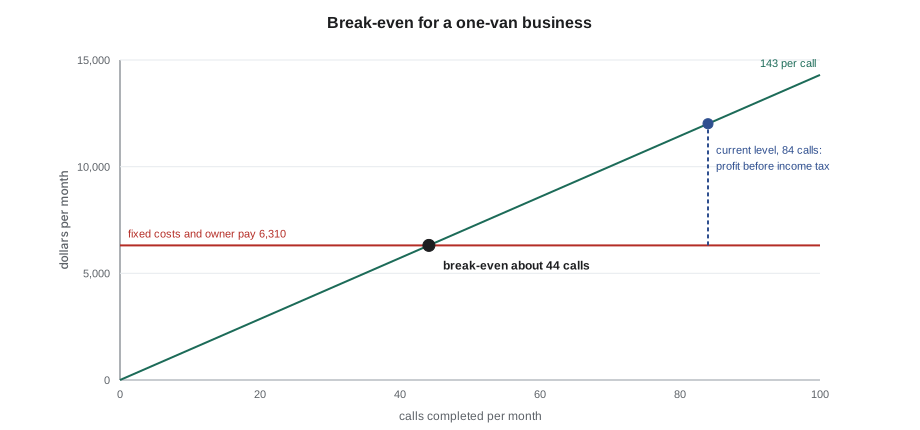
His early mistake was setting his service call well below what the area's established companies charged, hoping to win customers on price. He won the customers, but with so little contribution per call that he needed far more calls than he could do. Pricing starts from costs and the break-even point (lesson 6), then checks the market, not the other way round.
Habits that keep a small business alive
- Keep the books every week, not every quarter, and look at the numbers: calls, average invoice, cash in the bank, unpaid invoices.
- Put the sales tax and an amount for income tax aside from every payment.
- Take payment at the job and follow up unpaid invoices quickly.
- Answer the phone, or return calls within a few hours; a missed call is often a lost customer.
- Do excellent work and ask every customer for an honest review (lesson 10).
- Build relationships with other companies; Bastien's overflow work from Penfold is a steady part of his income, and he sends Penfold the gas work he does not do.
- Keep learning: makers' training, new appliance technology, and the business skills in this course.
Growing: the first employee
Bastien's first part-time helper, hired in the fall of 2026, changed his business more than any tool. With someone answering the phone and booking calls part of the day, he could spend more of his own time on repairs. But an employee brings new obligations: wages and payroll deductions on a schedule, WSIB coverage, employment standards for hours, overtime and holidays, a workplace harassment policy, training, and the employer's share of payroll costs. The true cost of an employee is well above the wage.
Worked problem
What a part-time helper costs
Bastien's helper works 20 hours a week at 21 dollars an hour, and payroll costs and other employment costs add about 15 in 100. What does the helper cost per year, over 52 weeks?
Show solution
- Weekly wage:
- \[20 \times 21 = 420\]
- With employment costs:
- \[420 \times 1.15 = 483\]
- Per year:
- \[483 \times 52 = 25{,}116\]
Answer: About 25,100 dollars a year (sample figures). At 143 dollars of contribution per call, that is about 176 extra calls a year, or less than one more call a day, that the helper must make possible by freeing Bastien's time. If the helper lets him finish one more call each working day, the hire pays for itself.
Buying an existing business
Instead of starting from nothing, some technicians buy an existing service business when its owner retires. That brings customers, a phone number people already know, maker authorizations (if the makers agree to transfer them), staff and equipment, but it also brings the old business's reputation, debts and commitments. A buyer needs the business's financial statements for several years, an independent valuation, a lawyer to check what is being bought, and the maker and landlord agreements in writing. Harriet bought Penfold from her father over several years, a common way to make a sale affordable for the buyer.
Planning for the long run
A small business plan does not need to be long, but it should be written: the services offered and those not offered, the area served, the prices and how they were set, the start-up budget and reserve, the break-even point, the marketing plan, and a few goals for the first year, such as calls per day and the number of reviews. Bastien reviews his plan every six months. The figures in it, more than any feeling about how busy he is, tell him when to raise prices, when to hire and when to say no to work outside his area.
Harriet's last piece of advice to Bastien, which she passes on to every technician who asks about going out on their own, was to keep good relationships with former employers and competitors. The appliance service trade in any city is small; the company you leave may be the one that sends you overflow work, buys your business when you retire, or hires you back if things do not work out.
Every business owner eventually leaves the business, by selling it, passing it to family or staff, or closing it. Planning for that day early, with clean records, documented procedures, good staff and steady customers, is what gives a small business a value someone else will pay for. Gus Penfold planned his handover to Harriet for ten years; Bastien, two years into his business, has already started keeping the kind of records a buyer would want to see.
For many technicians, the best path is to stay with a good employer and grow into a senior technician, a trainer, a service manager or a partner. The business skills in this course are just as valuable there as they would be in a business of their own.
Common mistakes
MistakeStarting a business without a cash reserve.
InsteadSave several months of living costs and plan for slow payment.
MistakeSpending the sales tax collected.
InsteadKeep it in a separate account until the return is filed.
MistakeSetting prices below the market to win customers.
InsteadPrice from costs and the break-even point, then check the market.
MistakeBuying every specialist tool before the first call.
InsteadBuy what the work needs now and add tools as the work grows.
MistakeAssuming a corporation or LLC removes the need for insurance.
InsteadLimited liability does not cover the owner's own careless work; insure the business.
Summary and key terms
- Owning a service business means doing the office work as well as the repairs, with more freedom and more risk.
- Sole proprietorships are simplest; corporations limit personal liability but cost more to run.
- A new business registers its name, gets a CRA business number, registers for HST when required, and checks WSIB and Hamilton's licensing rules.
- Liability, auto, tools and goods insurance, and a separate business bank account, are needed from the start.
- Start-up costs are only part of the money needed; a cash reserve carries the business through slow early months.
- Break-even calls = (fixed costs + owner's pay) ÷ contribution per call; price from costs, then check the market.
- Weekly books, tax set aside, prompt payment, quick replies, good work and good relationships keep a small business alive.
- Sole proprietorship
- A business owned by one person, who is personally responsible for its debts.
- Limited liability
- Protection of an owner's personal assets from most of the business's debts.
- Fixed costs
- Costs that stay the same each month regardless of how many calls are done.
- Contribution
- What is left from each sale after the costs that rise with each sale.
- Break-even point
- The amount of work at which income equals all costs, including the owner's pay.
- Cash reserve
- Money set aside to pay costs while income is low or late.
Practice problems
Work each problem on paper first, then reveal the answer to check.
What does an owner-operator do besides repairs?
Show answer
Booking, routing, ordering, pricing, collecting, bookkeeping, taxes, insurance, marketing and complaints.
What must an Ontario sole proprietor do before trading under a name other than their own?
Show answer
Register the name under the Business Names Act.
Fixed costs and pay total 6,310 dollars a month and each call contributes 143 dollars. What is the break-even?
Show answer
About 44.1, so 45 calls a month.
Why can a profitable business still fail?
Show answer
It can run out of cash while waiting for payments or covering early costs.
Why did Bastien's low service call charge cause trouble?
Show answer
It left so little contribution per call that he needed more calls than he could do.
Lesson quiz · 5 questions
Score 60% or more to complete this lesson.
Create a free account to save your progress, take quizzes and earn a certificate.