
APP-410 · Lesson 12 of 12 · 24 min
A day of service calls
▶ Video coming soon A video version of this lesson is on the way.
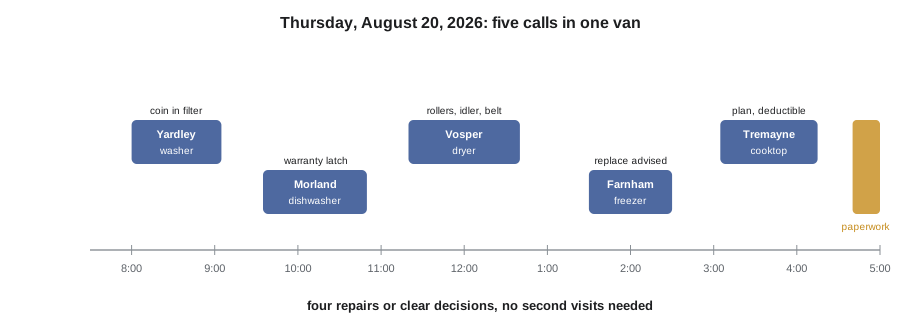
This lesson follows one full working day, Thursday, August 20, 2026, from Dee's case files and Fenna's board, and uses it to bring together everything in the course: booking, arrival, explanation, estimates, repair-or-replace advice, warranty and extended-plan rules, parts, pricing, payment, records, conduct in homes and reviews. Dee worked alone that day in her van. She had five calls, all booked by Fenna with model numbers and photos of the rating plates, grouped in the east Mountain and lower city east.
7:30 a.m.: before the first call
Dee's day started at the parts counter. Ade had restocked her van from the previous day's work orders and staged two parts Fenna's bookings had flagged: a door latch assembly for a dishwasher under warranty and a set of drum rollers and an idler pulley for an older dryer. Dee checked the board on her tablet: five calls in four two-hour windows, with Fenna's buffer after the dryer call because it was booked as a bearing-type noise. She checked her drop cloths, shoe covers, towels and her meter's battery, and left at 7:45.
| Window | Customer | Appliance and complaint | Booking notes |
|---|---|---|---|
| 8 to 10 | Florence Yardley, Inch Park | Washer, will not drain | Model photo; small dog, will be shut away |
| 8 to 10 | Ralph Morland, Kennedy | Dishwasher, door will not latch | Under maker's warranty, 10 months old; receipt on file |
| 10 to noon | Edwin Vosper, Riverdale | Dryer, loud squeal | 15 years old; buffer after this call |
| noon to 2 | Delphine Farnham, Beasley | Upright freezer, warm | Food moved to a neighbour's freezer; priority |
| 2 to 4 | Imelda Tremayne, Stipley | Radiant cooktop element, no heat | Extended service plan; plan details on file |
8:00: the washer that would not drain
Dee texted Mrs. Yardley at 7:40 that she was on her way, and arrived at 8:00. The dog was already in the yard. Dee introduced herself, put on shoe covers, laid a drop cloth and towels, and asked Mrs. Yardley to tell her what had happened. The washer had stopped halfway through a cycle the day before, full of water, and showed a drain fault. Dee drained it through the drain pump filter at the front, catching the water in a pan, and found a coin and a hair clip in the filter, jamming the pump impeller. With them removed, the pump ran freely and the washer drained and spun normally through a test cycle.
No part was needed. Dee showed Mrs. Yardley the coin and the clip, explained how to clean the filter herself every few months and how to check pockets before washing, and charged only the 95 dollar service call, 107.35 dollars with HST. She mentioned that a survey would arrive that evening with a link for a review, and left at 9:05. Lesson links: explanation in plain words (lesson 1) and a fair charge that the customer had been told about when booking (lesson 6).
9:35: a warranty dishwasher
Mr. Morland's ten-month-old dishwasher would not latch; the door sprang open when closed. Dee confirmed the model and serial number against the warranty record, photographed the rating plate and Mr. Morland's purchase receipt, not the box, and recorded the fault and the latch's failed spring. She fitted the door latch assembly that Ade had staged, ran a short cycle, checked for leaks and that the door locked and unlocked correctly, and tagged the old latch with the work order number for return to the maker.
Mr. Morland paid nothing; the maker would pay Penfold its labour and trip allowance once Ade submitted the claim. Dee explained that the repair was under the maker's warranty and that the maker's parts warranty applied to the new latch. She left at 10:50, eight minutes later than planned, and sent Fenna a quick message, as Penfold's rules require when a day starts to slip. Lesson links: warranty paperwork (lesson 4) and staged parts that made a first-visit fix possible (lessons 5 and 7).
11:20: repair or replace a 15-year-old dryer
Mr. Vosper's dryer squealed loudly and had begun to smell hot. Dee found two worn drum rollers, a seized idler pulley and a glazed belt. The rest of the dryer was in good condition: the heating element, thermostats and thermal fuse tested good, the drum and cabinet were sound, and the vent, which Dee checked from the dryer to the outside hood, was rigid metal, short and clean.
Before doing anything, Dee wrote an estimate: the 95 dollar service call and 145 dollars for the rollers, idler, belt and labour from the flat-rate book, a total of 240 dollars before HST. Mr. Vosper asked whether he should just buy a new dryer. Dee gave him the facts: a comparable new dryer would cost about 850 dollars installed; the repair was well under half of that; the dryer was near the end of its typical life, but its other parts looked good and dryers of its simple design often run for years after a roller repair.
Worked problem
Repair or replace on the dryer call
The repair is 240 dollars before tax and a comparable new dryer is about 850 dollars installed. What fraction of the new price is the repair?
Show solution
- Fraction:
- \[240 \div 850 \approx 0.28\]
Answer: About 28 in 100 of the new price, well under half. With the rest of the dryer in good order, repair was the sensible choice, and Dee said so when asked.
Mr. Vosper chose the repair. Dee fitted the parts from her van, ran the dryer through a full timed cycle, measured the outlet temperature, and showed him the quiet drum. He paid 271.20 dollars by credit card, which cost Penfold about 6.78 dollars in card fees at the sample rate. Dee left at 12:40, inside Fenna's buffer.
1:30: a freezer at the end of its life
Mrs. Farnham's upright freezer was 17 years old and warm inside. Her food was already safe in a neighbour's freezer, which Fenna had suggested when booking. Dee found the compressor running continuously but drawing low current, frost only on the first few centimetres of the evaporator, and an oily spot where a refrigerant line passed behind the inner liner: a leak inside the cabinet walls, where it could not be reached.
Dee explained it plainly: the cooling system had lost its refrigerant through a leak inside the walls; fixing it would mean a sealed-system repair costing far more than half the price of a new freezer, on a freezer older than the usual life of such units, so she would not recommend it. Mrs. Farnham agreed. Dee charged the 95 dollar service call, 107.35 dollars with HST, and Fenna booked a haul-away through Quarrington Metal Recovery, with the refrigerant to be recovered first as APP-110 described. Dee recorded the readings, her advice and Mrs. Farnham's decision on the work order. Lesson links: an honest repair-or-replace conversation (lesson 3) and careful records (lesson 8).
3:05: an extended service plan
Mrs. Tremayne's radiant cooktop had one element that would not heat. Before diagnosing, Dee checked the plan details Fenna had recorded, and after finding the fault, an open radiant element with its limiter good, she phoned the plan administrator from the van. The administrator confirmed the element was covered and gave an authorization number, which Dee wrote on the work order. Only then did she fit a new element from her van stock and test every element and its switch.
The plan required the customer to pay a 75 dollar deductible per visit, which Mrs. Tremayne paid, and the administrator would pay Penfold its own rate for the rest. Dee explained to Mrs. Tremayne what the plan had covered and what the deductible was for, and left at 4:15. Lesson links: authorization before an extended-plan repair (lesson 4) and explaining charges clearly (lessons 2 and 6).
4:40: closing the day
Back at the shop, Dee closed every work order: findings, readings, photos, approvals, parts, payments and the advice given. She handed the tagged warranty latch to Ade, whose system had already added the day's used parts to her restock list. The survey texts went out automatically at 6 p.m.; by the next morning Mrs. Yardley and Mr. Vosper had both left five-star reviews, and Mr. Vosper's mentioned Dee by name, which Harriet thanked him for in a short reply.
Worked problem
What the day earned
Customers paid 95, 0, 240, 95 and 75 dollars before tax for Dee's five calls. The maker would pay a sample 115 dollars for the warranty call and the plan administrator a sample 180 dollars for the cooktop. Dee spent 350 minutes in customers' homes. What did the day earn before tax, and what is that per billable hour?
Show solution
- Paid by customers:
- \[95 + 0 + 240 + 95 + 75 = 505\]
- Total with the warranty and plan payments:
- \[505 + 115 + 180 = 800\]
- Billable hours:
- \[350 \div 60 \approx 5.83 \text{ h}\]
- Earned per billable hour:
- \[800 \div 5.83 \approx 137\]
Answer: About 800 dollars for the day before tax, or about 137 dollars per billable hour (sample figures), comfortably above the roughly 100 dollar cost of a billable hour in lesson 6. Two calls earned only the service call, and two paid below Penfold's normal prices, yet the day worked because the board was well planned, the parts were on the van and nothing had to be done twice.
What made the day work
Little of the day's success came from technical skill alone, although every repair needed it. It came from the business habits this course has described:
- Booking with model numbers, photos, warranty and plan details, which let Ade stage the right parts (lessons 5 and 7).
- Routing in one area with a buffer after the riskiest call (lesson 7).
- Arrival and explanation: call-ahead texts, shoe covers, listening, plain explanations, and the price before the work (lessons 1 and 2).
- Honest advice: repair for the dryer, replacement for the freezer, each with the facts behind it (lesson 3).
- Following the rules for warranty and plan work, so both would be paid (lesson 4).
- Clear pricing and payment, with every charge expected and collected at the job (lesson 6).
- Complete records closed the same day (lesson 8).
- Respect in the home: the dog secured, the floors protected, and nothing left behind (lesson 9).
- Reviews that came from real customers, invited honestly, and answered (lesson 10).
A technician who masters these habits is valuable to any employer, and is ready, like Bastien in lesson 11, to run a business one day.
The same day, done badly
It is worth imagining how the same five calls could have gone without those habits. Suppose the bookings had no model numbers: no parts would have been staged, so the dishwasher latch and the dryer rollers would each have needed a second visit, two return trips at about 112.50 dollars each (lesson 5) and two customers waiting days for a repair. Suppose Dee had not photographed the receipt: the warranty claim might have been rejected, turning a low-paying job into an unpaid one. Suppose she had fitted the cooktop element before calling the plan administrator: the plan might have refused to pay. And suppose she had recommended a new dryer to Mr. Vosper and repaired Mrs. Farnham's freezer: both customers would have spent money badly, and at least one would probably have said so in a review.
Worked problem
What the bad version would have cost
In the bad version, two calls need second visits at about 112.50 dollars each, and the 115 dollar warranty claim and the 180 dollar plan payment are both refused. How much less would the day have earned, or cost, compared with the good version?
Show solution
- Cost of two second visits:
- \[2 \times 112.50 = 225\]
- Payments lost:
- \[115 + 180 = 295\]
- Total difference:
- \[225 + 295 = 520\]
Answer: About 520 dollars worse (sample figures), on a day that earned 800 dollars, before counting the unhappy customers, the bad reviews and the slots on later days taken up by return visits. Most of the difference comes not from repair skill but from booking, paperwork and following the rules.
Dee's own summary, when Harriet showed this comparison at a staff meeting, was simple: "The repair is the easy part. Everything around it is what makes it a good day." That is the lesson of this course.
Kiran, who started at Penfold on October 19, will take this course in a later level of his apprenticeship, and Harriet plans for him to spend a full day in the office with Fenna and Ade before then, so that he sees how a day like August 20 looks from the other side of the board.
Common mistakes
MistakeStarting a warranty or plan repair before confirming coverage.
InsteadConfirm the warranty record or get the plan's authorization number first.
MistakeRecommending replacement for every old appliance.
InsteadWeigh the repair cost, age and condition; the 15-year-old dryer was worth repairing.
MistakeLeaving work orders to finish at the end of the week.
InsteadClose every work order the same day.
MistakeLetting a day slip without telling the office.
InsteadMessage the dispatcher as soon as a call runs over.
MistakeTreating service-call-only visits as wasted.
InsteadA clear diagnosis and honest advice are what the customer paid for.
Summary and key terms
- A well-booked board with staged parts made first-visit fixes possible on every repair call.
- Each call followed the same routine: call-ahead, introduction, protection, listening, explanation, estimate, approval.
- Repair-or-replace advice was given honestly, with numbers, and the customer decided.
- Warranty and extended-plan rules were followed so the company would be paid.
- Every charge was known in advance and collected at the job.
- Records were closed the same day, and reviews were invited honestly and answered.
- The day earned about 137 dollars per billable hour in the sample figures, because nothing had to be done twice.
- Board
- The day's schedule of calls for each van.
- Staged part
- A part placed on the van in advance for a booked call.
- Deductible
- The amount a plan holder pays per visit before the plan pays.
- Authorization number
- The code a plan administrator issues to approve a covered repair.
- Billable hours
- Hours spent on customers' jobs that are paid for.
- Haul-away
- Removal of an old appliance for recycling.
Practice problems
Work each problem on paper first, then reveal the answer to check.
What did Ade stage on Dee's van, and why?
Show answer
A dishwasher latch and dryer rollers and idler, because the bookings had model numbers and likely faults.
Why did Dee photograph Mr. Morland's receipt?
Show answer
The maker needs proof of purchase for the warranty claim; a receipt, not the box.
A 240 dollar repair against an 850 dollar new dryer is what fraction?
Show answer
About 0.28.
What must happen before an extended-plan repair?
Show answer
The administrator issues an authorization number.
The day earned 800 dollars in 5.83 billable hours. About what is that per hour?
Show answer
About 137 dollars.
Lesson quiz · 5 questions
Score 60% or more to complete this lesson.
Create a free account to save your progress, take quizzes and earn a certificate.