
APP-410 · Lesson 6 of 12 · 29 min
Pricing, invoicing and payment
▶ Video coming soon A video version of this lesson is on the way.
On Thursday, October 22, 2026, Harriet spent the afternoon at her desk with Penfold's 2026 figures, getting ready for the price review she plans to finish in December for January 2027. She started where she always starts: not with what competitors charge, but with what an hour of a technician's time really costs the company. When she had added up wages, payroll costs, the van, and each technician's share of the rent, insurance, software and office staff, the answer was a little over 100 dollars for every hour a technician spends on customers' jobs. Penfold's labour rate is 110 dollars an hour. "That's not much room," she wrote in her notes, "and it's the service calls and the flat-rate book that keep us healthy, not the hourly rate."
This lesson explains how service companies set prices, the difference between flat-rate and time-and-materials pricing, what a service call charge covers, the difference between markup and margin, what an invoice must show, how customers pay, and how to handle deposits and unpaid bills.
What a price has to cover
A price has to pay for far more than the technician's wage. Every hour a technician spends on a customer's job must also pay for the hours that are not billed (driving, restocking, training, callbacks), the payroll costs on top of wages, the van and its fuel, tools and test equipment, the office staff who book and invoice the calls, rent, insurance, software, advertising, and a profit that lets the company replace vans and survive a slow month. Underpricing is one of the commonest reasons small service companies fail.
Worked problem
What a billable hour costs
Use Penfold's sample figures for one technician. Wage 34 dollars an hour, with payroll costs and benefits adding 30 in 100. Paid hours 2,000 a year, of which 1,400 are billable (spent on customers' jobs). Van costs 14,000 dollars a year. The technician's share of overhead is 38,000 dollars a year. What does each billable hour cost?
Show solution
- Wage with payroll costs:
- \[34 \times 1.30 = 44.20 \text{ per paid hour}\]
- Yearly labour cost:
- \[44.20 \times 2{,}000 = 88{,}400\]
- Total yearly cost:
- \[88{,}400 + 14{,}000 + 38{,}000 = 140{,}400\]
- Cost per billable hour:
- \[140{,}400 \div 1{,}400 \approx 100.29\]
Answer: About 100 dollars for every billable hour, before any profit (sample figures). At 110 dollars an hour the margin is thin, so the service call charge and the flat-rate book, which reward efficient technicians, carry much of the profit.
Look at how much the billable share matters. If the same technician billed only 1,200 hours instead of 1,400, the cost per billable hour would rise to about 117 dollars, above the labour rate. Good routing (lesson 7), good parts stock (lesson 5) and few callbacks all raise the billable share.
Flat rate and time and materials
Service companies price repairs in two main ways:
- Time and materials charges for the actual time spent at an hourly rate, plus parts. It is simple and fair for unusual jobs, but the customer does not know the price in advance, and a slow technician costs the customer more than a fast one.
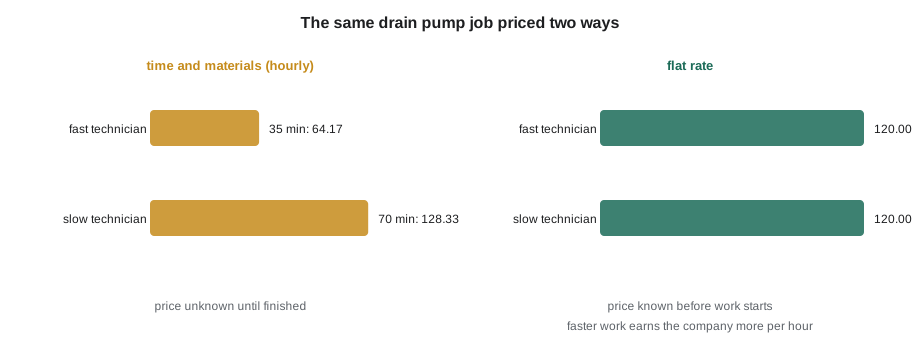
- Flat-rate pricing charges a set price for each common repair, from a flat-rate book, regardless of how long it takes on the day. The customer knows the price before the work starts, an efficient technician earns the company more per hour, and a slow day is the company's risk, not the customer's.
Penfold uses a flat-rate book for its common repairs, built from the average time each job takes, at its labour rate, and reviewed every year. For jobs not in the book, such as sealed-system repairs or unusual faults, it estimates hours at the labour rate. APP-110 showed the effect on a drain pump job: at the 120 dollar flat rate, Dee's usual 35 minutes earns the company far more per hour than Kiran's first 70 minutes, but the customer pays the same either way.
The service call charge
Penfold charges a service call of 95 dollars on every visit. It covers the trip to the home and the diagnosis, and it is charged whether or not the customer goes ahead with the repair, because the technician's time and the van's cost are the same either way. Customers are told the charge when they book, again on arrival, and it appears as its own line on the estimate and the invoice. Some companies credit part of the service call against the repair; Penfold keeps them separate and keeps the flat rates lower instead. Either approach is fair if it is explained before the visit.
Other charges are set the same way: a haul-away fee for removing an old appliance, an after-hours charge for evening and weekend emergency calls, and a trip charge for return visits to a distant area. Each is listed in Fenna's booking script so customers hear it first.
Markup and margin
Parts are priced above their cost to pay for ordering, stocking, returns, warranty handling and parts that are lost or damaged. Two words describe the difference between cost and price, and they are easily confused:
- Markup is the profit as a share of the cost.
- Margin is the profit as a share of the price.
Worked problem
Markup and margin on a part
A part costs Penfold 60 dollars and is sold for 100 dollars. What are the markup and the margin?
Show solution
- Profit on the part:
- \[100 - 60 = 40\]
- Markup, profit as a share of cost:
- \[40 \div 60 \approx 0.667\]
- Margin, profit as a share of price:
- \[40 \div 100 = 0.40\]
Answer: A markup of about 67 in 100 is the same as a margin of 40 in 100. Anyone setting prices must know which one they mean; a company that aims for a 40 in 100 margin but adds a 40 in 100 markup earns only about 29 in 100 margin.
Penfold prices most parts from the distributor's suggested list price, which is set to give a reasonable margin. Ade checks the list against Penfold's cost each quarter.
What the invoice shows
The invoice is the customer's record and the company's proof of what was done and paid. Penfold's invoices show the company's name, address and phone; the date and invoice number; the customer and the appliance; the work done and each charge; parts by description and whether genuine or aftermarket; the subtotal, the tax and the total; the warranty; the payment received and how; and the technician's name.
Because Penfold is registered for HST, its invoices also show its GST/HST registration number. Business customers need it to claim input tax credits: for purchases of 100 dollars or more, the invoice must show the supplier's registration number and the tax charged, and for purchases of 500 dollars or more it must also show the buyer's name, a description and the terms of payment.
Worked problem
Adding tax to an invoice
An invoice for a repair totals 297 dollars before tax. What is the total with 13 in 100 HST?
Show solution
- Tax:
- \[297 \times 0.13 = 38.61\]
- Total:
- \[297 + 38.61 = 335.61\]
Answer: 335.61 dollars, the same total as Mrs. Marchbanks's repair in lesson 2.
Taking payment
Penfold takes payment at the end of each completed call, on the technician's tablet: debit and credit cards, tap payments, and e-transfer or cheque for customers who prefer them. Card payments cost the company a processing fee, typically about 2 to 3 in 100 of the payment for credit cards and less for debit (typical; rates depend on the processor and the card).
Worked problem
The cost of a card payment
A customer pays a 335.61 dollar invoice by credit card. At a sample processing rate of 2.5 in 100, what does the payment cost Penfold?
Show solution
- Fee:
- \[335.61 \times 0.025 \approx 8.39\]
Answer: About 8.39 dollars. Card fees add up over thousands of calls, which is why they belong in the overhead used to set prices.
Since 2022, card network rules have allowed Canadian businesses outside Quebec to add a surcharge for credit card payments, within a cap and with clear notice before payment, and some provinces have their own rules. Penfold has decided not to surcharge; its prices already include card costs.
Deposits protect the company on special-order parts. Penfold asks for a deposit equal to the part's price on control boards, sealed-system parts and any part the distributor will not take back, explained on the estimate and refunded if the part cannot be obtained.
Unpaid bills are rare when payment is taken at the job, but they happen: a declined card, a customer who was not home, a business customer on account. Fenna sends a reminder after 15 days and a second after 30, and phones before anything stronger. Harriet decides whether a bill goes to a collection agency or to small claims court; technicians never argue about payment in the home.
Discounts and fairness
Customers sometimes ask for a discount, and some discounts make sense: a published discount for older customers, a reduced service call when a customer has two appliances looked at in one visit, or a waived service call after a company mistake. Penfold's rule is that discounts are published or approved by the office, applied the same way to everyone who qualifies, and shown on the invoice. Technicians do not invent discounts on the doorstep. A discount given to one customer and refused to the next damages trust and, when customers compare notes, the company's reputation.
Harriet also refuses to compete on price alone. A company that cuts its service call to win customers either loses money or cuts corners, as Bastien found (lesson 11). Penfold competes on punctuality, explanation, first-visit fixes and honest advice, and prices to cover its real costs.
Updating the price book
Costs rise every year: wages, parts, fuel, insurance and software. Penfold reviews its flat-rate book and its service call charge once a year, in December, for the coming January, using the year's figures. Harriet checks the cost of a billable hour, the average time each common job actually took (from the work orders), parts prices, and the prices of established competitors. Changes are announced on the website and in Fenna's booking script from the first day they apply, and estimates given before the change are honoured.
Worked problem
The effect of a price increase
Penfold's average labour charge per completed call is about 115 dollars, on about 4,600 calls a year. If Harriet raises the labour rate and flat rates by 4 in 100, and the number of calls stays the same, how much more labour revenue would that bring in a year?
Show solution
- Increase per call:
- \[115 \times 0.04 = 4.60\]
- Increase per year:
- \[4.60 \times 4{,}600 = 21{,}160\]
Answer: About 21,000 dollars more a year (sample figures), which would roughly cover a 4 in 100 rise in wages and costs. Small annual increases are easier for customers to accept than large increases after several years without one.
When a customer says another company is cheaper, the technician does not argue or criticize the competitor. The honest reply is to explain what Penfold's price includes, such as the labour warranty, genuine parts and a technician who will explain everything, and to leave the choice to the customer.
Payment problems at the door
Most payment problems at the job have simple causes and calm solutions. A card is declined: the technician asks whether the customer has another card or would prefer an electronic transfer, and if not, Fenna phones the next day. The customer disputes a line on the invoice: the technician goes through the estimate and the approvals recorded on the work order, and if the disagreement remains, says the office will review it and phone, rather than arguing. The customer asks to pay later: Penfold's policy allows it only for business customers with an account, or with Harriet's approval, because unpaid invoices are expensive to chase.
Technicians do not accept cash tips in place of an invoice payment, do not take cash without issuing a receipt, and never agree to a lower price for cash. Unrecorded cash payments create tax problems for the company and can look like the technician is keeping money that belongs to the business. Every payment, by any method, is recorded on the work order and the invoice.
Prices, invoices and payments are where customers decide whether a company is fair. A company whose prices are explained before the work, whose invoices match the estimate line by line, and whose technicians never surprise anyone at the end of a call earns trust that no discount can buy, and that trust is what keeps customers coming back year after year.
Common mistakes
MistakeSetting prices from competitors' prices alone.
InsteadStart from what a billable hour actually costs, then compare.
MistakeConfusing markup with margin.
InsteadMarkup is profit over cost; margin is profit over price.
MistakeTelling a customer about the service call charge only at the end.
InsteadSay it at booking, on arrival and on the estimate.
MistakeOrdering an expensive non-returnable part without a deposit.
InsteadTake a deposit on special-order parts that cannot be returned.
MistakeArguing about an unpaid bill in the customer's home.
InsteadLeave collection to the office.
Summary and key terms
- Prices must cover unbilled time, payroll costs, vans, overhead and profit, not just wages.
- A billable hour cost Penfold about 100 dollars in the sample figures; raising the billable share lowers that cost.
- Flat-rate pricing gives a known price and rewards efficiency; time and materials suits unusual jobs.
- The 95 dollar service call covers the trip and diagnosis and is charged whether or not the repair goes ahead.
- Markup is profit as a share of cost; margin is profit as a share of price.
- Invoices show the work, parts, tax and payment, and Penfold's GST/HST number.
- Card fees, deposits on special orders and a clear collection routine protect the company's cash.
- Billable hour
- An hour a technician spends on a customer's job that is paid for by the customer or a warranty.
- Time and materials
- Pricing by the hours actually worked plus parts.
- Flat-rate book
- A price list for common repairs, each at a set price.
- Service call charge
- A set charge for the trip and diagnosis.
- Markup
- Profit as a share of cost.
- Margin
- Profit as a share of the selling price.
- Processing fee
- The fee a card processor charges the business for each card payment.
- Deposit
- Part payment in advance, usually for a special-order part.
Practice problems
Work each problem on paper first, then reveal the answer to check.
Why does the billable share of a technician's hours matter so much to pricing?
Show answer
All the yearly costs are spread over the billable hours; fewer billable hours mean a higher cost per hour.
What is the markup on a part that costs 60 dollars and sells for 100 dollars?
Show answer
About 67 in 100.
What is the margin on the same part?
Show answer
40 in 100.
What does Penfold's service call charge cover?
Show answer
The trip to the home and the diagnosis, whether or not the repair goes ahead.
What does a 2.5 in 100 card fee cost on a 335.61 dollar invoice?
Show answer
About 8.39 dollars.
Lesson quiz · 5 questions
Score 60% or more to complete this lesson.
Create a free account to save your progress, take quizzes and earn a certificate.