
APP-410 · Lesson 7 of 12 · 25 min
Scheduling and routing service calls
▶ Video coming soon A video version of this lesson is on the way.
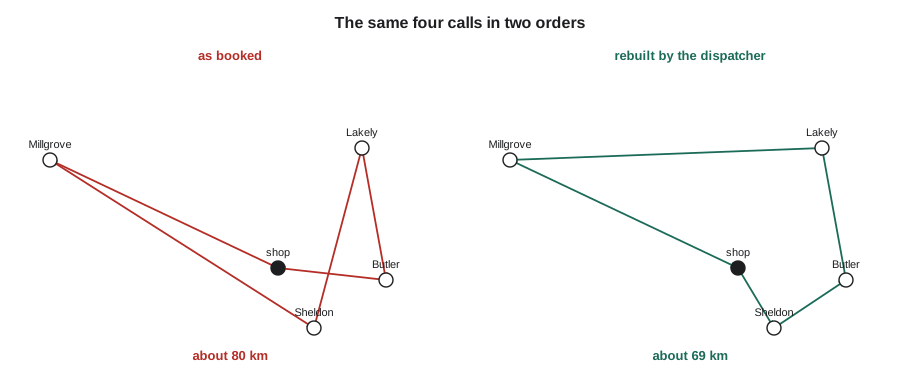
On the afternoon of Monday, September 7, 2026, a holiday, Fenna checked the next day's board from home, as she often does before a busy Tuesday. Hiro had four calls booked: a propane conversion of a new range for Rufus Calloway near Millgrove, in rural Flamborough, a dishwasher in Lakely, a gas dryer in Butler and a range in Sheldon. The calls had been booked in the order customers phoned, which would have sent Hiro out to Millgrove first, back across the city to the east Mountain, and then down to the lower city and back up: about 80 km of driving. Fenna phoned Mr. Calloway, who said an afternoon visit suited him better anyway, and rebuilt the day so that Hiro worked through the three city calls close to the shop first and drove out to Millgrove last. The new route was about 69 km. On Tuesday Hiro finished the conversion, tested and labelled the range as APP-230 described, and was back at the shop before four.
This lesson explains how a service company books calls into windows, groups them by area, orders each technician's day, decides which calls are urgent, and measures how well its scheduling works. Good scheduling is invisible to customers when it works and the first thing they notice when it does not.
Booking calls well
Scheduling starts when the customer phones. Fenna's booking script collects everything the technician needs, because a well-booked call is half-diagnosed:
- The customer's name, address, phone and the best way to reach them on the day.
- The appliance type, brand, model and serial number (Fenna asks the customer to read them from the plate, or to text a photo), and its age.
- The complaint in the customer's words, any fault code, and what has already been tried.
- Whether it is under a maker's warranty or an extended plan, and the proof of purchase.
- Access: stairs, parking, pets, building entry codes, and whether someone over 18 will be home.
- The charges: the service call, the payment methods, and any trip charge for distant areas.
With the model and complaint, Ade can often check before the visit whether a likely part is in stock, and stage it on the right van. A call booked as "fridge not working, no model number" is the one most likely to need a second visit.
Windows, zones and capacity
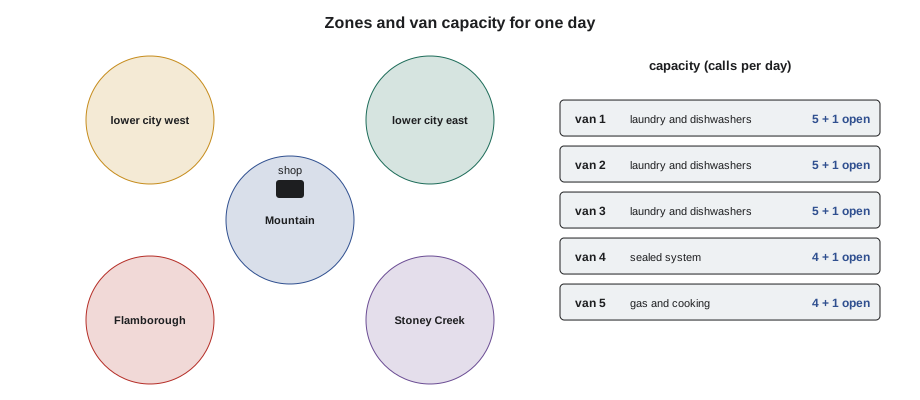
Penfold divides its service area into zones: on the Mountain, the lower city east and west, and the outlying communities such as Flamborough, Glanbrook and Stoney Creek. Each van works mainly in one or two zones each day, so travel between calls stays short. Fenna books each zone's calls into two-hour windows (lesson 1), and she keeps a capacity for each van: the number of calls it can usually finish, based on the type of work. A van doing mostly laundry and dishwasher calls can usually take five or six; a van doing sealed-system or gas work, four.
Fenna does not fill every slot. She leaves room in each day for urgent calls and for the jobs that run long, which is why lesson 1's buffer rule helped. A board filled to the last minute in the morning is a board full of late arrivals in the afternoon.
Priorities
Not every call is equally urgent, and Penfold books by need as well as by order of calling:
- Safety first. A smell of gas, burning, sparking or a CO alarm is not a booking at all: the customer is told to leave the appliance off and, for gas or CO, to leave the home and call the gas utility or emergency services. Penfold follows up after the emergency has been dealt with.
- Food and water. A refrigerator or freezer that is warm, or a washer or dishwasher that is leaking, is booked the same day or the next morning if possible, with advice on keeping food cold or turning off the water.
- Vulnerable customers. Older customers living alone, customers with medical needs such as refrigerated medication, and families with infants are given priority where possible.
- Everything else is booked in the next available window in the customer's zone.
Return visits for ordered parts are booked as soon as Ade confirms the part's arrival date, and callbacks under the labour warranty (lesson 4) are booked ahead of new calls, because the customer has already waited once.
Ordering the day
Once the calls for a van are known, the order in which they are visited decides how much of the day is spent driving. The aim is a route that does not double back across the area, while still meeting each customer's window. Routing software can do this automatically, but a dispatcher who knows the area, as Fenna does, often improves on it by phoning a customer to move a window, as she did with Mr. Calloway.
Worked problem
Comparing two routes
Hiro's four calls in the order they were booked made a route of about 80 km. Fenna's rebuilt route was about 69 km. At an average driving speed of 45 km/h, how much driving time did the new route save?
Show solution
- Original driving time:
- \[80 \div 45 \approx 1.78 \text{ h}\]
- New driving time:
- \[69 \div 45 \approx 1.53 \text{ h}\]
- Time saved:
- \[(80 - 69) \div 45 \times 60 \approx 15 \text{ min}\]
Answer: About 15 minutes of driving and 11 km of fuel saved on one van in one day. Over five vans and a year of working days, small savings like this add up to many extra calls.
Keeping customers informed on the day
Penfold's scheduling system sends each customer a confirmation when the call is booked, a reminder the evening before with the window, and a text when the technician starts driving to them, with the technician's first name and an estimated arrival time. When the board changes during the day, because a call ran long or an urgent call was added, Fenna moves the later calls and lets those customers know. A customer who knows what is happening rarely complains; a customer who has watched the window pass in silence often does.
Technicians help by updating the board from the tablet as they go: arrived, diagnosis done, waiting for approval, complete. When a call looks like it will run long, a quick message to Fenna gives her time to move the next customer before they are late.
Measuring scheduling
Fenna watches a few numbers every week:
- On-time arrivals: the share of calls where the technician arrived within the window.
- First-visit completion (also called first-time fix): the share of calls finished on the first visit, which is about 78 in 100 at Penfold.
- Calls per van per day, by type of work.
- Callbacks under the labour warranty, by technician.
- Lead time: how many days a new customer waits for the first available window in each zone.
Worked problem
What a better first-visit rate is worth
Penfold completes about 4,600 calls a year. If first-visit completion rose from 78 to 85 in 100, how many second trips would be avoided, and what would that save at about 112.50 dollars per second trip (lesson 5)?
Show solution
- Improvement:
- \[0.85 - 0.78 = 0.07\]
- Second trips avoided:
- \[0.07 \times 4{,}600 = 322\]
- Saving:
- \[322 \times 112.50 = 36{,}225\]
Answer: About 322 fewer second trips and about 36,000 dollars a year (sample figures), plus 322 fewer customers waiting for a return visit. Better booking information and better truck stock are how Penfold aims to get there.
Seasons, weather and peak days
Demand for appliance service is not steady. Refrigerator and freezer calls rise sharply in a summer heat wave, as the July 18 on-call day in APP-330 showed, because condensers struggle and old units fail. Dryer and range calls rise in the late fall and winter. Holidays bring a rush of range and oven calls, and long weekends bring calls from customers who discovered a fault while home. Fenna plans for these peaks: she adds Saturday on-call coverage in summer heat and before major holidays, schedules training and van maintenance in the quiet weeks, and warns customers honestly when lead times are long.
Weather affects the day itself. Snow and ice slow driving and make some rural calls unsafe, so on bad-weather days Fenna books fewer calls per van and keeps rural calls for better days unless they are urgent. Technicians are never expected to drive in conditions they judge unsafe; a call can always be rebooked.
Planning capacity across the week
Capacity planning looks ahead, so that customers are not told they must wait two weeks. Fenna compares the calls expected in each zone with the vans available, and adjusts by moving a van to a busier zone, offering overtime, or extending the lead time.
Worked problem
Will the week fit?
Fenna expects about 118 calls next week. She has five vans for five days. Three vans average 5 calls a day and two vans doing sealed-system and gas work average 4 calls a day, and she keeps one slot a day free on each van for urgent calls. How many calls can she book, and will the week fit?
Show solution
- Calls per day, before free slots:
- \[3 \times 5 + 2 \times 4 = 23\]
- Less one free slot per van:
- \[23 - 5 = 18\]
- Calls for the week:
- \[18 \times 5 = 90\]
Answer: She can book about 90 calls ahead and keep 25 slots for urgent work, against 118 expected. Unless some urgent slots go unused, the week will not fit, so Fenna offers Saturday overtime and tells new non-urgent customers that the first available window is the following week.
Scheduling software and the human touch
Penfold's scheduling software holds the board, sends the customer texts, suggests routes and keeps the history of every customer and appliance. It saves Fenna hours each week, but it cannot know that one customer works nights and must be booked in the afternoon, that a rural road floods in spring, or that a particular customer needs extra time and patience. The best results come from software doing the routine work and a dispatcher who knows the area and the customers making the judgment calls, as Fenna did on September 7.
Technicians help by keeping the board accurate. A call left open on the tablet after the technician has left looks to the office like a technician still on site, and a call closed before the customer has approved the work leaves the records wrong. The board is only as good as the information put into it.
Return visits and callbacks on the board
Return visits for ordered parts and callbacks under the labour warranty take board space just like new calls, and a busy board can make customers who are waiting for a part wait even longer. Fenna books them ahead of new non-urgent calls, gives them to the technician who did the first visit where possible, because that technician already knows the appliance and the customer, and keeps a list of every open return visit, checked each morning, so that none is forgotten when a part arrives. When a part arrives and the customer cannot be reached after three tries, Fenna writes to them and keeps the part for an agreed time before it is returned or refunded under the terms on the estimate.
Fenna also keeps track of how long return visits take to happen. A customer who waits two days for a part is usually satisfied; a customer who waits two weeks because nobody booked the visit when the part arrived is not. The measure she watches is the number of days from the part's arrival to the completed return visit, and her target is two working days.
Calls in distant areas, such as Mr. Calloway's, cost more to serve because of the driving. Penfold groups them on one day each week per area where it can, charges a published trip charge for the farthest areas, and tells customers in those areas when booking that the first available day may be a little later than in the city. Customers usually accept a short wait when they are told the reason.
Good scheduling, in the end, is a promise kept many times a day: the customer was told a window, and the technician arrived in it, or the customer heard early and honestly why not. Every part of the system, from the booking script to the routing and the open slots, exists to keep that promise as often as possible and to handle the exceptions well.
Common mistakes
MistakeBooking a call without the model and serial number.
InsteadAsk the customer to read or photograph the plate when booking.
MistakeBooking calls in the order customers phoned.
InsteadGroup calls by zone and order the day to avoid doubling back.
MistakeFilling every slot on the board.
InsteadLeave room for urgent calls and jobs that run long.
MistakeBooking a gas smell as a normal service call.
InsteadTell the customer to leave the home and call the gas utility or emergency services.
MistakeLeaving later customers waiting in silence when the day runs late.
InsteadUpdate the board and let them know as soon as the day changes.
Summary and key terms
- A well-booked call includes the model, serial, complaint, warranty status, access details and charges.
- Calls are grouped by zone, booked into two-hour windows and limited by each van's capacity, with slots left open.
- Safety calls are not bookings; warm refrigerators, leaks and vulnerable customers get priority.
- Ordering each van's day to avoid doubling back saves driving time and allows more calls.
- Confirmations, reminders and on-the-way texts keep customers informed, and technicians update the board as they go.
- On-time arrivals, first-visit completion, calls per van, callbacks and lead time measure scheduling.
- Zone
- A part of the service area that one van works in on a given day.
- Capacity
- The number of calls a van can usually complete in a day for a given type of work.
- First-visit completion
- The share of calls finished on the first visit; also called first-time fix.
- Lead time
- How long a customer waits for the first available appointment.
- Dispatcher
- The person who books and routes service calls and manages the board during the day.
- Board
- The schedule of every van's calls for the day.
Practice problems
Work each problem on paper first, then reveal the answer to check.
What booking detail most often prevents a second visit?
Show answer
The model and serial number, so the likely part can be checked and staged.
Why does Fenna leave open slots on the board?
Show answer
For urgent calls and jobs that run long.
A route shrinks from 80 km to 69 km at 45 km/h. About how much time is saved?
Show answer
About 15 minutes.
What should a customer who smells gas be told?
Show answer
Leave the home and call the gas utility or emergency services.
Raising first-visit completion by 7 in 100 on 4,600 calls avoids how many second trips?
Show answer
About 322.
Lesson quiz · 5 questions
Score 60% or more to complete this lesson.
Create a free account to save your progress, take quizzes and earn a certificate.