
APP-410 · Lesson 8 of 12 · 25 min
Records, tax and insurance basics
▶ Video coming soon A video version of this lesson is on the way.
On Tuesday, October 13, 2026, the day after Thanksgiving, Harriet met Celia Thackery, the bookkeeper who keeps Penfold's accounts two days a week, for the third-quarter review. Celia had the HST return ready to file: Penfold had collected 47,060 dollars of HST on its sales for July to September and paid 21,400 dollars of HST on its own purchases, so it owed the difference to the Canada Revenue Agency. They went through the payroll remittances, the WSIB premium, the van insurance renewal coming up in November, and a question from Hiro about whether the shop's old work orders from 2019 could finally be shredded. Celia's answer was the same as every year: "Not until we've checked the six-year rule for each box."
This lesson explains the records a service business must keep, the basics of the sales taxes and payroll obligations in Ontario, workers' compensation, and the insurance a service company needs. A technician does not file returns, but a technician's paperwork is the raw material for all of them, and anyone who plans to run a business one day needs to understand them.
The records a service business keeps
Every service call creates records, and the work order is the most important. Penfold's work orders hold the booking, the customer's details, the appliance, the findings, the estimate and approvals, the parts used, the readings and photos, the invoice and the payment. Together with the purchase invoices for parts, payroll records, bank and card statements, vehicle logs and tax returns, they are the company's books.
Good records do four jobs. They support the tax returns. They prove warranty claims and refrigerant handling. They protect the company in disputes, such as a customer who says a repair was never approved or a water leak that started after a visit. And they show how the business is doing, so the owner can decide what to change.
Technicians make most of these records, so their habits matter: complete every field, record approvals with the time, photograph model plates and receipts, note readings, and close the work order the same day.
How long records are kept
The Canada Revenue Agency generally requires businesses to keep their books and records, including the supporting documents for income tax and GST/HST, for six years from the end of the last tax year they relate to, longer in some cases, such as when a return is under objection or appeal. Other laws set their own periods: payroll records, refrigerant records under Ontario's ozone-depleting substances regulation, and records the company's insurer or warranty contracts require. Penfold keeps everything for at least six full years after the end of the year, and longer where a rule or a dispute needs it.
Worked problem
When can an old box be shredded?
A box holds work orders and parts invoices from Penfold's 2019 tax year, which ended December 31, 2019. Under the six-year rule, from what date may it be destroyed, if no other rule or dispute requires it?
Show solution
- End of the tax year:
- December 31, 2019.
- Six years later:
- December 31, 2025.
Answer: From January 1, 2026, so Hiro's box can go, after Celia checks that it holds no refrigerant or payroll records with longer periods and that no claim involves those customers. Penfold shreds it through a document-destruction company because it contains customers' personal information.
GST/HST
Ontario uses the harmonized sales tax (HST) of 13 in 100, which combines the federal GST and the provincial part. A business must register for GST/HST once its taxable sales exceed 30,000 dollars in a single calendar quarter or over four consecutive quarters; below that it is a small supplier and may register voluntarily. A registered business charges HST on its taxable sales, claims input tax credits for the HST it pays on its business purchases, and files returns monthly, quarterly or yearly depending on its size, paying the difference.
Worked problem
A quarter of HST
In July to September Penfold's taxable sales were 362,000 dollars, and it paid 21,400 dollars of HST on its own business purchases. How much HST did it collect, and how much does it owe for the quarter?
Show solution
- HST collected:
- \[362{,}000 \times 0.13 = 47{,}060\]
- Less input tax credits:
- \[47{,}060 - 21{,}400 = 25{,}660\]
Answer: Penfold owes 25,660 dollars for the quarter. The HST it collected was never its money; it held it for the government, which is why Celia keeps it in a separate account.
The most common tax mistake in small service businesses is spending the sales tax collected as if it were income, then being unable to pay the return. Keeping tax money separate from the start prevents it.
Payroll and workers' compensation
An employer deducts income tax, Canada Pension Plan contributions and Employment Insurance premiums from employees' pay, adds its own CPP and EI contributions, and remits them to the CRA on a set schedule. It issues T4 slips each year. In Ontario, most employers must also register with the Workplace Safety and Insurance Board (WSIB) and pay premiums for no-fault workplace injury insurance; WSIB coverage replaces the right to sue the employer for most workplace injuries. Appliance service is a covered industry, so every Penfold employee is covered.
Workers' compensation premiums depend on the industry's injury record and the company's own record, so safe work, which the earlier courses covered at length, saves money as well as injuries. Injuries must be reported to the WSIB within the required time, and the technician's prompt report to the office is the first step.
Insurance a service company needs
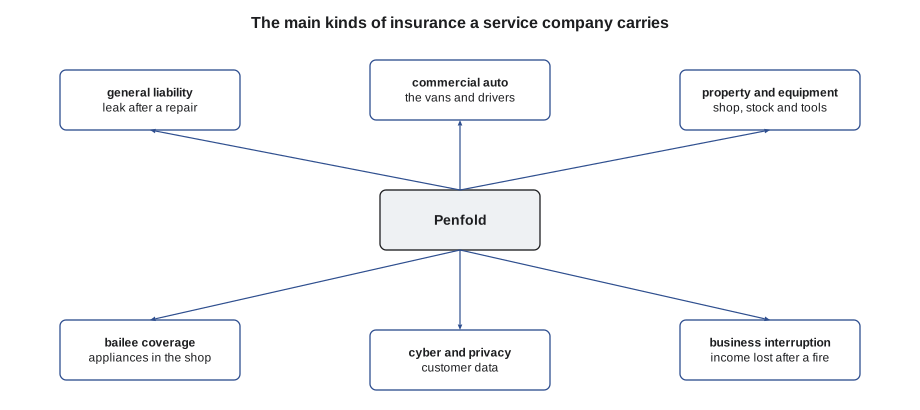
Insurance protects the company against losses it could not afford to pay itself. Penfold reviews its insurance every year with its broker, Rupert Fairclough. The main kinds are:
- Commercial general liability (CGL) covers claims that the company's work or people caused injury to someone or damage to their property: a water line that leaks after a dishwasher repair and damages a floor, or a customer who trips over a technician's toolbox.
- Commercial auto insurance covers the vans and their drivers. Personal car insurance does not cover a vehicle used for business.
- Property and equipment insurance covers the shop, the parts stock, tools and test equipment, including tools carried in the vans.
- Bailee or customer-goods coverage protects customers' appliances while they are in Penfold's shop for bench repair.
- Cyber and privacy coverage helps if customer data is stolen or a ransomware attack shuts down the booking system.
- Business interruption coverage replaces lost income if a fire or flood closes the shop.
Customers sometimes ask whether a company is insured. Penfold's answer is yes, with a certificate of insurance available on request, which property managers and businesses routinely ask for before letting a contractor work in their buildings.
A technician's part in records and claims
When something goes wrong on a call, such as a leak, damage to a floor or an injury, the technician's notes and photos decide how the claim is handled. Penfold's rules are:
- Make the situation safe first: stop the leak, turn off the power, help anyone who is hurt.
- Photograph the damage and the work area, and note the time and what happened, without guessing about cause or fault.
- Do not promise the customer that Penfold will pay; say that the office will be in touch the same day.
- Phone Harriet before leaving the property, and complete an incident report that day.
Insurers can refuse claims that are reported late or where the company admitted fault without their agreement, so these rules protect the customer's chance of being paid as well as the company.
Vehicle records
Vans are one of a service company's largest costs, and their records matter for taxes, insurance and safety. Penfold keeps, for each van, the purchase or lease documents, insurance, repair and maintenance records, fuel receipts and a vehicle log showing the distance driven for business. The tax authorities allow vehicle costs to be deducted only for business use, and a log is the evidence. Penfold's vans are used only for business, but a technician-owner who also uses the same vehicle personally must split the costs.
Worked problem
Business use of a vehicle
A sole proprietor drove a vehicle 28,000 km in the year, of which 23,800 km were for business, according to the log. The vehicle's costs for the year were 11,600 dollars. What share of the costs relates to business use?
Show solution
- Business share:
- \[23{,}800 \div 28{,}000 = 0.85\]
- Business part of the costs:
- \[11{,}600 \times 0.85 = 9{,}860\]
Answer: Eighty-five in 100 of the use was for business, so about 9,860 dollars of the costs relate to the business, subject to the tax rules for vehicles. Without a log, the business share is hard to prove.
Expenses and receipts
Technicians sometimes pay for small things on the road: a fitting from a hardware store, parking, or fuel when the company card does not work. Penfold reimburses these only with a receipt attached to the work order or the expense form, because every business expense needs a record and, for HST, a receipt that supports the input tax credit. Receipts are photographed in the tablet app the same day, before they fade or get lost in the van.
Year-end and the owner's view
At the end of each year Celia prepares the year-end figures for Penfold's accountant, who files the company's income tax return. Harriet uses the same figures to see how the business did: revenue by type of work, the cost of a billable hour, parts margins, warranty and plan income, callbacks, and the profit left for the year. These numbers drive the next year's price review (lesson 6), the truck stock lists (lesson 5) and decisions about hiring and vans.
Technicians rarely see the full accounts, but they influence every line: the hours billed, the parts recorded, the callbacks avoided, the claims paid, the damage avoided and the customers who come back. A technician who understands where the money comes from and where it goes makes better decisions on every call, and is better prepared to run a business one day (lesson 11).
Customer information in the records
Work orders contain customers' personal information: names, addresses, phone numbers, door codes and sometimes notes about health or access. Records are kept as long as the law requires, as this lesson explained, but they are also protected for as long as they are kept, and destroyed securely when they are no longer needed. Lesson 9 covers privacy in more detail.
Refrigerant and environmental records
Some records are required by environmental law rather than tax law. Ontario's regulation on ozone-depleting substances and their replacements requires refrigerant to be recovered by certified people, emptied equipment to be tagged, and records to be kept, as APP-110 explained for the haul-away units sent to Quarrington Metal Recovery. Penfold keeps its recovery cylinders' records, the tags and the work orders together, so that it can show where every recovered kilogram of refrigerant went.
These records are inspected far less often than tax records, but the penalties for careless refrigerant handling can be large, and the records are the company's evidence that it did the job properly.
Questions customers ask about tax
Customers sometimes ask why HST is charged on a repair, or ask to pay without it. The answer is simple and the same every time: a registered business must charge HST on its taxable sales, including repairs, and Penfold cannot leave it off. A business customer who is registered for HST can usually claim it back as an input tax credit, which is why business customers ask for invoices showing Penfold's registration number.
Technicians never agree to leave tax off an invoice, accept cash "without the tax", or alter an invoice after it has been issued. Those are not favours to the customer; they are tax offences for the company, and an honest company cannot do them.
None of this needs a technician to become an accountant. It needs complete work orders closed the same day, receipts photographed, parts and payments recorded, incidents reported at once, and honesty about every dollar. With those habits, the bookkeeper, the accountant, the insurer and the tax authorities all have what they need, and the business can show at any time exactly what it did and why.
Common mistakes
MistakeSpending the sales tax collected as income.
InsteadKeep it in a separate account until the return is filed.
MistakeShredding old work orders without checking the retention rules.
InsteadCheck the tax, payroll, refrigerant and claim rules for each box first.
MistakeUsing a personal car for service calls on personal insurance.
InsteadBusiness use needs commercial auto coverage.
MistakeTelling a customer after a leak that Penfold will pay for everything.
InsteadMake safe, photograph, note the facts, and let the office handle the claim.
MistakeLeaving work order fields blank.
InsteadComplete every field the same day; the records support taxes, warranties and claims.
Summary and key terms
- Work orders, purchase invoices, payroll, bank records and returns are the company's books, and technicians create most of them.
- The CRA generally requires records to be kept six years from the end of the tax year; other rules can require longer.
- Businesses register for GST/HST over 30,000 dollars of taxable sales, charge 13 in 100 HST in Ontario, claim input tax credits and remit the difference.
- Employers remit payroll deductions to the CRA and pay WSIB premiums for workplace injury coverage.
- General liability, commercial auto, property and equipment, bailee, cyber and business interruption insurance protect the company.
- After an incident: make safe, photograph, note facts, do not promise payment, and phone the office before leaving.
- Work order
- The full record of a service call from booking to payment.
- Retention period
- How long a record must be kept.
- Input tax credit
- A credit for the GST/HST a registered business pays on its business purchases.
- Small supplier
- A business with taxable sales under 30,000 dollars that need not register for GST/HST.
- General liability insurance
- Insurance against claims of injury or property damage caused by the company's work.
- Certificate of insurance
- A document from the insurer or broker proving the company's coverage.
- Bailee coverage
- Insurance for customers' goods while they are in the company's care.
Practice problems
Work each problem on paper first, then reveal the answer to check.
When must a business register for GST/HST?
Show answer
When its taxable sales exceed 30,000 dollars in a quarter or over four consecutive quarters.
Penfold collected 47,060 dollars of HST and paid 21,400 dollars on purchases. What does it owe?
Show answer
25,660 dollars.
Why must sales tax collected be kept separate?
Show answer
It belongs to the government; spending it leaves the company unable to pay the return.
What does general liability insurance cover?
Show answer
Claims that the company's work or people caused injury or property damage.
What must a technician not do after a leak at a customer's home?
Show answer
Promise that Penfold will pay; the office handles claims.
Lesson quiz · 5 questions
Score 60% or more to complete this lesson.
Create a free account to save your progress, take quizzes and earn a certificate.