
APP-410 · Lesson 1 of 12 · 26 min
Customer service on the service call
▶ Video coming soon A video version of this lesson is on the way.
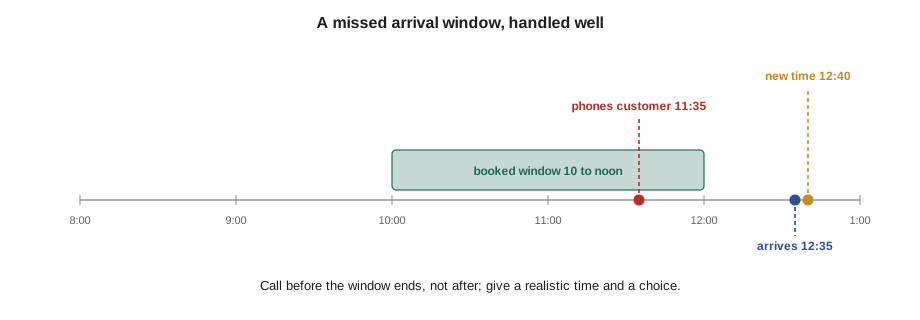
On Monday, August 17, 2026, Dee's second call of the day ran long. A dryer in a basement laundry had a seized drum roller that took forty minutes longer than planned, and her next customer, Ottoline Hollingworth in Crerar, had been told to expect a technician between 10 a.m. and noon. At 11:35 Dee could see she would not make it. She pulled over, phoned Mrs. Hollingworth herself, apologized, explained that the call before had needed a part fitted, and gave a new arrival time of 12:40. She also asked whether that still worked or whether Fenna should rebook the visit. Mrs. Hollingworth said she would wait. Dee arrived at 12:35, put on shoe covers at the door, listened to the whole story of the noisy dishwasher before touching it, and fixed a loose spray arm in twenty minutes. In Fenna's survey that evening, Mrs. Hollingworth gave the call five stars and wrote: "She was late but she called, and she listened."
This lesson is about the part of the service call that has nothing to do with meters and schematics: how a technician arrives, listens, explains, behaves in the home and leaves, and how a company measures whether its customers feel well served. A repair that works but leaves the customer annoyed, confused or worried about their floor is only half a good call.
Why customer service is part of the trade
Most customers never see the inside of their appliance and cannot judge whether a repair was done well. What they can judge is whether the technician arrived when promised, explained things clearly, treated their home with care and charged what they were told. Those things decide whether they call the company again, recommend it to a neighbour, or leave a public review. For a small company such as Penfold, almost all new work comes from repeat customers, referrals, brand warranty calls and online reviews, so the way each technician behaves on each call is the company's marketing.
Customer service is also part of safety and good diagnosis. A customer who feels listened to gives better information about the fault: when it happens, what it sounds like, what they have already tried. A technician who explains a hazard calmly, such as a crushed dryer duct or a missing anti-tip bracket, is more likely to have the advice followed. And a customer who trusts the technician is far less likely to dispute a bill.
Arrival windows and calling ahead
Penfold books calls in arrival windows rather than exact times, because a technician cannot know how long each call will take until the appliance is open. Fenna offers morning (8 to 10 or 10 to noon) and afternoon (noon to 2 or 2 to 4) windows of two hours. Customers are told three things when they book: the window, that the technician will phone or text about 30 minutes before arriving, and that the office will call if the window cannot be met. A two-hour window is a common compromise in the trade; shorter windows please customers but make routing harder, and longer windows make customers wait at home.
Lateness is the most common complaint in the trade, and the way it is handled matters more than the lateness itself. Penfold's rules are simple:
- If a technician can see that a window will be missed, they or Fenna phone the customer before the window ends, not after.
- The call gives a realistic new time and an honest, short reason, without blaming the previous customer by name.
- The customer is offered the choice of waiting or rebooking, and the choice is respected.
- When the technician arrives late, the first words are an apology, not an explanation.
Early arrivals need care too. A technician who arrives forty minutes before the window may catch a customer still in the shower; the call-ahead text gives the customer the chance to say whether early is all right.
The first five minutes
The first few minutes of a call set its tone. Penfold trains its technicians to follow the same routine at every door, so that it becomes habit even on a bad day:
- Park legally and considerately, not blocking the driveway or a neighbour's. Leave the van tidy, with the company name visible.
- Knock or ring, step back from the door, and introduce yourself by first name and company: "Hi, I'm Dee from Penfold Appliance Service. I'm here about your dishwasher." Show identification if asked; a customer who asks is being sensible, not rude.
- Put on shoe covers before stepping inside, or ask whether the customer prefers shoes off. Carry a drop cloth or mat for the work area.
- Ask the customer to show you the appliance and tell you what happened, and listen without interrupting. Ask open questions: when did it start, what does it do, has anything changed in the house, has anyone else worked on it.
- Repeat back what you heard in a sentence, so the customer knows you understood: "So it stopped draining on Saturday, and it's been beeping since you reset it."
- Explain what you will do next and roughly how long the diagnosis will take, and mention the service call charge if the office has not already confirmed it.
None of this takes more than five minutes, and it saves time later. Customers who have been heard tend to leave the technician to work, while customers who have been brushed off hover and repeat themselves.
Explaining findings in plain words
When the diagnosis is done, the technician explains what is wrong before talking about price. A good explanation has three parts: what failed, why it matters, and what the choices are. Technical words are fine if they are explained, and a picture is often better than words. Many technicians show the customer the failed part, the meter reading or a photo taken inside the machine.
Worked problem
Turning a diagnosis into plain words
Dee found that a dishwasher's drain pump impeller had a broken blade, and a sliver of glass was jammed in the pump housing. How should she explain it?
Show solution
- What failed: "The pump that pushes the water out has a broken blade. A piece of glass got into it, probably from a glass that broke in the machine."
- Why it matters: "With the blade broken it can't push the water out, so the water sits in the bottom and the machine stops with a drain fault."
- What the choices are: "I can replace the pump today from my van. Or, if you'd rather think about it, the service call covers today's visit and you can book the repair later."
- Then, and only then, the price, from the flat-rate book, with tax shown.
Answer: A short explanation in that order lets the customer understand the problem before hearing a number, and it shows that the decision is theirs.
Some things should never be said: guesses presented as facts, criticism of a previous technician or of the brand the customer chose, and anything that sounds like pressure. If the technician does not yet know the cause, the honest answer is "I need to test one more thing before I can tell you."
Behaviour in the home
A service call happens in someone's home, often in their kitchen, with their children or pets nearby and their belongings everywhere. Penfold's expectations are written in its employee handbook and reviewed every September:
- Ask before moving anything: the dishes in the dishwasher, the food in the fridge, the laundry on the dryer.
- Protect floors and counters. Use a drop cloth, slide appliances on a sheet of cardboard or hardboard, and wipe up every drop of water.
- Use the customer's washroom only if invited, keep phone calls short and private, and do not eat, smoke or vape in the home.
- Keep conversation polite and neutral. Avoid politics and personal remarks, and never comment on the home or its contents.
- At the end, put everything back, run the appliance with the customer watching if possible, explain what was done, and leave the work area cleaner than it was found.
Lesson 9 covers safety and respect in homes in more detail, including pets, children, vulnerable customers and privacy.
Difficult conversations
Some customers are upset before the technician arrives: the fridge died with a week's groceries in it, the washer flooded the basement, or the last company did not fix the fault. The technician cannot change what happened, but can avoid making it worse. Listen first and let the customer finish. Acknowledge the problem ("Losing all that food is awful") without admitting fault for things nobody at Penfold did. Keep your voice calm and slow. Focus on what can be done today. If a customer becomes abusive or threatening, the technician is allowed to leave; Penfold's rule is to say calmly that the visit will be rescheduled, pack up, leave, and phone Harriet or Fenna from the van. No repair is worth a technician's safety.
When the company has made a mistake, such as a part ordered wrong, a missed window or a repair that failed within the labour warranty, the right response is a plain apology and a fix. Harriet's rule is that a technician may apologize on the company's behalf for anything the company did, and that the office, not the technician, decides on refunds or credits.
Measuring service: surveys and complaints
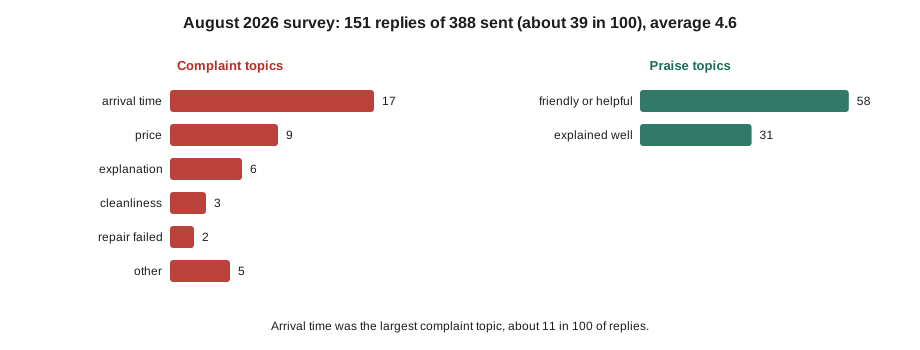
Penfold measures customer service in three ways: a short text survey sent the evening after each completed call, the complaints that reach the office, and public online reviews. Fenna's survey asks for a rating from one to five and invites a comment. Each month she counts the replies, the average rating and the comments by topic, and reports to Harriet.
Worked problem
Reading a month of survey results
In August 2026 Penfold completed 388 calls and sent a survey after each. Fenna received 151 replies, with an average rating of 4.6. Seventeen replies complained about arrival time. What was the response rate, and what share of the replies complained about arrival time?
Show solution
- Response rate:
- \[151 \div 388 \approx 0.389\]
- That is about 39 in 100 of the surveys sent.
- Share of replies about arrival time:
- \[17 \div 151 \approx 0.113\]
- That is about 11 in 100 of the replies.
Answer: About 39 in 100 customers replied, and about 11 in 100 of those complained about arrival time, the largest single topic. Harriet's response was to have Fenna leave a 15-minute buffer after any call booked as a sealed-system or bearing job.
A survey only helps if the company acts on it. Fenna reads every comment the day it arrives, and any rating of one or two gets a phone call from her or Harriet within a working day. Technicians see their own survey comments each month, good and bad, in a short meeting with Harriet rather than on a public board.
On the phone and after the call
Customer service starts before the technician arrives and continues after the van leaves. Fenna answers the phone with the company name and her own, and the booking call follows a script so that nothing is missed, but she is trained to let the customer tell the story first and to fill in the script afterwards. A customer who has just found water all over the kitchen floor wants to be heard before being asked for a serial number.
Technicians use the phone too: the call-ahead, a call to say a window will be missed, a call to a customer who is at work to approve an estimate. Penfold's rules for these calls are to say who is calling and from which company, to keep the call short and clear, to repeat any price and any decision back to the customer, and to record the approval with the time on the work order. Voicemail messages give the technician's first name, the company, the reason for the call and the office number, and never the customer's private details.
After the call, three things follow. The survey goes out that evening. Fenna phones the customer the next working day after any repair that is known to need watching, such as a sealed-system repair or a refrigerator that needs a day to reach temperature, and after any call that ended badly. And if a part has been ordered, the customer hears from the office when it arrives and when the return visit is booked, without having to chase it. Customers remember being kept informed long after they have forgotten the repair itself.
Worked problem
Following up after the call
Of 388 calls completed in August, Fenna made follow-up phone calls after 46 of them: sealed-system repairs, refrigerators restarted after a repair, and calls with a low survey rating. What share of the month's calls got a follow-up phone call?
Show solution
- Share with a follow-up call:
- \[46 \div 388 \approx 0.119\]
Answer: About 12 in 100 of calls got a follow-up call. Harriet considers that a good balance: enough to catch problems early, few enough that Fenna can make every call personally.
Common mistakes
MistakePhoning a customer after their arrival window has already ended.
InsteadPhone before the window ends, with a realistic new time and a choice to wait or rebook.
MistakeStarting to take an appliance apart before the customer has finished describing the fault.
InsteadListen to the whole story, ask open questions and repeat it back first.
MistakeLeading with the price before the customer understands the problem.
InsteadExplain what failed, why it matters and the choices, then give the price.
MistakeCriticizing the brand or a previous technician.
InsteadDescribe the fault and the fix; leave judgments out.
MistakeArguing with an abusive customer to finish the job.
InsteadSay calmly the visit will be rescheduled, leave, and phone the office.
Summary and key terms
- Customers judge a call by punctuality, explanation, care for their home and a fair, expected bill.
- Penfold books two-hour arrival windows with a call-ahead text about 30 minutes before arrival.
- A missed window is handled by phoning before it ends, with a new time and a choice to wait or rebook.
- The first five minutes follow a routine: introduction, shoe covers, listening, repeating back, explaining the next step.
- Findings are explained as what failed, why it matters and the choices, before the price.
- Technicians ask before moving anything, protect floors and leave the area cleaner than they found it.
- Technicians may leave an abusive situation and let the office reschedule.
- Surveys, complaints and reviews are counted each month and acted on; low ratings get a call within a working day.
- Arrival window
- The period in which the customer is told the technician will arrive.
- Call-ahead
- A phone call or text a short time before arrival, confirming the technician is on the way.
- Shoe covers
- Disposable or washable covers worn over work boots inside a customer's home.
- Drop cloth
- A cloth or mat laid down to protect the floor and catch water and parts.
- Open question
- A question that cannot be answered yes or no, such as "What happens when it stops?"
- Response rate
- The share of surveys sent that customers answer.
Practice problems
Work each problem on paper first, then reveal the answer to check.
What three things does Penfold tell customers about timing when they book?
Show answer
The window, that the technician will call or text about 30 minutes before arriving, and that the office will call if the window cannot be met.
When should a customer hear that their window will be missed?
Show answer
Before the window ends, by phone, with a new time and a choice.
What are the three parts of a good explanation of findings?
Show answer
What failed, why it matters, and what the choices are.
What should a technician do if a customer becomes abusive?
Show answer
Say calmly the visit will be rescheduled, leave, and phone the office.
If 151 of 388 surveys are answered, what is the response rate?
Show answer
About 39 in 100.
Lesson quiz · 5 questions
Score 60% or more to complete this lesson.
Create a free account to save your progress, take quizzes and earn a certificate.