
APP-330 · Lesson 8 of 12 · 25 min
Ice machines and undercounter refrigeration
▶ Video coming soon A video version of this lesson is on the way.
On Friday, August 7, 2026, Hiro's afternoon call was a home bar in Freelton. Octavia Rookwood's built-in clear-ice machine, a 38 cm (15 in) wide undercounter unit, had been making thin, cloudy cubes that came out in clumps, and lately it took most of a day to fill its bin. Hiro pulled the front panel and shone a light on the evaporator, the vertical grid where the cubes form. Its surface was coated with a chalky white scale, and the water distributor tube above it had half its holes blocked. Scale insulates the evaporator, so the cubes freeze slowly and unevenly; it also roughens the surface, so the cubes stick and the harvest drags on. The water filter cartridge on the supply line was dated two years earlier, and the house had hard water. Hiro ran the maker's cleaning cycle with its nickel-safe ice machine cleaner, scrubbed the distributor, ran the sanitizing cycle, replaced the filter, threw out every cube in the bin, and checked that the drain ran freely into its standpipe through an air gap. The first batch after the cleaning came out clear and released in under two minutes. He booked a cleaning visit for six months later and showed Ms. Rookwood the cleaning reminder in the unit's menu.
This lesson explains how stand-alone ice machines make ice, how they harvest and stop when the bin is full, why water quality and cleaning decide how well they work, how they drain, how to diagnose them, and what to know about the undercounter refrigerators and beverage centres that are often installed beside them.
Kinds of ice maker
- Refrigerator ice makers, covered in the refrigerator course, freeze water in a tray inside the freezer and eject the cubes with a motor or a twisting tray.
- Clear-ice machines (cube or gourmet ice machines) are stand-alone undercounter or freestanding units. They circulate water over a cold evaporator grid so that ice builds up layer by layer, which pushes out air and dissolved minerals and makes clear, hard cubes.
- Nugget or flake ice machines freeze a thin layer of ice inside a refrigerated cylinder and scrape it off with a slowly turning auger, compressing it into soft, chewable nuggets.
- Portable countertop ice makers dip metal fingers into a small water reservoir, freeze bullet-shaped pieces around them, then warm the fingers briefly to drop the ice into a basket. They have no water connection and their basket is not refrigerated.
- Commercial ice machines, the large modular heads on bins in restaurants and hotels, work on the same principles at a much larger scale.
Penfold services refrigerator ice makers, residential and light-commercial undercounter ice machines and portable units. Large commercial ice machines and remote-condenser systems are left to commercial refrigeration contractors, who carry the parts and the commercial training. That is a company rule, and many appliance shops draw the same line.
The batch cycle of a clear-ice machine
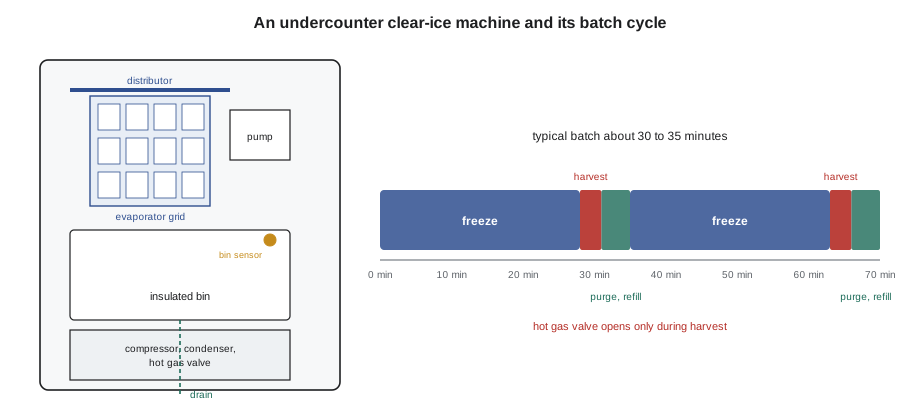
Most undercounter clear-ice machines work in batches. Each batch has a freeze phase and a harvest phase.
- Freeze: a small water pump lifts water from a reservoir to a distributor that spreads it in a curtain over the evaporator. The evaporator, cooled by the refrigeration system, freezes the water a little at a time into cubes in its grid cells. Unfrozen water runs back to the reservoir and around again. Because the water keeps moving, air bubbles and minerals stay in the water instead of being trapped in the ice. A freeze phase typically lasts about 20 to 30 minutes (typical).
- Harvest: when the board decides the cubes are big enough, by time, by a thermistor on the evaporator or by the falling water level in the reservoir, it opens a hot gas valve. Hot discharge gas from the compressor flows straight into the evaporator and warms it just enough for the slab of cubes to slide off into the bin below. A harvest sensor, often a hinged water curtain or a thermistor, tells the board that the ice has dropped.
- Purge: most machines drain some or all of the reservoir water after each batch, carrying away the minerals that the clear ice left behind, and refill with fresh water through the water inlet valve.
A bin sensor, a thermostat bulb, a thermistor or an optical sensor near the top of the bin, stops production when the bin is full and restarts it when ice has been used. In many residential clear-ice machines the bin is insulated but not refrigerated, so the ice melts slowly and the melt water runs to the drain; the machine replaces it with new batches. Customers sometimes report this as a leak or as a fault.
Worked problem
How much ice a batch makes
A machine is rated to make 23 kg of ice a day. Each batch takes 30 minutes from the start of one freeze to the start of the next. About how much ice does one batch make?
Show solution
- Batches per day:
- \[24 \times 60 \div 30 = 48\]
- Ice per batch:
- \[23 \div 48 \approx 0.48 \text{ kg}\]
Answer: About 0.48 kg per batch at full output. Ratings are measured at set air and water temperatures; on a hot day, with warm supply water or a dirty condenser, a machine makes noticeably less, so a customer's "it only makes half as much in July" may be normal.
Water quality and scale
An ice machine is a water appliance. Dissolved minerals, mainly calcium and magnesium carbonates, are left behind as water freezes, and although the purge carries most of them away, some deposit as scale on the evaporator, the distributor, the reservoir and the water probes. Scale slows freezing, makes cubes stick and cloudy, blocks distributor holes and fools water-level sensors. Hard water makes scale faster; very soft or purified water can make cubes that freeze slowly and melt quickly, so some makers set limits on both.
Most installations include a water filter on the supply line, often with a scale inhibitor that keeps minerals in solution. The filter is changed as often as the maker specifies, commonly every six months (typical), and a cartridge that has gone years without a change, as Ms. Rookwood's had, does more harm than good.
Worked problem
Minerals delivered to a machine
A household's water has a hardness of 250 mg/L. An ice machine takes in about 40 L of water a day to make ice and purge. How much hardness mineral reaches the machine in six months? (1 grain per US gallon is about 17.1 mg/L, for comparison with softener ratings.)
Show solution
- Hardness in grains per gallon:
- \[250 \div 17.1 \approx 14.6\]
- Mineral per day:
- \[250 \times 40 = 10{,}000 \text{ mg} = 10 \text{ g}\]
- In six months (182 days):
- \[10 \times 182 = 1{,}820 \text{ g} \approx 1.8 \text{ kg}\]
Answer: About 1.8 kg of mineral passes through the machine in six months. Most of it leaves with the purge water, but even a small fraction left behind is enough to coat the evaporator, which is why makers call for cleaning every six months or so and more often on hard water.
Cleaning and sanitizing
Ice is food, and an ice machine must be kept as clean as any food-contact surface. Makers specify two separate steps, done in this order:
- Cleaning removes scale and mineral deposits, using the maker's approved ice machine cleaner, usually a mild acid such as phosphoric or citric acid that is safe for nickel-plated evaporators. Many machines have a cleaning cycle that circulates the solution over the evaporator for a set time, then rinses. Using the wrong cleaner, such as a household descaler or a strong acid, can strip the evaporator's plating and void its warranty.
- Sanitizing kills bacteria, mould and slime, using the maker's approved sanitizer at the dilution the manual gives. Slime, often pink or black, grows in the reservoir, the bin and the drain in warm, damp, dark conditions.
Dee's and Hiro's routine, following the makers' manuals, is: turn off production and discard all ice; run the cleaning cycle at the specified dilution; remove and scrub the distributor, water curtain and reservoir by hand; rinse; run the sanitizing cycle; wipe the bin and its door gasket with sanitizer; discard the first batch or two of ice; and replace the water filter if it is due. They wear gloves and eye protection, mix cleaners and sanitizers only as the label says and never together, and leave the customer the dates of the cleaning and the next one due.
Worked problem
Mixing a cleaning solution
A sample manual calls for 150 mL of cleaner in 3 L of water for the cleaning cycle. What is the ratio, and how much cleaner is needed for a 2 L reservoir at the same strength?
Show solution
- Ratio:
- \[3{,}000 \div 150 = 20, \text{ so 1 part cleaner to 20 parts water}\]
- Cleaner for 2 L:
- \[2{,}000 \div 20 = 100 \text{ mL}\]
Answer: One part cleaner to 20 parts water, so 100 mL for 2 L. Stronger is not better: too much acid can damage the evaporator plating, and too little leaves scale behind. The figures here are a sample; each maker's manual governs.
Drains and installation
Clear-ice machines drain all the time: purge water, melt water from the bin and cleaning solutions. Most drain by gravity to a floor drain or standpipe, through an air gap that stops waste water from siphoning back into the machine. Where no gravity drain is available, a drain pump kit lifts the water to a higher drain. A drain with a dip or a long flat run collects slime, and a blocked drain floods the bin. Installation instructions also give the water supply size and pressure range, the shut-off valve, the electrical circuit and the front-breathing clearance at the toe grille.
Plumbing a new drain or water line is a plumber's work in Ontario; Penfold connects to existing valved water supplies and drains that meet the installation instructions.
Undercounter refrigeration
Ice machines are often installed beside other undercounter refrigeration: undercounter refrigerators and freezers, beverage centres, refrigerated drawers and wine coolers (lesson 9). These are small refrigerators with the same sealed systems, defrost methods and controls as the refrigerator course described, packed into a space under the counter. The point that matters most for undercounter units is ventilation: a built-in undercounter unit is designed to draw and discharge its condenser air through the toe grille at the front, because its back and sides are boxed in. A freestanding unit with a rear condenser, pushed into a cabinet opening, overheats, runs constantly and fails early. Before diagnosing a warm undercounter unit, check that it is a front-breathing model, that the toe grille is clear, and that the condenser behind it is clean.
Diagnosing an ice machine
| Complaint | Likely causes | Checks |
|---|---|---|
| No ice, machine silent | Bin sensor reads full, power, control fault, machine switched to clean or off | Bin sensor and its reading; mode; fault code |
| No ice, compressor runs | No water (closed valve, failed inlet valve, frozen line), failed pump, hot gas valve stuck open, low charge | Water in the reservoir; pump running; evaporator temperature |
| Thin, cloudy or clumped cubes | Scale, blocked distributor, low water flow, warm ambient or dirty condenser | Inspect the evaporator; clean; check the condenser |
| Long harvest, cubes stick | Scale, failed hot gas valve, harvest sensor fault | Clean; check the valve coil and harvest sensor |
| Water on the floor | Blocked drain, failed drain pump, cracked reservoir, loose fitting | Run water into the bin; follow the drain |
| Smell or slime | Overdue cleaning and sanitizing, drain backing up | Clean and sanitize; check the drain slope and air gap |
New residential ice machines use small charges of hydrocarbon refrigerant such as R-600a or R-290 and carry flammable-refrigerant markings, so sealed-system work follows the maker's flammable-refrigerant procedure, as for refrigerators.
Portable and nugget ice makers
Portable countertop ice makers are common and inexpensive. Their reservoir is filled by hand, their fingers freeze bullets of ice in a few minutes, and a small heater or hot gas warms the fingers to release the ice into a basket. Because the basket is not refrigerated, the ice melts back into the reservoir and is refrozen. Their faults are mostly scale, slime from water left standing, and a failed water pump or sensor; their sealed systems are rarely worth repairing. Customers are told to empty and dry them when not in use and to clean them as the manual says, often with a vinegar or citric solution.
Nugget ice machines scrape ice from the inside of a refrigerated cylinder with an auger driven by a gear motor. Their particular faults are worn auger bearings and seals, a gear motor that stalls on scale, and a water level float that sticks. They need regular cleaning like any ice machine, and their drains handle a steady trickle of melt water.
Common mistakes
MistakeUsing a household descaler or strong acid on an ice machine evaporator.
InsteadUse the maker's nickel-safe ice machine cleaner at the specified dilution.
MistakeCleaning without sanitizing, or sanitizing without cleaning.
InsteadClean to remove scale first, then sanitize to kill growth, as the manual specifies.
MistakeKeeping the ice that was in the bin during cleaning.
InsteadDiscard all ice before cleaning and the first batches after it.
MistakeReporting melt water in an unrefrigerated bin as a leak.
InsteadExplain that the bin is insulated, not refrigerated, and the melt water drains away.
MistakeBuilding a rear-breathing unit into an undercounter opening.
InsteadUse a front-breathing model with a clear toe grille.
Summary and key terms
- Clear-ice machines freeze circulating water layer by layer on an evaporator grid.
- Each batch freezes, harvests with a hot gas valve, purges minerals and refills.
- A bin sensor stops production when the bin is full; many bins are insulated, not refrigerated.
- Scale from hard water slows freezing, clouds and clumps cubes and blocks distributors.
- Clean with the maker's nickel-safe cleaner, then sanitize, then discard the first ice.
- Ice machines drain continuously through an air gap or a drain pump.
- Undercounter units must be front-breathing, with a clear toe grille.
- Penfold services residential and light-commercial undercounter machines; large commercial systems go to refrigeration contractors.
- Clear-ice machine
- A stand-alone ice maker that freezes circulating water into clear cubes on an evaporator grid.
- Evaporator grid
- The cold plate with cells where cubes form in a clear-ice machine.
- Hot gas valve
- A valve that sends hot discharge gas into the evaporator to release the ice.
- Bin sensor
- A sensor that stops ice production when the bin is full.
- Scale
- Mineral deposits left by hard water.
- Sanitizing
- Treating surfaces to kill bacteria, mould and slime.
- Front-breathing
- Drawing and discharging condenser air through the front toe grille.
Practice problems
Work each problem on paper first, then reveal the answer to check.
What does the hot gas valve do in a clear-ice machine?
Show answer
It warms the evaporator so the ice slides off at harvest.
Why are cubes from a scaled evaporator thin and cloudy?
Show answer
Scale insulates the evaporator and roughens it, so the ice freezes slowly and sticks.
In what order are cleaning and sanitizing done?
Show answer
Cleaning first, then sanitizing.
Why does an unrefrigerated bin produce melt water?
Show answer
The ice slowly melts and the machine replaces it with new batches.
What must be true of an undercounter unit's ventilation?
Show answer
It must be front-breathing, with a clear toe grille.
Lesson quiz · 5 questions
Score 60% or more to complete this lesson.
Create a free account to save your progress, take quizzes and earn a certificate.