
APP-330 · Lesson 6 of 12 · 23 min
Portable and through-wall units
▶ Video coming soon A video version of this lesson is on the way.
Hiro's case file for Tuesday, July 14, 2026, came from a six-suite walk-up in Hannon owned by Silas Pellingham. Each suite had a through-wall air conditioner in a metal sleeve under a window. The tenant in suite 4 complained that her unit kept stopping on hot afternoons. Hiro found that the original unit had been replaced the summer before, not with a through-wall chassis but with a window unit that happened to fit the sleeve. A window unit draws condenser air in through louvres on its sides; inside a sleeve those side louvres faced solid metal, so the condenser could breathe only through the small opening at the back. The condenser overheated, the head pressure and current climbed, and the compressor's overload opened every afternoon. Hiro measured 8.9 A against a nameplate of 6.4 A before it tripped. The fix was a through-wall chassis of the right size for the sleeve, which draws and discharges all its condenser air through the rear grille. In the building's ground-floor office, Hiro also replaced a burned cord on a packaged terminal air conditioner and tested its heat strip. A week later, on Tuesday, July 21, Dee had the opposite problem in Gilkson: Celeste Castellane's new portable air conditioner ran constantly and never cooled her living room below 27 °C (80 °F).
This lesson explains how portable air conditioners work and why their hoses matter so much, how their ratings should be read, what makes a through-wall unit different from a window unit, how packaged terminal air conditioners are powered and heated, and what to check on each.
Portable air conditioners
A portable air conditioner has the same refrigeration system as a window unit, packed into a floor-standing cabinet on wheels. The evaporator cools room air and blows it back into the room. The condenser needs air too, and since the whole unit sits indoors, that air must come from somewhere and the heat must go outdoors through a hose to a window kit. How it does that decides how well it works.
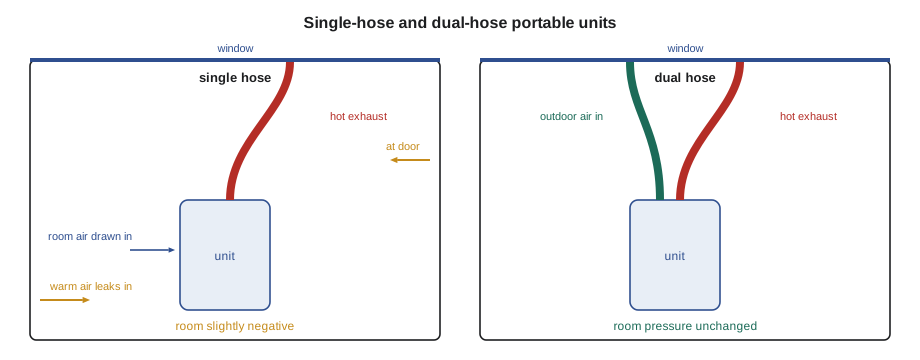
- A single-hose unit draws condenser air from the room, heats it, and blows it out through the hose. Every cubic metre of air it pushes outdoors is replaced by warm outdoor air leaking in around doors and windows, which the unit then has to cool. This infiltration can cancel a large part of the unit's cooling on a hot day.
- A dual-hose unit draws its condenser air from outdoors through one hose and returns it through the other, so it does not depressurize the room. It costs more and has two hoses to fit, but it delivers far more of its rated cooling on hot days.
Portable units deal with condensate in one of three ways: many spray it onto the condenser and send it out through the exhaust hose as vapour, which works well except in very humid weather; some collect it in an internal tank with a float switch that stops the unit and shows a code when the tank is full; and many have a drain port for a hose or a small condensate pump. A unit that "stops cooling and blinks" is often a full tank.
Worked problem
What infiltration costs a single-hose unit
A single-hose unit exhausts about 70 L/s of room air at 24 °C. It is replaced by outdoor air at 32 °C. The heat this brings in is about 1.2 W for each L/s of air and each degree Celsius of temperature difference. How much of the unit's cooling does the infiltration use up?
Show solution
- Temperature difference:
- \[32 - 24 = 8\ ^\circ\text{C}\]
- Heat brought in:
- \[1.2 \times 70 \times 8 = 672 \text{ W}\]
- In BTU/h (1 W is about 3.41 BTU/h):
- \[672 \times 3.41 \approx 2{,}290 \text{ BTU/h}\]
Answer: About 670 W, or nearly 2,300 BTU/h of sensible heat, before counting the moisture the outdoor air carries in. On a unit that delivers perhaps 6,000 BTU/h on a hot day, that is more than a third of its cooling spent on air it pulled in itself.
Reading a portable unit's rating
Older portable units were labelled with a cooling figure from a laboratory test that ignored infiltration and the heat from the hose. Boxes sold in Canada often now carry a second, lower figure from the newer seasonally adjusted test, called the SACC (seasonally adjusted cooling capacity). A unit labelled 12,000 BTU/h on the old basis may show 7,000 to 8,000 BTU/h SACC (typical). The SACC is much closer to what the unit will really deliver, and it is the figure to use when a customer asks whether a unit is big enough.
Ms. Castellane's unit was a single-hose model rated 8,000 BTU/h SACC in a living room of about 32 m² (340 ft²) with a south-facing window wall: under-sized for the room on a hot afternoon even when everything was right. Dee also found that the exhaust hose had been stretched to its full length and draped in a sagging loop, and the window kit had a 4 cm (1 1/2 in) gap at one end stuffed with a towel. She shortened and straightened the hose, sealed the window kit with its foam strip, and explained that a dual-hose unit, or a window unit in a different window, would do better in that room. The shop's job is to fix faults and give honest advice; selling a different unit is the customer's choice.
Checking a portable unit
- The hose: as short and straight as the instructions allow, never extended beyond the maker's length, with no kinks or sags where condensate can collect. A hose that is hot to the touch along its length is normal; the heat it radiates back into the room is one reason the SACC is lower than the old rating. An insulated hose sleeve helps.
- The window kit: sealed around its edges, with the maker's adapters. Gaps let the exhaust air back in and outdoor air in.
- The condensate: an empty tank, a clear drain port and a float switch that moves freely. Many units show a code such as "FL" or "P1" for a full tank (sample codes; the manual lists them).
- The filters: portable units usually have two, one for the evaporator air and one for the condenser air, and both clog with pet hair and dust.
- The refrigeration side: the same checks as a window unit, with current measured against the nameplate and the temperature drop across the evaporator. Many portable units use R-32 or R-290 and carry flammable-refrigerant markings.
Through-wall units
A through-wall air conditioner looks like a window unit but is designed to sit in a metal wall sleeve that passes through an exterior wall. The difference that matters is where the condenser breathes. A window unit draws outdoor air through louvres on its sides and top that sit outside the building. A through-wall chassis draws and discharges all its condenser air through its rear grille, because inside a sleeve its sides are enclosed. Putting a window unit in a sleeve, as had happened in suite 4, chokes its condenser.
Through-wall units are sized to match their sleeves, and sleeves come in a few standard sizes for each brand (typical). A replacement chassis must fit the existing sleeve or the sleeve must be replaced, which is carpentry and wall work beyond an appliance call. The sleeve should slope slightly to the outside so condensate drains, and its rear grille must be clear of leaves, nests and paint. Many through-wall units also have resistance heat or a heat pump for spring and fall.
| Feature | Window unit | Through-wall unit | Portable unit |
|---|---|---|---|
| Condenser air | Side and top louvres outdoors | Rear grille only | Room air or outdoor air by hose |
| Installation | Window opening with side panels | Permanent sleeve in the wall | Floor, hose to a window kit |
| Condensate | Slinger ring and tilt outdoors | Slinger and sloped sleeve | Evaporated in exhaust, tank or drain |
| Typical weakness | Cold-air leaks around the window | Wrong chassis in the sleeve | Infiltration and hose heat |
Packaged terminal air conditioners
A packaged terminal air conditioner (PTAC) is the larger, commercial cousin of the through-wall unit, common in hotels, apartment buildings, seniors' residences and offices. It sits in a standard wall sleeve about 1,070 by 410 mm (42 by 16 in) (typical), runs on 208 or 230 V, and usually includes an electric heat strip for heating. A packaged terminal heat pump (PTHP) reverses its refrigeration cycle to heat efficiently in mild weather and uses its heat strip when it is colder outside.
PTACs plug into a dedicated receptacle under the unit or connect through a subbase or junction box, and their power cords carry the same kind of leakage-detecting plug as room units, sized for the heat strip's current. The cord is matched to the circuit: a 15 A cord, a 20 A cord and a 30 A cord have different plugs, and the heat strip's rating must suit the circuit breaker (typical). The cord Hiro replaced in Mr. Pellingham's office had overheated where its plug was loose in a worn receptacle; he told the owner the receptacle also needed an electrician.
Worked problem
A heat strip on 208 V
A PTAC's heat strip is rated 3.5 kW at 230 V. The building is supplied at 208 V. What does the strip actually deliver, and what current does it draw? A resistive heater's power varies with the square of the voltage.
Show solution
- Power at 208 V:
- \[3.5 \times (208 \div 230)^{2} \approx 2.86 \text{ kW}\]
- Current:
- \[2{,}860 \div 208 \approx 13.8 \text{ A}\]
Answer: About 2.86 kW and 13.8 A, roughly 18 in 100 less heat than the 230 V rating, as the appliance electrical course showed for ranges and dryers. PTACs are often rated for both voltages on the nameplate for this reason, and a customer who finds the heat weak on 208 V is seeing normal behaviour.
Penfold's service on PTACs and PTHPs covers filters, coils, fan motors, controls, thermistors, heat strips and their limits, cords and, when the chassis is factory-sealed with a small charge as most are, the sealed system by a certified technician. Because the chassis slides out of the sleeve, many faults are handled by fitting a spare chassis and taking the faulty one to the shop. A building with many PTACs usually wants a maintenance contract: filters cleaned monthly or quarterly, coils washed once a year and the heat strips tested before winter (typical).
Room units in apartment buildings
Buildings with dozens of through-wall units or PTACs give an appliance shop steady work and some particular problems. Sleeves rust out at their base where condensate sits, letting water into the wall below the unit; a stain on the ceiling of the suite below, or soft drywall under the window, points to a leaking sleeve or a sleeve that has lost its outward slope. Rear grilles fill with leaves, nests and, in older buildings, layers of paint. Wall seals around the sleeve dry out and let in air and water. Sleeve repairs and replacements are building work for a contractor, but the technician who finds them reports them to the owner in writing.
Tenants also tend to block the units' room-side airflow with furniture and curtains, and to run them on the coldest setting around the clock. A short explanation, and a filter cleaned in front of the tenant, often prevents the next call. Penfold keeps a record of each unit in a building under its maintenance contract, by suite, with its model, serial number, install date, cord type and the date of each service, so that a repeat fault on one unit is noticed.
Electrical problems are common in older buildings. Receptacles worn loose by years of plugging and unplugging, aluminum branch wiring, overloaded circuits and missing grounds all show up as burned plugs, tripping cords or breakers that trip whenever the heat strip comes on. The technician replaces the appliance's cord with the maker's part and refers the building wiring to an electrician, with a written note to the owner.
Window units installed in tall buildings need extra care. The unit must be supported as its instructions show, with the supplied brackets or the building's approved support, and must never rest on the sash alone, because a unit that falls from a window can kill someone below. Many building owners set their own rules for window units, and a technician who finds an unsafe installation tells the owner.
Finally, a building owner who wants to replace old room units often asks for advice. The questions to answer are the sleeve size and condition, the circuit and its receptacle, the voltage, the heating needed, and whether the new units use R-32 or R-290 and what that means for the building's service arrangements.
Common mistakes
MistakeFitting a window unit into a through-wall sleeve because it fits the opening.
InsteadUse a through-wall chassis that breathes through its rear grille.
MistakeJudging a portable unit's size by the large figure on an old box.
InsteadUse the SACC figure, which allows for infiltration and hose heat.
MistakeExtending or looping a portable unit's exhaust hose.
InsteadKeep it as short and straight as the instructions allow, with the window kit sealed.
MistakeTreating a portable unit that stops and blinks as a failed compressor.
InsteadCheck the condensate tank and float switch first.
MistakeReplacing a PTAC cord without checking the receptacle it plugs into.
InsteadInspect the receptacle and its connection; refer a worn or overheated receptacle to an electrician.
Summary and key terms
- Portable units vent their condenser air through a hose; single-hose units cause infiltration.
- Infiltration can use up a third or more of a single-hose unit's cooling on a hot day.
- SACC ratings are lower than old portable ratings and much closer to real performance.
- Hose length, kinks and window-kit gaps cut a portable unit's performance.
- Through-wall chassis breathe through their rear grilles; window units must not go in sleeves.
- PTACs and PTHPs run on 208 or 230 V and include heat strips; their cords match the circuit.
- A heat strip on 208 V delivers about 18 in 100 less heat than at 230 V.
- Spare chassis and maintenance contracts suit buildings with many PTACs.
- Portable air conditioner
- A floor-standing room air conditioner that vents its condenser air through a hose.
- Infiltration
- Outdoor air leaking into a room to replace air exhausted from it.
- SACC
- Seasonally adjusted cooling capacity, a portable unit's realistic cooling rating.
- Through-wall unit
- A room air conditioner designed to sit in a wall sleeve and breathe through its rear grille.
- Wall sleeve
- The metal housing built through a wall to hold a through-wall unit or PTAC.
- PTAC
- Packaged terminal air conditioner: a sleeve-mounted unit with cooling and a heat strip.
- Heat strip
- An electric resistance heater inside a PTAC or room unit.
Practice problems
Work each problem on paper first, then reveal the answer to check.
Why does a single-hose portable unit cool poorly on a hot day?
Show answer
It exhausts room air, which is replaced by warm outdoor air the unit must then cool.
What is the SACC?
Show answer
A portable unit's seasonally adjusted cooling capacity, closer to real performance.
What happens when a window unit is put in a through-wall sleeve?
Show answer
Its side louvres are blocked, the condenser overheats and the compressor trips.
What voltages do PTACs run on?
Show answer
208 or 230 V.
What does a portable unit that stops and blinks most often need?
Show answer
Its condensate tank emptied or its float switch freed.
Lesson quiz · 5 questions
Score 60% or more to complete this lesson.
Create a free account to save your progress, take quizzes and earn a certificate.