
APP-330 · Lesson 10 of 12 · 24 min
Small appliances worth repairing
▶ Video coming soon A video version of this lesson is on the way.
Friday, July 31, 2026, was a rainy bench day at the shop, and Dee spent it on the small appliances that customers had dropped off at the parts counter. The first was Agnes Ferrabee's fifteen-year-old tilt-head stand mixer from Thorner. It groaned when switched on, the motor turned, and the beater did not. Dee unplugged it, took off the gear housing cover and drained the old grease. As she expected, the motor's steel worm gear was fine but the plastic worm follower gear it drives had lost its teeth: on many mixers that gear is made deliberately softer than the rest of the gear train so that it fails first when the mixer is overloaded, sparing the motor and the steel gears (typical). Ade had the part on the shelf. With the new gear, fresh food-grade grease, the housing back on and a test with a stiff bread dough, the mixer ran smoothly. The bill was the shop's flat rate for a mixer gear repair, far less than a new mixer. The next item on the bench, a three-year-old countertop microwave with a failed magnetron, went the other way: the parts and labour came to more than a new oven, and Fenna phoned the customer to say so before anything was ordered.
This lesson is about deciding which small appliances are worth repairing, how to repair them safely so they stay as safe as when they were made, what the right-to-repair laws now require of makers, and how Penfold runs its small-appliance bench.
Why small appliances are worth a look
Most small appliances are thrown away when they fail, and many could be fixed. Some are built to last for decades, are expensive to replace and fail in predictable, repairable ways. Repairing them saves the customer money, keeps material out of landfill and builds goodwill that brings the customer back for larger jobs. Others are made so cheaply, or sealed so thoroughly, that a repair costs more than the appliance, and the honest answer is to recycle it.
Penfold accepts small appliances only at its shop counter, for bench repair, not on home visits. Its list, set by Harriet and reviewed each year, covers stand mixers, espresso and bean-to-cup machines, premium blenders, food processors, premium vacuums and a few others for which parts and service data are available. Kettles, toasters, low-cost coffee makers and inexpensive countertop microwaves are not on the list; the counter staff explain why and point customers to the recycling depot.
| Appliance | Typical repairable faults | Usually worth it? |
|---|---|---|
| Stand mixer | Stripped follower gear, worn brushes, speed control, dry grease | Yes, for quality models |
| Espresso or bean-to-cup machine | Scale, leaking gaskets and seals, pump, thermostats, grinder | Often, for mid-range and premium models |
| Premium blender | Worn drive coupling, jar bearing, switch | Often |
| Premium vacuum | Brushroll, belt, motor brushes, battery, hose, filters | Often |
| Food processor | Interlock switch, drive coupling, motor | Sometimes |
| Kettle, toaster, low-cost coffee maker | Element, thermostat, switch | Rarely; parts are seldom sold |
| Low-cost countertop microwave | Magnetron, board, door | Rarely; usually more than a new oven |
Repair or replace
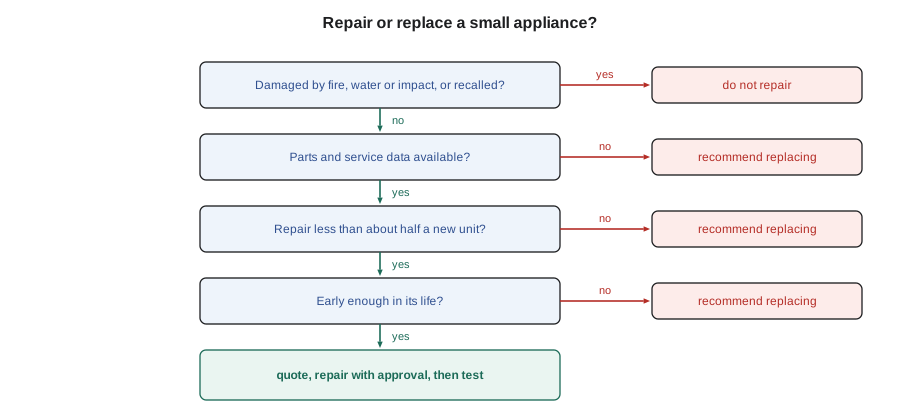
The decision is the customer's, but the technician gives them the facts: the cost of the repair, the price of a comparable new appliance, the appliance's age and expected life, whether parts and service data are available, and whether the repair will leave it safe. A common rule of thumb is to recommend repair when its cost is less than about half the price of a comparable new unit and the appliance is in the first half of its expected life (typical); quality appliances with long lives pass that test far more often than cheap ones.
Worked problem
A mixer worth repairing
A comparable new stand mixer costs about 450 dollars. Ms. Ferrabee's repair needs an 18-dollar gear and one hour of bench time at 85 dollars, plus 13 in 100 HST. What does the repair cost, and how does it compare with a new mixer before tax?
Show solution
- Before tax:
- \[18 + 85 = 103 \text{ dollars}\]
- With tax:
- \[103 \times 1.13 = 116.39 \text{ dollars}\]
- Fraction of a new mixer:
- \[103 \div 450 \approx 0.23\]
Answer: About 116 dollars with tax, less than a quarter of the price of a new mixer, for an appliance that will probably run for many more years. Repair is the clear recommendation.
Worked problem
A microwave not worth repairing
A comparable new countertop microwave costs about 130 dollars. The failed magnetron costs 75 dollars, and the repair, discharge, leakage survey and testing take an hour of bench time at 85 dollars. How does the repair compare?
Show solution
- Repair before tax:
- \[75 + 85 = 160 \text{ dollars}\]
- Compared with a new oven:
- \[160 \div 130 \approx 1.23\]
Answer: The repair would cost about 23 in 100 more than a new oven, before tax, for a three-year-old appliance. Penfold recommends replacement and charges only its bench diagnostic fee.
Keeping a repaired appliance safe
Small appliances sold in Canada must be certified to the applicable CSA or equivalent standard and carry a certification mark such as CSA, cUL or cETL. A repair must leave the appliance as safe as its certified design: the same kinds of parts in the same places, the same insulation and clearances, and the same protective devices.
Dee's rules for the small-appliance bench are:
- Protective devices are replaced, never bypassed. A thermal fuse is a one-time device that opens permanently if the appliance overheats. When one has opened, the cause is found (a failed thermostat, a scaled element, a blocked vent) and the fuse is replaced with one of the same opening temperature and current rating, crimped or clamped, never soldered, as the maker specifies. A higher-rated fuse, or a jumper, removes the protection.
- Thermostats, pressure switches and safety valves on espresso machines and other heated appliances are replaced only with the maker's parts. An espresso machine's boiler holds hot water and steam under pressure; its safety valve must never be blocked or adjusted.
- Cords are replaced with the maker's cord or one of the same type, conductor size, length class and plug, with the strain relief refitted so that a pull on the cord cannot reach the terminals. A grounded appliance keeps its grounding conductor connected to the metal frame.
- Internal wiring is routed exactly as it was, away from hot parts and sharp edges, with the original clips, sleeves and insulating barriers back in place.
- After the repair, the appliance is tested: a visual check of the wiring, a grounding continuity check from the plug's ground pin to the metal frame on grounded appliances, an insulation check from the live pins to accessible metal with an insulation tester or an appliance safety tester where the shop has one, and a full functional test under load.
- Damaged, recalled or water-soaked appliances are not repaired. An appliance with fire or heat damage, a cracked housing that exposes live parts, or a recall notice is returned unrepaired, with an explanation.
| Test after repair | What it shows | Typical result for a pass |
|---|---|---|
| Grounding continuity, plug ground pin to metal frame | The grounding path is intact | Very low resistance, a fraction of an ohm |
| Insulation, live pins to accessible metal | No leakage path from live parts | A very high resistance, in megohms |
| Function under load | Motors, heaters and controls work as designed | Normal operation and temperatures |
| Protective devices | Thermostats and switches cycle as they should | Correct cycling; no overheating |
Espresso machines, vacuums and batteries
Espresso and bean-to-cup machines are the most common premium small appliance on Penfold's bench. Their faults are mostly about water: scale in the boiler or thermoblock, the valves and the brew group from hard water and skipped descaling; hardened gaskets and O-rings that leak; and worn vibratory pumps that cannot reach brewing pressure. Descaling with the maker's descaler, replacing the group gasket and shower screen, and lubricating the brew unit with food-safe grease fix many of them. Electrical work on these machines is done with the machine unplugged and fully cooled, because the boiler can stay hot and pressurized long after it is switched off.
Premium vacuums come in with tangled brushrolls, broken belts, worn motor brushes, cracked hoses and clogged filters, and cordless models with failing lithium-ion batteries. A battery that is swollen, cracked, leaking or has been crushed is not charged, tested or shipped as an ordinary part. It is isolated in a non-flammable container, its terminals are taped, and it goes to battery recycling, which in both countries is available through retailers and collection programs. Replacement batteries come only from the maker or an equivalent approved source, never from unbranded packs with no certification.
Right to repair
Laws in several places now push makers to make repair possible. They matter to an independent shop like Penfold because they make parts, tools and service information easier to get.
In the European Union, the Right to Repair Directive applies from July 31, 2026. It requires makers of covered products, which include many household appliances, to offer repairs at a reasonable price, to make spare parts, tools and repair information available to independent repairers, and not to block independent repair with software or hardware tricks. Canadian and US customers often buy appliances from makers who now design to these rules.
In Canada, two federal bills that received royal assent in November 2024 amended the Copyright Act so that getting around a digital lock is allowed for diagnosing, maintaining or repairing a product, and for making products work together. Quebec's 2023 law against planned obsolescence adds requirements on repairability and the availability of parts and repair information, phased in over several years. These laws do not oblige every maker to sell every part, but they remove some of the legal barriers that once stopped independent technicians.
None of these laws changes the safety rules above. A part bought from a maker under a right-to-repair law must still be the right part, fitted correctly, and the repaired appliance must still pass its tests.
Running the small-appliance bench
Small-appliance work is profitable only if it is organized. Penfold's bench follows a few habits, which the business course will treat more fully:
- Intake at the counter: the appliance, its accessories and the customer's description are logged with a tag number, and the customer agrees to a bench diagnostic fee that is credited to the repair if they go ahead.
- Estimate before work: after diagnosis, Fenna phones or texts the customer with the repair cost and a recommendation. No parts are ordered without approval.
- Flat rates for common repairs, such as a mixer gear or an espresso descale and gasket service, make quoting quick and fair.
- Unclaimed items are handled under the shop's written policy, which the customer signs at intake.
- Records: the fault, the parts, the tests passed and the technician are on the ticket, so a returned appliance can be traced.
Three common bench repairs
Stand mixer gear service. With the mixer unplugged, the planetary or gear housing cover is removed, the old grease is scraped out and weighed or measured so the same amount can be replaced, and each gear is inspected. A stripped follower gear, a worn worm gear, a cracked planetary housing and worn motor brushes are the usual finds. The new gear is fitted with the maker's food-safe grease in the amount the service data gives, the cover is refitted with a new gasket if one is used, and the mixer is run through its speeds with and without a stiff load. A mixer whose speed hunts or surges may need its speed control adjusted or replaced, as the service data describes.
Espresso machine descale and gasket service. The machine is unplugged and fully cooled. The water tank and its filter are removed, the maker's descaler is run through the boiler or thermoblock as the manual describes, the group gasket and shower screen are replaced, and the brew unit on bean-to-cup machines is removed, rinsed and greased with food-safe grease. The machine is then flushed with fresh water until no taste of descaler remains, its pressure and temperature are checked in operation, and its safety valve is confirmed free.
Blender drive coupling. A blender whose motor runs but whose blade does not turn usually has a worn drive coupling, the toothed rubber or plastic part between the motor shaft and the jar. It is replaced with the maker's part; some couplings unscrew in the opposite direction from normal, which the service data notes. The jar's blade bearing is checked for play and leaks at the same time, because a worn bearing wears the new coupling quickly.
Each of these repairs ends with the safety checks in the table above, a note on the ticket of the parts and tests, and a short explanation to the customer of what failed and how to avoid it: not overloading the mixer, descaling the espresso machine on schedule, and not running the blender dry or overloaded.
Common mistakes
MistakeReplacing an opened thermal fuse with a higher-rated one or a jumper.
InsteadFind why it opened, then fit one of the same opening temperature and current rating, crimped or clamped.
MistakeQuoting a repair without comparing it with the price of a new appliance.
InsteadGive the customer the repair cost, the replacement price and a recommendation.
MistakeCharging a swollen lithium-ion battery to test it.
InsteadIsolate it, tape its terminals and send it to battery recycling.
MistakeWorking on an espresso machine soon after switching it off.
InsteadUnplug it and let it cool fully; the boiler stays hot and under pressure.
MistakeReturning a repaired appliance after only a functional test.
InsteadCheck grounding continuity and insulation as well, and record the results.
Summary and key terms
- Some small appliances are durable and repairable; many cheap ones are not worth repairing.
- Penfold repairs a set list of small appliances at its bench, not on home visits.
- Recommend repair when it costs less than about half a comparable new unit early in its life (typical).
- Repairs must keep the appliance as safe as its certified or listed design.
- Thermal fuses and other protective devices are replaced with matching parts, never bypassed.
- Repaired appliances get grounding, insulation and functional tests before they go back.
- Damaged lithium-ion batteries are isolated and recycled, never charged.
- Right-to-repair laws make parts and information easier to get but do not change the safety rules.
- Worm follower gear
- A gear driven by a worm gear, often made softer to fail first and protect a mixer.
- Thermal fuse
- A one-time device that opens permanently when an appliance overheats.
- Safety valve
- A valve that releases pressure from a boiler if it rises too high.
- Strain relief
- A fitting that stops a pull on the cord from reaching the terminals.
- Grounding continuity
- An unbroken path from the plug's ground pin to the appliance's metal frame.
- Bench diagnostic fee
- A charge for diagnosing an appliance at the shop, credited to the repair if approved.
- Right to repair
- Laws that require makers to make parts, tools and information available for repair.
Practice problems
Work each problem on paper first, then reveal the answer to check.
Why do many stand mixers have a plastic follower gear?
Show answer
It is designed to fail first under overload and protect the motor and steel gears.
What must replace an opened thermal fuse?
Show answer
A fuse of the same opening temperature and current rating, after the cause is found.
What tests are done after a small-appliance repair?
Show answer
Grounding continuity, insulation and a functional test under load.
What is done with a swollen lithium-ion battery?
Show answer
It is isolated, its terminals taped, and it is sent to battery recycling.
Does a right-to-repair law change the safety rules for a repair?
Show answer
No; the part must still be correct and the appliance must still pass its tests.
Lesson quiz · 5 questions
Score 60% or more to complete this lesson.
Create a free account to save your progress, take quizzes and earn a certificate.