
APP-330 · Lesson 4 of 12 · 26 min
Over-the-range and built-in microwaves
▶ Video coming soon A video version of this lesson is on the way.
On Monday, August 31, 2026, Dee and Hiro spent the morning in Percival Vellacott's kitchen in Macassa, replacing a 2009 over-the-range microwave whose control board had failed. The new oven had come from a retailer, and Penfold had been asked to install it. The job took longer than the customer expected, and every extra minute had a reason. The old wall plate had been fastened with drywall anchors alone, so Hiro found a stud with his finder and the new plate went up with two screws into the stud and the maker's toggle bolts in the other holes. The duct above the cabinet ran to a wall cap whose damper had been painted shut, so the old oven had been blowing cooking fumes back into the kitchen for years; Dee freed it and checked it swung. The new oven shipped set for recirculation, so before lifting it Dee turned its blower to exhaust outdoors through the top, as the installation instructions showed. Then the two of them lifted it together, hooked it on the plate, fed the cord up into the cabinet and drew the top bolts tight. A water test, a leakage survey at a maximum of 0.1 mW/cm², and a check that the hood fan's high speed pushed the wall cap's damper wide open finished the call.
This lesson covers microwaves that are fitted into the kitchen rather than set on a counter: over-the-range ovens that double as range hoods, built-in and trim-kit installations, combination wall ovens and microwave drawers. It explains how they are mounted, powered and vented, what clearances matter, and how their service differs from a countertop oven.
Kinds of fitted microwave
- An over-the-range (OTR) microwave hangs on a wall plate above a range or cooktop and is bolted through the bottom of the cabinet above it. It combines a microwave oven with a range hood: a hood fan under the oven draws air from the cooktop through grease filters, lights in its underside light the cooktop, and the air is either recirculated through a charcoal filter or ducted outdoors.
- A built-in microwave is a countertop or purpose-built oven installed in a cabinet or wall opening with the maker's trim kit, which closes the gap around the oven and, just as important, channels its cooling air in and out at the front.
- A combination wall oven pairs a microwave, often with convection, above a conventional wall oven in one cabinet. Speed ovens combine microwave, convection and grill heating in one cavity.
- A microwave drawer sits below the counter and opens like a drawer, with a motor-driven slide and the same door interlock principles worked by the drawer's movement.
All of them contain the same magnetron, high-voltage circuit and door safety system as a countertop oven, and every rule from lessons 2 and 3 still applies. What changes is how they are mounted and ventilated, how much they weigh, and how they are reached for service.
Mounting an over-the-range oven
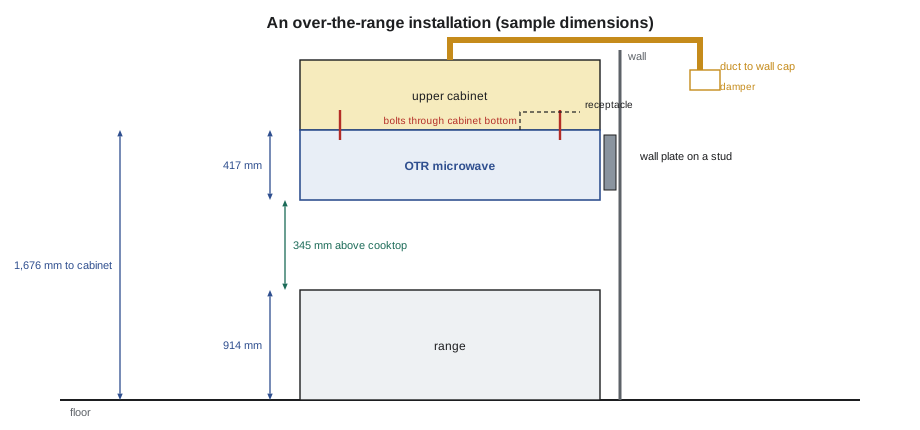
An OTR oven typically weighs 23 to 30 kg (50 to 65 lb) (typical) and hangs over a hot cooking surface, so its mounting is a safety matter. The installation instructions, which come with a paper template, are followed exactly. The key points are:
- The wall plate is fastened to at least one wall stud, with the maker's toggle bolts in the other holes, in the positions the template shows. Drywall anchors alone are not acceptable.
- The top bolts pass through holes drilled in the bottom of the upper cabinet, in the template's positions, and take much of the load. The cabinet must be sound; a cabinet with a thin or damaged bottom is reinforced first.
- Two people lift the oven. One supports it while the other starts the top bolts, and the oven is never left hanging on the plate alone.
- Clearances above the cooking surface and in the cabinet opening are those the instructions give. A common pattern is a cabinet opening about 76 cm (30 in) wide and a minimum distance from the cooking surface to the bottom of the oven (typical; the oven's instructions and the range's instructions both apply, and the stricter one governs).
Worked problem
Checking the height above the cooktop
The cooktop is 914 mm above the floor and the bottom of the upper cabinet is 1,676 mm above the floor. The new OTR oven is 417 mm tall. The sample instructions require at least 330 mm from the cooking surface to the bottom of the oven. Does the installation meet it?
Show solution
- Height of the oven bottom:
- \[1{,}676 - 417 = 1{,}259 \text{ mm}\]
- Distance above the cooktop:
- \[1{,}259 - 914 = 345 \text{ mm}\]
- Compare:
- \[345 \ge 330\]
Answer: Yes: 345 mm against a 330 mm minimum, with 15 mm to spare. If the range's own instructions call for a larger distance, that larger figure governs, and the oven cannot be installed above that range.
Power for a fitted oven
An OTR oven plugs into a receptacle inside the cabinet above it, and most installation instructions call for a dedicated, grounded 120 V circuit of the rating they state, often 20 A (typical). A built-in oven or combination wall oven may be hard-wired or plugged into a receptacle behind the oven, and a combination wall oven is often on its own 240 V circuit. If the existing receptacle, its circuit or its grounding does not meet the instructions, the customer is referred to an electrician; Penfold technicians connect to existing, correct circuits and do not run new ones.
Worked problem
Why the instructions ask for a dedicated circuit
An OTR oven draws 1,650 W from the line when the magnetron runs. Its hood fan on high draws 90 W and its cooktop lights 40 W. What current does it draw at 120 V with everything running, and what does that leave on a 15 A circuit?
Show solution
- Total power:
- \[1{,}650 + 90 + 40 = 1{,}780 \text{ W}\]
- Current:
- \[1{,}780 \div 120 \approx 14.8 \text{ A}\]
- Left on a 15 A circuit:
- \[15 - 14.8 = 0.2 \text{ A}\]
Answer: About 14.8 A, leaving almost nothing for a kettle or toaster on the same circuit. That is why the oven needs a circuit of its own, of the rating the instructions give, and why a customer whose breaker trips when the microwave and kettle run together has a circuit problem, not an oven fault.
Venting an over-the-range oven
An OTR oven's hood fan can be set up in one of three ways, and the oven usually ships set for one of them. Changing the setup means turning or moving the blower inside the oven and fitting or removing plates, as the instructions show, before the oven is lifted onto the wall.
- Recirculating: air is drawn through the grease filters and a charcoal filter and blown back into the kitchen through the grille. It removes some grease and odour but none of the heat or moisture. The charcoal filter is replaced every 6 to 12 months (typical).
- Outside exhaust through the top: the blower discharges into a duct that runs up through the cabinet to a roof or wall cap.
- Outside exhaust through the back: the blower discharges straight through the wall behind the oven to a wall cap.
Ducted installations use the duct size and type the instructions give, typically a rectangular duct about 8 by 25 cm (3 1/4 by 10 in) or a round duct about 15 cm (6 in) across (typical), with as few elbows as possible. Each elbow and the cap count as an equivalent length of straight duct, and the total must not exceed the instructions' maximum. Every ducted system needs a damper that opens when the fan runs and closes when it stops, to keep out cold air and pests. A painted, rusted or blocked damper, like Mr. Vellacott's, makes the fan noisy and nearly useless.
Worked problem
Equivalent length of a duct run
A sample installation table gives these equivalent lengths: straight duct at its actual length, each 90° elbow 3 m, a wall cap 0 m, and a maximum total of 42 m. A run has 3 m of straight duct and two 90° elbows. Is it within the limit?
Show solution
- Equivalent length:
- \[3 + 2 \times 3 + 0 = 9 \text{ m}\]
- Compare with the maximum:
- \[9 \le 42\]
Answer: Well within the limit. Long runs with many elbows lose airflow, and the fan then moves less air than its rating; the sample values here are for illustration, and each oven's own table governs.
Most OTR hood fans move about 300 to 400 cubic feet per minute on high (typical). Larger range hoods can depressurize a house, as the cooking course explained, and the Ontario Building Code sets requirements for exhaust and make-up air that the installer and the customer's contractor must respect.
Many OTR ovens also have a heat sensor under the oven that starts the hood fan automatically if the cooktop below runs very hot, to protect the oven's electronics. A customer who says "the fan comes on by itself" is often describing this feature. The fan cannot be switched off by the user until the area has cooled.
Built-in installations and trim kits
A countertop oven needs air: it draws cooling air in through its vents and pushes hot air out, usually at the back, the sides or the top. Pushing a countertop oven into a cabinet without the maker's trim kit starves it of air, and the magnetron and electronics overheat; the thermal cutouts open, the oven stops partway through cooking, and parts fail early. A trim kit is designed for a specific oven model and channels air in and out at the front. If a customer's oven is boxed in without its kit, the fix is the kit, not a new magnetron.
Built-in and combination wall ovens are designed to be installed in a cabinet and come with their own cutout dimensions, ventilation path and anti-tip or mounting brackets. Their installation instructions, like those of any wall oven, give the cutout size, the support the cabinet must provide and the electrical connection.
Servicing fitted ovens
Fitted ovens are serviced in place where the design allows. Many OTR ovens let the technician remove the grille and the control panel from the front and reach the control board, the door switches or the hood fan motor without taking the oven down. Work on the high-voltage parts or the magnetron usually means taking the oven off the wall: two people, the cord unplugged in the cabinet, the top bolts out while the oven is supported, and the oven lifted off the plate and carried to a protected surface. Built-in ovens slide out of their trim kits, and combination wall ovens follow their own manual.
The common faults are the same as on countertop ovens, plus those of the hood: grease-clogged filters, failed hood fan motors and lights, a heat sensor that holds the fan on, and stuck dampers. After any repair that touched the door, switches, waveguide or magnetron, the oven gets a leakage survey (lesson 3) once it is back in place, and after any reinstallation the mounting is checked and the duct connection is confirmed.
| Complaint | Usual cause | Check |
|---|---|---|
| Hood fan noisy, little airflow outside | Stuck damper, crushed or long duct, blower set for recirculation | Watch the damper; check the blower setup |
| Hood fan starts on its own | Heat sensor responding to a hot cooktop | Explain; test the sensor if it runs when cold |
| Oven stops partway through cooking (built-in) | No trim kit, blocked vents, overheating | Fit the trim kit; clear the air path |
| Grease dripping from the filters | Filters not cleaned | Clean or replace the grease filters |
| Oven sagging at the front | Loose top bolts or failed wall plate fastening | Support the oven and refasten as the instructions show |
Microwave drawers and combination ovens
A microwave drawer opens with a motor that drives the drawer out on slides when the user presses a button, and closes it the same way. Its door safety system works like any other: interlock switches worked by the drawer's movement, and a monitor switch. Common faults are a drawer that will not open or close because of a failed drive motor, a jammed slide or a fault in the drawer's position switches, and the control shows a code for each. The drawer is never forced, because its gear train is easily damaged; the service manual explains how to release it manually when it is stuck.
Combination wall ovens and speed ovens add convection elements, grill elements and their fans and limits to the microwave section. Their diagnosis combines the cooking course's methods for elements and sensors with this course's methods for the high-voltage circuit and door system. Because they are hard-wired or plugged in behind the cabinet, and heavy, they are removed from the wall only as the manual describes, with two people.
Common mistakes
MistakeHanging an OTR oven on a wall plate fastened only with drywall anchors.
InsteadFasten the plate to at least one stud with the maker's toggle bolts as the template shows.
MistakeLifting an OTR oven alone.
InsteadTwo people lift it; one supports it until the top bolts are tight.
MistakeInstalling a ducted OTR oven still set for recirculation.
InsteadTurn or move the blower as the instructions show before lifting the oven.
MistakeBuilding a countertop oven into a cabinet without its trim kit.
InsteadUse the maker's trim kit so the oven gets its cooling air.
MistakePlugging an OTR oven into a shared circuit because the receptacle is there.
InsteadUse the dedicated circuit the instructions call for, or refer the customer to an electrician.
Summary and key terms
- OTR ovens are microwaves and range hoods in one, hung on a wall plate and bolted through the cabinet.
- The wall plate goes into at least one stud; two people lift the oven.
- Clearances above the cooktop come from the oven's and the range's instructions; the stricter governs.
- Most OTR ovens need a dedicated grounded 120 V circuit of the rating the instructions give.
- Hood fans recirculate through charcoal or exhaust outdoors through the top or back.
- Ducts follow the instructions' size and equivalent-length limit, with a free-swinging damper.
- Built-in ovens need the maker's trim kit for cooling air.
- High-voltage work on an OTR oven usually means taking it down; survey for leakage once it is back.
- Over-the-range microwave
- A microwave oven combined with a range hood, mounted above a cooktop.
- Wall plate
- The steel bracket on the wall that an OTR oven hangs on.
- Trim kit
- The maker's kit that fits a countertop oven into a cabinet and channels its cooling air.
- Recirculating hood
- A hood that filters air through charcoal and returns it to the kitchen.
- Damper
- A flap in the duct or cap that opens when the fan runs and closes when it stops.
- Equivalent length
- The length of straight duct that causes the same resistance as a fitting.
- Heat sensor
- A sensor that starts the hood fan automatically when the cooktop below is very hot.
Practice problems
Work each problem on paper first, then reveal the answer to check.
What must an OTR wall plate be fastened to?
Show answer
At least one wall stud, with the maker's toggle bolts in the other holes.
What is done to the blower before a ducted installation?
Show answer
It is turned or moved to the outside-exhaust setup the instructions show.
Why does a built-in oven need its trim kit?
Show answer
To channel cooling air in and out at the front so the oven does not overheat.
A hood fan starts by itself when the cooktop is on high. Is this a fault?
Show answer
Usually not; it is the heat sensor protecting the oven.
What is checked after reinstalling an OTR oven that had a door repair?
Show answer
The mounting, the duct connection and a leakage survey.
Lesson quiz · 5 questions
Score 60% or more to complete this lesson.
Create a free account to save your progress, take quizzes and earn a certificate.