
APP-330 · Lesson 2 of 12 · 26 min
Microwave high-voltage circuits and safe discharge
▶ Video coming soon A video version of this lesson is on the way.
On Monday, August 24, 2026, Dee's first call was Leander Oakhurst in Burkholme, whose four-year-old 1,100 W countertop microwave ran normally, with the light on, the fan blowing and the tray turning, but left a cup of water cold. Dee unplugged the oven, waited, took off the outer cover and, before her hands went anywhere near the parts, discharged the high-voltage capacitor with her insulated discharge tool, first across its terminals and then from each terminal to the chassis. Only then did she test. The magnetron filament read 0.3 Ω and showed no connection to its case, which is what a good magnetron shows. The capacitor showed its internal bleeder resistor and no short to its case. The high-voltage diode, tested by the maker's method, conducted in both directions. It had shorted, so the circuit could not build the voltage the magnetron needs. A new diode, the cover back on, and a water test gave 940 W. In the file Dee added a line she repeats to every apprentice: "The capacitor is discharged before I test anything, every time, even when I watched the oven sit unplugged for an hour."
Kiran had already seen why. On the morning of Tuesday, October 20, his second day, Dee had shown him a recycled microwave on the shop bench with its cover off and had not let him touch it. This lesson explains the high-voltage circuit he was looking at: the transformer, the capacitor, the diode and the magnetron, how they make several thousand volts, how inverter ovens differ, how to discharge the circuit safely, and how to test the parts with the oven unplugged.
Why the microwave is the most dangerous appliance on the bench
Most appliances run on 120 V or 240 V, which can kill, and a few store energy in capacitors after they are unplugged. A microwave oven does both on a far larger scale. Its high-voltage transformer raises the line voltage to about 2,000 V AC (typical), and its voltage doubler pushes the magnetron's cathode to about 4,000 V negative (typical). The transformer can drive several hundred milliamps at that voltage, many times more than enough to stop a heart, and the high-voltage capacitor can hold a lethal charge long after the plug is pulled if its bleeder resistor has failed. The outer cover is the only barrier between a person and that circuit, and the cover is screwed on because it is meant to be removed only by a trained technician.
Penfold's rules for the high-voltage section, which follow the makers' service manuals, are:
- The oven is unplugged, not just switched off, before the outer cover is loosened.
- The high-voltage capacitor is discharged by the procedure below before anything inside is touched, measured or disconnected.
- No high-voltage measurement is ever made with the oven running. Ordinary meters, test leads and the technician's body are not rated for it. All high-voltage parts are tested cold, with resistance, diode and capacitance checks.
- The oven is never run with the outer cover off, and never with any part of the door safety system bypassed (lesson 3).
- Rings, watches and metal jewellery come off, and the technician works with one hand where possible.
The circuit, part by part
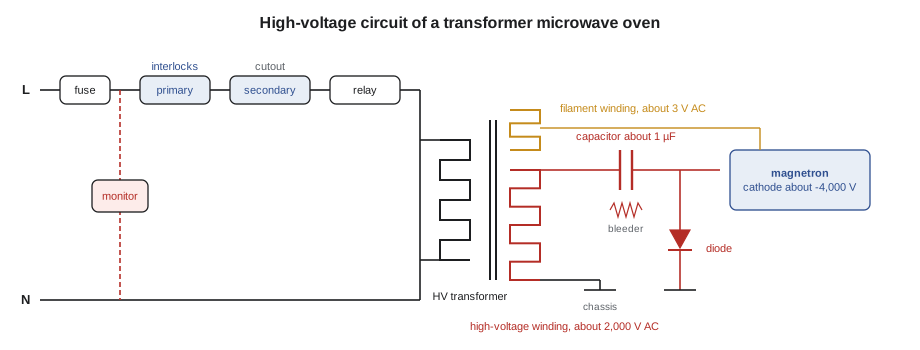
Follow the power from the plug. The line passes through a main fuse, often a ceramic fuse of about 15 to 20 A (typical), then through the door interlock switches (lesson 3) and one or more thermal cutouts, and finally through a relay or triac on the control board that the board closes when cooking starts. When that relay closes, line voltage reaches the primary winding of the high-voltage transformer. The transformer has two secondary windings:
- A filament winding of only a few turns that supplies about 3 V AC to heat the magnetron's cathode (typical). It is a low voltage, but it is connected to the high-voltage side, so the filament leads are just as dangerous.
- A high-voltage winding that delivers about 2,000 V AC (typical). One end is usually bonded to the oven chassis; the other feeds the capacitor.
The high-voltage capacitor, typically about 0.9 to 1.1 µF and rated around 2,100 V AC (typical), sits between the high-voltage winding and the magnetron. Inside it is a bleeder resistor of about 10 MΩ (typical) that drains its charge after the oven stops. The high-voltage diode runs from the capacitor-magnetron junction to the chassis. Some ovens also have a high-voltage fuse in the secondary circuit, or a protector across the capacitor that shorts if the voltage climbs too high. The magnetron's cathode connects to the capacitor-diode junction and its anode is the chassis.
How the doubler makes about 4,000 V
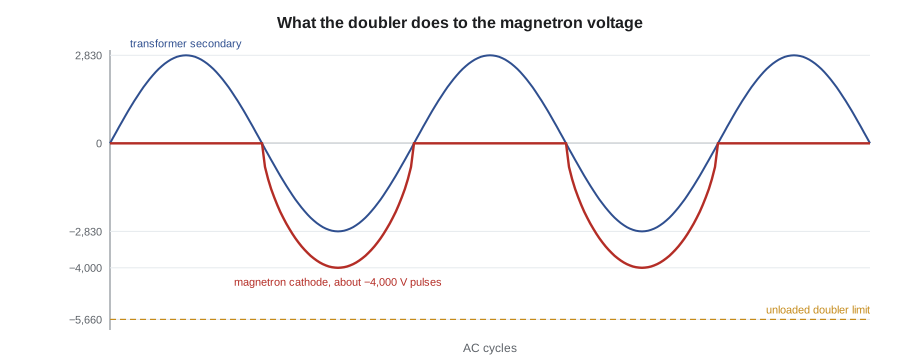
The capacitor and diode form a half-wave voltage doubler. On one half of each AC cycle, the high-voltage winding drives current through the diode, and the capacitor charges to about the peak of the winding's voltage. On the next half cycle the winding's voltage reverses and adds to the voltage already stored in the capacitor, so the magnetron's cathode is driven to roughly twice the peak, negative compared with the chassis. Without a load the voltage could reach about twice the peak; with the magnetron running, the magnetron conducts as soon as the voltage reaches its operating level and holds the voltage close to about 4,000 V (typical). The magnetron therefore receives pulses of high voltage 60 times a second.
Worked problem
Peak and doubled voltage
A high-voltage winding delivers 2,000 V AC (the usual RMS value). What is its peak voltage, and roughly what could the doubler reach with no magnetron connected?
Show solution
- Peak of a sine wave is about 1.414 times the RMS value:
- \[2{,}000 \times 1.414 \approx 2{,}830 \text{ V}\]
- An unloaded doubler can approach twice the peak:
- \[2 \times 2{,}830 \approx 5{,}660 \text{ V}\]
Answer: About 2,830 V peak, and as much as about 5,660 V with no load. The running magnetron clamps the voltage near its operating level, about 4,000 V. Either way, the numbers are far beyond anything a hand-held meter or its leads are built to measure, which is why the circuit is only ever tested cold.
Inverter microwave ovens
An inverter oven replaces the heavy high-voltage transformer, capacitor and diode with an inverter board. The board rectifies the line to a DC bus, switches it at tens of kilohertz through a small high-frequency transformer, and rectifies and filters the output to drive the magnetron (typical). Because the board can vary how much energy it delivers, the magnetron runs continuously at lower power settings instead of cycling.
The inverter board is a high-voltage device in its own right. It holds a charged bus capacitor on its line side (as the electronics course explained) and high-voltage parts on its output side, and its metal heat sinks may be live. Makers usually treat it as a replaceable unit: the technician confirms that the board receives line power and a command, checks the magnetron cold, and replaces the board if the maker's flowchart points to it. The board's own discharge procedure, its test points and its waiting time are in the service manual, and they are followed exactly. Penfold does not repair inverter boards at component level.
Discharging the high-voltage capacitor
The bleeder resistor should drain the capacitor within a minute or so after the oven stops, but a bleeder can fail open, and a failed capacitor can hold its charge for days. The discharge is therefore done every time, whether or not the oven has been sitting unplugged. Makers' procedures differ in detail; Dee's, which follows the pattern in most manuals, is:
- Unplug the oven and wait at least a minute, then remove the outer cover without letting the cover or a screwdriver fall into the circuit.
- Locate the capacitor and its terminals using the wiring diagram. On inverter ovens, find the board's named discharge points instead.
- Using an insulated discharge tool rated for the voltage, with the hand well behind its guard, connect across the two capacitor terminals and hold for several seconds. Penfold's tool has an insulated handle, a resistor to limit the discharge current and a clip lead, as the makers recommend.
- Then connect from each terminal to the chassis in turn, because a fault can leave one side charged.
- Only then disconnect the leads, and leave the capacitor shorted with a jumper while working if the manual says to.
Worked problem
Energy stored in the capacitor
How much energy does a 1.0 µF high-voltage capacitor hold at 2,830 V, and at 4,000 V? The energy stored in a capacitor is half the capacitance times the voltage squared.
Show solution
- At 2,830 V:
- \[\tfrac{1}{2} \times 1.0 \times 10^{-6} \times 2{,}830^{2} \approx 4.0 \text{ J}\]
- At 4,000 V:
- \[\tfrac{1}{2} \times 1.0 \times 10^{-6} \times 4{,}000^{2} = 8.0 \text{ J}\]
Answer: Four to eight joules delivered at thousands of volts is easily enough to cause a severe injury or worse. The energy is small compared with a household load, but the voltage drives it through skin, which is why the discharge is never skipped.
Worked problem
How fast the bleeder works
The capacitor holds 2,830 V. Its bleeder resistor is 10 MΩ. The time constant equals resistance times capacitance, and after five time constants about 1 in 150 of the starting voltage is left. How long does the bleeder take, and what is left?
Show solution
- Time constant:
- \[10 \times 10^{6} \times 1.0 \times 10^{-6} = 10 \text{ s}\]
- Five time constants:
- \[5 \times 10 = 50 \text{ s}\]
- Voltage left:
- \[2{,}830 \times e^{-5} \approx 19 \text{ V}\]
Answer: A working bleeder brings the capacitor down to about 19 V in under a minute. If the bleeder has failed open, nothing drains it, which is why the technician discharges the capacitor anyway.
Testing the parts cold
With the capacitor discharged and the leads removed from the part being tested, each high-voltage component is checked against the maker's values. The figures below are typical; the service manual's figures govern.
| Part | Test (oven unplugged, capacitor discharged) | Typical good result |
|---|---|---|
| Magnetron filament | Resistance between the two filament terminals | Less than 1 Ω |
| Magnetron insulation | Each filament terminal to the magnetron case, highest resistance range | No continuity (open) |
| High-voltage capacitor | Terminal to terminal; then each terminal to the case; capacitance meter if available | About the bleeder value (about 10 MΩ); open to case; within about 10 in 100 of the marked µF |
| High-voltage diode | By the maker's method: often a 9 V battery in series with the meter, or a meter that can test high-voltage diodes | Conducts one way only |
| Transformer primary | Resistance across the primary | A fraction of an ohm to about 2 Ω |
| Transformer high-voltage winding | Resistance across the winding | About 50 to 150 Ω |
| Transformer filament winding | Resistance across the winding | Less than 1 Ω |
| Thermal cutouts and fuses | Continuity when cold | Closed |
A diode cannot be checked with an ordinary meter's diode test alone, because it is really a stack of many junctions in series and needs more than the meter's small test voltage to conduct; that is why makers specify a battery in series or a special tester. A shorted diode, like Mr. Oakhurst's, reads low both ways. A capacitor that shows a short between its terminals, or any connection to its case, is replaced. A magnetron with an open filament, or with any reading from the filament to its case, is replaced; so is one whose antenna dome is cracked or burned.
When the main fuse has blown, it has blown for a reason, and a new fuse is not installed until the reason is found. The usual causes are a shorted diode, capacitor or magnetron, a shorted transformer winding, or the door monitor switch doing its job because an interlock has failed (lesson 3). Every high-voltage part and the interlock system are checked before the oven is powered again, and the replacement fuse is the exact type and rating on the diagram.
Diagnosing an inverter oven
On an inverter microwave the same questions are asked in a different order. Does the control board close its relay and send the inverter board its command when cooking starts? Does the inverter board receive line voltage? Is the magnetron sound when tested cold, with its filament under 1 Ω and no connection to its case? If all three answers are yes and the oven still does not heat, the maker's flowchart usually points to the inverter board, which is replaced as a unit. The board is never powered with the outer cover off, and its discharge points and waiting time are those in its service manual.
Inverter boards also have their own protective faults. Many shut down if their heat sink overheats, if the magnetron draws too much or too little current, or if the line voltage is far outside its range, and some show a fault code on the display. A board that fails again soon after replacement often has a cause outside itself: a magnetron with a weak filament, a blocked cooling path, or a loose connector at the magnetron's filament terminals that overheats. Those are checked before a second board is ordered.
Common mistakes
MistakeTrusting the bleeder resistor and skipping the discharge.
InsteadDischarge the capacitor every time: across the terminals, then each terminal to the chassis.
MistakeMeasuring the high voltage with a meter while the oven runs.
InsteadNever; test every high-voltage part cold by resistance, diode and capacitance checks.
MistakeTesting the high-voltage diode with an ordinary diode-test function and calling it open.
InsteadUse the maker's method, such as a battery in series, because the diode needs more test voltage.
MistakeReplacing a blown main fuse and plugging the oven in to see what happens.
InsteadFind why it blew first: the diode, capacitor, magnetron, transformer and interlocks.
MistakeTreating the filament leads as low voltage because the filament runs on 3 V.
InsteadThe filament winding sits at the full high voltage; treat it like the rest of the circuit.
Summary and key terms
- The transformer makes about 2,000 V AC; the doubler drives the magnetron cathode to about 4,000 V.
- The high-voltage capacitor holds a lethal charge and is discharged before anything is touched.
- Discharge across the terminals, then from each terminal to the chassis, with an insulated tool.
- Nothing in the high-voltage section is measured with the oven running.
- Test the magnetron, capacitor, diode and transformer cold against the maker's values.
- A shorted diode reads low both ways; a good magnetron filament reads under 1 Ω and open to its case.
- Inverter ovens use a board instead of a transformer, with their own discharge points and procedure.
- A blown main fuse always has a cause, which is found before the oven is powered again.
- High-voltage transformer
- The transformer that raises line voltage to about 2,000 V and supplies the magnetron filament.
- Voltage doubler
- The capacitor and diode circuit that roughly doubles the transformer's peak voltage.
- High-voltage capacitor
- The capacitor in the doubler, which can hold a lethal charge after the oven is unplugged.
- Bleeder resistor
- A high-value resistor inside the capacitor that drains its charge after use.
- High-voltage diode
- The diode that, with the capacitor, forms the doubler.
- Inverter board
- An electronic board that replaces the transformer in an inverter microwave oven.
- Discharge tool
- An insulated tool used to drain a capacitor safely before work.
Practice problems
Work each problem on paper first, then reveal the answer to check.
About what voltage does the doubler apply to a running magnetron?
Show answer
About 4,000 V negative, typical.
In what order is the capacitor discharged?
Show answer
Across its terminals, then from each terminal to the chassis.
Why is an ordinary meter's diode test not enough for a microwave diode?
Show answer
The diode needs more test voltage than the meter provides.
What does a good magnetron show between filament and case?
Show answer
No continuity.
What is done before replacing a blown main fuse?
Show answer
Find and fix the cause, checking the high-voltage parts and the interlocks.
Lesson quiz · 5 questions
Score 60% or more to complete this lesson.
Create a free account to save your progress, take quizzes and earn a certificate.