
APP-330 · Lesson 7 of 12 · 25 min
Dehumidifiers
▶ Video coming soon A video version of this lesson is on the way.
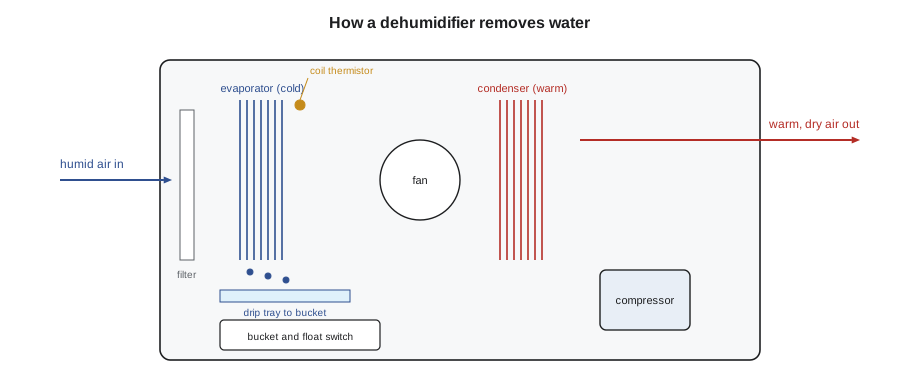
Orville Wexley's basement in Lawfield smelled musty again, though his five-year-old dehumidifier ran all day. Dee went on Monday, August 10, 2026. The basement was cool, about 16 °C (61 °F), and the unit's bucket held only a cup of water after a day of running. When she took off the front grille, the reason was plain: the evaporator coil was a solid block of frost, so the air passed around it instead of through it, and nothing condensed. A dehumidifier in a cool basement normally frosts a little and then defrosts by stopping its compressor and running its fan until a thermistor on the coil reports that the frost has melted. This one never defrosted. With the unit unplugged, Dee unclipped the coil thermistor and measured it: open circuit, where the service data called for about 10 kΩ at 25 °C (77 °F). With the thermistor open, the board read the coil as warm and never started a defrost. A new thermistor, a melted coil, a clean filter and a short drain hose to the floor drain, and by the next morning Mr. Wexley's bucket would not need emptying again. The humidity meter Dee left in the basement read 47 in 100 a week later.
This lesson explains how a refrigerant dehumidifier removes water from air, why cool basements make them frost and how they defrost, when a desiccant unit is the better tool, how dehumidifiers are rated, how they drain, and how to diagnose the commonest faults.
How a dehumidifier removes water
A refrigerant dehumidifier is a small refrigeration system arranged so that both of its coils sit in the same airstream. A fan draws room air first through the evaporator, which runs well below the air's dew point, so water vapour condenses on the cold fins and drips into a pan and then a bucket or drain. The cooled, drier air then passes through the condenser, which reheats it, and leaves the unit warmer and much drier than it entered. A humidistat or an electronic humidity sensor switches the compressor to hold the humidity the user has set.
Because the condenser sits indoors, a dehumidifier warms the room slightly. All the electricity it uses ends up as heat in the room, and so does the latent heat released when the water vapour condenses. In a damp basement in summer that is harmless and sometimes welcome; it is why a dehumidifier cannot be used as an air conditioner.
Worked problem
How much heat a dehumidifier adds
A dehumidifier draws 600 W and removes 16.6 L of water a day. Condensing water releases about 2,450 kJ per kilogram, and 1 L of water is about 1 kg. What is the total heat it adds to the room, on average?
Show solution
- Electrical heat:
- \[600 \text{ W}\]
- Latent heat per day:
- \[16.6 \times 2{,}450 \approx 40{,}670 \text{ kJ}\]
- Average latent heat rate:
- \[40{,}670{,}000 \div 86{,}400 \approx 471 \text{ W}\]
- Total:
- \[600 + 471 \approx 1{,}070 \text{ W}\]
Answer: About 1,070 W, the same as a small space heater, while the unit runs at full output. That is normal and explains why customers notice the room getting warmer.
Cool rooms, frost and defrost
The colder the room, the colder the evaporator runs. In a room below about 18 °C (65 °F) the evaporator surface can fall below freezing, and the water collects as frost instead of dripping off (typical). A little frost is normal; a thick layer blocks the airflow, and water removal stops. Dehumidifiers defrost in one of two ways:
- Most household units stop the compressor and keep the fan running, so room air melts the frost. A coil thermistor tells the board when the coil is cold enough to need a defrost and when it has warmed enough to restart. Older units used a bimetal defrost thermostat on the coil instead.
- Some units use hot-gas defrost, opening a valve that sends hot refrigerant from the compressor straight into the evaporator, which melts frost faster and lets the unit work in cooler rooms.
A failed thermistor or defrost thermostat, as in Mr. Wexley's unit, a low refrigerant charge (which also makes the coil run colder and frost from one end), a dirty filter and a fan that is not turning all cause heavy frost. Below about 5 °C (41 °F), refrigerant dehumidifiers spend more time defrosting than drying and become nearly useless (typical).
A desiccant dehumidifier uses a slowly turning wheel coated with a drying material such as silica gel or a zeolite. Room air passes through one sector of the wheel, which adsorbs the moisture; a small heater and fan dry the other sector and blow the moist air into the bucket or out through a duct. Desiccant units have no compressor, work in cold garages, crawl spaces and cottages, and are quieter, but they use more energy per litre in warm rooms and blow out warmer air. For a cold space, a desiccant unit is the right recommendation.
Ratings and what they mean
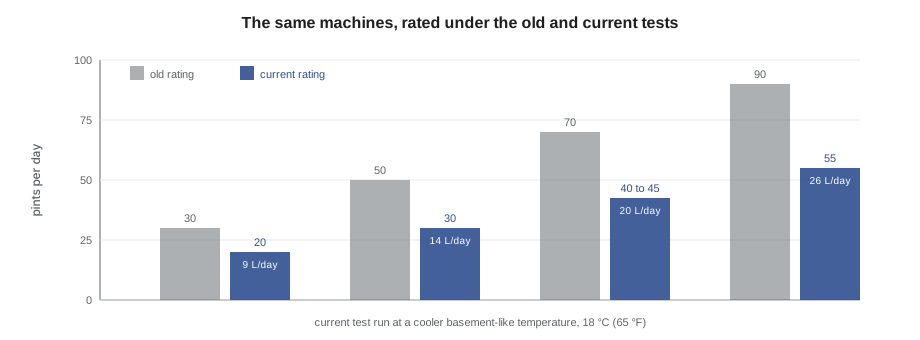
Dehumidifiers sold in Canada are usually labelled in pints per day under the same test method used in the US, often with the litre figure beside it. Since 2019 that test has been run at 18 °C (65 °F) and 60 in 100 relative humidity, a basement-like condition, instead of the older 27 °C (80 °F). The same unit therefore carries a smaller number than it did under the old test: a unit sold as 70 pints a day under the old rating is now rated about 40 to 45 pints a day, and one once called 50 pints is now about 30 (typical equivalents published by ENERGY STAR). Efficiency is given as an integrated energy factor in litres of water per kWh.
Customers replacing an old unit often compare the new rating with the old one and think they have bought a smaller machine. A quick explanation of the change saves a callback.
Worked problem
Capacity and running cost
A dehumidifier is rated 35 pints a day under the current test, and its integrated energy factor is 1.8 L/kWh. One US pint is 0.473 L. In a damp basement it removes 12 L a day. What is its rating in litres, and what does a day of running cost at 0.12 dollars per kWh?
Show solution
- Rating in litres:
- \[35 \times 0.473 \approx 16.6 \text{ L/day}\]
- Energy for 12 L:
- \[12 \div 1.8 \approx 6.7 \text{ kWh}\]
- Cost:
- \[6.7 \times 0.12 \approx 0.80 \text{ dollars a day}\]
Answer: About 16.6 litres a day of rated capacity, and roughly 80 cents a day to run in a damp basement at the sample price. Setting the humidity target sensibly and keeping the filter clean keep that cost down.
For most basements, a setting of about 45 to 50 in 100 relative humidity controls mould and musty smells without running the unit needlessly (typical). A cheap humidity meter left in the basement, as Dee did, tells the customer whether the unit is doing its job.
Draining the water
- Bucket: a float switch stops the compressor and lights an indicator when the bucket is full or not seated. A bucket that is not pushed fully home, or a float that sticks, gives a false full signal.
- Gravity drain: most units have a port for a garden hose or a short tube. The hose must run downhill all the way to a floor drain or sump, with no loops or rises, and the bucket is usually left in place to catch the water. A hose that rises even a little backs water into the unit.
- Built-in pump: some units pump water up to a sink or out a window through a thin tube. The pump has its own float and fault code, and a kinked or frozen tube stops it.
Whole-house dehumidifiers that are ducted into a furnace or air handler are installed by HVAC contractors; Penfold services portable units.
Diagnosing a dehumidifier
| Complaint | Likely causes | Checks |
|---|---|---|
| Runs, little or no water, coil frosted | Cool room, failed coil thermistor or defrost control, low charge, dirty filter | Thermistor resistance against its table; room temperature; frost pattern |
| Fan runs, compressor never starts | Humidity already below the setting, failed capacitor or relay, overload, control fault | Lower the setting; test the capacitor and compressor cold |
| Compressor runs, coil warm and dry | Refrigerant leak | Look for oil; explain that a leaking unit is usually replaced |
| "Bucket full" with an empty bucket | Bucket not seated, stuck float, failed float switch | Seat the bucket; free the float; test the switch |
| Water on the floor | Hose rising or kinked, cracked pan or bucket, iced coil melting | Run the hose downhill; inspect the pan |
| Smells or stains on the cabinet | Overheating wiring, failed fan motor, recalled model | Stop using; check the model against recall lists |
Like room air conditioners, most dehumidifiers are low-cost, factory-sealed appliances, and a refrigerant leak usually means replacement. Thermistors, float switches, fans, capacitors and controls are worth replacing.
Dehumidifiers have been the subject of large safety recalls for overheating and fire. When a unit shows heat damage, or a customer mentions a recall notice, the model and serial number are checked against Health Canada's recall database before any repair, and a recalled unit is handled under the maker's recall instructions.
Dehumidifiers and the damp basement
A dehumidifier treats a symptom. A damp basement usually has a cause that the technician can point out, even though fixing it is not appliance work: gutters and downspouts that dump water against the foundation, ground that slopes toward the house, a sump pit without a cover, a clothes dryer whose vent is disconnected and blowing moist air into the basement, an unvented bathroom or laundry, cracks in the foundation walls, or simply warm, humid summer air coming in through open windows and meeting cool basement walls. A customer whose dehumidifier fills its bucket twice a day may need a gutter repaired more than a larger dehumidifier.
Where the unit sits also matters. It should stand in the open, a little away from walls, so it can draw air from the whole space and blow its dry air out; a unit tucked into a corner behind boxes dries only the corner. Doors and windows to the outdoors are kept closed while it runs. In a large or divided basement, two smaller units or one larger unit placed centrally work better than one small unit in a far room.
The humidity target is the other lever. A setting of about 45 to 50 in 100 suits most basements, as the main lesson explained. Setting the unit to its driest possible setting makes it run constantly, wastes energy, warms the basement and wears the unit out, without helping mould control very much.
Worked problem
Is the unit keeping up?
A customer empties a 7 L bucket twice a day. The unit's current rating is 35 pints a day, which is about 16.6 L a day at the test conditions. Is it working near its capacity?
Show solution
- Water removed per day:
- \[2 \times 7 = 14 \text{ L}\]
- Fraction of the rating:
- \[14 \div 16.6 \approx 0.84\]
Answer: About 84 in 100 of its rated capacity, so the unit is working hard but keeping up. If the humidity meter still reads high, the basement has a moisture source the unit cannot match, and the customer should look for the cause or add capacity.
When a customer asks which size to buy, the honest answer starts with the basement: its area, how damp it is, whether there is standing water after rain, and whether the moisture source has been dealt with. ENERGY STAR publishes a sizing guide by area and dampness, and the current ratings, measured at basement-like conditions, are the ones to use with it. A unit sized for a very wet basement runs less and lasts longer in a merely damp one, while an undersized unit runs constantly and still leaves the space musty. Units with a built-in pump or a gravity drain to a floor drain suit basements where nobody wants to empty a bucket every day.
Dehumidifiers also need maintenance: the filter washed every few weeks in the damp season, the bucket cleaned with mild detergent to stop slime and odours, the coils kept free of dust, and the drain hose checked for kinks and slime. A unit that is put away for the winter is drained, dried and stored upright.
Common mistakes
MistakeRecharging a frosted dehumidifier without checking the defrost control.
InsteadTest the coil thermistor or defrost thermostat and check the room temperature first.
MistakeRecommending a refrigerant dehumidifier for an unheated garage in winter.
InsteadRecommend a desiccant unit, which works in cold spaces.
MistakeComparing a new unit's rating with an old unit's rating directly.
InsteadExplain that the current test gives smaller numbers for the same machine.
MistakeRunning the drain hose up and over a step to the floor drain.
InsteadRun it downhill all the way, with no loops or rises.
MistakeRepairing a heat-damaged unit without checking for a recall.
InsteadCheck the model and serial number against the recall database first.
Summary and key terms
- A dehumidifier condenses water on a cold evaporator and reheats the air on its condenser.
- It warms the room by its electrical input plus the latent heat of the water removed.
- In cool rooms the coil frosts; units defrost by stopping the compressor or with hot gas.
- A failed coil thermistor or defrost control leaves the coil frozen and the bucket empty.
- Desiccant dehumidifiers suit cold spaces where refrigerant units stall.
- Current ratings, tested at a cooler temperature, are smaller than old ratings for the same machine.
- Gravity drain hoses must run downhill all the way; float switches stop the unit when the bucket is full.
- Heat-damaged units are checked against recall databases before any repair.
- Dehumidifier
- An appliance that removes water vapour from air, usually by cooling it below its dew point.
- Dew point
- The temperature at which air becomes saturated and water starts to condense.
- Coil thermistor
- A temperature sensor on the evaporator that tells the board when to defrost.
- Desiccant
- A drying material, such as silica gel, that adsorbs water vapour.
- Integrated energy factor
- A dehumidifier's efficiency, in litres of water removed per kWh.
- Float switch
- A switch worked by a float that stops the unit when the bucket is full.
- Humidistat
- A control that switches equipment to hold a set relative humidity.
Practice problems
Work each problem on paper first, then reveal the answer to check.
Why does a dehumidifier make a room slightly warmer?
Show answer
Its electrical input and the latent heat of the condensed water both end up in the room.
What usually causes a frozen coil and an empty bucket in a cool basement?
Show answer
A failed coil thermistor or defrost control, a low charge or a dirty filter.
When is a desiccant unit the better choice?
Show answer
In cold spaces such as unheated garages and crawl spaces.
Why do new dehumidifiers show smaller capacity numbers?
Show answer
The current test runs at a cooler, basement-like temperature.
What rule applies to a gravity drain hose?
Show answer
It must run downhill all the way, with no rises or loops.
Lesson quiz · 5 questions
Score 60% or more to complete this lesson.
Create a free account to save your progress, take quizzes and earn a certificate.