
APP-330 · Lesson 5 of 12 · 26 min
Room and window air conditioners
▶ Video coming soon A video version of this lesson is on the way.
Thursday, July 9, 2026, was the third day of a heat wave, and Dee's van had five air-conditioner calls on it. The first was Ruth Brackwell in Yeoville, whose four-year-old 8,000 BTU/h window unit blew air that was barely cooler than the room. Dee could hear the fan running, and every few minutes a hum from the compressor followed by a click and silence. She unplugged the unit, slid it out of its cabinet on the bench in the customer's porch, discharged the dual run capacitor with a resistor tool as she always did, and measured it. Its fan side read 4.9 µF against a marked 5 µF, which was fine; its compressor side read 21.4 µF against a marked 35 µF. A weak capacitor could not give the compressor enough starting torque, so the compressor hummed until its overload opened, cooled, and tried again. With a new capacitor of the same ratings, the compressor started at once and drew 5.6 A against a nameplate figure of 6.1 A. Dee washed the matted filter, checked that the slinger ring on the condenser fan was throwing water onto the coil, and refitted the unit with its slight tilt to the outside. The supply air at the grille fell to about 12 °C (54 °F) within ten minutes.
This lesson explains how a room air conditioner works, what is inside one, which refrigerants new units use and what that means for service, how units are rated and sized, how they are powered, and how to diagnose the commonest faults. Portable and through-wall units, which work the same way in different packages, are covered in lesson 6.
What a room air conditioner is
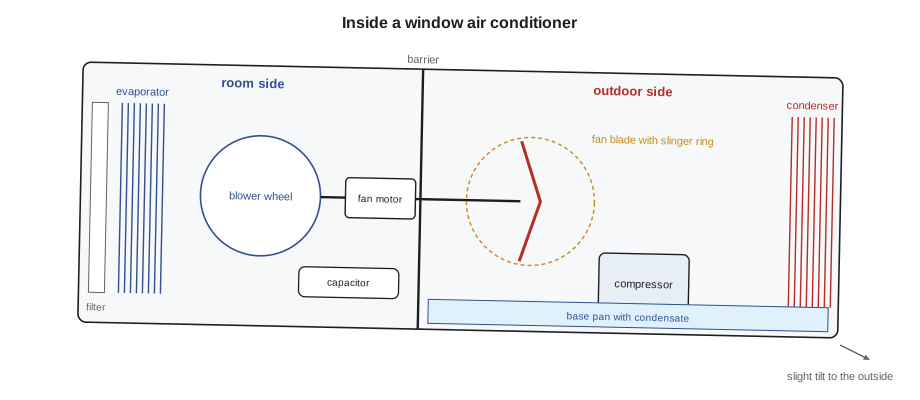
A room air conditioner is a complete refrigeration system in one cabinet, built, charged and sealed at the factory. It moves heat from the room to the outdoors. Inside the room, the evaporator coil absorbs heat and moisture from the air that a blower wheel draws through it. Outside, the condenser coil rejects that heat, plus the heat of compression, to the outdoor air pushed through it by a fan. A rotary compressor pumps the refrigerant around, and a capillary tube meters it from the high side to the low side, just as in a refrigerator. Because the unit is factory-sealed with a small charge, it counts as a small appliance for refrigerant rules.
Several types share these parts. Window units sit in a window opening, either a vertically sliding window or, with a different cabinet, a horizontal slider. Saddle or U-shaped units straddle the sill so the window can close between their halves, which makes them quieter. Through-wall units sit in a permanent sleeve through the wall, and portable units stand on the floor and vent through a hose (lesson 6). Ductless mini-split systems, with separate indoor and outdoor units joined by refrigerant lines, are not room air conditioners: they are field-installed split systems, and Penfold leaves them to air-conditioning contractors.
The parts that fail
- The fan motor is a double-shaft PSC motor that drives the indoor blower wheel from one end and the outdoor fan blade from the other. It needs its run capacitor, and its bearings dry out with age. A seized motor or a loose blower wheel stops all airflow, and the evaporator then ices over.
- The run capacitor is usually a single dual capacitor with three terminals: C (common), HERM (to the compressor's start winding) and FAN (to the fan motor's auxiliary winding). It is marked with two values, such as 35/5 µF, and a voltage rating such as 370 or 440 V AC. The appliance electrical course showed how to discharge and test it.
- The compressor has run and start windings, an external or internal overload, and on many units a separate overload clip on its terminal cover. It is tested cold for open, shorted and grounded windings, as the refrigerator course showed.
- The controls are a mechanical thermostat and selector switch on older units and a control board with a room thermistor and a coil thermistor on most newer ones. A board can show a fault code, and many have a test mode in the service data.
- The condensate system: water from the evaporator runs to the base pan and out to the condenser side, where the slinger ring on the outdoor fan blade picks it up and throws it onto the hot condenser coil, where it evaporates and improves efficiency. That is why window units make a slapping or spraying sound in humid weather, and why they must be tilted slightly to the outside as the instructions show, so water does not run back into the room.
| Complaint | Likely causes | First checks |
|---|---|---|
| Fan runs, no cooling; compressor hums and clicks off | Weak run capacitor, failed compressor, overload | Discharge and test the capacitor; test the compressor cold |
| No airflow, coil iced | Failed fan motor or capacitor, loose blower wheel, matted filter | Spin the wheel by hand with power off; check the filter |
| Runs, weak cooling, coil partly frosted | Dirty filter or coil, low charge (a leak), very cool outdoor air | Clean filter and coils; check airflow; look for oil at joints |
| Water dripping into the room | Unit tilted inward, blocked drain path, iced coil melting | Check the tilt and base pan; clear the drain |
| Musty smell | Mould on the evaporator, blower wheel or base pan | Clean with the maker-approved method; dry the unit |
| Trips breaker or cord device | Shorted compressor or wiring, cord damage, shared circuit | Test the windings to ground; inspect the cord; check the circuit |
Refrigerants in new units
Older room air conditioners used R-22, and units from about 2010 used R-410A, an HFC with a global warming potential (GWP) of about 2,088. New units use lower-GWP refrigerants, mostly R-32 (GWP about 675), which is classed as mildly flammable (A2L), and R-290 (propane, GWP about 3), which is flammable (A3). Units with these refrigerants carry flammable-refrigerant symbols and colour-coded markings on their process tubes, and they need different care.
For a technician in Ontario, any work that involves handling a halocarbon refrigerant such as R-32 or R-410A requires the ODP card under O. Reg. 463/10, as the refrigerator course explained. R-290 is a hydrocarbon, not a halocarbon, and is not covered by that regulation, but its flammability makes the maker's procedure and proper training essential.
For flammable refrigerants, Penfold follows the makers' flammable-refrigerant service guides: work in a well-ventilated area, use a leak detector and recovery equipment rated for A2L or A3 refrigerants, keep ignition sources away, never braze on a charged system, and follow the maker's procedure for opening and closing the system. Most room air conditioner repairs, however, never open the sealed system at all. Capacitors, fan motors, controls, thermistors and cleaning account for most of the work. A room unit with a refrigerant leak is usually not worth repairing, and Penfold tells the customer so before any sealed-system work.
Ratings, sizing and power
Room air conditioners are rated in BTU/h of cooling, from about 5,000 for a small bedroom to 25,000 or more for large spaces (typical). Their efficiency is rated as a CEER (combined energy efficiency ratio), in BTU of cooling per watt-hour, including standby power. A higher CEER means lower running cost, and ENERGY STAR models exceed the minimum.
Worked problem
Power and current from the rating
An 8,000 BTU/h window unit has a CEER of 11.0. Roughly what power does it draw when the compressor runs, and what current at 115 V?
Show solution
- Power is cooling divided by efficiency:
- \[8{,}000 \div 11.0 \approx 727 \text{ W}\]
- Current:
- \[727 \div 115 \approx 6.3 \text{ A}\]
Answer: About 730 W and 6.3 A. Mrs. Brackwell's unit, after its repair, drew 5.6 A against a nameplate figure of 6.1 A, which is normal on a moderate day; a current well above the nameplate figure points to a struggling compressor or a blocked condenser.
Sizing is mostly about floor area, adjusted for sun, occupancy and kitchens. ENERGY STAR's sizing guide gives capacities by room area and suggests adding about 10 in 100 for a very sunny room, subtracting about 10 in 100 for a heavily shaded one, adding about 600 BTU/h for each regular occupant beyond two, and adding about 4,000 BTU/h for a kitchen (typical guidance). An oversized unit cools quickly but cycles off before it removes much moisture, leaving the room cold and clammy.
Worked problem
Sizing a room unit
A bedroom is 4.5 m by 5.5 m. The sizing guide recommends 7,000 BTU/h for 23 to 28 m² (250 to 300 ft²). The room faces west and gets strong afternoon sun. What size unit suits it?
Show solution
- Floor area:
- \[4.5 \times 5.5 = 24.75 \text{ m}^{2}\]
- Guide size for 23 to 28 m²:
- 7,000 BTU/h
- Add 10 in 100 for sun:
- \[7{,}000 \times 1.10 = 7{,}700 \text{ BTU/h}\]
Answer: About 7,700 BTU/h, so the nearest common size of 8,000 BTU/h suits the room. A 12,000 BTU/h unit would cool it but would short-cycle and leave it humid.
Most room units up to about 12,000 BTU/h run on a standard 115 V receptacle, and larger units need a 230 V circuit and a matching receptacle (typical). They should not be run on extension cords. The plug on the power cord is usually a safety device that trips if the cord is damaged.
Many room air conditioners sold in Canada carry the same kind of leakage-detecting cord as those sold in the US; if the plug's test button does not trip and reset, the cord assembly is replaced with the maker's part.
Testing a unit that runs but does not cool
Dee's sequence for the commonest call starts with the cheapest and most likely causes:
- Airflow first. Pull the filter and look at the evaporator face. A matted filter or a coil caked with dust can cut airflow enough to ice the coil and stop cooling. Check that the blower wheel and fan blade turn freely by hand with the unit unplugged.
- Listen to the compressor. A compressor that never tries points to the controls, the thermostat or a broken wire. One that hums and trips its overload points to the run capacitor or the compressor itself.
- Test the capacitor after discharging it: each section should read within its marked tolerance, typically about plus or minus 5 or 6 in 100 (typical; the tolerance is printed on the case). A swollen or leaking case means replace it whatever it reads.
- Test the compressor cold: run to common, start to common, and run to start should add up correctly, and no terminal should show continuity to the compressor's shell.
- Measure the running current with a clamp meter and compare it with the nameplate, and measure the temperature drop across the coil. A drop of about 10 to 11 °C (18 to 20 °F) between the return air and the supply air is typical of a healthy unit on a warm day (typical).
- Check the condenser side: a condenser clogged with cottonwood fluff, lint or grease raises the head pressure and the current, and the unit cools poorly. The coil is cleaned with the maker-approved cleaner and the bent fins are straightened with a fin comb.
Worked problem
Is the capacitor within tolerance?
A dual capacitor is marked 35/5 µF ±6 in 100. Its HERM section reads 21.4 µF. What range is acceptable, and what fraction of its rating does it have?
Show solution
- Allowed variation:
- \[0.06 \times 35 = 2.1 \ \mu\text{F}\]
- Acceptable range:
- \[35 - 2.1 = 32.9 \text{ to } 35 + 2.1 = 37.1 \ \mu\text{F}\]
- Fraction of rating:
- \[21.4 \div 35 \approx 0.61\]
Answer: The acceptable range is 32.9 to 37.1 µF. At 21.4 µF the capacitor has only about 61 in 100 of its rating and is replaced with one of the same capacitance and the same or a higher voltage rating.
Room units are washed and cleaned on the bench, not in place, when they are badly soiled, using the maker's method and protecting the controls and motor from water. Mould in the base pan and on the blower wheel is a common cause of smells; a unit stored wet over the winter grows it quickly, so Penfold advises customers to run a unit on fan only for an hour before removing it in the fall.
Seasonal service and storage
Room air conditioners spend half the year in a closet or a garage, and how they are stored affects how they start in spring. Penfold's advice to customers, printed on the back of its invoices in the cooling season, is to run the unit on fan only for an hour before removing it, so the coil and base pan dry; to wash the filter; to store the unit upright, never on its side or back, so compressor oil stays in the compressor; and to keep it covered in a dry place. A unit that has been stored on its side is left upright for several hours before it is started (typical; the manual gives the time).
Units left in the window over winter need a cover over their outdoor side and a seal around the window panels, and they are a common source of drafts. Window units also must be secured as their instructions show, with the supplied brackets or screws, so they cannot fall from the window; a falling unit is a serious hazard to people below.
Common mistakes
MistakeReplacing a compressor that hums and trips without testing the run capacitor.
InsteadDischarge and test the capacitor first; a weak HERM section is the commonest cause.
MistakeOpening the sealed system of a low-cost unit with a leak.
InsteadExplain to the customer that a leaking room unit is usually replaced rather than repaired.
MistakeTreating an R-32 or R-290 unit like an R-410A unit.
InsteadFollow the maker's flammable-refrigerant procedure with A2L or A3 rated tools.
MistakeLevelling a window unit or tilting it toward the room.
InsteadTilt it slightly to the outside as the instructions show, so condensate drains away.
MistakeRunning a room unit on an extension cord.
InsteadPlug it directly into a suitable receptacle on a circuit that can carry it.
Summary and key terms
- A room air conditioner is a factory-sealed refrigeration system that moves heat from the room outdoors.
- One double-shaft PSC motor drives the indoor blower and the outdoor fan with its slinger ring.
- A dual run capacitor serves the compressor (HERM) and the fan (FAN) from a common terminal.
- New units use R-32 (A2L) or R-290 (A3), which need flammable-refrigerant procedures.
- Most repairs never open the sealed system: capacitors, motors, controls and cleaning.
- Units are rated in BTU/h and CEER; sizing follows floor area with adjustments for sun, people and kitchens.
- Diagnosis runs from airflow to the compressor's behaviour, the capacitor, the windings and the current.
- Window units are tilted slightly outward, plugged directly into a suitable circuit and kept clean.
- Room air conditioner
- A self-contained, factory-sealed air conditioner for one room.
- Dual run capacitor
- A single capacitor with HERM, FAN and C terminals serving both the compressor and fan motor.
- Slinger ring
- A ring on the outdoor fan blade that throws condensate onto the condenser coil.
- CEER
- Combined energy efficiency ratio: BTU of cooling per watt-hour, including standby power.
- A2L refrigerant
- A mildly flammable refrigerant with low toxicity, such as R-32.
- A3 refrigerant
- A flammable refrigerant with low toxicity, such as R-290.
- Overload
- A device that opens the compressor circuit when it overheats or draws too much current.
Practice problems
Work each problem on paper first, then reveal the answer to check.
What are the three terminals of a dual run capacitor?
Show answer
C (common), HERM (compressor) and FAN (fan motor).
Why does a window unit make a slapping sound in humid weather?
Show answer
The slinger ring is throwing condensate onto the condenser.
A compressor hums and clicks off every few minutes. What is checked first?
Show answer
The run capacitor, after discharging it.
Which refrigerants are replacing R-410A in new room units?
Show answer
R-32 and R-290.
Why can an oversized room unit leave a room clammy?
Show answer
It cycles off before it removes much moisture.
Lesson quiz · 5 questions
Score 60% or more to complete this lesson.
Create a free account to save your progress, take quizzes and earn a certificate.