
APP-120 · Lesson 8 of 12 · 27 min
Capacitors and start devices
▶ Video coming soon A video version of this lesson is on the way.
Dee's third bench night was on Thursday, November 5, after the defrost call. She laid out a row of parts from her scrap box: a pair of run capacitors with swollen tops, a black plastic block that clips onto a refrigerator compressor, a round disc with two terminals, a microwave oven's high-voltage capacitor and a discharge tool made from a resistor, two insulated leads and a pair of clips. "Tonight is about the parts that help motors start," she said, "and the parts that can still bite you after you unplug the appliance."
Lesson 7 showed that single-phase motors need help to start. Many get it from a capacitor, and refrigerator and freezer compressors get it from a start relay. This lesson explains what capacitors do and how to handle and test them safely, then covers the start devices and overload protectors on household compressors. RAC-130 covered capacitors in refrigeration systems; here the focus is on the parts found in household appliances and their typical failures.
What a capacitor does
A capacitor is two conducting plates separated by a thin insulator. When voltage is applied, charge builds up on the plates, and the capacitor stores energy in the electric field between them. Its size, its capacitance, is measured in microfarads (µF). On AC, a capacitor charges and discharges every half cycle, so AC current flows through the circuit it is in even though no current crosses the insulator. The current in a capacitor runs ahead of the voltage, which is what lets a capacitor in series with a motor's auxiliary winding shift that winding's current and make a rotating field.
A capacitor's opposition to AC current is its capacitive reactance, measured in ohms. It is smaller for a larger capacitor and at a higher frequency:
Worked problem
Reactance of a 5 µF run capacitor
What is the reactance of a 5 µF run capacitor at 60 Hz, and roughly what current flows through it with 120 V across it?
Show solution
- \[X_C = \frac{1}{2\pi \times 60 \times 5 \times 10^{-6}} = 530.5\ \Omega\]
- \[I = \frac{120}{530.5} = 0.226\ \text{A}\]
Answer: About 530 Ω and 0.23 A. A capacitor that has lost half its capacitance has twice the reactance and passes about half the current, so the motor's auxiliary winding gets too little help and the motor starts weakly or not at all.
Run capacitors and start capacitors
Run capacitors stay in the circuit while the motor runs. They are usually metal or plastic cans filled with oil or dry film, rated in microfarads and in AC volts, often 370 V or 440 V. Their capacitance is small, typically a few microfarads for appliance fans and pumps and up to tens of microfarads for compressors, and they are built to carry current continuously. Their tolerance is printed on them, commonly plus or minus 5 or 6 in 100.
Start capacitors are in the circuit only for the second or so while a motor starts, switched out by a relay or centrifugal switch. They have a much larger capacitance, often tens to hundreds of microfarads, and are usually in a black plastic case. They are not built to stay energized, and a start capacitor left in the circuit by a stuck relay will overheat and burst within a short time. Household refrigerators rarely use them; some room air conditioners, larger freezers and hard-start kits do.
A dual capacitor has three terminals marked C or COM, FAN or F, and HERM or H, and holds two run capacitors in one can, one for a fan motor and one for a compressor. They are common in room air conditioners. Each section is tested separately from C.
Capacitor safety
A capacitor can hold its charge after the appliance is unplugged. Most run capacitors in appliances hold only a small amount of energy, but enough to give a painful shock or to damage a meter, and some have no internal resistor to drain them. The high-voltage capacitor in a microwave oven, covered in APP-110, holds enough to kill. Treat every capacitor as charged until you have discharged it and measured it.
Worked problem
Energy in a charged run capacitor
A 5 µF run capacitor on a 370 V rated circuit can be left charged to the peak of the supply, about 1.414 times the RMS voltage. What energy can it hold at the peak of a 370 V supply?
Show solution
- Peak voltage: 370 × 1.414 = 523 V.
- \[E = \tfrac{1}{2} C V^2 = 0.5 \times 5 \times 10^{-6} \times 523^2 = 0.68\ \text{J}\]
Answer: About 0.7 J, small compared with the few joules in a microwave capacitor, but enough at 500 V to give a sharp shock that can make you pull your hand into something worse. Discharge every capacitor before handling it.
To discharge a capacitor, use a discharge tool: a resistor, typically about 20 kΩ rated at a few watts, with insulated leads and clips. Clip one lead to one terminal, then touch the other to the second terminal, holding only the insulated parts, and keep it there for several seconds. Then measure across the terminals on DC volts to confirm close to 0 V. Never short a capacitor's terminals with a screwdriver: the sudden discharge can weld the tip, throw sparks into your eyes and damage the capacitor.
Worked problem
How long the discharge takes
A 5 µF capacitor is discharged through a 20 kΩ resistor. What is the time constant, and roughly how long until it is fully discharged?
Show solution
- \[\tau = R \times C = 20{,}000 \times 5 \times 10^{-6} = 0.1\ \text{s}\]
- After five time constants, about 0.5 s, the voltage has fallen to less than 1 in 100 of its starting value.
Answer: The time constant is 0.1 s, and the capacitor is effectively discharged in about half a second. Larger capacitors take longer: a 50 µF start capacitor through the same resistor takes about 5 s, which is why technicians hold the tool on for several seconds and then confirm with the meter.
Testing capacitors
With the capacitor discharged, one lead disconnected and the meter on its capacitance range, the reading should be within the tolerance of the rated value. A 5 µF capacitor rated plus or minus 6 in 100 should read between 4.7 and 5.3 µF. A reading well below the rating, or close to zero, means it has failed; a reading of a short means the insulator has broken down.
Look at the can too. A run capacitor whose top has swollen into a dome, or that has leaked oil, has failed even if it still reads close to its rating, and it will soon fail completely. Two of the cans on Dee's bench had domed tops. Replace a capacitor with one of the same capacitance and the same or a higher voltage rating, never a lower one, and for a dual capacitor, match both sections.
| Reading | Meaning | Action |
|---|---|---|
| Within the printed tolerance | Good | Look for a swollen or leaking can before keeping it |
| Well below the rating | Weak; the motor starts poorly or runs hot | Replace with the same µF and the same or higher voltage |
| Close to 0 µF or OL | Open | Replace |
| Short or very low resistance | Insulation broken down | Replace; check the motor and wiring for damage |
Refrigerator compressors and their start devices
A household refrigerator's compressor is a sealed split-phase motor with three terminals on its body: common (C), start (S) and run (R). The start winding must be connected only while the compressor starts, but a sealed compressor cannot have a centrifugal switch inside, so the switching is done outside by a start device clipped onto the terminals. An overload protector, also on the terminals, opens if the compressor draws too much current or gets too hot.
Three kinds of start device are used. Most modern refrigerators use a PTC relay, a positive temperature coefficient thermistor. Cold, it has low resistance, typically a few ohms to a couple of tens of ohms, and passes current to the start winding. The current heats it within a second or so, its resistance shoots up and it effectively disconnects the start winding, while a small current keeps it hot as long as the compressor runs. Many PTC devices also contain a run capacitor. Older refrigerators use a current relay, a coil in series with the run winding that pulls in contacts to the start winding while the starting current is high and drops them out as the current falls. Larger compressors sometimes use a potential relay, which drops out the start circuit when the voltage across the start winding rises as the compressor comes up to speed.
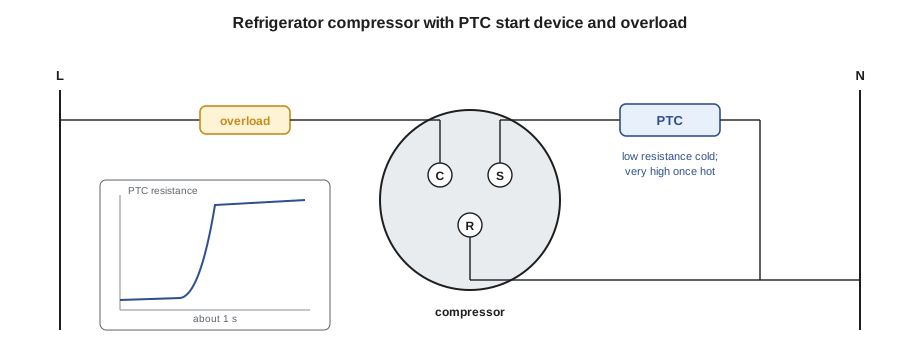
A PTC must cool down before it can start the compressor again, which takes a few minutes. That is why a refrigerator switched off and straight back on may not restart at once: the compressor tries to start with a hot PTC, cannot, draws high current and the overload opens. A refrigerator that clicks every few minutes, with the compressor humming briefly and stopping each time, is showing exactly that cycle: the compressor is trying to start and the overload is protecting it.
Worked problem
A compressor that clicks every few minutes
Dee told Kiran about a call from August 2026, before he joined Penfold: a refrigerator was warm and clicked every three or four minutes. With the unit unplugged and the start device removed, she measured the compressor terminals: C to R 3.1 Ω, C to S 10.2 Ω, R to S 13.3 Ω, and each terminal to the compressor body OL. The PTC device measured OL between its two terminals at room temperature, where the part's data called for about 4 to 20 Ω. What was the fault?
Show solution
- Windings: R to S should equal C to R plus C to S: 3.1 + 10.2 = 13.3 Ω. The windings are intact.
- No reading to the body: no short to ground.
- The PTC reads OL cold; it should read a few ohms. It has failed open.
Answer: The PTC start device had failed open, so the start winding was never connected and the compressor could not start; the overload clicked open each time. A new start device fixed it, and Dee clamped the compressor at start: a surge, then a running current close to the rating on the plate. If the windings had read wrongly or the compressor had still failed to start with a good start device, the problem would have been inside the sealed system, which is work for a technician with refrigerant certification, covered in APP-210.
Overload protectors
The overload protector is a bimetal disc with a small heater, or a disc that carries the compressor current directly, mounted against the compressor shell so that it senses both current and temperature. It opens if the current is too high, as during a failed start, or if the compressor gets too hot, as when a condenser fan stops or the condenser is clogged with dust. It closes again after cooling. An overload that opens repeatedly is doing its job; the fault is whatever makes the compressor overheat or fail to start.
Test an overload for continuity when it is cool: it should read close to 0 Ω. An overload that reads OL when cool has failed. Replace it with the exact part listed for the compressor, because its rating is matched to that compressor's current.
Hard-start kits and other start aids
Some technicians fit a hard-start kit, a start capacitor with a relay or PTC, to a compressor that struggles to start. It can help where the supply voltage is low or a compressor is near the end of its life, but it can also hide a real fault. Penfold's rule, Dee said, is to fit only the start components the manufacturer specifies, and to find out why a compressor is struggling before adding anything.
Reading a capacitor's label
A run capacitor's label gives its capacitance and tolerance, such as 5 µF plus or minus 6 in 100, its AC voltage rating, its operating temperature range and often its frequency. A dual capacitor gives both values, such as 35 + 5 µF. Check every value against the old part, and fit a capacitor rated for the same or a higher voltage and temperature.
Common mistakes
MistakeHandling a capacitor without discharging it.
InsteadDischarge with a resistor tool, then confirm close to 0 V on the meter.
MistakeShorting a capacitor's terminals with a screwdriver.
InsteadUse a discharge tool; a dead short can weld the tip and throw sparks.
MistakeFitting a replacement capacitor with a lower voltage rating.
InsteadMatch the µF and use the same or a higher voltage rating.
MistakeRestarting a refrigerator straight after switching it off and calling the click a fault.
InsteadThe PTC needs a few minutes to cool; wait before judging the start.
MistakeReplacing an overload that keeps tripping.
InsteadThe overload is protecting the compressor; find why it overheats or cannot start.
MistakeKeeping a capacitor that reads correctly but has a swollen top.
InsteadA domed or leaking can has failed; replace it.
Summary and key terms
- A capacitor stores charge; on AC it shifts the current in a motor's auxiliary winding so the motor can start and run.
- Capacitive reactance falls as capacitance rises: X = 1 ÷ (2πfC).
- Run capacitors stay in circuit; start capacitors are larger and must be switched out after starting.
- Discharge every capacitor with a resistor tool and confirm with the meter before handling it.
- Test capacitance against the printed tolerance and inspect the can for swelling or leaks.
- Refrigerator compressors start with a PTC, current or potential relay outside the sealed shell.
- The overload protects the compressor against high current and heat; repeated tripping points to another fault.
- Capacitor
- Two plates separated by an insulator that store charge and pass AC current.
- Microfarad (µF)
- The usual unit of capacitance for appliance capacitors.
- Capacitive reactance
- A capacitor's opposition to AC current, in ohms.
- Run capacitor
- A capacitor that stays in a motor circuit while the motor runs.
- Start capacitor
- A larger capacitor connected only while a motor starts.
- PTC start device
- A thermistor that passes start-winding current when cold and blocks it once hot.
- Current relay
- A start relay whose coil carries the run current and closes the start contacts while that current is high.
- Overload protector
- A device on a compressor that opens on high current or high temperature.
Practice problems
Work each problem on paper first, then reveal the answer to check.
What is the reactance of a 10 µF capacitor at 60 Hz?
Show answer
About 265 Ω.
What range should a 5 µF, plus or minus 6 in 100 capacitor read?
Show answer
4.7 to 5.3 µF.
Why must a PTC start device cool before it can restart a compressor?
Show answer
When hot its resistance is very high, so it cannot connect the start winding.
On a compressor, C to R reads 3 Ω and C to S reads 10 Ω. What should R to S read?
Show answer
About 13 Ω.
What does a refrigerator that clicks every few minutes usually show?
Show answer
The compressor is failing to start and the overload is opening.
Lesson quiz · 5 questions
Score 60% or more to complete this lesson.
Create a free account to save your progress, take quizzes and earn a certificate.