
APP-120 · Lesson 1 of 12 · 27 min
Voltage, current, resistance and power in appliances
▶ Video coming soon A video version of this lesson is on the way.
On Thursday evening, October 22, after the van tool tour from his first week, Kiran stayed at the Penfold shop with Dee for the first of her Thursday bench nights. She had a whiteboard, a box of parts pulled from scrapped appliances and a rule she repeated before every session: "Every reading you take on a call is one of four numbers: volts, amps, ohms or watts. If you know how they fit together, the appliance tells you what is wrong. If you don't, you're guessing with a meter in your hand." This course follows those Thursday nights and the calls that went with them through Kiran's first month, ending with a fault he traced on a schematic on Thursday, November 12.
APP-110 taught how to use a meter safely and take the basic readings. This course explains what the readings mean. It covers the electrical quantities and how they relate, how appliance circuits are arranged, how to read the ladder diagrams and wiring schematics that come with every appliance, how 120 V and 240 V supplies feed appliances, and how the main components work and fail: switches, thermostats and limits, heating elements, motors, capacitors and start devices, relays, solenoids and valves. It ends with grounding and GFCI protection, testing with power off and power on, and tracing a fault on a schematic. The refrigeration fundamentals course introduced electricity for refrigeration systems; here the focus is on household appliances, where heating loads are large and the circuits run on 120 V and 240 V straight from the house wiring.
Voltage: the push
Voltage is the electrical pressure that pushes current through a circuit. It is measured in volts (V) between two points, never at one point alone. A household receptacle provides about 120 V between its hot and neutral slots. A range or dryer receptacle provides about 240 V between its two hot terminals. Inside an appliance, voltage appears across every part that is doing work: a heating element with 240 V across it is getting its full push, and one with 0 V across it is not getting any.
Voltage is also how a technician finds an open circuit. When a switch, a fuse or a wire in a series path opens, no current flows, and the full supply voltage appears across the open point. A thermal fuse that has blown reads about 240 V across its terminals on a dryer that is calling for heat; a good, closed fuse reads close to 0 V. That idea, that a good closed part has almost no voltage across it and an open part has the whole supply across it, comes up again and again in this course.
Current: the flow
Current is the flow of electric charge through the circuit, measured in amperes (A, often called amps). Current only flows when there is a complete path from the supply, through the load and back. It is the same at every point in a single series path. Current is what does the work, makes the heat and trips breakers, and it is what injures people: APP-110 showed that a few tens of milliamps through the body can be fatal.
Technicians measure current with a clamp meter around one conductor. The reading tells you whether a load is working. A heating element that should draw 12.5 A and draws 0 A is not getting voltage or is open. A motor that should draw 3 A and draws 9 A is overloaded, seized or has a shorted winding.
Resistance: the opposition
Resistance is how much a part opposes current, measured in ohms (Ω). A heating element is made to have a specific resistance so that it turns current into a specific amount of heat. A wire, a closed switch or a good connection should have almost no resistance. A broken wire or an open switch has, for practical purposes, infinite resistance, which the meter shows as OL. Resistance is measured with power off and the part isolated, because the meter supplies its own small current to make the measurement.
Resistance in an appliance is not always fixed. The resistance of most metals rises as they heat, so a heating element measures a little lower cold than its hot rating suggests. Temperature sensors are made to change resistance with temperature on purpose, as lesson 5 explains. And a connection that is loose or corroded adds resistance where there should be none, which can make a part overheat.
Ohm's law
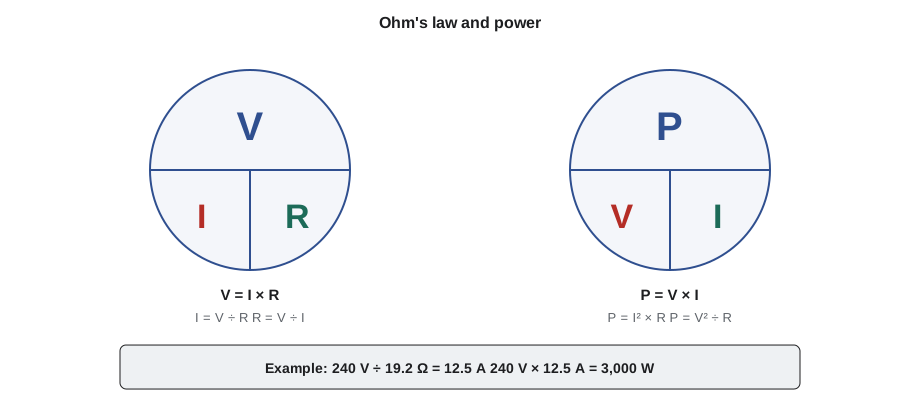
The three quantities are tied together by Ohm's law: the voltage across a part equals the current through it times its resistance.
If you know any two, you can work out the third. On a service call that means a technician can predict what a good part should read and compare. If an element of known resistance has 240 V across it, its current must be 240 divided by its resistance. If the clamp shows much less, either the voltage is not what it seems or the element is not what it should be.
Power: the work done
Power is the rate at which a part uses energy, measured in watts (W). For a heating element, power is the heat it makes. The power used by any part is the voltage across it times the current through it. Combining that with Ohm's law gives two more forms that technicians use all the time:
The last form is the most useful for heating elements. Every element is rated in watts at a stated voltage, and from that rating its resistance follows: the resistance equals the rated voltage squared divided by the rated power. Lesson 6 uses this to check elements.
Worked problem
Resistance and current of an oven bake element
An oven's bake element is rated 3,400 W at 240 V. What resistance should it measure, and what current should it draw at its rated voltage?
Show solution
- \[R = \frac{V^2}{P} = \frac{240^2}{3{,}400} = \frac{57{,}600}{3{,}400} = 16.94\ \Omega\]
- \[I = \frac{V}{R} = \frac{240}{16.94} = 14.17\ \text{A}\]
- Check: P = V × I = 240 × 14.17 = 3,400 W.
Answer: About 16.9 Ω and 14.2 A. A cold element usually reads a little lower than 16.9 Ω, because its resistance rises as it heats.
What happens at 208 V
Most houses in Canada and the United States are fed with 120/240 V. Many apartment and condominium buildings, and some townhouse complexes, are fed instead from a three-phase supply that gives 120 V from each hot conductor to neutral but only 208 V between two hot conductors. A range or dryer in such a building gets 208 V, not 240 V.
A heating element's resistance does not change with the supply, so its power falls with the square of the voltage. At 208 V, an element rated at 240 V makes only about three-quarters of its rated heat, because (208 ÷ 240)² is about 0.751. That is not a fault. Many ranges and dryers are rated for both voltages, with lower power at 208 V shown on the rating plate, and some manufacturers make elements for 208 V buildings.
Worked problem
The condominium oven
On Friday, October 30, Kiran and Dee took a call at a condominium building. The customer's new range took much longer to preheat than her old one. Its bake element is rated 3,400 W at 240 V. Dee measured 207 V between L1 and L2 at the range receptacle and asked Kiran what the element makes at 208 V.
Show solution
- From the earlier example, R = 16.94 Ω.
- \[P = \frac{208^2}{16.94} = \frac{43{,}264}{16.94} = 2{,}554\ \text{W}\]
- Ratio: 2,554 ÷ 3,400 = 0.751, about three-quarters of the rated power.
- \[I = \frac{208}{16.94} = 12.28\ \text{A}\]
Answer: About 2,550 W and 12.3 A, so the oven heats about a quarter more slowly than it would on 240 V. The range was working as designed for the building's supply. Dee showed the customer the 208 V rating on the plate and explained that the old range had a larger element. There was no fault to repair.
The same building had a second complaint that day: the clothes dryer took longer than the customer expected. The dryer's heater was rated 5,400 W at 240 V and makes about 4,060 W at 208 V. The longer drying time was again the supply, not the dryer, although Kiran still checked the vent and found it clean, because a restricted vent and a 208 V supply together can make drying times very long.
Watts, volt-amperes and motors
For heating elements, watts equal volts times amps. Motors and other loads with coils are different, because their current and voltage are not perfectly in step. Multiplying volts by amps for a motor gives volt-amperes (VA), which is larger than the real power in watts. The ratio of the two is called the power factor. A refrigerator compressor drawing 1.2 A at 120 V uses 144 VA, but its real power might be only about 100 W. For appliance work, the practical points are simple: compare a motor's current with its nameplate amps rather than working out watts, and use volt-amperes when adding up loads on a circuit.
Energy and the kilowatt-hour
Customers pay for energy, not power. Energy is power multiplied by time, and the utility measures it in kilowatt-hours (kWh). A 1,000 W load running for one hour uses 1 kWh. Technicians are often asked what an appliance costs to run, or whether a repair will lower a bill.
Worked problem
Energy used by a dishwasher heater
A dishwasher's heater is rated 1,000 W at 120 V and runs for a total of 40 minutes in a cycle. How much energy does it use per cycle, and how much current does it draw while on?
Show solution
- Time: 40 minutes = 40 ÷ 60 = 0.667 h.
- Energy: 1,000 W × 0.667 h = 667 Wh = 0.667 kWh.
- \[I = \frac{P}{V} = \frac{1{,}000}{120} = 8.33\ \text{A}\]
Answer: About 0.67 kWh per cycle and 8.3 A while the heater is on. On a 15 A circuit shared with other kitchen loads, an 8.3 A heater leaves little room, which is one reason dishwashers often have their own circuit.
Circuit capacity
Every branch circuit has a breaker or fuse rated in amps, and an appliance must not draw more than its circuit can carry. Common household ratings are 15 A and 20 A for 120 V receptacle circuits, 30 A for electric dryers and 40 A or 50 A for electric ranges. The appliance's rating plate gives its maximum current or power, and the installation instructions name the circuit it needs. When a breaker trips, the question is always whether the appliance drew too much current, through a short or an overload, or whether something else on the circuit was also running.
| Appliance | Typical supply | Typical rating | Typical full-load current |
|---|---|---|---|
| Refrigerator | 120 V | 600 to 800 VA | 5 to 7 A (much less while running) |
| Dishwasher | 120 V | 1,200 to 1,500 W | 10 to 12.5 A |
| Microwave oven | 120 V | 1,500 to 1,800 W input | 12.5 to 15 A |
| Electric dryer | 120/240 V | 5,000 to 5,600 W | 21 to 24 A |
| Electric range, all on | 120/240 V | 10,000 to 13,000 W | 42 to 54 A, though elements rarely all run at once |
The table shows why one rule from APP-110 matters: never replace a breaker or a fuse with a larger one to stop it tripping. The breaker protects the house wiring, and a larger one lets the wiring overheat before it trips. If an appliance trips a correctly sized breaker, the appliance or the wiring has a fault, and the job is to find it.
Using the numbers on a call
Dee finished the first bench night by turning the whiteboard into a checklist that Kiran copied into his notebook. On every electrical fault, she said, ask four questions in order. First, is the supply right? Measure the voltage at the appliance. Second, is the part getting that voltage? Measure across the part when it should be on. Third, is the part drawing the right current? Clamp its lead and compare with what Ohm's law predicts. Fourth, with power off, is the part's resistance right? Compare with the tech sheet or with the value worked out from the rating. A good part with the right voltage draws the right current. When one of those three numbers is wrong, it points at the fault.
Worked problem
Predicting a dryer heater's current
A dryer's heater is rated 5,400 W at 240 V. Kiran measures 238 V across it with the dryer heating. What should his clamp read?
Show solution
- \[R = \frac{240^2}{5{,}400} = 10.67\ \Omega\]
- \[I = \frac{238}{10.67} = 22.3\ \text{A}\]
Answer: About 22.3 A. If the clamp read 0 A with 238 V across the heater, the heater would be open, because voltage is present but no current flows. If it read 22 A, the heater is working and a no-heat complaint lies elsewhere, such as airflow or a cycling thermostat.
Common mistakes
MistakeMeasuring voltage at one point and calling it the voltage there.
InsteadVoltage is always between two points: name both, such as L1 to neutral.
MistakeExpecting a 240 V element to make its rated heat on a 208 V supply.
InsteadAt 208 V it makes about three-quarters of its rated power; check the supply before condemning the appliance.
MistakeCalling a slightly low cold resistance on an element a fault.
InsteadElements read a little lower cold than their hot rating suggests; compare with the tech sheet.
MistakeWorking out a motor's power as volts times amps and calling it watts.
InsteadFor motors that gives volt-amperes; compare motor current with the nameplate instead.
MistakeFitting a larger breaker because the old one keeps tripping.
InsteadThe breaker protects the wiring; find the overload or the short instead.
MistakeSkipping the supply check because the appliance is obviously at fault.
InsteadAlways measure the supply first; the condominium oven had no fault at all.
Summary and key terms
- Voltage is the push, measured between two points; current is the flow; resistance opposes the flow.
- Ohm's law: V = I × R. Power: P = V × I = I² × R = V² ÷ R.
- An element's resistance follows from its rating: R = V² ÷ P.
- On 208 V, a 240 V element makes about three-quarters of its rated power, because power falls with the square of voltage.
- Motors draw volt-amperes greater than their real power; compare their current with the nameplate.
- Energy is power times time, in kilowatt-hours; circuit ratings limit how much current an appliance may draw.
- On every electrical fault, check the supply, the voltage at the part, the current through it and its resistance.
- Volt (V)
- The unit of electrical pressure, measured between two points.
- Ampere (A)
- The unit of electric current.
- Ohm (Ω)
- The unit of resistance.
- Watt (W)
- The unit of power, the rate of using energy.
- Ohm's law
- The relationship V = I × R between voltage, current and resistance.
- Volt-ampere (VA)
- Voltage times current for a load such as a motor; larger than its real power in watts.
- Power factor
- The ratio of real power to volt-amperes for a load with coils.
- Kilowatt-hour (kWh)
- A unit of energy: 1,000 W used for one hour.
- 208 V supply
- The voltage between two hot conductors of a three-phase supply in many apartment buildings.
Practice problems
Work each problem on paper first, then reveal the answer to check.
What resistance should a 3,600 W, 240 V broil element have?
Show answer
R = 240² ÷ 3,600 = 16.0 Ω.
What current does a 1,000 W, 120 V heater draw?
Show answer
I = 1,000 ÷ 120 = 8.33 A.
About what fraction of its rated power does a 240 V element make on 208 V?
Show answer
About three-quarters (0.751).
A heater has 238 V across it and draws 0 A. What does that mean?
Show answer
It is open: voltage is present but no current flows.
How much energy does a 1,500 W microwave oven use in 10 minutes?
Show answer
1,500 W × 10 ÷ 60 h = 250 Wh = 0.25 kWh.
Lesson quiz · 5 questions
Score 60% or more to complete this lesson.
Create a free account to save your progress, take quizzes and earn a certificate.