
APP-120 · Lesson 7 of 12 · 25 min
Motors: shaded pole, PSC and universal
▶ Video coming soon A video version of this lesson is on the way.
On Tuesday, November 10, a customer called because her dryer hummed when she pushed the start button but the drum did not turn. If she gave the drum a spin by hand and pushed start again, it ran. Dee raised an eyebrow at Kiran in the van: "Tell me what that symptom means before we get there." He thought about it for two traffic lights. "It can run, but it can't start. So whatever starts it is broken." She nodded. "Now we find out which part that is."
Motors turn fans, drums, pumps, agitators and timers. Household appliances use several types, each chosen for its cost, its torque and how it is controlled. This lesson covers the three in the course title, shaded pole, permanent split capacitor and universal, plus the split-phase motor found in most dryers and disposers, and introduces the electronically controlled motors that APP-320 covers in depth. Lesson 8 then covers the capacitors and start devices that help some of these motors start.
How an induction motor turns
Most appliance motors are induction motors. The stationary part, the stator, has windings that carry AC current and make a magnetic field. The rotating part, the rotor, is a cylinder of laminated steel with aluminum or copper bars in it, often called a squirrel-cage rotor. The changing field from the stator induces currents in the rotor bars, and those currents make the rotor follow the field around. An induction motor's speed is set mainly by the supply frequency and the number of poles in its windings; a 2-pole motor on 60 Hz runs at a little under 3,600 rpm, a 4-pole at a little under 1,800 rpm.
A single winding on single-phase AC makes a field that pulses back and forth but does not rotate, so a single-phase induction motor cannot start by itself. Once spinning, it keeps running, which is exactly the dryer customer's symptom. Every single-phase motor therefore has some way to make a rotating field for starting: a shading coil, a second winding with a capacitor, or a second winding switched in only at start. The way it starts is what gives each type its name.
Shaded pole motors
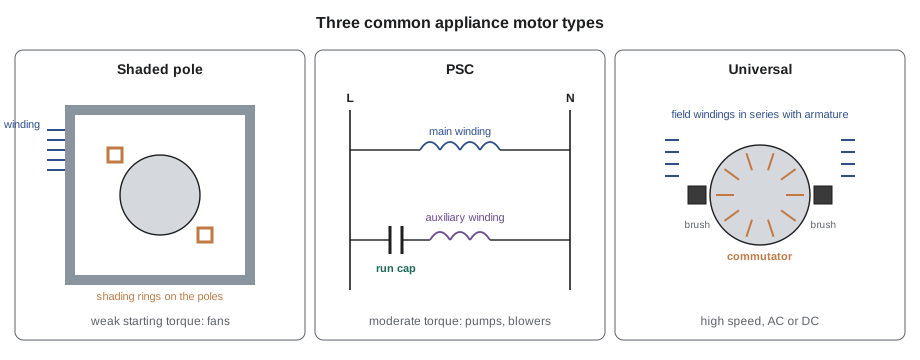
A shaded pole motor has one winding on a laminated frame, and a heavy copper ring, the shading coil, around part of each pole. The shading coil delays the field in that part of the pole, which gives a weak rotating effect, enough to start a light load. Shaded pole motors are cheap, quiet and simple, and they are used where little starting torque is needed: refrigerator evaporator and condenser fans, range hood fans, small pumps, ice maker fans and some microwave oven fans.
They have low efficiency and run warm, and their usual failures are an open winding, dried or worn sleeve bearings that let the shaft drag, and a fan blade blocked by ice or debris. A shaded pole motor that hums but does not turn is usually seized or blocked, not short of a start device, because it has none. Its winding has a single resistance, typically somewhere between a few tens and a few hundred ohms for small 120 V appliance fans; the tech sheet gives the value. Many newer refrigerators have replaced shaded pole fans with low-voltage DC fans run by the control board.
Permanent split capacitor (PSC) motors
A PSC motor has two windings, a main or run winding and an auxiliary or start winding, placed at an angle to each other. A run capacitor is connected in series with the auxiliary winding, and both windings stay connected the whole time the motor runs. The capacitor shifts the current in the auxiliary winding ahead of the current in the main winding, which makes a true rotating field and gives the motor moderate starting torque and good running efficiency.
PSC motors are found in washer and dishwasher pumps on older models, room air conditioner fans and compressors, dehumidifiers and some range hood blowers. They are reversible on many designs by swapping which winding the capacitor is in series with, which some washers use. A PSC motor has three leads: common, run and start, or the capacitor terminals. With power off, the resistance from common to start is usually higher than from common to run, and the resistance from run to start equals the two added together. A failed capacitor is the commonest PSC fault; the motor then hums, starts weakly or runs hot.
Worked problem
Identifying PSC motor windings
A pump motor's three leads are unmarked. Kiran measures between each pair: A to B 18.4 Ω, A to C 6.1 Ω, B to C 12.3 Ω. Which lead is common, which is run and which is start?
Show solution
- The largest reading is across both windings in series: A to B, 18.4 Ω. So A and B are run and start, and C is common.
- Check: A to C plus B to C = 6.1 + 12.3 = 18.4 Ω.
- The smaller winding resistance is usually the run winding: C to A, 6.1 Ω, so A is run.
- The larger is the start winding: C to B, 12.3 Ω, so B is start.
Answer: C is common, A is run and B is start. This method works for any single-phase motor with two windings and a common lead, and it is also how compressor terminals are identified, as RAC-130 showed.
Split-phase motors with a centrifugal switch
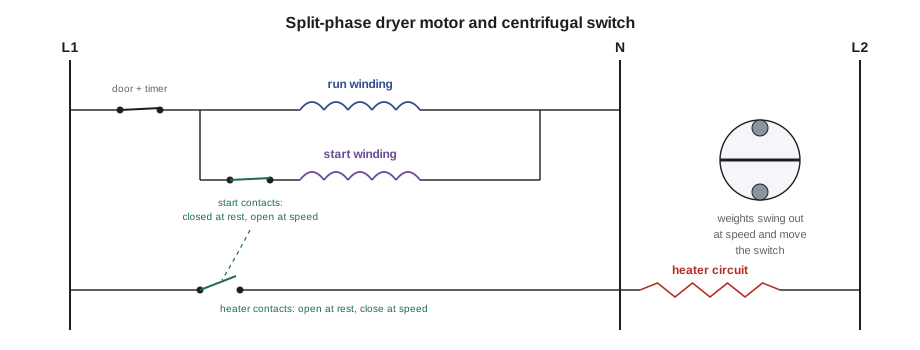
Most electric and gas dryers, many food waste disposers and some older washers use a split-phase motor. Like a PSC motor it has a run winding and a start winding, but the start winding is connected only while the motor starts. A centrifugal switch on the shaft disconnects the start winding when the motor reaches about three-quarters of its speed, and reconnects it when the motor stops. The start winding has finer wire and more resistance relative to its reactance than the run winding, which gives the phase shift needed for starting without a capacitor.
In a dryer, the centrifugal switch usually does a second job: it has another set of contacts that close only when the motor is up to speed, and those contacts are in the heater circuit, as the sample schematic in lesson 3 showed. A dryer whose motor runs normally but which will not heat can have a failed set of heater contacts on its centrifugal switch. A dryer that hums but will not start, as on the Tuesday call, has an open start winding, a centrifugal switch whose start contacts have stayed open, or a drum that is too hard to turn because of a seized idler pulley, a broken belt jammed in place or worn drum supports.
Worked problem
The Tuesday dryer that hums
With the dryer unplugged and the motor harness disconnected, Kiran measures the motor's windings through the harness plug, using the tech sheet's pin chart. The tech sheet gives typical values of about 3 Ω for the run winding and about 3.5 Ω for the start winding, measured through the centrifugal switch at rest. He reads run winding 2.9 Ω and start winding through the switch OL. He then turns the drum by hand: it turns freely, and the belt and idler are good. What is the fault?
Show solution
- Run winding 2.9 Ω: normal.
- Start winding through the centrifugal switch reads OL with the motor at rest, when the switch should be closed.
- The drum turns freely, so the motor is not being held back mechanically.
Answer: Either the start winding is open or the centrifugal switch's start contacts have failed open. On this dryer the switch is part of the motor, so the repair is a new motor. Kiran clamped the new motor's lead at start: a brief surge of about 25 A, settling to about 5 A within a second as the centrifugal switch dropped out the start winding. That brief surge is normal; a motor that stayed at high current would be stalled.
Universal motors
A universal motor runs on AC or DC. It has field windings on the stator and an armature, a rotor with its own windings connected to a commutator, a ring of copper segments. Carbon brushes ride on the commutator and carry current to the armature. The field and armature are in series, so the same current flows through both, and the motor's direction depends on how they are connected, not on the direction of the supply current. Universal motors run fast, often 10,000 rpm or more, are light for their power and can have their speed controlled by varying the voltage.
In appliances they are found in some direct-drive and older front-load washers, where a control board varies the speed electronically and a tachometer reports the speed back, and in many small appliances such as mixers, blenders and vacuum cleaners. Their brushes wear out and are a normal service part; worn brushes cause loss of power, intermittent running and heavy sparking at the commutator. A burnt or grooved commutator needs attention or a new armature. Universal motors are noisier than induction motors and are less common in new large appliances, where brushless motors are replacing them.
| Motor type | Starting method | Typical uses | Common faults |
|---|---|---|---|
| Shaded pole | Shading coils on the poles | Refrigerator fans, hood fans, small pumps | Open winding, dry bearings, blocked blade |
| PSC | Run capacitor in series with the auxiliary winding | Pumps, blowers, room AC fans | Failed capacitor, open winding |
| Split-phase | Start winding switched out by a centrifugal switch | Dryers, disposers | Open start winding or switch, failed heater contacts |
| Universal | Series field and armature with brushes | Some washers, small appliances | Worn brushes, damaged commutator |
| Brushless DC | Electronic commutation by a control | Newer washers, refrigerator fans, compressors | Control or sensor faults; see APP-320 |
Synchronous and brushless motors
Two other kinds are common enough to recognize. Small synchronous motors, which turn at a speed locked exactly to the supply frequency, drive electromechanical timers, dispenser augers and some drain pumps; a timer motor that does not turn stops the whole cycle from advancing. Brushless DC motors, often called BLDC or ECM, use permanent magnets on the rotor and an electronic control that switches the stator windings in sequence. They are efficient and quiet, and are now used in many washers, refrigerator fans and inverter compressors. They are tested differently, through the control's diagnostics and with specific resistance and voltage checks the manufacturer gives, and APP-320 covers them.
Testing motors
With power off, measure each winding's resistance and compare with the tech sheet: an open winding reads OL, and a winding much lower than its value may have shorted turns. Measure from each lead to the motor frame: a good motor reads OL, and any reading shows insulation breakdown. Turn the shaft by hand: it should turn freely and quietly, without grinding or tight spots. Check the drive: belts, pulleys, couplings and whatever the motor turns.
With power on, clamp the motor's current and compare with the nameplate. A motor drawing close to its rated current and turning at the right speed is working. A motor drawing very high current and not turning is stalled: it is either jammed, missing its start winding or capacitor, or has a failed winding. Do not leave a stalled motor energized; its thermal protector will usually open after a short time, but repeated stalls overheat the windings. A motor that runs but draws more than its rating is overloaded or failing.
Worked problem
Is the drain pump drawing too much?
A washer's drain pump is rated 0.9 A at 120 V. With the pump running and the washer draining, Kiran clamps 2.6 A, and the pump is louder than normal. What should he suspect?
Show solution
- Ratio: 2.6 ÷ 0.9 = 2.9, almost three times the rated current.
- A pump drawing that much while running is working against a heavy load or a failing bearing.
Answer: Something is loading the pump: a sock or coin in the pump inlet, a blocked drain hose or a worn bearing. He would check the filter and hose first, because a foreign object is the commonest cause. A pump that draws normal current but drains slowly points instead to a restriction after the pump or a kinked hose.
Common mistakes
MistakeReplacing a capacitor on a shaded pole motor.
InsteadShaded pole motors have no capacitor; a hum with no rotation means the motor is seized or blocked.
MistakeCondemning a dryer motor for a no-heat fault without checking its heater contacts.
InsteadThe centrifugal switch's heater contacts are part of the heater circuit; test them as part of the path.
MistakeTesting a split-phase start winding with the motor running.
InsteadThe start winding is switched out at speed; measure it with power off and the motor at rest.
MistakeLeaving a stalled motor energized while thinking.
InsteadRemove power; repeated stalls overheat the windings.
MistakeIgnoring the mechanical load.
InsteadTurn the shaft and drive by hand; a seized idler or bearing can make a good motor stall.
Summary and key terms
- Single-phase induction motors need a way to start: shading coils, a capacitor and auxiliary winding, or a switched start winding.
- Shaded pole motors are cheap, low-torque fan motors with one winding and no start device.
- PSC motors keep a run capacitor in series with the auxiliary winding all the time.
- Split-phase motors switch out their start winding with a centrifugal switch, which in dryers also enables the heater.
- Universal motors have brushes and a commutator, run fast and can run on AC or DC.
- Identify windings by resistance: the largest reading is across both windings; common is the lead not in it.
- Test motors for winding resistance, insulation to the frame, free rotation and running current.
- Stator
- The stationary part of a motor, which holds the windings.
- Rotor
- The rotating part of a motor.
- Shading coil
- A copper ring around part of a pole that gives a shaded pole motor its starting effect.
- PSC motor
- A permanent split capacitor motor, with a run capacitor always in series with its auxiliary winding.
- Split-phase motor
- A motor with a start winding that a centrifugal switch disconnects once the motor is running.
- Centrifugal switch
- A switch on a motor shaft operated by weights that swing out at speed.
- Universal motor
- A series-wound motor with brushes and a commutator that runs on AC or DC.
- Commutator
- A ring of copper segments on an armature that carries current from the brushes to the armature windings.
Practice problems
Work each problem on paper first, then reveal the answer to check.
Why can a single-phase induction motor run once spinning but not start by itself?
Show answer
A single winding makes a pulsing field that does not rotate.
A motor's leads read 18 Ω, 6 Ω and 12 Ω between pairs. Which reading is across both windings?
Show answer
The 18 Ω reading.
What does a dryer's centrifugal switch do besides dropping out the start winding?
Show answer
It closes contacts in the heater circuit when the motor is up to speed.
What part wears out normally on a universal motor?
Show answer
The carbon brushes.
A pump draws three times its rated current. What should you check first?
Show answer
For a blockage: the filter, the inlet and the drain hose.
Lesson quiz · 5 questions
Score 60% or more to complete this lesson.
Create a free account to save your progress, take quizzes and earn a certificate.