
APP-120 · Lesson 5 of 12 · 24 min
Switches, thermostats and limit controls
▶ Video coming soon A video version of this lesson is on the way.
On Thursday, November 5, Kiran and Dee took a call for a bottom-freezer refrigerator whose fresh food section was warming up. The freezer was cold, but the back wall of the freezer behind its cover panel was a solid block of frost, and almost no air was reaching the fresh food section. "Frost like that means defrost isn't happening," Dee said. "The defrost circuit is a heater, a timer or board, and a little switch that cares about temperature. One of the three has stopped doing its job." By the end of the call Kiran had tested all three, and the little switch was the culprit.
Switches decide when current flows. Some are worked by a person, such as door switches and selector switches. Some respond to temperature, such as thermostats, thermal fuses and high limits. Some respond to pressure or position. This lesson covers how each kind works, how it fails and how to test it, with the most attention to the temperature controls, because they are the commonest switches in appliances and the ones most often misunderstood.
Contacts and switch terms
A switch has one or more sets of contacts. A single-pole switch controls one conductor; a double-pole switch controls two at once, as a range element switch does with L1 and L2. A single-throw switch has one closed position; a double-throw switch has a common terminal (COM) that connects to one of two others, normally open (NO) or normally closed (NC). Many door switches in appliances are small double-throw switches with three terminals, used to turn one load on and another off when the door moves: open the refrigerator door and the lamp comes on while the fan stops.
Switch contacts fail in three ways. They can fail open, when the contacts burn or wear so badly that they no longer touch, or when a spring breaks. They can fail closed, when the contacts weld together after an arc. And they can develop high resistance, when burned or pitted contact surfaces still touch but heat up under load. A switch with high resistance often reads close to good on an ohmmeter, which uses very little current, and only shows its fault as a voltage drop when it carries the load current, as lesson 11 shows.
Door, lid and interlock switches
Door and lid switches protect people. A washer's lid switch or door lock stops the spin when the lid or door opens; a microwave oven has several door switches arranged so that the magnetron cannot run with the door open, and one of them, the monitor switch, deliberately shorts the supply and blows the fuse if the others fail closed. A dryer's door switch stops the drum. Dishwasher door switches stop the wash pump.
Interlock switches are never bypassed except as a deliberate, brief test with the technician in control, and a failed one is always replaced with the correct part. On microwave ovens in particular, the door switches and their adjustment are part of the oven's safety certification, and APP-330 covers the testing the manufacturer requires after any door switch repair.
Bimetal thermostats
A bimetal is two strips or a disc of different metals bonded together. When it heats, one metal expands more than the other, so the bimetal bends or, if it is a dished disc, snaps from one shape to the other at a set temperature, opening or closing contacts. Disc thermostats are everywhere in appliances: the dryer's cycling thermostat and high limit, the dishwasher's hi-limit, the refrigerator's defrost thermostat, and many safety cutoffs.
A disc thermostat is set at the factory. It opens at one temperature and closes again at a lower one; the gap between them is the differential. The opening and closing temperatures are usually stamped on the body, and the tech sheet lists them. A thermostat that opens on rising temperature, such as a high limit, is drawn closed on a schematic. A defrost thermostat is the opposite kind: it closes when cold and opens when warm, so that the defrost heater can only run while the evaporator is frozen.
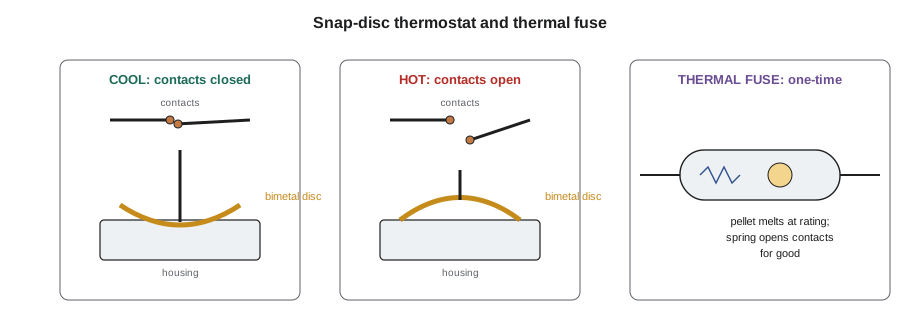
Bimetal thermostats fail open, fail closed or drift, opening at the wrong temperature. To test one, measure its continuity at a temperature where it should be closed, and check that it opens at a temperature where it should be open. On a dryer cycling thermostat, that can mean warming it with a heat gun while watching the meter, or measuring the exhaust temperature while the dryer runs and noting when the heater cycles. On a defrost thermostat, it means testing it while it is still cold.
Worked problem
Testing the defrost thermostat
On the refrigerator call, Kiran unplugged the unit, removed the freezer's back cover and found the evaporator coil encased in frost. With the thermostat still clipped to the frozen evaporator, he measured its two wires: OL. The tech sheet says it should be closed below about −7 °C (20 °F) and open above about 10 °C (50 °F). The defrost heater measured 32 Ω, and the tech sheet calls for a 450 W, 120 V heater. What is the fault?
Show solution
- The thermostat is well below its closing temperature, so it should read close to 0 Ω. It reads OL: it has failed open.
- Expected heater resistance: R = 120² ÷ 450 = 14,400 ÷ 450 = 32 Ω. The heater is good.
- With the thermostat open, the defrost heater can never get current, even when the control calls for defrost.
Answer: The defrost thermostat had failed open, so the evaporator never defrosted. Kiran melted the frost with a steamer, fitted a new thermostat, confirmed it read about 0 Ω once its clip was on the cold coil, and used the board's service test to force a defrost, clamping the heater lead at 3.7 A. Dee told the customer the fresh food section would take several hours to come back down to temperature.
Capillary thermostats
Older ovens, many refrigerator cold controls, chest freezers and some room air conditioners use a capillary thermostat. A sealed bulb filled with a liquid or gas sits where the temperature is measured, connected by a thin capillary tube to a bellows or diaphragm inside the control. As the bulb warms, the fill expands and pushes the bellows, which opens or closes the contacts. The knob sets a spring against the bellows, so turning it changes the temperature at which the contacts work.
The capillary tube must never be kinked, cut or stretched, because a lost fill makes the control fail open or closed for good. The bulb must sit exactly where the manufacturer placed it, clipped to the evaporator or held in its bracket in the oven; a bulb moved even a few centimetres can make the appliance run much too warm or too cold. When replacing one, route the new tube the same way as the old one and coil any extra length out of the way, never cutting it.
Thermal fuses and one-shot cutoffs
A thermal fuse is a one-time device: a pellet inside it melts at its rated temperature and lets a spring open the contacts permanently. Dryers use them in the exhaust duct or on the heater housing; ovens, dishwashers, microwave ovens and many small appliances use them as a last line of protection. The rated temperature is printed on the fuse body, and the replacement must have the same rating and the same current rating.
A blown thermal fuse is never the whole repair. It opened because something got too hot, and the technician must find out why. On a dryer that is usually a restricted vent or a lint-packed cabinet, as on the APP-110 call; on an oven it can be a relay stuck closed or a failed cooling fan. Replacing the fuse without finding the cause is how dryer fires start. Never bypass a thermal fuse, even briefly, with the appliance unattended.
High limits and cycling thermostats
Heating appliances usually have two temperature controls in series with the heater. The cycling or operating thermostat switches the heater on and off to hold the working temperature: in a dryer, it senses the exhaust air and typically opens somewhere around 57 to 68 °C (135 to 155 °F). The high limit is a safety device that opens only if something goes wrong, such as blocked airflow, at a much higher temperature, typically around 93 to 121 °C (200 to 250 °F) in a dryer. Some dryers add a thermal fuse that opens at a still higher temperature, or in a different location.
These values vary with the model and are printed on each part. Their arrangement matters more than the exact numbers. If the high limit opens repeatedly, the cycling thermostat or the airflow is not keeping the temperature down. If the thermal fuse opens, both of the controls before it failed to do their job, or the airflow problem was severe. A technician who finds a blown fuse checks the vent, the blower and the cycling thermostat before leaving.
Electronic sensors: thermistors and RTDs
Electronic controls measure temperature with sensors rather than switches. A thermistor is a small resistor whose resistance changes strongly with temperature. Most appliance thermistors are NTC types, for negative temperature coefficient: their resistance falls as they warm. Refrigerators, freezers, dishwashers, washers and dryers with electronic controls use them. The control board sends a small current through the sensor, reads the voltage and works out the temperature.
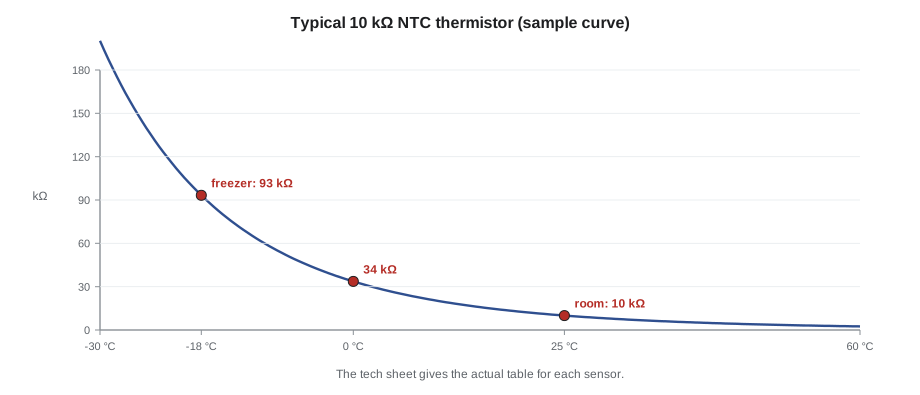
Thermistor values vary by manufacturer, so a technician uses the resistance table in the tech sheet, measuring the sensor's resistance with the board connector unplugged and the sensor's actual temperature known. A common sensor reads about 10 kΩ at 25 °C (77 °F); one following a typical curve reads about 34 kΩ at 0 °C (32 °F) and about 93 kΩ at −18 °C (0 °F). A sensor that reads OL is open, one that reads close to 0 Ω is shorted, and either makes the board display a fault code or misjudge the temperature. A sensor that reads a value matching the wrong temperature makes the appliance run too warm or too cold.
Ovens with electronic controls usually use an RTD, a resistance temperature detector, a platinum sensor whose resistance rises as it warms. A typical oven RTD reads about 1,080 to 1,100 Ω at room temperature and about 1,650 to 1,700 Ω at 175 °C (350 °F). A sensor reading far from the tech sheet table at room temperature is faulty, and one that reads correctly cold but fails at temperature is often found by its fault code or by an oven that overshoots or undershoots badly. APP-320 covers sensors and their board circuits in depth.
Worked problem
Checking an oven sensor
An oven runs about 25 °C (45 °F) hot. With the oven cold in a 21 °C (70 °F) kitchen, the tech sheet's table gives about 1,080 Ω. Kiran unplugs the sensor connector at the board and measures 1,078 Ω, and from either sensor pin to the oven cavity OL. Is the sensor faulty?
Show solution
- A platinum sensor of this kind follows a standard curve; at this kitchen temperature the curve gives about 1,080 Ω, as the table says.
- The measured 1,078 Ω is within a few ohms of the table value.
- OL to the cavity shows no short to ground.
Answer: The sensor is good at room temperature, so the next step is the oven's calibration offset in its settings, which many controls allow the user or technician to adjust, and then a check of the sensor at temperature. Replacing a sensor that reads correctly is a common, wasted repair.
Pressure and position switches
Some switches respond to things other than temperature. Washers and dishwashers sense water level with pressure switches, which close when the air trapped in a tube or chamber is compressed by rising water. Gas dryers and some ranges use switches that prove a fan is running. Ice makers and dispensers use switches that sense the position of an arm or a door. Each is still a set of contacts and is tested the same way, by checking that it opens and closes when its condition changes. APP-220 covers water-level switches in detail.
Testing switches safely
With power off and the switch isolated, check continuity in each position: about 0 Ω closed, OL open. With power on and the load running, measure the voltage across a closed switch: a good closed switch reads close to 0 V, and a switch with burned contacts reads a volt or more. Across an open switch in a working circuit, the full supply appears. A switch that tests good cold but whose appliance fails when warm may be opening early, and needs testing at temperature.
| Device | Normal state at rest | How it fails | Test |
|---|---|---|---|
| Door or lid switch | NO or NC as drawn | Open, closed or high resistance | Continuity in both positions; voltage drop under load |
| Cycling thermostat | Closed when cool | Opens too early or late, or fails open | Continuity cool; watch it open with gentle heat or in service |
| High limit | Closed | Fails open, or opens because of an airflow fault | Continuity cool; find the airflow fault if it trips |
| Defrost thermostat | Closed when cold, open when warm | Fails open | Continuity while frozen |
| Thermal fuse | Closed | Opens once and stays open | Continuity; find the overheating cause |
| NTC thermistor | Resistance per table | Open, shorted or off the table | Resistance at a known temperature, connector unplugged |
Common mistakes
MistakeReplacing a blown thermal fuse and leaving.
InsteadFind out why it blew: check the vent, airflow, cycling thermostat and relays.
MistakeTesting a defrost thermostat after it has warmed up.
InsteadA defrost thermostat is open when warm; test it while it is still cold.
MistakeKinking or cutting a capillary tube to shorten it.
InsteadCoil the extra length; a damaged capillary loses its fill and ruins the control.
MistakeCondemning a sensor without the manufacturer's resistance table.
InsteadMeasure at a known temperature and compare with the tech sheet.
MistakePassing a switch because it beeps on continuity.
InsteadBurned contacts can pass an ohmmeter test; check the voltage drop under load.
MistakeBypassing a door interlock to save time.
InsteadInterlocks protect people; bypass only for a brief controlled test, and replace failed ones with the correct part.
Summary and key terms
- Switches fail open, fail closed or develop high resistance that shows up only under load.
- Door, lid and interlock switches protect people and are never left bypassed.
- Bimetal disc thermostats open and close at factory-set temperatures; defrost thermostats close when cold.
- Capillary thermostats sense with a filled bulb; never kink or cut the tube, and place the bulb exactly.
- A thermal fuse opens once; always find why it blew.
- Heating appliances use a cycling thermostat for control and a high limit and often a thermal fuse for safety.
- NTC thermistors fall in resistance as they warm; oven RTDs rise; test both against the tech sheet table.
- Single-pole, double-throw (SPDT)
- A switch with a common terminal that connects to either a normally open or a normally closed terminal.
- Bimetal
- Two bonded metals that bend or snap with temperature because they expand differently.
- Differential
- The difference between the temperature at which a thermostat opens and the one at which it closes.
- Capillary thermostat
- A thermostat that senses temperature with a filled bulb connected by a thin tube to a bellows.
- Thermal fuse
- A one-time device that opens permanently at its rated temperature.
- High limit
- A safety thermostat that opens only if a heating appliance overheats.
- NTC thermistor
- A temperature sensor whose resistance falls as temperature rises.
- RTD
- A resistance temperature detector, usually platinum, whose resistance rises with temperature.
Practice problems
Work each problem on paper first, then reveal the answer to check.
When should a defrost thermostat be closed?
Show answer
When it is cold, below its closing temperature.
What resistance should a 450 W, 120 V defrost heater have?
Show answer
32 Ω.
What does a typical 10 kΩ NTC thermistor read at 0 °C (32 °F)?
Show answer
About 34 kΩ.
Why must a technician find the cause when a thermal fuse has blown?
Show answer
It opened because something overheated, and the fault will repeat or cause a fire.
How can a switch pass a continuity test and still be faulty?
Show answer
Burned contacts can have high resistance that only shows as a voltage drop under load.
Lesson quiz · 5 questions
Score 60% or more to complete this lesson.
Create a free account to save your progress, take quizzes and earn a certificate.