
APP-120 · Lesson 10 of 12 · 25 min
Grounding, polarity and GFCI protection
▶ Video coming soon A video version of this lesson is on the way.
On Wednesday, November 11, Kiran and Dee went to a newly renovated kitchen where the dishwasher tripped its ground fault protection partway through every cycle. The renovator's electrical contractor had fitted a GFCI receptacle for it under the sink, because the receptacle sat close to the sink. "New protection on an old dishwasher," Dee said in the van. "Either the GFCI is faulty, or it's telling the truth about the dishwasher. My money's on the dishwasher."
Grounding, polarity and ground fault protection are what keep a fault inside an appliance from becoming a shock. APP-110 introduced them as safety rules. This lesson explains how they work, how to check them, how a GFCI decides to trip, and how leakage in an appliance causes trips that customers often blame on the protection. The wiring, receptacles, breakers and GFCI devices of the house belong to the electrical trade; the appliance technician's job is to find out whether the appliance is at fault and to say so clearly when the house wiring is.
Three conductors, three jobs
A 120 V appliance cord has three conductors. The hot carries current to the appliance. The neutral carries it back. Both carry the same current in normal operation. The equipment grounding conductor, green or bare, connects the appliance's metal frame to the house grounding system, and carries no current at all in normal operation. It exists for faults: if a hot wire touches the frame, the grounding conductor gives the fault current a low-resistance path back to the panel, the current is large, and the breaker trips at once.
The neutral is connected to ground at one place only, at the service panel. Beyond the panel, the neutral and the ground are kept separate, so that normal current flows only on the neutral. That is why lesson 4 insisted that the neutral and the frame be separate in a four-wire range or dryer connection.
Worked problem
Why the ground trips the breaker
A worn wire inside a washer rubs through and touches the cabinet. The hot is 120 V, and the path from the cabinet back to the panel through the grounding conductor has a total resistance of about 0.5 Ω. What current flows, and what happens on a 15 A breaker? What if the ground were missing?
Show solution
- With the ground: I = 120 ÷ 0.5 = 240 A, sixteen times the breaker rating.
- A breaker trips almost instantly at that current, so the fault is cleared.
- Without the ground, there is no path, so no current flows and the breaker does not trip; the cabinet simply sits at 120 V.
- A person touching the cabinet and a grounded faucet, with about 1,000 Ω through the body, would carry 120 ÷ 1,000 = 0.12 A, or 120 mA.
Answer: With a good ground, about 240 A flows and the breaker trips at once. With no ground, the cabinet stays live and waits for someone to touch it: 120 mA through the body is in the range that can stop the heart. This is the washer tingle from APP-110, where a two-prong receptacle had no ground.
Checking grounds and polarity
At a 120 V receptacle, three readings check the wiring. Hot to neutral should be about 120 V. Hot to ground should also be about 120 V; if it is 0 V while hot to neutral is right, the ground is missing. Neutral to ground should be close to 0 V; a few volts can mean a long run with a heavy load, and more suggests a loose neutral. A plug-in receptacle tester gives a quick indication, but it cannot tell every fault, so the meter readings are the proof.
Polarity means the hot and neutral are on the correct terminals. The receptacle's narrow slot is the hot and the wide slot the neutral, and a polarized plug fits only one way. Inside an appliance, switches, fuses and thermostats are placed on the hot side, so that when they open, the parts beyond them are dead. With reversed polarity, a switch opens the neutral instead, and the load it controls stays connected to the hot even when it is off. A lamp socket's threaded shell, normally on the neutral, becomes live. A technician who finds reversed polarity notes it and refers the receptacle to a licensed electrical contractor.
Inside the appliance, check the ground from the cord's ground pin to the cabinet with power off: it should read close to 0 Ω. Check that every ground wire inside the cabinet, to the door, the motor, the pump and any panel that carries electrical parts, is connected. Ground screws removed during a repair must go back, with their star washers, which bite through the paint to make contact.
How a GFCI works
A ground fault circuit interrupter compares the current going out on the hot with the current coming back on the neutral. Both pass through a small current transformer, a toroid, in opposite directions. Normally they are equal and cancel. If some current leaks to ground instead of returning on the neutral, such as through a person or through damaged insulation to a grounded frame, the two are no longer equal, the toroid senses the difference, and the GFCI trips. The household devices used in Canada and the United States are designed to trip at a difference of about 5 mA, within a narrow band of a few milliamps, and to trip fast enough to prevent a fatal shock.
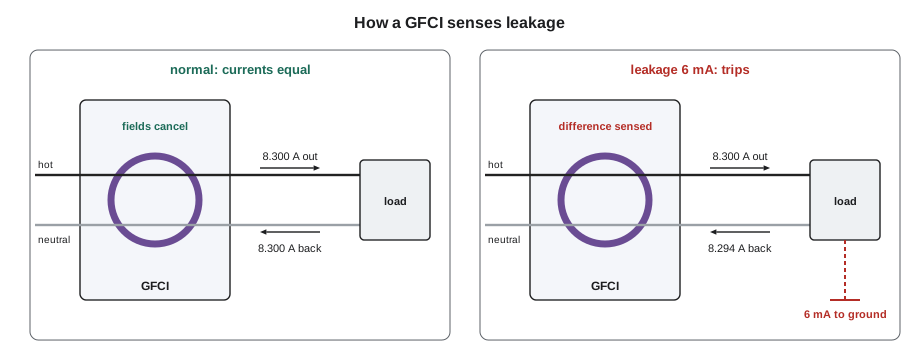
A GFCI does not need a ground conductor to work, because it only compares hot and neutral. That is why the electrical codes allow a GFCI as a way to protect receptacles on older two-wire circuits that have no ground, marked with a label saying no equipment ground. It also means a GFCI does not protect against a fault between hot and neutral, such as a person holding both wires of a cord; that current returns on the neutral and looks normal. And a GFCI does not limit current in a short circuit; the breaker does that.
Worked problem
How much leakage trips a GFCI
In a 120 V appliance, damaged insulation creates a path from a live part to the grounded frame with a resistance of 20 kΩ. How much current leaks, and will it trip a GFCI?
Show solution
- \[I = \frac{120}{20{,}000} = 0.006\ \text{A} = 6\ \text{mA}\]
- A household GFCI trips at about 5 mA.
Answer: About 6 mA, enough to trip a GFCI, although it is far too small to trip a breaker and the appliance works normally otherwise. A leakage path of 20 kΩ is a serious insulation fault, even though most meters would show it only on their kilohm range. At 50 kΩ the leakage would be 2.4 mA and might not trip a GFCI on its own, but leakages from several parts on one circuit add.
Why appliances trip GFCIs
When an appliance trips a GFCI, the GFCI is usually telling the truth. The commonest causes are heating elements with moisture or breakdown in their insulation, which leak current to their grounded sheath when hot or wet; motors and pumps with water in them or with damaged windings; wet wiring and connectors, from a leak inside a dishwasher or washer; and pinched or chafed wires touching the cabinet. Sheathed elements are a frequent culprit, because the magnesium oxide inside them absorbs moisture if they sit unused or if their seals are damaged.
Leakage often appears only under the conditions that cause it: when the element is hot, when water is present, or partway through a cycle. That is why a dishwasher may trip only during its drying or heated wash step, and a range only after the oven has been on for a while. A technician times the trip against the cycle, which points to the load that was on when it tripped.
Worked problem
The dishwasher that tripped partway through
Kiran ran the dishwasher in its service test, turning each load on one at a time. The circulation pump, drain pump and inlet valve ran without a trip. Within about 40 seconds of the heater coming on, the GFCI tripped. With power off and the heater wires disconnected, he measured the heater: 14.6 Ω across its terminals, as expected for its 1,000 W, 120 V rating. From each heater terminal to its sheath, the meter read 1.8 MΩ cold. What is the fault?
Show solution
- The heater's element is intact: 120² ÷ 1,000 = 14.4 Ω expected, 14.6 Ω measured.
- A good sheathed element reads OL to its sheath; 1.8 MΩ cold shows a leakage path, which typically becomes much lower when the element is hot and damp.
- The trip came only when the heater was on.
Answer: The heater was leaking to its sheath, and the GFCI was doing exactly its job. Kiran replaced the heater, ran a full cycle without a trip and pressed the GFCI's test button to show the customer that it still worked. He wrote on the work order that the GFCI and the kitchen wiring were sound and that the fault had been in the dishwasher.
Most handheld meters measure resistance with only a few volts, which may not show insulation breakdown that appears at the full supply voltage or when hot. Some technicians carry an insulation tester, which applies a higher test voltage, typically 250 V or 500 V, to measure insulation resistance in megohms. Use one only on parts disconnected from any electronics and only to the manufacturer's procedure, because the test voltage can damage control boards and sensors.
What the codes require
In Ontario, the Ontario Electrical Safety Code, based on the Canadian Electrical Code, requires GFCI protection for receptacles in places such as bathrooms, outdoors and near sinks, and requires arc fault protection for most 125 V, 15 A and 20 A receptacle circuits in dwellings, with some exceptions. The exact list, and the exceptions for some appliance receptacles, are in the current edition of the code and in ESA guidance, and they change from edition to edition. An appliance technician does not decide which protection a circuit needs; that is the electrical contractor's work. The technician's job is to know that the protection is there, to recognize when it trips because of an appliance fault, and never to suggest removing it.
Arc fault circuit interrupters, AFCIs, protect against a different hazard: the small arcs that occur at a damaged cord, a loose connection or a nail through a cable, which can start a fire without ever drawing enough current to trip a breaker. An AFCI watches the shape of the current for the pattern that arcing makes and trips when it sees it. Many breakers now combine AFCI and GFCI protection in one device. An appliance that trips an AFCI may have a loose or arcing connection, a damaged cord, or, occasionally, a motor or control whose normal electrical noise the AFCI misreads; the manufacturer's guidance and the electrical contractor sort out the latter.
| Protection | Trips on | Does not protect against | Appliance faults that trip it |
|---|---|---|---|
| Breaker or fuse | Overcurrent and short circuits | Small leakage currents and shocks | Shorts to the frame or between conductors; overloads |
| GFCI | About 5 mA difference between hot and neutral | Hot-to-neutral contact; overloads | Element sheath leakage, wet wiring, pump and motor leakage |
| AFCI | The current pattern of an arc | Shocks (unless combined with GFCI) | Loose, burned or arcing connections; damaged cords |
Rules for the appliance technician
- Never cut off, bend or bypass a ground pin, or use an adapter that defeats the ground.
- Never advise a customer to plug an appliance that trips a GFCI into an unprotected receptacle or extension cord to stop the trips.
- Reconnect every ground wire and screw removed during a repair, with its star washer.
- Test the cord's ground pin to the cabinet with power off after any repair that disturbed wiring.
- When the house wiring is at fault, such as a missing ground, reversed polarity or a faulty GFCI, record the readings and refer it to a licensed electrical contractor; do not change receptacles or breakers yourself.
Testing a GFCI
A GFCI has a test button that creates a small, deliberate leakage inside the device. Pressing it should trip the GFCI at once, and pressing reset should restore power. Manufacturers recommend testing monthly. A GFCI that will not trip on its test button has failed and must be replaced by the electrical trade.
Common mistakes
MistakeBlaming the GFCI because the appliance worked on its old circuit.
InsteadA GFCI trips on real leakage; test the appliance's loads one at a time.
MistakeTesting an element only across its terminals.
InsteadAlso test each terminal to the sheath; leakage there trips GFCIs.
MistakeAssuming a GFCI needs a ground to work.
InsteadIt compares hot and neutral; a ground is not part of its sensing.
MistakeLeaving a ground screw out after a repair.
InsteadRefit every ground with its star washer and check the cord ground to the cabinet.
MistakeSuggesting an extension cord to an unprotected receptacle.
InsteadNever defeat protection; find and fix the leakage.
MistakeUsing an insulation tester with the control board connected.
InsteadDisconnect electronics and follow the manufacturer's procedure.
Summary and key terms
- The hot and neutral carry the load current; the equipment ground carries current only during a fault, so the breaker trips.
- Neutral and ground are joined only at the service panel.
- At a receptacle, hot to neutral and hot to ground read about 120 V; neutral to ground close to 0 V.
- Reversed polarity puts switches on the neutral and can leave parts live when switched off.
- A GFCI trips at about 5 mA of difference between hot and neutral; it does not need a ground to work.
- Appliances trip GFCIs through element sheath leakage, water in wiring or motors, and chafed wires; time the trip to the load.
- Protection requirements belong to the electrical code and trade; never remove or bypass protection.
- Equipment grounding conductor
- The green or bare conductor that connects appliance frames to the grounding system.
- Polarity
- The correct placement of the hot and neutral conductors.
- GFCI
- A ground fault circuit interrupter, which trips when current leaks to ground.
- AFCI
- An arc fault circuit interrupter, which trips on the current pattern of an arc.
- Leakage current
- Current that flows from a live part to ground through insulation or water instead of returning on the neutral.
- Toroid
- The ring-shaped current transformer in a GFCI that senses a difference between hot and neutral currents.
- Insulation tester
- A meter that applies a high test voltage to measure insulation resistance in megohms.
Practice problems
Work each problem on paper first, then reveal the answer to check.
A receptacle reads hot to neutral 120 V and hot to ground 0 V. What is wrong?
Show answer
The ground is missing.
How much current leaks through a 30 kΩ path at 120 V?
Show answer
4 mA.
Why can a GFCI protect a two-wire circuit with no ground?
Show answer
It compares hot and neutral currents and does not need a ground to sense leakage.
A range trips its GFCI only after the oven has been on for a while. What is a likely cause?
Show answer
An element leaking to its sheath when hot.
Who should fix reversed polarity at a receptacle?
Show answer
A licensed electrical contractor.
Lesson quiz · 5 questions
Score 60% or more to complete this lesson.
Create a free account to save your progress, take quizzes and earn a certificate.