
APP-120 · Lesson 2 of 12 · 27 min
Series, parallel and combination circuits
▶ Video coming soon A video version of this lesson is on the way.
Dee's second bench night, on Thursday, October 29, started with a board she had built years earlier from scrap: two oven lamp sockets, a door switch, a thermal fuse, a small heating element and a row of terminals, all screwed to a piece of plywood and fed through a GFCI-protected test cord. "Every appliance is made of three kinds of path," she said. "Things in a line, things side by side, and mixtures of the two. Learn how the voltage and current behave in each and you can work out what any meter reading is telling you."
Earlier that day Kiran had been on a dishwasher call that turned on exactly this point, and lesson 9 tells it. This lesson explains series, parallel and combination circuits as they appear in appliances, with the rules that govern each and the readings a technician should expect when a part in them fails.
Series circuits
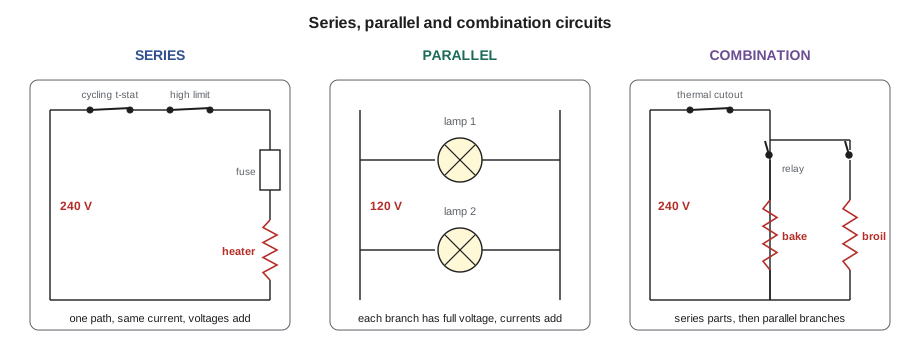
In a series circuit the parts are connected end to end, so there is only one path for current. The same current flows through every part. The supply voltage is shared among the parts, and the voltages across them add up to the supply. The total resistance is the sum of the individual resistances.
Appliances use series paths mostly for safety and control. A dryer's heater is in series with its cycling thermostat, its high-limit thermostat and its thermal fuse; if any of them opens, the heater stops. A dishwasher's door switch is in series with the wash motor, so the motor cannot run with the door open. A refrigerator's defrost heater is in series with its defrost thermostat, which opens when the evaporator is clear of frost.
The rule that makes series paths easy to troubleshoot is the one from lesson 1. A closed switch, a good fuse or a good wire has almost no resistance, so almost no voltage appears across it. If any part in the path opens, the current stops everywhere, and the whole supply voltage appears across the open part. Measuring across each part in turn with power on, the open part is the one with the full supply across it.
Worked problem
Finding the open part in a series path
A dryer will not heat. Its heater circuit is the heater, a cycling thermostat, a high-limit thermostat and a thermal fuse, all in series across 240 V. With the dryer running on a heat cycle, Kiran measures: across the heater 0 V, across the cycling thermostat 0 V, across the high limit 0 V, across the thermal fuse 240 V. Which part is open?
Show solution
- Current is zero, so there is no voltage across any part that is closed or good.
- The full 240 V appears only across the thermal fuse.
Answer: The thermal fuse is open. A blown thermal fuse usually means the dryer overheated, so before replacing it Kiran must find the cause, which is most often a restricted vent, as in APP-110.
Parallel circuits
In a parallel circuit each part is connected directly across the supply, so each has its own path. Every part has the full supply voltage across it. The current from the supply divides among the branches, and the branch currents add up to the total. Adding a branch lowers the total resistance, because it gives current one more path.
Most appliance loads are in parallel, because each one needs the full supply and should keep working if another fails. An oven's two lamps are in parallel, so one can burn out while the other stays lit. A refrigerator's compressor, evaporator fan and lights are each connected across 120 V. The surface elements of a range are each across 240 V through their own switches.
Worked problem
Two oven lamps in parallel
An oven has two 40 W, 120 V lamps in parallel. What is the resistance of each lamp, the total resistance and the total current?
Show solution
- \[R_{lamp} = \frac{V^2}{P} = \frac{120^2}{40} = \frac{14{,}400}{40} = 360\ \Omega\]
- Two equal resistances in parallel give half of one: 360 ÷ 2 = 180 Ω.
- \[I_{total} = \frac{120}{180} = 0.667\ \text{A}\]
- Each lamp draws 120 ÷ 360 = 0.333 A; together, 0.667 A.
Answer: Each lamp is 360 Ω when hot, the pair is 180 Ω and together they draw about 0.67 A. If one burns out, the other still has 120 V across it and stays lit, drawing 0.33 A.
In a parallel circuit an open branch does not stop the others, and the voltage across the open branch is still the full supply. So voltage alone will not find an open part in parallel; you need current. A clamp on each branch shows the one that draws nothing. With power off, you can isolate each branch and measure its resistance.
A short circuit in parallel is the opposite problem. A branch whose resistance falls close to zero, such as a heating element whose coil touches its sheath or a wire with burned insulation touching the cabinet, draws a very large current and trips the breaker or blows a fuse. Because every parallel branch is across the same supply, the other branches do not limit the current through the short.
Combination circuits
Real appliances mix the two. A load in parallel with other loads usually has its own switches and protective devices in series with it. That arrangement is a combination circuit: series parts within each branch, and branches in parallel across the supply.
An electric oven is a good example. During preheat, many ovens switch on both the bake element and the broil element, each in its own branch across 240 V, so that the oven heats quickly. Each element branch has a relay contact in series, and both branches share a series path through the oven's thermal cutout, which opens if the oven overheats.
Worked problem
Bake and broil together during preheat
During preheat an oven runs its 3,400 W bake element and its 3,600 W broil element together, each across 240 V. What is the total current, and what is the combined resistance?
Show solution
- Bake: R = 240² ÷ 3,400 = 16.94 Ω; I = 240 ÷ 16.94 = 14.17 A.
- Broil: R = 240² ÷ 3,600 = 16.00 Ω; I = 240 ÷ 16.00 = 15.00 A.
- Total current: 14.17 + 15.00 = 29.17 A.
- \[R_{total} = \frac{1}{\frac{1}{16.94} + \frac{1}{16.00}} = 8.23\ \Omega\]
- Check: 240 ÷ 8.23 = 29.2 A.
Answer: About 29.2 A in total, and a combined resistance of about 8.2 Ω. That is why a range needs a 40 A or 50 A circuit, and why a clamp on the range supply shows a large jump when preheat starts.
Combination circuits are where reasoning matters most. Suppose the broil element in that oven is open. The bake branch still draws 14.17 A, so the oven still heats, but more slowly during preheat, and broiling does not work at all. A clamp on the supply during preheat would read about 14 A instead of about 29 A, and a clamp on each element lead would show which one draws nothing. This was the fault on the oven call in APP-110, where the open broil element made preheat slow even though baking seemed to work.
Voltage dividers and why open parts read the supply
When two resistances are in series across a supply, the voltage divides between them in proportion to their resistance. Two equal parts each get half. This explains a reading that confuses new technicians: if you measure across an open switch while the load beyond it is still connected, you read the supply voltage, because the meter's very high resistance and the load's low resistance are in series, and almost all the voltage appears across the meter.
Worked problem
Two lamps wrongly wired in series
On Dee's board, the two 40 W, 120 V lamps are rewired in series across 120 V. What voltage does each lamp get, and what power does each make?
Show solution
- Each lamp is about 360 Ω hot; in series, the total is 720 Ω.
- The current is 120 ÷ 720 = 0.167 A.
- Each lamp gets half the supply: 0.167 × 360 = 60 V.
- \[P = \frac{V^2}{R} = \frac{60^2}{360} = 10\ \text{W}\]
Answer: Each lamp gets 60 V and makes about 10 W, a quarter of its rating, so both glow dimly. In practice a cold lamp filament has lower resistance than a hot one, so the numbers shift a little, but the point holds: series loads share the supply and each runs below its rating. A load running dim or weak can mean that something has put it in series with an unwanted resistance, such as a burned connection, which lesson 11 shows how to find.
Neutral paths and shared returns
In 120 V appliances, every load's current returns to the supply on the neutral. In a 120/240 V appliance such as a dryer, the 240 V heater returns its current on the other hot conductor, while the 120 V motor, timer and light return theirs on the neutral. Several loads often share one neutral wire inside the appliance. If that shared neutral opens, every 120 V load on it stops at once, while the 240 V loads may keep working. A dryer whose drum will not turn but whose heater still warms up, or the reverse, is a clue that the fault is in a part of the circuit the two loads do not share.
Shared paths are also why a single burned connector can cause several strange symptoms at once. Dee told Kiran about a refrigerator whose lights, fan and ice maker all quit together: the fault was one blackened terminal on the neutral of a harness connector that all three loads used. Reading the schematic, which is the subject of the next lesson, showed what the loads had in common.
Finding faults by circuit type
| Circuit | Open part | Shorted part |
|---|---|---|
| Series | All current stops; full supply voltage appears across the open part | Current rises; the remaining parts get more voltage |
| Parallel | Only that branch stops; it still has full voltage across it but draws no current | Very high current; the breaker or fuse opens |
| Combination | Loads beyond the open part stop; others keep working | Depends where: in a branch, that branch and the protection; in a shared series part, the whole circuit |
Dee's summary at the end of the night was short. In a series path, look for the part with the whole voltage across it. In a parallel branch, look for the branch with no current. In a combination, first find which loads still work and which do not, then find the part those dead loads have in common.
Kiran tried it on her board before he left. She opened the thermal fuse without telling him. He switched on, saw the element stay cold and both lamps stay lit, and reasoned aloud: the lamps are in their own branch, so the supply is fine; the element branch has the fuse and the door switch in series; measure across each. The fuse had 120 V across it. "That's the whole course," Dee said. "The rest is just learning the parts."
Kirchhoff's two rules
Everything in this lesson rests on two rules named after the physicist Gustav Kirchhoff. The current rule says that the current flowing into any junction equals the current flowing out of it: at the point where the oven's supply splits into the bake and broil branches, 29.17 A comes in and 14.17 A plus 15.00 A goes out. The voltage rule says that, around any closed loop, the voltage rises and drops add up to zero: in the dryer's heater loop, the 240 V supplied is shared among the heater and every switch in series with it, so the drops across them add up to 240 V. A technician rarely writes these rules down, but uses them every time a reading is checked against what it should be. If the parts of a loop do not add up to the supply, there is another drop somewhere, and that drop is the fault.
Common mistakes
MistakeLooking for an open part in a parallel circuit by voltage alone.
InsteadAn open parallel branch still has full voltage across it; clamp each branch for current or isolate and measure resistance.
MistakeReplacing a load because it has 0 V across it in a series path.
InsteadZero volts across a part in a dead series path is normal; the open part is the one with the full supply across it.
MistakeExpecting a shorted branch to be limited by the other parallel loads.
InsteadParallel branches do not limit each other's current; a short draws heavy current until the protection opens.
MistakeForgetting that 120 V loads in a 120/240 V appliance share the neutral.
InsteadWhen several 120 V loads fail together, check the shared neutral and connectors.
MistakeAssuming an oven is fine because it bakes.
InsteadDuring preheat both elements may run; clamp each element lead to find a weak or dead branch.
Summary and key terms
- Series: one path, the same current everywhere, voltages add, resistances add; an open part stops everything and has the full supply across it.
- Parallel: each branch has the full supply, branch currents add, and total resistance falls as branches are added; an open branch draws no current but still has full voltage.
- Most appliance circuits are combinations: series switches and protectors within branches, and branches in parallel.
- Series loads share the supply; a load running weak may be in series with an unwanted resistance.
- 120 V loads in a 120/240 V appliance return on the neutral; a shared neutral or connector can stop several loads at once.
- Find faults by asking which loads work, which do not, and what the dead loads have in common.
- Series circuit
- A circuit with only one path, so the same current flows through every part.
- Parallel circuit
- A circuit in which each part is connected directly across the supply in its own branch.
- Combination circuit
- A circuit with both series and parallel parts.
- Branch
- One of the paths in a parallel circuit.
- Open circuit
- A break in a path, so no current flows.
- Short circuit
- An unintended low-resistance path that lets very high current flow.
- Voltage divider
- Two or more resistances in series that share the supply voltage in proportion to their resistance.
- Shared neutral
- A neutral conductor used as the return path by several loads.
Practice problems
Work each problem on paper first, then reveal the answer to check.
What is the total resistance of 10 Ω, 20 Ω and 30 Ω in series?
Show answer
60 Ω.
What is the total resistance of two 16 Ω elements in parallel?
Show answer
8 Ω.
In a series heater circuit with an open high limit, where does the full voltage appear?
Show answer
Across the open high limit.
Two oven lamps are in parallel and one burns out. What happens to the other?
Show answer
It stays lit; it still has 120 V across it.
During preheat a clamp on the range supply reads about half the expected current. What might be wrong?
Show answer
One of the two elements, often the broil element, is open.
Lesson quiz · 5 questions
Score 60% or more to complete this lesson.
Create a free account to save your progress, take quizzes and earn a certificate.