
AERO-310 · Lesson 8 of 12 · 23 min
Buckling of columns and plates
The idealized model of Lesson 6 put 306 MPa of compression into the upper booms of the Tern root box at ultimate load. That is well within the compressive yield strength of 7075-T6, about 476 MPa. If strength were the only question, the cover would be fine. But thin structure in compression rarely fails by crushing. It fails by buckling: a sudden sideways deflection at a stress that depends on stiffness and geometry rather than strength. Buckling is the most common way aircraft compression structure fails, and the reason upper wing covers, spar webs and fuselage keel panels are designed as they are. This lesson covers the two basic cases, columns and plates. Lesson 9 combines them into the stiffened panel.
Euler buckling of columns
A slender, straight column loaded along its axis stays straight until the load reaches a critical value, at which point a slightly bent shape is also in equilibrium and the column can deflect sideways. For a pin-ended column of length \(L\), Euler found the critical load in 1744.
The second form divides by the area and uses the radius of gyration \(\rho = \sqrt{I/A}\). The ratio \(L'/\rho\), the slenderness ratio, controls everything. The effective length \(L'\) accounts for the end conditions through a fixity coefficient \(c\): 1 for pinned ends, 4 for fully fixed ends, 0.25 for a cantilever. Real end conditions are never perfectly pinned or fixed. Stringers continuous over ribs are often taken with \(c\) around 1.5 to 2, a value that companies calibrate with tests. Note that the critical stress depends on \(E\), not on strength: a stronger alloy with the same modulus buckles at the same Euler stress.
Short columns: the Johnson parabola
Euler's formula predicts very high stresses for short, stocky columns, higher than the material can carry. In reality, as the critical stress approaches the yield strength, the material's stiffness falls and the column fails at a lower load. A simple way to bridge the gap is the Johnson parabola, which starts at the compressive yield strength \(F_{cy}\) for a zero-length column and meets the Euler curve tangentially at half the yield stress.
For 7075-T6, with \(E\) = 71.7 GPa and \(F_{cy}\) = 476 MPa, the transition slenderness is about 54.5. Wing stringers between ribs are usually in the Johnson range, where both stiffness and strength matter. More refined methods use the material's tangent modulus, but the Johnson curve is accurate enough for most sizing.
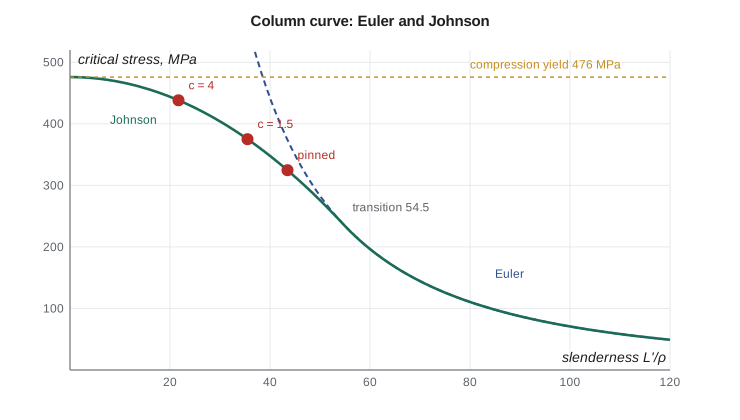
Plate buckling
A skin panel between stringers and ribs is a plate supported on its edges. When compressed in its plane, it buckles into a pattern of half-waves at a critical stress that depends on its thickness-to-width ratio, its edge supports and the type of loading.
Here \(b\) is the loaded width (for compression, the distance between stringers) and \(k\) is the buckling coefficient. For a long plate in compression with all edges simply supported, \(k\) = 4.0. With the long edges clamped it rises to about 6.97. A plate with one long edge free, such as the outstanding flange of a stringer, has \(k\) of only about 0.43, which is why flanges are kept short and often given lips. In shear, a long simply supported plate has \(k\) of about 5.35, rising for shorter panels. Because the critical stress goes with \((t/b)^2\), halving the stringer spacing raises the skin's buckling stress fourfold, and doubling the thickness does the same.
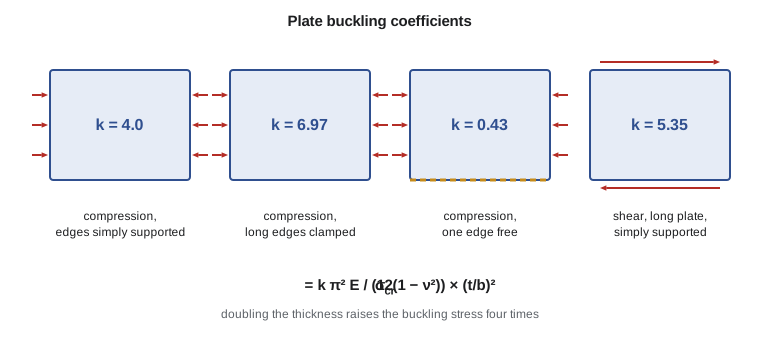
Plate buckling is very different from column buckling in one respect. A column that buckles has no reserve: the load it can carry falls as it deflects. A plate supported on its edges has a large reserve after buckling. Once it buckles, the middle of the plate stops taking additional load, but the material near the supported edges keeps carrying more, until the stiffeners or the edges themselves fail. Aircraft designers rely on that post-buckling strength, as Lesson 9 explains, and many wing and fuselage panels are designed to buckle at loads below limit load without any damage.
Local buckling and crippling
Stringers and spar caps are made of thin flanges and webs, and each of those elements is itself a plate that can buckle locally before the whole member buckles as a column. Short, thin-walled members fail by crippling: local buckling of the flanges followed by collapse of the corners, at a stress that can be well below the compressive yield strength. Crippling is predicted by empirical methods such as those of Needham and Gerard, which relate the crippling stress of each element to its width-to-thickness ratio. The full stringer strength then combines crippling and column buckling: the crippling stress replaces the yield strength at the top of the Johnson parabola.
# Buckling: Euler and Johnson columns for a stringer, plate buckling of the skin between stringers
import math
E, nu, Fcy = 71700.0, 0.33, 476.0       # MPa, 7075-T6 extrusion-like values (compression yield)
# stringer with its effective skin: area 330 mm2, radius of gyration 11.5 mm, rib pitch 500 mm
A, rho_g, Lrib = 330.0, 11.5, 500.0
def column(Leff):
    lr = Leff / rho_g
    lr_t = math.sqrt(2 * math.pi ** 2 * E / Fcy)          # transition slenderness
    if lr >= lr_t:
        return math.pi ** 2 * E / lr ** 2, lr, "Euler"
    return Fcy - Fcy ** 2 / (4 * math.pi ** 2 * E) * lr ** 2, lr, "Johnson"
print(f"Transition slenderness L'/rho = {math.sqrt(2*math.pi**2*E/Fcy):.1f}")
for c, lab in ((1.0, "pinned at ribs"), (1.5, "partly fixed, c = 1.5"), (4.0, "fully fixed, c = 4")):
    s, lr, kind = column(Lrib / math.sqrt(c))
    print(f"   {lab:22s}: L'/rho = {lr:5.1f}, {kind:7s} stress {s:6.1f} MPa, load {s*A/1000:5.1f} kN")
# skin panel between stringers: plate buckling sigma_cr = k pi^2 E / (12 (1 - nu^2)) (t / b)^2
def plate(k, t, b): return k * math.pi ** 2 * E / (12 * (1 - nu ** 2)) * (t / b) ** 2
t, b = 1.6, 1020.0 / 7
for k, lab, tt, bb in ((4.0, "skin, compression, edges simply supported", t, b),
                       (6.97, "skin, compression, long edges clamped", t, b),
                       (5.35, "skin, shear, edges simply supported", t, b),
                       (0.43, "stringer flange 20 x 2 mm, one edge free", 2.0, 20.0)):
    print(f"   k = {k:4.2f} {lab:42s}: {plate(k, tt, bb):6.1f} MPa")
print(f"Skin panel {b:.0f} mm wide x {t} mm thick buckles in compression near {plate(4.0, t, b):.0f} MPa, far below the boom stress")
# crippling of the Z stringer flanges by a Needham-type relation (coefficient illustrative)
bt = 20.0 / 2.0
Fcc = 0.316 * math.sqrt(E * Fcy) / bt ** 0.75
print(f"Needham-type crippling estimate for 20 x 2 mm flanges: {min(Fcc, Fcy):.0f} MPa")Transition slenderness L'/rho = 54.5 pinned at ribs : L'/rho = 43.5, Johnson stress 324.7 MPa, load 107.1 kN partly fixed, c = 1.5 : L'/rho = 35.5, Johnson stress 375.1 MPa, load 123.8 kN fully fixed, c = 4 : L'/rho = 21.7, Johnson stress 438.2 MPa, load 144.6 kN k = 4.00 skin, compression, edges simply supported : 31.9 MPa k = 6.97 skin, compression, long edges clamped : 55.6 MPa k = 5.35 skin, shear, edges simply supported : 42.7 MPa k = 0.43 stringer flange 20 x 2 mm, one edge free : 284.6 MPa Skin panel 146 mm wide x 1.6 mm thick buckles in compression near 32 MPa, far below the boom stress Needham-type crippling estimate for 20 x 2 mm flanges: 328 MPa
The results explain why the first-pass layout cannot stand. A stringer with its attached skin, 330 mm² in area with a radius of gyration of 11.5 mm, carries 325 MPa as a pinned column between ribs 500 mm apart, rising to 375 MPa with a realistic fixity of 1.5. Its flanges, 20 by 2 mm, buckle locally near 285 MPa and cripple at about 328 MPa. That is close to the 306 MPa booms of the first-pass model, too close for comfort with no allowance for imperfections or eccentricity. The skin between stringers is the bigger issue: 1.6 mm over 146 mm buckles at only 32 MPa in compression, a tenth of the boom stress. The skin will be buckled for most of the flight envelope above about 1 g, so the cover must be designed as a post-buckled stiffened panel. That is exactly what Lesson 9 does, and it leads to a thicker skin and more stringers.
Imperfections and tests
Real columns and plates are never perfectly straight and flat, and loads are never perfectly central. Imperfections make the deflection grow gradually rather than suddenly, and they lower the failure load, sometimes a lot. Thin curved shells, such as fuselage skins in compression, are especially sensitive: their actual buckling loads can be a fraction of the classical prediction. For that reason, buckling allowables in the aircraft industry rest heavily on test data, and companies maintain design curves calibrated by panel tests. The methods in this lesson give the shape of the answer; tests give the numbers that are certified.
Buckling of curved fuselage panels
Fuselage skins are curved, and curvature changes buckling behaviour. A slightly curved panel is stiffer against buckling than a flat one of the same thickness and width, because it must stretch as well as bend to buckle. The classical theory for curved panels gives buckling stresses that rise with curvature, but tests show that real curved panels buckle well below the classical prediction, because small imperfections trigger an early collapse. Design curves for curved panels therefore include large empirical reduction factors, and they come from test programs run by research agencies and manufacturers over many decades. For the Swift fuselage of Lesson 7, the keel panels between stringers will buckle in compression under the hard landing case, and the design accepts this as long as the stringers and frames carry the load, exactly as in a wing cover.
Worked problem
Euler load of a stringer
A hat stringer has an area of 250 mm² and a second moment of area of 42 000 mm⁴. Rib spacing is 600 mm and the end fixity is taken as 2. Find the Euler stress, with \(E\) = 71.7 GPa, and check whether Euler applies for \(F_{cy}\) = 476 MPa.
Show solution
- \(\rho = \sqrt{42\,000/250} = 13.0\) mm. \(L' = 600/\sqrt{2} = 424\) mm. \(L'/\rho = 32.7\).
- Euler: \(\sigma = \pi^2 \times 71\,700/32.7^2 = 662\) MPa.
- The transition slenderness is 54.5, so the stringer is in the Johnson range: \(\sigma = 476 - 476^2 \times 32.7^2/(4\pi^2 \times 71\,700) = 476 - 85 = 391\) MPa.
Answer: Euler alone would have overestimated the strength by 70 percent. Always check which side of the transition the member falls on.
Worked problem
Shear buckling of a spar web
The Tern's front spar web at the root is 3 mm thick and about 290 mm deep between caps, with stiffeners every 300 mm. Estimate its shear buckling stress using k = 7.0 for a nearly square panel, \(E\) = 71.7 GPa and ν = 0.33, and compare it with the 66 MPa from Lesson 6.
Show solution
- Use the smaller dimension, b = 290 mm: \(\tau_{cr} = 7.0 \times \pi^2 \times 71\,700/(12 \times 0.891) \times (3/290)^2\).
- \(= 7.0 \times 66\,170 \times 1.07 \times 10^{-4} = 49.6\) MPa.
Answer: The web would buckle in shear below the ultimate shear stress. That is acceptable if it is designed as a tension-field web, in which the buckled web carries load in diagonal tension; otherwise it needs to be thicker or have closer stiffeners.
Common mistakes
MistakeUsing Euler's formula for short columns.
InsteadBelow the transition slenderness, use the Johnson parabola or a tangent-modulus method.
MistakeMeasuring plate width along the loading direction.
InsteadFor compression, b is the distance between the supported long edges, across the load.
MistakeAssuming a buckled plate has failed.
InsteadEdge-supported plates carry substantial load after buckling; the stiffeners usually fail first.
MistakeTrusting classical shell buckling predictions without knockdown factors.
InsteadCurved shells are imperfection-sensitive; use test-based allowables.
Summary and key terms
- Thin compression structure fails by buckling.
- Euler's formula gives column buckling in terms of slenderness; the Johnson parabola covers short columns up to the yield or crippling stress.
- Plates buckle at kπ²E/(12(1−ν²))(t/b)², with k depending on edge support and loading.
- Stringer flanges buckle locally and cripple.
- Edge-supported plates have large post-buckling strength.
- For the Tern first-pass cover, the stringers are marginal and the skin buckles at only 32 MPa, so the cover must be designed as a post-buckled stiffened panel.
- Slenderness ratio
- The effective length divided by the radius of gyration, L'/ρ.
- Fixity coefficient
- A factor c describing end restraint; the effective length is L/√c.
- Johnson parabola
- A column formula for short and intermediate columns that limits the stress to the yield value.
- Plate buckling coefficient
- The factor k in the plate buckling formula, set by edge support and load type.
- Crippling
- Failure of a short thin-walled member by local buckling followed by collapse of its corners.
- Post-buckling strength
- The ability of an edge-supported plate to carry load after it has buckled.
Practice problems
Work each problem on paper first, then reveal the answer to check.
A pinned column has L'/ρ = 100 and E = 70 GPa. What is its Euler stress?
Show answer
π² × 70 000/10 000 = 69 MPa.
How does the Euler load change if the column length is halved?
Show answer
It increases four times.
A skin 2 mm thick spans 120 mm between stringers. Find its compression buckling stress with k = 4, E = 71.7 GPa, ν = 0.33.
Show answer
4 × 66 170 × (2/120)² = 73.5 MPa.
Why are stringer flanges often given a lip?
Show answer
A free edge has k ≈ 0.43; a lip supports it and raises local buckling stress.
In the program, reduce the rib pitch to 400 mm. What happens to the pinned-column stress?
Show answer
The slenderness falls to about 35, and the stress rises to about 375 MPa.
Why do companies rely on test data for buckling allowables?
Show answer
Imperfections lower buckling loads, especially for curved shells, in ways theory cannot predict exactly.
Lesson quiz · 5 questions
Score 60% or more to complete this lesson.
Create a free account to save your progress, take quizzes and earn a certificate.