
AERO-310 · Lesson 10 of 12 · 23 min
Fatigue and damage tolerance
Every flight of the Tern loads its lower wing skin in tension, unloads it on landing and adds dozens of smaller cycles from gusts and manoeuvres along the way. Each cycle is far below the static strength of the skin, yet after enough of them a crack can start at a rivet hole and grow. The commuter operators who will buy the Block 2 fly short sectors, often eight or ten a day, so an aircraft can reach 30 000 flights in fifteen years. Marcus tells Arjun that for the lower wing cover, fatigue and damage tolerance, not static strength, set the thickness, and that the evidence the team provides here is what lets the aircraft stay in service safely for its whole life.
Fatigue in metals
Metal fatigue is the gradual growth of damage under repeated loading. Cracks start at points of high local stress, such as fastener holes, sharp corners, scratches and corrosion pits, often after many thousands of cycles in which nothing visible happens. Once started, a crack grows a little with each cycle until the remaining material can no longer carry the load, and the part fractures, often at a stress well below the static strength. Fatigue is the leading cause of structural failures in service across all of engineering, and aircraft, with their light, highly stressed structure and very large numbers of load cycles, are particularly exposed.
Fatigue strength is measured by cycling test specimens at a constant stress amplitude until they fail. Plotting the amplitude against the number of cycles on logarithmic axes gives an S-N curve. Over much of its range it is close to a straight line, described by Basquin's relation \(N = N_{ref}(S_{ref}/S_a)^k\), with an exponent \(k\) often between about 3 and 6 for notched aluminium details. Unlike steel, aluminium alloys have no clear endurance limit: even small stress amplitudes eventually cause failure if repeated often enough. The mean stress matters too; a tensile mean shortens life, which is handled with Goodman-type corrections.
Variable loading and Miner's rule
Aircraft do not see constant-amplitude cycles. They see a spectrum: one large ground-air-ground cycle per flight from the change between ground loads and 1 g flight, plus many smaller gust and manoeuvre cycles of varying sizes. Palmgren and Miner proposed a simple way to combine them. Each block of \(n_i\) cycles at amplitude \(S_i\) uses up a fraction \(n_i/N_i\) of the life, where \(N_i\) is the life at that amplitude from the S-N curve. Failure is predicted when the fractions add up to one.
Miner's rule ignores the order in which cycles are applied and the interaction between large and small cycles, so it is not precise. In practice its error is compensated by scatter factors and by calibration against full-scale tests. It remains the standard tool for comparing designs and for safe-life calculations.
Three design philosophies
Aircraft structures are designed against fatigue in one of three ways. In safe-life design, a part is given a fixed life, found by analysis and test and divided by a scatter factor, often 3 to 5, and is retired before it reaches that life whether or not it shows damage. Landing gear and some engine parts are designed this way, because they have no alternative load path. In fail-safe design, the structure is arranged so that if one member fails, others carry the load until the failure is found: multiple spars, multiple fasteners, crack-stopping straps. In damage-tolerance design, the structure is assumed to contain cracks from the start, of a size just below what inspection can find, and the designer shows that those cracks will grow slowly enough to be found by scheduled inspections long before they become dangerous.
Damage tolerance became the standard for transport category aircraft after accidents showed the limits of the other approaches. In 1988 an airliner lost a large section of its upper fuselage in flight after many small cracks along a lap joint, each too small to matter alone, linked up. That accident led to rules on multiple-site and widespread fatigue damage and on the limit of validity of the structural maintenance program. Today, section 525.571 of the Airworthiness Manual requires damage tolerance evaluation for transport category aeroplanes, and the airworthiness standards Transport Canada applies to commuter aeroplanes (Chapter 523 of the Airworthiness Manual) require commuter aeroplanes like the Tern to be shown free of catastrophic fatigue failure through a combination of these methods.
Crack growth: fracture mechanics
Damage tolerance rests on fracture mechanics. The stress field near a crack tip is described by the stress intensity factor \(K = \beta\sigma\sqrt{\pi a}\), where \(a\) is the crack length and \(\beta\) a geometry factor, about 1.12 for an edge crack. A crack grows by fatigue at a rate that depends on the range of \(K\) in each cycle, \(\Delta K\). Over a wide middle range, Paris found that the rate follows a power law. The crack becomes unstable when \(K\) at the highest load reaches the fracture toughness \(K_c\) of the material.
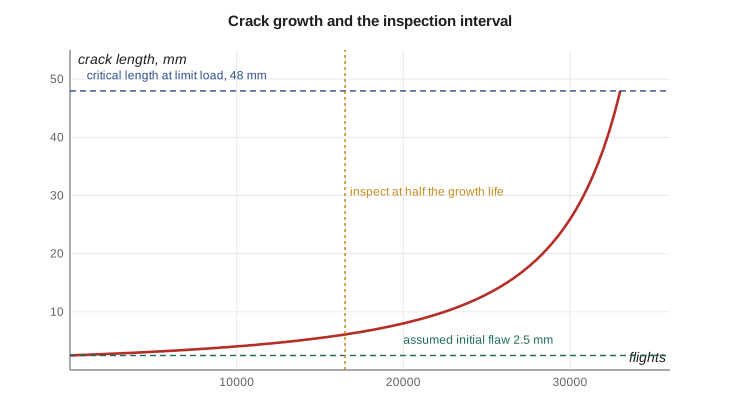
Integrating the Paris law from an initial crack \(a_0\) to the critical length \(a_c\) gives the number of cycles available. Because the growth rate rises steeply with crack length, most of the life is spent while the crack is small. The inspection program is then set so that a crack is inspected several times between the size at which it can be reliably detected and the critical size. A common approach sets the inspection interval at half the growth period, so that every crack gets at least two chances of being found.
# Fatigue of the lower wing skin: Miner's rule with a flight spectrum, then crack growth by the Paris law
import math
# S-N curve for a notched 2024-T3 detail (Basquin form, coefficients illustrative): N = (S_ref / S_a) ** k * N_ref
S_ref, N_ref, k = 65.0, 1e5, 4.0
def life(Sa): return N_ref * (S_ref / Sa) ** k
spectrum = [  # (stress amplitude MPa at the detail, cycles per flight): one ground-air-ground cycle plus gusts
    (55.0, 1), (18.0, 12), (28.0, 3), (40.0, 0.3), (60.0, 0.02)]
D = sum(n / life(Sa) for Sa, n in spectrum)
print(f"Miner damage per flight {D:.3e}; mean life {1/D:,.0f} flights")
for sf in (3, 4):
    print(f"   safe life with a scatter factor of {sf}: {1/D/sf:,.0f} flights")
# Paris-law growth of a through crack from a rivet hole in the lower skin
C, m = 8.0e-11, 3.2           # m per cycle, MPa sqrt(m) (illustrative 2024-T3 values)
beta = 1.12
dS = 95.0                     # MPa, equivalent stress range per flight
Kc, S_lim = 70.0, 161.0       # fracture toughness of the thin sheet; skin stress at limit load
a_c = (Kc / (beta * S_lim)) ** 2 / math.pi
for a0 in (0.00127, 0.0025, 0.005):
    a, N, da = a0, 0, 1e-5
    while a < a_c:
        dK = beta * dS * math.sqrt(math.pi * a)
        rate = C * dK ** m
        N += da / rate; a += da
    print(f"Initial crack {a0*1000:4.2f} mm grows to critical {a_c*1000:5.1f} mm in {N:,.0f} flights; "
f"inspection every {N/2:,.0f} flights")Miner damage per flight 7.440e-06; mean life 134,402 flights safe life with a scatter factor of 3: 44,801 flights safe life with a scatter factor of 4: 33,601 flights Initial crack 1.27 mm grows to critical 48.0 mm in 52,945 flights; inspection every 26,472 flights Initial crack 2.50 mm grows to critical 48.0 mm in 32,968 flights; inspection every 16,484 flights Initial crack 5.00 mm grows to critical 48.0 mm in 19,443 flights; inspection every 9,721 flights
With the illustrative S-N curve and spectrum, the Miner sum gives a damage of 7.4 × 10⁻⁶ per flight, a mean life of about 134 000 flights. With a scatter factor of 4, the safe life is about 34 000 flights, just above the operators' 30 000. The crack growth calculation is more revealing. A 2.5 mm crack at a rivet hole grows to the critical length of 48 mm, the size at which it would fracture at limit load, in about 33 000 flights, so inspection every 16 500 flights would catch it twice. If the operators' inspection method can only reliably find 5 mm cracks, the growth life from that size falls to about 19 000 flights and the interval to under 10 000. Arjun learns the lesson that every damage tolerance engineer learns: the detectable crack size, and therefore the inspection method, is as important to safety as the material and the stress.
The lower skin thickness is chosen with this in mind. A thicker skin lowers the stress range per flight, and because crack growth goes roughly with the third power of the stress range, a 10 percent thinner skin can cost 30 percent of the crack growth life. Marcus's team settles on a lower cover skin for the Block 2 that keeps the 1 g stress in the root bay at about the same level as Block 1, which has years of satisfactory service history, and uses 2024-T3, chosen for its slow crack growth and high toughness rather than its strength.
Testing and in-service evidence
Analysis alone does not satisfy the rules for fatigue. The structure is tested, from coupons and joint specimens up to a full-scale airframe cycled through many times the design life in a test rig. Cracks found in the test are fixed in the design, and the inspection program is set from what the test shows. In service, operators report cracks they find, and manufacturers update the inspection program through service bulletins and the regulator issues airworthiness directives where needed. Fatigue management is continuous for the whole life of an aircraft type.
Corrosion and the environment
Fatigue does not act alone. Corrosion pits on an aluminium skin are excellent places for fatigue cracks to start, and a crack growing in a humid or salty environment can grow faster than one in dry air. Aircraft that operate from coastal airports or are washed often with de-icing fluids are particularly exposed. Designers protect fatigue-critical structure with anodizing or conversion coatings, primers, sealant in joints and drainage paths that stop water collecting. Maintenance programs include corrosion inspections alongside the fatigue inspections, because the two problems feed each other. For the Tern, which will operate on gravel strips and in cold, wet conditions in northern Manitoba, the team specifies sealant in all lower cover joints and wet-installed fasteners in the root bay.
Worked problem
Miner damage for two blocks
A detail has a life of 200 000 cycles at 40 MPa amplitude and 20 000 cycles at 70 MPa. Each flight applies one 70 MPa cycle and ten 40 MPa cycles. What is the predicted life in flights?
Show solution
- Damage per flight: \(1/20\,000 + 10/200\,000 = 5.0 \times 10^{-5} + 5.0 \times 10^{-5} = 1.0 \times 10^{-4}\).
- Life: \(1/(1.0 \times 10^{-4}) = 10\,000\) flights.
Answer: The single large cycle per flight does as much damage as the ten smaller ones. Ground-air-ground cycles often dominate fatigue damage for that reason.
Worked problem
Critical crack length
A skin has a fracture toughness of 70 MPa√m and carries 161 MPa at limit load. Find the critical crack length for an edge crack with β = 1.12.
Show solution
- \(a_c = (1/\pi)(70/(1.12 \times 161))^2\).
- \(= (1/\pi)(0.388)^2 = 0.0480\) m, or 48 mm.
Answer: Doubling the limit stress would cut the critical crack length to a quarter, about 12 mm, which would leave little room for inspection.
Common mistakes
MistakeTreating Miner's rule as a precise prediction.
InsteadIt ignores sequence effects; use scatter factors and calibrate with tests.
MistakeAssuming aluminium has an endurance limit like steel.
InsteadAluminium alloys keep accumulating damage at low amplitudes.
MistakeSetting inspection intervals without knowing the detectable crack size.
InsteadThe interval depends on growth from the reliably detectable size to the critical size.
MistakeChoosing the strongest alloy for a fatigue-critical tension skin.
InsteadCrack growth rate and toughness matter more than static strength there.
Summary and key terms
- Fatigue cracks start at stress raisers and grow under repeated loading.
- S-N curves and Miner's rule give fatigue lives under spectra; safe-life design retires parts with a scatter factor.
- Fail-safe design provides alternative load paths.
- Damage-tolerance design assumes cracks exist, uses the Paris law da/dN = C(ΔK)^m to grow them to the critical length set by fracture toughness, and sets inspections, often at half the growth life.
- For the Tern lower skin, a 2.5 mm crack takes about 33 000 flights to become critical.
- Full-scale tests and service experience keep the program current.
- S-N curve
- A plot of stress amplitude against cycles to failure.
- Miner's rule
- The sum of cycle fractions n/N used to predict fatigue failure under variable loading.
- Safe life
- A fixed retirement life with a scatter factor applied.
- Fail-safe
- A design that keeps an alternative load path after one member fails.
- Damage tolerance
- Design in which assumed cracks are shown to be found by inspection before they become critical.
- Stress intensity factor
- K = βσ√(πa), describing the stress field at a crack tip.
- Paris law
- da/dN = C(ΔK)^m, the power-law crack growth relation.
Practice problems
Work each problem on paper first, then reveal the answer to check.
If the stress range doubles and m = 3.2, how does the crack growth rate change?
Show answer
It increases by 2^3.2, about 9.2 times.
Why does most crack growth life occur while the crack is small?
Show answer
The growth rate rises steeply with crack length through ΔK.
In the program, raise the scatter factor to 5. What is the safe life?
Show answer
About 134 000/5 = 26 900 flights.
What does a ground-air-ground cycle represent?
Show answer
The change from ground loads to flight loads and back once per flight.
Name one structural item usually designed as safe-life.
Show answer
Landing gear.
What happens to the critical crack length if the fracture toughness is 20 percent lower?
Show answer
It falls by about 36 percent, since a_c ∝ K_c².
Lesson quiz · 5 questions
Score 60% or more to complete this lesson.
Create a free account to save your progress, take quizzes and earn a certificate.