
TRD-101 · Lesson 6 of 12 · 19 min
Ladders, scaffolds and elevated work platforms
Most of Maya's work at height is not at a slab edge but a few feet off the floor: hanging pipe from the ceiling, reaching a sleeve in the underside of the slab above, installing a vent at the top of a wall. For this work she uses ladders, rolling scaffolds and, on the high ceilings of the parking levels and the lobby, scissor lifts. These are everyday tools, and that is exactly why they cause so many injuries. People use them without thinking, take shortcuts with them and stand on parts that were never meant to be stood on.
This lesson covers the safe use of each. The principle from lesson 4 still applies: choose the access equipment that removes the most hazard. A platform with guardrails is better than a step ladder, and a step ladder is better than standing on a bucket.
Choosing the right access
| Equipment | Best for | Main hazards | Better choice when |
|---|---|---|---|
| Step ladder | Short tasks at low height in one spot | Over-reaching, standing on the top steps, tipping sideways | The task takes more than a few minutes or needs both hands and force |
| Platform ladder | Short to medium tasks; both hands free with a guarded platform | Over-reaching, moving it while on it | Work spreads across a large area |
| Extension ladder | Access between levels; short tasks against a wall | Wrong angle, sliding base, not tied off, carrying loads up | Regular access is needed: a stair tower is better |
| Rolling scaffold | Work spread across a ceiling or wall at moderate height | Unlocked casters, missing guardrails, moving with people on it, uneven floors | The floor is uneven or the height is beyond the scaffold's rating |
| Scissor lift | Overhead work across large areas; heavy tools and material | Tipping on slopes or holes, crushing against overhead structure, falls from the platform with the gate open | Reach over obstacles is needed: a boom lift |
| Boom lift | Work above or across obstacles, outside the building | Ejection from the basket, tip-over, contact with overhead lines, crushing | The work is at a fixed spot: a scaffold may be safer |
Ladders
Falls from ladders are among the most common serious injuries in construction, and OSHA's ladder standard, 1926.1053 in Subpart X, is regularly among OSHA's most cited construction standards. Subpart X requires a stairway or ladder at any point of access where there is a break in elevation of 19 in or more, sets rules for the design and use of ladders, and requires training by a competent person for every worker who uses them. Portable ladders are generally built to ANSI A14 standards. Ladders are best used for access and for short, light work; when a task needs force, both hands or a long time, a platform is the better choice.
Before using any ladder, Maya inspects it: rails straight and uncracked, rungs or steps secure and clean, feet in good condition, locks and spreaders working, labels readable. A damaged ladder is tagged "Do not use" and removed from the work area. She also checks the duty rating on the label. The rating must cover her weight plus her tools and material; most contractors use only heavy-duty ladders rated for at least 250 lb (about 113 kg), and many choose extra-heavy-duty models.
| Rule | Why |
|---|---|
| Set up on firm, level ground; never on boxes, pallets or loose material | The ladder is only as stable as its base |
| Set an extension ladder at a 4-to-1 angle: the base 1 ft out for every 4 ft of height to the top support | Too steep and it tips backward; too shallow and the base slides out |
| Extend the ladder at least 3 ft above the landing it gives access to, and tie it off top and bottom | A handhold when stepping on and off, and the ladder cannot slide or tip |
| Keep three points of contact: two hands and a foot, or two feet and a hand | A slip with one point of contact becomes a fall |
| Face the ladder when climbing; carry tools in a belt or haul them up with a line | Hands are free to hold on |
| Keep your belt buckle between the rails; move the ladder instead of reaching | Over-reaching tips ladders sideways |
| Do not stand on the top step or top cap of a step ladder, or the top rungs of an extension ladder | There is nothing left to hold, and the ladder is unstable |
| Fully open a step ladder and lock the spreaders; never use it folded against a wall | A folded step ladder slides out from under you |
| Keep metal and aluminum ladders away from electrical work and overhead lines | They conduct electricity; use fiberglass for electrical work |
# Where to put the base of an extension ladder (4-to-1 rule)
height_to_support = 12    # vertical height from the ground to where the ladder rests
base_out = height_to_support / 4
extension = 3          # length above the landing
print(f"Set the base {base_out:.2f} ft out from the wall")
print(f"Ladder length needed: at least {((height_to_support**2 + base_out**2) ** 0.5 + extension):.1f} ft")Set the base 3.00 ft out from the wall Ladder length needed: at least 15.4 ft
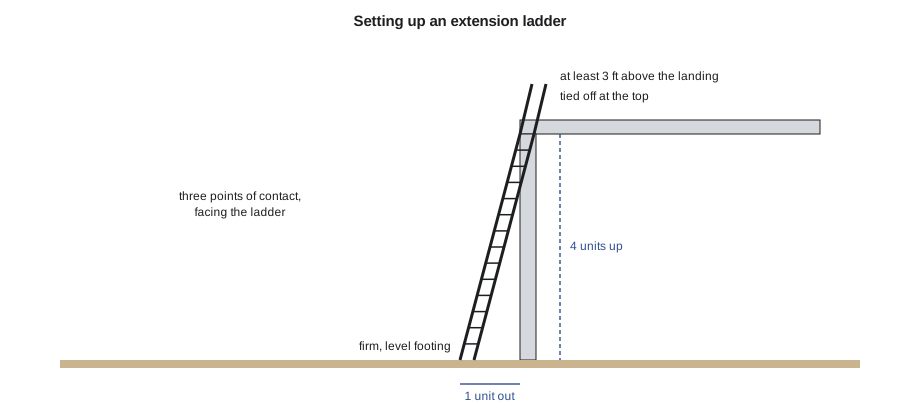
A quick check for the angle that Luis showed Maya: stand at the base with your toes against the ladder's feet and stretch your arms straight out. If your palms just reach the rung in front of you, the angle is about right. It is not precise, but it catches a ladder that is far too steep or too flat.
Kingsway Tower has reduced its ladder use deliberately. The stair towers went in early, so ladders are not used for access between floors, and Stonebridge and Northbridge supply platform ladders with guarded tops for work in the suites. Step ladders are allowed only where a platform ladder will not fit. The change cut ladder incidents on the site to almost none.
Rolling scaffolds
Rolling scaffolds, sometimes called mobile scaffolds or baker scaffolds in their narrow form, are common in interior work. They are quick to set up and move, which is also their danger. OSHA's scaffold standard, Subpart L, requires fall protection on scaffolds where a worker could fall more than 10 ft, requires a competent person to inspect scaffolds before each shift and after anything that could affect their integrity, and requires workers who use scaffolds to be trained by a qualified person. Many contractors require guardrails on baker scaffolds at any height, because a fall from a narrow platform onto a concrete floor can cause serious injury from well under 10 ft.
| Check | Before use |
|---|---|
| Casters | All casters locked; floor level, clean and free of holes, cords and debris |
| Frame | Frames, braces and pins in place and undamaged, assembled per the manufacturer |
| Platform | Fully planked or decked, with no gaps; planks secured so they cannot slide |
| Guardrails | Top rail, midrail and toe boards on all open sides and ends |
| Height | Within the manufacturer's height-to-base ratio, with outriggers if required |
| Access | Built-in ladder or stairs; never climb the cross braces |
| Tag | A current inspection tag showing the scaffold is ready for use |
Many sites use a scaffold tag system: green means the scaffold has been inspected and is ready for use, yellow means it can be used only with special precautions written on the tag (such as a harness because a guardrail is missing for a specific task), and red means do not use. On Kingsway Tower, an untagged scaffold is treated as red. Any change, such as moving a plank or removing a guardrail, makes the scaffold red until a competent person re-inspects it.
Two rules about moving rolling scaffolds catch new workers. First, nobody rides on a rolling scaffold while it is being moved. Second, before moving it, check the route: a floor drain opening, a cord or a small step in the slab can stop a caster dead and tip the whole scaffold. Maya learned to look for overhead obstructions too: sprinkler pipe and ductwork are at exactly the height of the platform.
Scissor lifts and boom lifts
Mobile elevating work platforms (MEWPs), also called aerial lifts, include scissor lifts, which rise straight up, and boom lifts, which reach up and out on an arm. OSHA's aerial lift standard, 1926.453, covers boom-supported lifts and requires workers in the basket to wear a body harness or restraint attached to the boom or basket; scissor lifts are treated as mobile scaffolds, protected by their guardrails. The ANSI A92 standards for MEWPs, published in 2018 and in effect since 2020, require operator training and familiarization on each model, and a rescue plan. Only trained and authorized workers operate lifts.
| Hazard | Control |
|---|---|
| Tip-over on a slope, hole, soft ground or edge | Use only on firm, level surfaces; check the travel path for openings and edges; never drive elevated near an edge unless the machine is rated for it |
| Crushing against overhead structure | Watch overhead while raising and driving; keep hands inside the guardrails; many newer lifts have anti-entrapment devices |
| Falls from the platform | Keep the gate closed and the guardrails in place; never stand on the rails; harness in boom lifts |
| Ejection from a boom lift basket | Harness and short lanyard attached to the basket anchor |
| Contact with overhead power lines | Keep minimum distances; use a spotter near lines; plan the work so the boom never approaches them |
| Overloading | Respect the rated platform capacity, including people, tools and material |
Maya will not operate a scissor lift until Northbridge trains her and the foreman authorizes her, but she will ride in one with Luis on the parking levels, where the ceilings are high. The daily routine is the same every time: a walk-around inspection of the machine before use, a function test of the controls and the emergency lowering, a check of the floor where they will work for drains and openings, and a look at the ceiling for sprinkler pipe and conduit they could be crushed against.
Working on and around access equipment
Access equipment creates hazards for people below as well as people on it. Tools and fittings can fall from a platform, and a person working on a ladder in a doorway can be knocked off by someone opening the door. Maya's habits include tethering tools at height when working over people or openings, barricading the area below a scaffold or lift when there is a risk of falling objects, and putting a sign or a spotter in doorways and corridors where she has set up a ladder.
Stairs and temporary access
Most falls related to access happen not on ladders or scaffolds but on stairs, ramps and temporary walkways, simply because people use them so often. On a building under construction, stairs may be unfinished concrete or steel pans, without handrails at first, covered in dust or ice, and used by people carrying materials that block their view of their feet.
| Access route | Common hazard | What a safe one looks like |
|---|---|---|
| Temporary stairs and stair towers | Missing handrails, debris on treads, poor lighting | Handrails and guardrails on open sides, treads clear, lights working |
| Unfinished permanent stairs | Pan stairs not yet filled with concrete; wet or icy treads | Pans filled or temporary treads installed before use; salt and sand in winter |
| Ramps and runways | Too steep, no edge protection, slippery surface | Gentle slope with cleats, guardrails on open sides, kept clear |
| Hoist landings | Gap between hoist and floor, gate left open | Landing gates closed unless the car is there; no material stacked at the landing |
Maya's habit on stairs is the same as on a ladder, just quicker: one hand on the rail, never carrying a load she cannot see over, and taking long items up in the hoist rather than up the stairs. When she finds debris on a stair tread or a light out in a stairwell, she clears it or reports it the same shift, because the next person on those stairs may be carrying a box of fittings and looking straight ahead.
Common mistakes
MistakeStanding on the top step of a step ladder to reach a little higher.
InsteadGet a taller ladder or a platform; never stand on the top step or top cap.
MistakeMoving a rolling scaffold with someone still on the platform.
InsteadEveryone gets off before the scaffold is moved, and the route is checked first.
MistakeUsing a scaffold with a missing guardrail because it was green this morning.
InsteadAny change makes the scaffold red until it is re-inspected.
MistakeRaising a scissor lift without looking overhead.
InsteadWatch overhead while raising and driving to avoid crushing against pipes and structure.
Summary and key terms
- Subpart X requires a ladder or stair at breaks in elevation of 19 in or more, and ladder training by a competent person.
- Inspect ladders before use, check the duty rating, set extension ladders at 4 to 1, extend and tie them off, and keep three points of contact.
- Platform ladders and stair towers reduce ladder falls.
- Rolling scaffolds need locked casters, full planking, guardrails and a current tag; nobody rides them while they move.
- Green, yellow and red scaffold tags show whether a scaffold may be used; untagged means red.
- Only trained, authorized workers operate elevating work platforms; workers in boom lifts wear a harness attached to the basket.
- Protect people below with tool tethers, barricades and spotters.
- Duty rating
- The maximum load a ladder is designed to carry, including the worker, tools and material.
- Four-to-one rule
- Setting an extension ladder so the base is one unit out for every four units of height to its support.
- Three points of contact
- Keeping two hands and a foot, or two feet and a hand, on a ladder at all times.
- Rolling scaffold
- A scaffold on casters that can be moved from place to place.
- Scaffold tag
- A tag showing whether a scaffold has been inspected and may be used.
- MEWP
- A mobile elevating work platform, such as a scissor lift or boom lift.
- Competent person
- A person trained and experienced enough to identify hazards and with the authority to correct them.
Practice problems
Work each problem on paper first, then reveal the answer to check.
An extension ladder reaches a support 12 ft above the ground. How far out should the base be?
Show answer
3 ft (one quarter of the height).
What does a yellow scaffold tag mean?
Show answer
The scaffold may be used only with the special precautions written on the tag.
Name three checks before using a rolling scaffold.
Show answer
Casters locked, full planking, guardrails on all sides, built-in access, current tag, level floor.
Why are fiberglass ladders used for electrical work?
Show answer
Metal ladders conduct electricity; fiberglass does not when clean and dry.
What two things does Maya check above and below before raising a scissor lift?
Show answer
The floor for drains, openings and slopes, and the ceiling for pipes and structure she could be crushed against.
Lesson quiz · 5 questions
Score 60% or more to complete this lesson.
Create a free account to save your progress, take quizzes and earn a certificate.