
TRD-101 · Lesson 10 of 12 · 19 min
Air monitoring, dusts and fumes
Lesson 9 showed why the air in a confined space can kill in seconds. Most of the airborne hazards on a construction site work more slowly. Silica dust from cutting and coring concrete, fumes from soldering and welding, solvent vapor from adhesives and coatings, carbon monoxide from fuel-burning equipment, and in older buildings asbestos fibers and mold spores, cause illnesses that show up months, years or decades later: silicosis, lung cancer, chronic obstructive lung disease, mesothelioma, nervous system damage. Because the harm is delayed, these hazards are easy to ignore on the day, and that is exactly why they need deliberate control.
This lesson covers how airborne hazards are measured, starting with the portable gas monitor that every confined space entry depends on, and then the main dusts and fumes a mechanical apprentice meets and how they are controlled.
The portable gas monitor
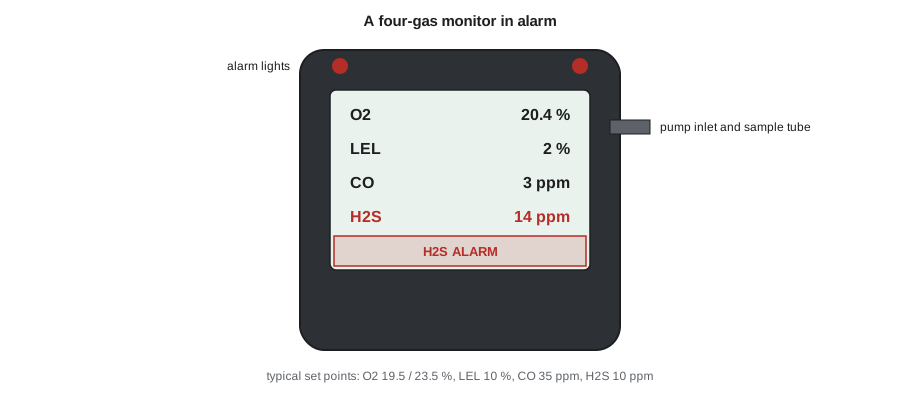
The instrument used most often on construction sites is a portable multi-gas monitor, usually a four-gas monitor that measures oxygen, flammable gases as a percentage of the lower explosive limit (LEL), carbon monoxide and hydrogen sulfide. It samples the air either by diffusion, letting air reach the sensors on its own, or with a pump that draws air through a tube, which is how a manhole or pit is tested from outside before entry. The monitor shows each reading and sounds an alarm, with lights and vibration, when a reading crosses a set point.
| Sensor | What it measures | Typical alarm set points |
|---|---|---|
| Oxygen | Percent oxygen in the air; normal is about 20.9 percent | Low alarm at 19.5 percent; high alarm at 23.5 percent |
| Flammable (LEL) | Flammable gases and vapors as a percentage of the lower explosive limit | Alarm at 10 percent of the LEL, well below the level at which the mixture can ignite |
| Carbon monoxide | Parts per million (ppm) of CO | Commonly 35 ppm, the NIOSH recommended limit; OSHA's construction limit is 50 ppm averaged over eight hours |
| Hydrogen sulfide | Parts per million of H2S | Commonly 10 ppm for the low alarm, with a higher second alarm; many employers set lower values |
The lower explosive limit is the lowest concentration of a gas in air that can burn. For methane it is about 5 percent by volume. A reading of 10 percent LEL means the methane is at a tenth of that, about 0.5 percent by volume: not yet flammable, but a sign that something is producing gas and that the space must not be entered until it is ventilated and the source is found.
# Compare a set of readings from a pit with the monitor's alarm set points
alarms = {"O2 low %": 19.5, "O2 high %": 23.5, "LEL %": 10, "CO ppm": 35, "H2S ppm": 10}
readings = {"top": (20.8, 0, 2, 0), "middle": (20.4, 2, 3, 4), "bottom": (18.9, 4, 3, 14)}
for level, (o2, lel, co, h2s) in readings.items():
    problems = []
    if o2 < alarms["O2 low %"]: problems.append("low oxygen")
    if o2 > alarms["O2 high %"]: problems.append("oxygen enriched")
    if lel >= alarms["LEL %"]: problems.append("flammable")
    if co >= alarms["CO ppm"]: problems.append("carbon monoxide")
    if h2s >= alarms["H2S ppm"]: problems.append("hydrogen sulfide")
print(f"{level:7s} O2 {o2:4.1f}% LEL {lel}% CO {co} ppm H2S {h2s} ppm ->", ", ".join(problems) or "within set points")top O2 20.8% LEL 0% CO 2 ppm H2S 0 ppm -> within set points middle O2 20.4% LEL 2% CO 3 ppm H2S 4 ppm -> within set points bottom O2 18.9% LEL 4% CO 3 ppm H2S 14 ppm -> low oxygen, hydrogen sulfide
The readings in this example came from the ejector pit in lesson 9's story. At the top the air looked fine. Halfway down, hydrogen sulfide was starting to appear. At the bottom, oxygen was low and hydrogen sulfide was above the alarm. A worker who tested only at the cover would have climbed into a pit where the bottom layer could knock them down.
Bump tests and calibration
A gas monitor is only trustworthy if its sensors respond. Sensors can be damaged by exposure to high gas levels, silicone vapors from sealants, moisture and age, and a dead sensor still shows a reassuring zero. Two checks keep monitors honest.
| Check | What it is | How often |
|---|---|---|
| Bump test | Briefly exposing the monitor to a known test gas to confirm every sensor responds and every alarm works | Before each day's use, as most manufacturers recommend |
| Calibration | Adjusting the monitor's readings against a certified test gas so they are accurate | At the interval the manufacturer sets, and whenever a bump test fails |
| Fresh-air zero | Setting the baseline in clean air at start-up | Each time the monitor is turned on, in known clean air |
On Kingsway Tower, the monitors live in a docking station in Stonebridge's trailer that bump tests and calibrates them automatically and keeps a record. A monitor that fails its bump test is locked out of use until it is calibrated and passes. Maya is not yet trained to use a monitor for an entry, but she has been shown how to read one and to recognize the alarm, because she may be working near an entry or in a space where a monitor is clipped to someone's collar.
Ventilation
The main way to make the air in a space safe is ventilation: blowing fresh air in or drawing contaminated air out. For confined spaces, the usual method is a blower outside the space pushing fresh air through a flexible duct to the bottom of the space, which pushes contaminated air out through the opening. The blower's intake must be in clean air, away from vehicle exhaust and generators, or it will pump carbon monoxide into the space. Ventilation must run continuously during the entry, and the monitor stays on, because the work itself can produce gas.
Never ventilate a space with pure oxygen. It does not make the air safer; it creates an oxygen-enriched atmosphere in which clothing and materials catch fire readily.
Silica dust
Crystalline silica is found in concrete, block, brick, mortar, stone and many other construction materials. Cutting, coring, grinding, chipping and drilling these materials releases fine respirable dust that can reach deep into the lungs, where it causes silicosis, an incurable scarring of the lungs, and increases the risk of lung cancer, chronic obstructive pulmonary disease and kidney disease. OSHA's construction silica standard, 1926.1153, sets a permissible exposure limit of 50 micrograms per cubic meter averaged over eight hours. Employers can comply by following Table 1 in the standard, which lists common tasks such as core drilling and handheld sawing with the engineering controls and respirators required for each, or by measuring exposures. The standard also requires a written exposure control plan and a competent person to carry it out.
| Task | Main control | Extra protection |
|---|---|---|
| Core drilling through concrete slabs and walls | Wet coring with water fed to the bit; vacuum to collect slurry | Respirator if working indoors for long periods or the water feed is not effective |
| Drilling anchor holes for pipe hangers | Drill with an integrated dust extraction shroud and a HEPA vacuum | Respirator when drilling overhead for long periods |
| Cutting block or concrete with a handheld saw | Water spray at the blade, or a shroud and HEPA vacuum | Respirator, as the employer's plan or Table 1 specifies |
| Chipping concrete to expose embedded pipe | Tool with dust extraction; wet methods | Respirator; keep others out of the area |
| Cleanup | HEPA vacuum or wet sweeping; no dry sweeping or compressed air | None if done properly |
Dry sweeping and blowing dust off clothes with compressed air are two habits that put more silica in the air than the original task. Kingsway Tower bans both. Maya cleans up with the HEPA vacuum and a damp rag, and leaves her dusty coveralls at the site.
Fumes from soldering, brazing and welding
Heating metals and fluxes produces fumes: fine particles of metal oxides and decomposed flux. Soldering copper water lines with lead-free solder, which is required for drinking water systems in both Canada and the United States, produces relatively small amounts of fume, mostly from the flux. Brazing and welding produce more, and welding on galvanized steel or stainless steel produces zinc oxide, which causes a flu-like illness called metal fume fever, or hexavalent chromium, which can cause cancer.
The controls follow the hierarchy: substitute where possible (press fittings instead of solder), ventilate with a fan or local exhaust that pulls the fume away from the worker's breathing zone, position yourself upwind of the plume and keep your head out of it, and use respiratory protection where ventilation is not enough. Fluxes can also irritate the skin, which is why Maya wears gloves when applying them.
Carbon monoxide from equipment
Carbon monoxide is produced by any fuel-burning equipment: propane heaters used to keep concrete and workers warm in winter, gas-powered saws and pumps, generators and vehicles. It is colorless and odorless, and in an enclosed parking level or basement it builds up quickly. Symptoms start with headache, dizziness and nausea, and can progress to confusion, collapse and death. Many construction workers have been poisoned using a gas-powered saw indoors for just a few minutes.
On Kingsway Tower, gas-powered tools are not allowed inside the building; electric and battery tools are used instead. Propane heaters are used only with ventilation, and Stonebridge places fixed CO monitors on the parking levels in winter. If Maya gets a headache or feels dizzy while working near heaters or engines, she gets to fresh air and tells her supervisor; the symptoms are a warning, not something to push through.
Asbestos and other hidden hazards in older buildings
Kingsway Tower is new, but Northbridge also works in older buildings, and Maya will be sent to renovation jobs during her apprenticeship. Buildings constructed before the 1980s may contain asbestos in pipe insulation, boiler insulation, floor tiles, drywall joint compound, plaster and many other materials. Disturbing asbestos releases fibers that cause asbestosis, lung cancer and mesothelioma, often decades later. OSHA's construction asbestos standard, 1926.1101, classifies asbestos work by the type of material and activity and sets controls, training and medical surveillance; building owners and employers must identify asbestos-containing material before work that might disturb it.
The rule for a new worker is clear: if you find insulation, tile or other material you suspect might contain asbestos, and nobody has told you it has been tested, do not disturb it. Stop, keep others away and tell your supervisor. The same applies to suspected mold, lead paint and pigeon droppings, each of which needs its own precautions.
Know the early signs
Monitors and controls are the main defense, but your own body often gives the first sign that something is wrong. The early symptoms of many airborne exposures are easy to mistake for a hangover, a cold or a long day. Learning them, and acting on them instead of pushing through, has saved many workers.
| Symptom | Possible airborne cause | What to do |
|---|---|---|
| Headache, dizziness, nausea near heaters or engines | Carbon monoxide | Get to fresh air at once, tell your supervisor, have the area tested |
| Light-headedness or drowsiness while gluing or painting | Solvent vapor | Stop, get to fresh air, improve ventilation before continuing |
| Rotten egg smell near a drain or pit that then fades | Hydrogen sulfide deadening the sense of smell | Leave the area immediately and report it |
| Fever, chills and aching after welding or brazing | Metal fume fever from zinc oxide | Report it; review ventilation and respiratory protection |
| Persistent cough or wheeze | Dust, fumes or sensitizers | Report it and see a doctor; tell them about your work |
When Maya felt light-headed on her second day of gluing PVC in a small, closed washroom, she remembered this table, stepped out into the corridor and told Luis. They propped the door open, set up a fan to exhaust to the window and took turns doing the joints. Her headache was gone within twenty minutes.
Common mistakes
MistakeUsing a gas monitor that has not been bump tested today.
InsteadBump test before each day's use; a dead sensor reads zero.
MistakePlacing a ventilation blower's intake next to a running generator.
InsteadPut the intake in clean air, away from engines and exhaust.
MistakeDry sweeping concrete dust or blowing off clothes with compressed air.
InsteadUse a HEPA vacuum or wet methods.
MistakeRunning a gas-powered saw indoors for a quick cut.
InsteadUse electric or battery tools indoors; carbon monoxide builds up in minutes.
Summary and key terms
- Four-gas monitors measure oxygen, flammable gas as percent of LEL, carbon monoxide and hydrogen sulfide, and alarm at set points.
- A 10 percent LEL alarm is well below the flammable level but shows gas is present.
- Bump test monitors before each day's use and calibrate them as the manufacturer requires.
- Ventilate confined spaces with clean air, never with oxygen, and keep monitoring during the work.
- OSHA's silica standard sets a limit of 50 micrograms per cubic meter and lists controls by task in Table 1.
- Use press fittings, ventilation and good positioning to control soldering and welding fumes.
- Keep fuel-burning equipment out of enclosed areas; stop work and report suspected asbestos.
- Four-gas monitor
- A portable instrument measuring oxygen, flammable gas, carbon monoxide and hydrogen sulfide.
- Lower explosive limit (LEL)
- The lowest concentration of a gas in air that can ignite.
- Bump test
- A brief exposure of a monitor to test gas to confirm the sensors and alarms respond.
- Calibration
- Adjusting an instrument against a certified test gas so its readings are accurate.
- Respirable crystalline silica
- Fine dust from concrete, stone and similar materials that can reach deep into the lungs and cause silicosis.
- Metal fume fever
- A flu-like illness caused by breathing zinc oxide fume, for example from welding galvanized steel.
- HEPA vacuum
- A vacuum with a high-efficiency particulate air filter that captures fine dust.
Practice problems
Work each problem on paper first, then reveal the answer to check.
What four gases does a typical four-gas monitor measure?
Show answer
Oxygen, flammable gas (as percent LEL), carbon monoxide and hydrogen sulfide.
A monitor shows 0 ppm hydrogen sulfide next to an open sewer. What should make you suspicious?
Show answer
Whether it was bump tested; a damaged sensor can read zero.
Why is ventilating with oxygen dangerous?
Show answer
It creates an oxygen-enriched atmosphere where materials ignite easily.
Name two ways to control silica dust when coring a slab.
Show answer
Wet coring with water to the bit and collecting the slurry with a vacuum; a respirator where needed.
What should Maya do if she finds old pipe insulation she suspects contains asbestos?
Show answer
Not disturb it, keep others away and tell her supervisor.
Lesson quiz · 5 questions
Score 60% or more to complete this lesson.
Create a free account to save your progress, take quizzes and earn a certificate.