
TRD-101 · Lesson 3 of 12 · 18 min
Hazard Communication: labels and safety data sheets
On a single day on Kingsway Tower, Maya might handle PVC primer and solvent cement, pipe thread sealant, flux and solder, cutting oil for the threading machine, spray foam sealant, propane for the torch and a cleaner for the fixtures. Each of these is a hazardous chemical. Some are flammable, some irritate the skin and eyes, some give off vapors that cause dizziness or long-term harm, and a few can do several of these things at once. OSHA's Hazard Communication Standard, often called HazCom or the right-to-know standard, is the US system for telling workers about these hazards and how to work safely with them.
HazCom has four parts that work together: labels on containers, safety data sheets (SDSs) with the full details, worker training, and the employer's written hazard communication program with a list of the hazardous chemicals on the site. Chemical manufacturers and importers must classify their products and provide labels and SDSs. Employers must keep the labels on containers, make the SDSs available to workers, train them, and keep the written program. The standard is 29 CFR 1910.1200, and it applies to construction through 1926.59.
A system based on the GHS
Since 2012, HazCom has been aligned with the Globally Harmonized System of Classification and Labeling of Chemicals (GHS), a United Nations system used in many countries, including Canada. That is why a container of solvent cement bought in the United States and one bought in Canada now carry similar labels with the same red-bordered pictograms. In May 2024, OSHA updated the standard to align with a newer edition of the GHS (revision 7). The update phases in over several years. In January 2026 OSHA extended the compliance dates by four months: manufacturers and importers had until May 19, 2026, to update labels and SDSs for single substances, and have until November 19, 2027, for mixtures. Employers have until November 20, 2026, to update their programs, workplace labels and training for substances, and until May 19, 2028, for mixtures.
For a worker, the details of the transition matter less than the result: the information on a label and an SDS is organized the same way no matter which supplier made the product, so once you can read one, you can read them all.
Hazard classes and pictograms
Hazardous products are classified into hazard classes, grouped as physical hazards (such as flammable liquids, gases under pressure and corrosives to metals) and health hazards (such as acute toxicity, skin corrosion and irritation, eye damage, respiratory sensitization, carcinogenicity and specific target organ toxicity). Each class is divided into categories by severity, with category 1 the most severe. The classification decides which pictograms, signal word and hazard statements appear on the label.
| Pictogram | What it means | Example Maya might see |
|---|---|---|
| Flame | Flammable products, self-heating or self-reactive products, products that release flammable gas with water | PVC primer and solvent cement, propane, spray foam |
| Flame over circle | Oxidizers, which make fires burn hotter | Oxygen for the oxy-fuel torch used by the steamfitters |
| Gas cylinder | Gases under pressure | Propane, oxygen and acetylene cylinders; compressed air |
| Exploding bomb | Explosives and some self-reactive products | Rare on a mechanical site; powder-actuated tool cartridges are regulated separately |
| Corrosion | Corrosive to metals; causes severe skin burns or serious eye damage | Drain cleaners, some acidic descalers and concrete cleaners |
| Skull and crossbones | Acute toxicity that can cause death or severe poisoning, even in small amounts | Some pesticides and industrial chemicals; uncommon in plumbing |
| Exclamation mark | Less severe acute toxicity, skin or eye irritation, skin sensitization, narcotic effects, respiratory irritation | Pipe thread sealant, many cleaners, solvent vapor causing dizziness |
| Health hazard | Serious longer-term health hazards: cancer, sensitization of the lungs, reproductive harm, organ damage, aspiration hazard | Some solvents in primers; crystalline silica in concrete dust |
| Environment (not required by OSHA) | Hazardous to aquatic life; suppliers may show it, but OSHA does not require it | Some solvents and oils |
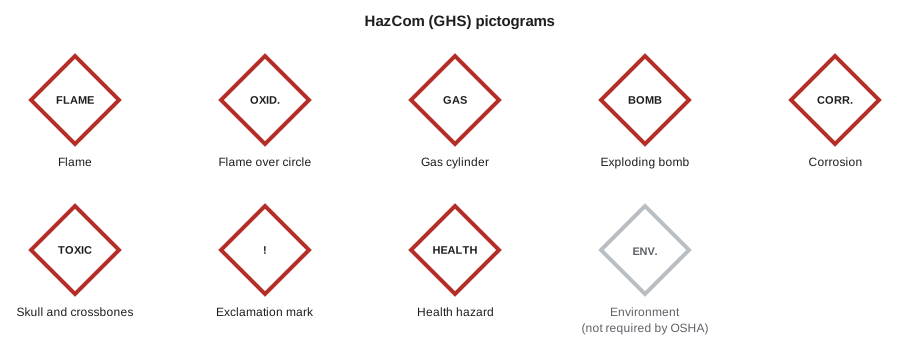
The environment pictogram, a dead fish and tree, is part of the GHS, and you will see it on many labels, but OSHA does not require it because environmental hazards are regulated by other agencies. Plumbers working on existing drain and sewer lines also meet biological hazards from sewage, which are not covered by HazCom labels; Lesson 11 covers the protective equipment and hygiene that go with them.
Reading a supplier label
The label from the manufacturer or importer is the first thing Maya sees on a product. It must be in English, and it carries six kinds of required information.
| Label element | What it tells Maya | On the solvent cement label |
|---|---|---|
| Product identifier | The product name, exactly as on the SDS | Medium-bodied PVC cement, gray |
| Name, address and phone | The manufacturer, importer or responsible party | Manufacturer's name, city and phone |
| Pictograms | The hazard classes at a glance | Flame, exclamation mark and health hazard |
| Signal word | DANGER for more severe hazards, WARNING for less severe | DANGER |
| Hazard statements | The nature of the hazards, in standard phrases | Highly flammable liquid and vapor; causes serious eye irritation; may cause drowsiness or dizziness |
| Precautionary statements | How to prevent harm, respond, store and dispose | Keep away from heat and open flames; use only in well-ventilated areas; wear eye protection; if in eyes, rinse cautiously with water |
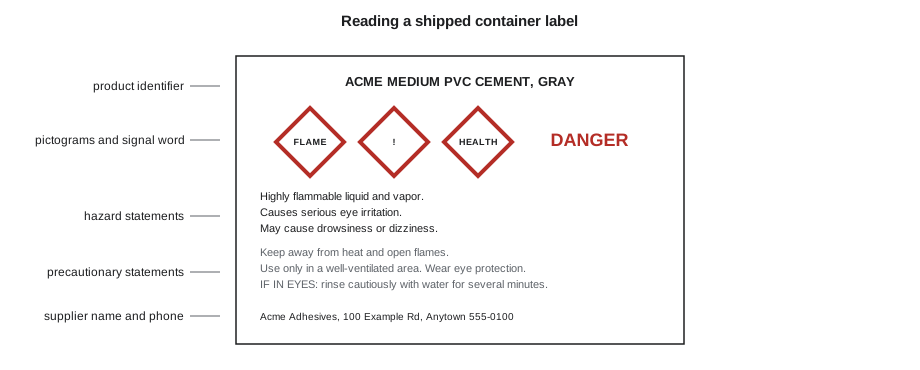
Two words on the label carry a lot of weight. The signal word tells you how serious the worst hazard is: DANGER for the more severe categories, WARNING for the less severe, and no signal word for the least severe. The hazard statements tell you exactly what the hazard is. When Luis handed Maya her first can of solvent cement, he asked her to read the label aloud before opening it. She found the flame pictogram, the signal word DANGER and the statement about drowsiness, and he explained why they glue pipe only with a window open or a fan running, and never near the soldering torch.
Workplace labels and decanted products
Products often end up in containers other than the one they came in. Maya might pour cutting oil from a large drum into a small squeeze bottle, or mix a cleaning solution in a spray bottle. OSHA allows the employer to label workplace containers either with the full supplier information or with the product identifier and words, pictures, symbols or a combination that give the general hazard information. A worker who transfers a product into a portable container for their own immediate use during the same shift does not have to label it, but if anyone else might use it, or it will be left overnight, it needs a label. Damaged or unreadable labels must be replaced.
Unlabeled containers are one of the most common hazard communication problems on construction sites, and one of the most dangerous. A clear liquid in an unmarked bottle could be water, a cleaner, a solvent or an acid. Kingsway Tower's rule is simple: if a container has no label, nobody uses it, and it goes to the foreman to be identified or disposed of. Food and drink containers are never used for chemicals, because someone will eventually drink from one.
Safety data sheets
The safety data sheet is the detailed document behind the label. Every SDS has the same 16 sections in the same order, so with practice Maya will find what she needs in seconds. Some sections matter more to a worker than others.
| Section | Title | When Maya reads it |
|---|---|---|
| 1 | Identification | To confirm it is the right product and find the supplier's emergency phone number |
| 2 | Hazard identification | To see the classification, signal word, pictograms and hazard statements |
| 3 | Composition and information on ingredients | To see which hazardous ingredients are present |
| 4 | First-aid measures | Before she starts work, and immediately if someone is exposed |
| 5 | Firefighting measures | To know which extinguisher to use |
| 6 | Accidental release measures | When there is a spill |
| 7 | Handling and storage | To store and use the product safely, including what it must not be stored with |
| 8 | Exposure controls and personal protection | To choose ventilation, gloves, eye protection and respirator |
| 9 to 11 | Physical and chemical properties; stability and reactivity; toxicological information | For flash point, incompatible products and the health effects of exposure |
| 12 to 16 | Ecological, disposal, transport, regulatory and other information | For disposal and the date the SDS was prepared or revised |
The employer must make the SDS for every hazardous chemical in the workplace readily accessible to workers during each work shift, on paper or electronically, with no barriers such as needing permission to see it. On a multi-employer site, each employer must tell the others about chemicals their workers bring that could expose other trades, and where the SDSs are kept. On Kingsway Tower, Stonebridge keeps a binder in the site trailer, Northbridge keeps one in its gang box on each active floor, and both companies have the SDSs on a phone app.
Training: the part that makes it work
Labels and SDSs are useless if workers cannot read them. HazCom training must happen when a worker is first assigned and whenever a new chemical hazard is introduced. It must cover the requirements of the standard, where hazardous chemicals are present in the worker's job, the location of the written program, the chemical list and the SDSs, how to detect a release, the physical and health hazards of the chemicals, the protective measures, and how to read labels and SDSs. Training must be in a language and vocabulary the worker understands. Maya received general training from Northbridge on her first day, and Luis covers each new product as she meets it. With the 2024 updates, Northbridge is refreshing its training this fall to cover the revised label and SDS formats.
Training also covers what to do when something goes wrong. If Maya splashes a product in her eyes, Section 4 of the SDS and the precautionary statements on the label both tell her what to do, usually rinsing with clean water for at least 15 minutes. The eyewash station on her floor is part of the system too. Lesson 12 covers first aid in more detail.
A day with hazardous products
Maya's work on the sixth floor shows how the pieces fit. In the morning she and Luis install PVC drain lines in four suites. Before starting, Maya checks the solvent cement label, opens the windows and runs a small fan to move the vapor away from where she is working, puts on safety glasses and the nitrile gloves the SDS recommends, and keeps the can closed between joints. When they finish, she wipes the drips, closes the cans and stores them in the flammables cabinet in the gang box, away from the propane cylinder.
In the afternoon they solder copper water lines. The flux label carries an exclamation mark and the statement that it causes skin irritation, so she keeps her gloves on and washes her hands before eating. The propane cylinder carries the flame and gas cylinder pictograms, and the hot work permit from Stonebridge requires a fire extinguisher at hand and a fire watch after the work. When the cleaner from the fixture supplier arrives in an unlabeled spray bottle, she does not use it. Dave finds the original container, fills out a workplace label and finds the SDS on the app. Ten minutes of care, three products, no exposures.
Common mistakes
MistakeUsing a product from an unlabeled container because you think you know what it is.
InsteadDo not use it; take it to the supervisor to be identified and labeled or disposed of.
MistakeStoring a decanted product in a drink bottle.
InsteadUse a proper container with a workplace label; never use food or drink containers.
MistakeReading only the product name on the label.
InsteadRead the pictograms, signal word and hazard statements before using any product for the first time.
MistakeAssuming the SDS is somewhere in the office.
InsteadKnow exactly where the SDSs for your floor are and check them before using a new product.
Summary and key terms
- HazCom has four parts: labels, safety data sheets, training, and the employer's written program with a chemical list.
- HazCom is aligned with the GHS; the 2024 update's employer deadline for substances is November 20, 2026, and for mixtures May 19, 2028.
- Pictograms show the hazard classes at a glance; the signal word DANGER or WARNING shows severity.
- Hazard statements say what the hazard is; precautionary statements say how to prevent harm and respond.
- Decanted products need a workplace label; unlabeled containers are never used.
- Every SDS has 16 sections; sections 2, 4, 7 and 8 are the ones a worker reads first.
- Training must cover the specific products a worker uses, in language they understand.
- HazCom
- OSHA's Hazard Communication Standard, 29 CFR 1910.1200, applied to construction through 1926.59.
- GHS
- The Globally Harmonized System of Classification and Labeling of Chemicals, a UN system used by HazCom and many other countries.
- Shipped container label
- The label provided by the manufacturer or importer, with six kinds of required information.
- Workplace label
- A label on an in-house container giving the product identifier and general hazard information.
- Safety data sheet
- A 16-section document describing a chemical's hazards, safe handling, protection and emergency measures.
- Signal word
- DANGER or WARNING, showing the severity of the most serious hazard on a label.
- Written hazard communication program
- The employer's document describing how labels, SDSs and training are handled, with a list of hazardous chemicals on site.
Practice problems
Work each problem on paper first, then reveal the answer to check.
What does the signal word DANGER tell you compared with WARNING?
Show answer
That at least one hazard is in a more severe category.
Maya pours cutting oil into a squeeze bottle that the whole crew will use. What does the bottle need?
Show answer
A workplace label with the product identifier and hazard information, and access to the SDS.
Which SDS section would you check to choose gloves?
Show answer
Section 8, exposure controls and personal protection.
Why is the solvent cement kept away from the soldering torch?
Show answer
It is a highly flammable liquid and its vapor can ignite.
What should Maya do with a clear liquid in an unlabeled bottle?
Show answer
Not use it, and take it to her supervisor to be identified and labeled or disposed of.
Lesson quiz · 5 questions
Score 60% or more to complete this lesson.
Create a free account to save your progress, take quizzes and earn a certificate.