
TRD-101 · Lesson 4 of 12 · 19 min
Spotting hazards and planning the task
Every lesson in this course deals with a particular hazard: falls, electricity, chemicals, confined spaces. This lesson is about the skill that ties them together: looking at a task before you start it, seeing what could hurt you, and deciding how to stop it from happening. Experienced tradespeople do this almost without thinking. They glance at a ladder's feet, look up before they drill, check where a cord runs and notice that the wind has picked up. New workers have to learn to do it deliberately, and most sites help them with a short written check at the start of each task.
OSHA requires employers to have competent persons make frequent and regular inspections of job sites, materials and equipment, and to instruct workers in recognizing and avoiding hazards. It does not prescribe a form, but most construction employers use a written job hazard analysis (JHA) or pre-task plan before each task or shift. OSHA's own guidance on safety and health programs recommends this kind of hazard identification. Northbridge uses a pre-task plan card that each crew fills out at the start of the day and updates when the work changes.
Hazards, risks and controls
Three words get used loosely on construction sites, but they mean different things. A hazard is anything that could cause harm: an open edge, a live wire, a solvent vapor, a heavy box. Risk combines how likely harm is and how bad it would be. An open edge on the tenth floor is a hazard whether anyone is near it or not; the risk depends on how many people work near it, for how long, and what protection is in place. A control is anything that removes the hazard or reduces the risk: a guardrail, a lockout, a fan, a mechanical lift.
The point of a hazard assessment is not to list every conceivable hazard. It is to find the hazards that matter for this task today, rate them honestly and make sure each one has a control that actually works. A form with fifteen ticked boxes and no thought behind it is worse than useless, because it gives everyone a false sense that the job has been planned.
How to look for hazards
Luis taught Maya a simple way to look at a work area: start with the task steps, then look up, down, around and at yourself. Most hazards fall into a small number of types, and asking a question for each type catches most of them.
| Hazard type | Questions to ask | Examples on Kingsway Tower |
|---|---|---|
| Gravity | Could I or anything else fall? Is anything overhead? | Slab edges, floor openings, ladders, tools on scaffolds, work on the floor above |
| Motion | What moves? Could I be struck, caught or crushed? | Telehandler and trucks at grade, crane loads, rotating threading machine, core drill kicking back |
| Electrical | What is energized? Where are cords, panels, buried or hidden services? | Temporary panels, extension cords, live circuits in walls being renovated, buried services |
| Pressure and stored energy | Is anything under pressure, tension or spring load? | Pressure-testing water lines, compressed air, gas cylinders, springs in closers |
| Chemical | What products am I using or near? What could I breathe or touch? | Solvent cement, flux, silica dust from coring, welding fumes from the steamfitters |
| Temperature | Is anything hot or cold? What is the weather? | Torch flame and hot pipe, summer heat on the roof, winter cold at grade |
| Biological | Could I contact sewage, mold, bird droppings or needles? | Tying into an existing sewer, drywall with mold growth in the old building next door |
| Body | How heavy, how awkward, how repetitive, how long? | Carrying cast iron pipe, working overhead, kneeling under sinks, a long day |
| Environment | Is it dark, wet, windy, noisy or crowded? Who else is working here? | Dark parking levels, rain on the slab, other trades on the same floor |
Looking at yourself is the step most people skip. Fatigue, rushing, distraction and frustration are not hazards in the usual sense, but they make people miss hazards and take shortcuts. Many sites train workers to notice four states in themselves: rushing, frustration, fatigue and complacency. When Maya notices she is rushing to finish before lunch, she slows down for the last joint rather than speeding up.
Rating the risk
Once hazards are listed, the crew decides how serious each one is. Northbridge's card uses a simple matrix: likelihood from 1 (rare) to 4 (likely) multiplied by severity from 1 (first aid) to 4 (fatal or permanent disability). Scores of 9 and above are high and need controls in place before the work starts, with the foreman's sign-off. Any hazard that could kill or permanently disable someone gets a flag, whatever its likelihood, because the controls for those hazards must never be left to chance.
# Northbridge pre-task risk score: likelihood (1-4) x severity (1-4)
tasks = [
    ("Carry pipe past an open floor edge", 2, 4),
    ("Cut and glue PVC with fan running", 2, 2),
    ("Solder copper near wood framing", 2, 3),
    ("Use a step ladder to reach a ceiling hanger", 3, 3),
    ("Sweep up offcuts", 2, 1),
]
for task, likelihood, severity in tasks:
    score = likelihood * severity
    level = "HIGH" if score >= 9 else "MEDIUM" if score >= 4 else "LOW"
    flag = " (serious injury potential)" if severity == 4 else ""
print(f"{task:46s} {score:2d} {level}{flag}")Carry pipe past an open floor edge 8 MEDIUM (serious injury potential) Cut and glue PVC with fan running 4 MEDIUM Solder copper near wood framing 6 MEDIUM Use a step ladder to reach a ceiling hanger 9 HIGH Sweep up offcuts 2 LOW
The numbers are only a way of making people think. The open edge scores 8, which is medium on the matrix, but the flag for serious injury potential means the crew treats it as seriously as a high score: the edge must have a guardrail before anyone works near it. The step ladder scores 9 because ladders are used constantly and falls from them are common; the control is to use a platform ladder or rolling scaffold instead.
The hierarchy of controls
Controls are not all equally good. The hierarchy of controls ranks them from most effective to least. The higher a control is on the list, the less it depends on people doing the right thing every time.
| Level | What it does | Example on Kingsway Tower |
|---|---|---|
| 1. Elimination | Removes the hazard completely | Prefabricating pipe assemblies at ground level instead of building them at height; pressure-testing with water instead of air |
| 2. Substitution | Replaces the hazard with something less hazardous | Press-fit copper fittings instead of soldering; a low-solvent cement; a battery tool instead of a corded one |
| 3. Engineering controls | Isolates people from the hazard with a physical change | Guardrails and covers, machine guards, local exhaust on a core drill, a ground fault circuit interrupter |
| 4. Administrative controls | Changes the way people work | Permits, procedures, training, signs, scheduling noisy work when fewer people are near, job rotation |
| 5. Personal protective equipment | Protects the individual worker | Hard hat, safety glasses, gloves, hearing protection, respirator, fall arrest harness |
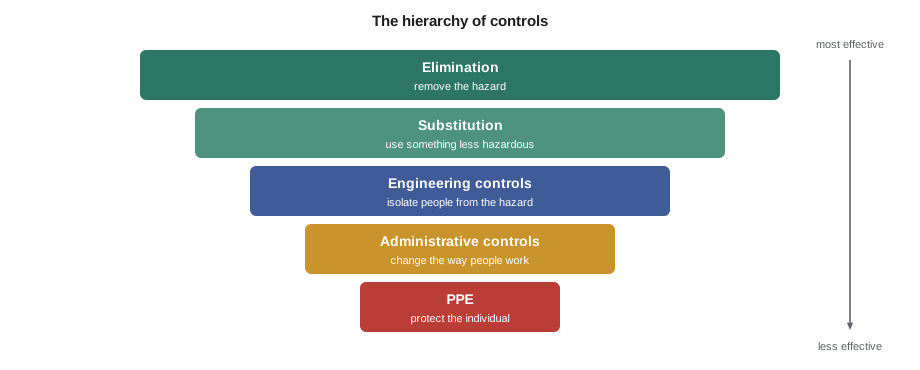
Personal protective equipment is at the bottom not because it is unimportant, but because it is the last line of defense. It protects only the person wearing it, only if it fits and is worn correctly, and only if it is in good condition. If a guardrail is missing and a worker relies on a harness, the harness has to be the right type, anchored to the right point, with enough clearance, every single time. If the guardrail is there, nobody has to get anything right. Good planning moves controls up the hierarchy wherever it can, and uses PPE as a backup rather than the main protection.
Press-fit fittings are a good example of substitution that Maya sees every day. Northbridge switched most of its copper water piping to press fittings a few years ago. A press tool crimps the fitting in seconds, with no flame, no flux and no hot pipe. That removes the burn hazard and most of the fire hazard, removes the need for a hot work permit in most areas and speeds up the work. Soldering is still used for some joints, with the controls described in lesson 3.
The pre-task card
Northbridge's card fits on one side of a page. The crew fills it out together at the start of the shift, each member signs it, and it stays at the work area so anyone can see it. When the task, the location or the conditions change, the crew stops and updates it.
| Card section | What the crew writes |
|---|---|
| Task and location | Install PVC drain lines, suites 601 to 604, sixth floor north |
| Steps | Unload pipe from hoist; carry to suites; measure, cut and glue; hang from ceiling; test |
| Hazards | North slab edge on route from hoist; solvent vapor; step ladder for hangers; cords from other trades |
| Controls | Guardrail checked at north edge; window open and fan running; platform ladder; cords on hooks |
| Permits needed | None today (no hot work) |
| PPE | Standard PPE plus nitrile gloves for cement |
| Emergency | First aid kit in gang box; nearest eyewash at the hoist; muster point across the street |
| Signatures | Luis Ferreira, Maya Chen; reviewed by Dave Kowal at 7:40 |
The most important part of the card is the link between each hazard and its control. If the crew lists solvent vapor as a hazard, the card must say how they will control it. A hazard with no control is a job that is not ready to start.
When things change
Hazard assessments go stale. The card that was right at 7:30 may be wrong by 10:00 because the drywall crew moved into the next suite, the guardrail at the north edge was taken down to land a load, or it started raining and water is running across the slab. Many serious incidents happen not during the planned work but during a change: a new task added on the fly, an unexpected problem that needs a quick fix, a crew covering for someone who went home sick.
Maya learned to treat any change as a reason to stop and look again. When Dave asked her and Luis to go to the roof after lunch to help another crew run a vent pipe through the roof membrane, they did not just pick up their tools and go. They filled out a new card: roof edge, wind, the hot asphalt kettle the roofers were using, a different ladder access. The roof crew's foreman joined them for two minutes to explain the roof's fall protection plan. It took five minutes and it meant the afternoon started with everybody knowing the same things.
Lifting, carrying and the body
Strains and sprains from lifting, carrying and awkward postures are the most common injuries in construction by number, even though they rarely make the news. Plumbers carry pipe and fittings, kneel under fixtures, reach overhead to hang pipe and twist in tight spaces. Over a career these add up to back injuries, shoulder problems and worn-out knees.
| Task | Hazard | Better way |
|---|---|---|
| Carrying lengths of pipe | Heavy, awkward loads; twisting | Use a pipe cart or the hoist; carry with a partner; keep loads close to the body |
| Lifting boxes of fittings from the floor | Bending at the waist | Store boxes on a bench at waist height; bend the knees and keep the back straight |
| Hanging pipe overhead | Arms above shoulders for long periods | Use a platform at the right height; pre-assemble on the floor; take breaks |
| Working under sinks | Kneeling and twisting | Use knee pads and a creeper or kneeling pad; switch sides |
| Drilling into concrete overhead | Vibration and force | Use a drill stand or a powered lift for the drill; rotate the task |
The hierarchy of controls applies here too. The best control is to eliminate the lift altogether: deliver material by hoist to the floor where it is needed, use carts and dollies, store things at waist height. Training in lifting technique is useful, but it is an administrative control, and it cannot make an unreasonably heavy or awkward load safe.
Common mistakes
MistakeFilling out the hazard card as a formality and ticking every box.
InsteadList the hazards that matter for this task today and write a real control for each one.
MistakeRelying on PPE when a higher control is available.
InsteadLook for elimination, substitution or engineering controls first; use PPE as the backup.
MistakeCarrying on with the original plan after the work or conditions change.
InsteadStop, look again and update the card whenever the task, place or conditions change.
MistakeIgnoring how you feel.
InsteadNotice rushing, frustration, fatigue and complacency, and slow down when you see them.
Summary and key terms
- A hazard is anything that could cause harm; risk combines likelihood and severity; a control removes the hazard or reduces the risk.
- Most US construction employers use a job hazard analysis or pre-task plan before each task or shift.
- Scan up, down, around and at yourself, and ask questions for each hazard type.
- Rate risks honestly and flag anything that could kill or permanently disable someone.
- The hierarchy of controls runs from elimination and substitution through engineering and administrative controls to PPE.
- Every listed hazard needs a working control before the task starts.
- Changes in the task, place or conditions are a reason to stop and reassess.
- Hazard
- Anything with the potential to cause harm.
- Risk
- A combination of the likelihood of harm and its severity.
- Control
- A measure that removes a hazard or reduces its risk.
- Hierarchy of controls
- A ranking of controls from most effective (elimination) to least (PPE).
- Engineering control
- A physical change that isolates people from a hazard, such as a guardrail or machine guard.
- Administrative control
- A change in the way work is done, such as a procedure, permit or training.
- Pre-task hazard assessment
- A short written review of a task's hazards and controls, done by the crew before starting.
Practice problems
Work each problem on paper first, then reveal the answer to check.
Classify each control: a guardrail, a hot work permit, a respirator, press-fit fittings instead of soldering.
Show answer
Engineering, administrative, PPE, substitution.
Why is PPE the last line of defense?
Show answer
It protects only the wearer, only if it fits, is in good condition and is used correctly every time.
Maya and Luis are sent to a different floor after lunch. What should they do first?
Show answer
Fill out a new hazard card for the new task and location.
Which four personal states make people miss hazards?
Show answer
Rushing, frustration, fatigue and complacency.
Name two ways to reduce the strain of carrying pipe.
Show answer
Use a cart or hoist, carry with a partner, keep loads close to the body, store at waist height.
Lesson quiz · 5 questions
Score 60% or more to complete this lesson.
Create a free account to save your progress, take quizzes and earn a certificate.