
TRD-101 · Lesson 11 of 12 · 19 min
Personal protective equipment: choosing, fitting and caring for it
Personal protective equipment, PPE, is the last line of defense in the hierarchy of controls. It does not remove the hazard; it puts a barrier between the hazard and one person. That makes it essential and also limited. A hard hat cannot stop a load of block falling from a crane, and a respirator that does not seal against the face filters very little. PPE works only when it is the right type for the hazard, fits the person wearing it, is in good condition and is worn the whole time the hazard is present.
OSHA requires employers to provide PPE wherever hazards in the work make it necessary, under 1926.95 and the specific standards for head, eye, hearing, respiratory and fall protection. In most cases the employer must pay for it; the main exceptions are ordinary safety-toe footwear and prescription safety glasses that workers can wear off the job, and everyday clothing. OSHA amended 1926.95 in late 2024 to say explicitly that PPE must fit each worker properly, a change aimed at workers, many of them women, who had been given equipment sized only for larger men. Equipment is generally built to ANSI or ASTM standards that the OSHA rules reference.
Standard PPE on Kingsway Tower
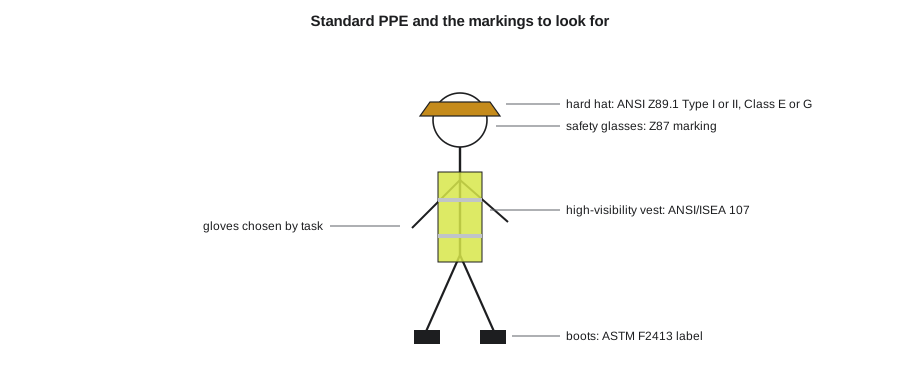
Every person on Kingsway Tower outside the site trailers wears five items: a hard hat, safety boots, a high-visibility vest or jacket, safety glasses and work gloves available for use. Task-specific PPE is added on top.
| Item | Standard in the US | What to look for |
|---|---|---|
| Hard hat | ANSI/ISEA Z89.1 | Type I protects the top of the head; Type II also protects the sides. Class E is rated for electrical protection, Class G for general use, Class C gives no electrical protection. |
| Safety boots | ASTM F2413 | Protective toe caps, with additional ratings for puncture resistance and electrical hazard marked on the label inside the boot. |
| High-visibility clothing | ANSI/ISEA 107 | Fluorescent background material with retroreflective stripes; the class or level needed depends on traffic speed and lighting. |
| Safety glasses | ANSI/ISEA Z87.1 | Impact-rated lenses and frames, with side protection; marked on the frame. Tinted lenses only outdoors. |
| Gloves | Selected by task | Cut-resistant for handling sheet metal and cutting; chemical-resistant as the SDS specifies; insulated for cold. |
Head protection
A hard hat protects against falling objects, bumps against fixed objects and, with an electrical rating, contact with low-voltage conductors. Its shell spreads the force of an impact and its suspension, the harness of straps inside, absorbs it by keeping a gap between the shell and the head. A hard hat with a damaged suspension or no gap protects very little.
| Inspect | Replace when |
|---|---|
| Shell for cracks, dents, gouges, chalky or faded surface | Any crack or deep gouge; chalky surface from sun damage; after any significant impact |
| Suspension for cracks, frayed straps, broken clips | Any damage, or at the interval the manufacturer gives, often yearly |
| Date code molded into the shell | At the manufacturer's service life, often several years from manufacture |
| Stickers and paint | Paint and solvents can weaken the shell; use only stickers the manufacturer allows |
Wearing a hard hat backward is allowed only if the manufacturer marks it as tested that way. Storing it on the dashboard of a truck, where sun and heat degrade the plastic, shortens its life. Many contractors, including Stonebridge, now require helmets with a chin strap for work at height, because a hard hat that falls off during a slip or fall gives no protection when the head strikes something.
Eye and face protection
Eye injuries are among the most common injuries on construction sites, and most are caused by flying particles: concrete chips from drilling, metal from grinding, sawdust, and debris blown by wind. Chemicals splashed in the eyes and the light from welding arcs are other causes. Safety glasses with side protection are the minimum. Goggles seal around the eyes and are used for chemical splashes, heavy dust and overhead drilling, where particles fall into the gap above ordinary glasses. A face shield protects the whole face from flying particles and splashes, but it is always worn over glasses or goggles, never alone. Welding helmets and goggles with filter lenses protect against arc light and are chosen by the welding process.
When Maya drills anchor holes overhead for pipe hangers, dust and chips fall straight down toward her face. Luis hands her goggles rather than glasses, and a dust shroud on the drill takes most of the dust away before it can fall.
Hearing protection
Noise-induced hearing loss is permanent and one of the most common occupational diseases in construction. It develops slowly and painlessly from repeated exposure, so many workers do not notice until it is too late. OSHA's construction noise standard, 1926.52, sets a permissible exposure of 90 decibels (dBA) averaged over eight hours, with a 5 dB exchange rate: every 5 dB increase halves the allowed time. Many safety professionals regard this as out of date; NIOSH recommends 85 dBA with a 3 dB exchange rate, and many contractors use that as their own rule.
# How long can a worker be exposed at each noise level?
limit, exchange = 90, 5   # dBA for 8 hours, and the exchange rate in dB
for task, level in [("Normal conversation", 60), ("Hammer drill", 100), ("Core drill", 95),
                    ("Cut-off saw", 105), ("Busy floor with several trades", 88)]:
    hours = 8 / 2 ** ((level - limit) / exchange)
print(f"{task:32s} {level} dBA allowed {hours:7.2f} hours" if hours < 24 else f"{task:32s} {level} dBA no practical limit")Normal conversation 60 dBA no practical limit Hammer drill 100 dBA allowed 2.00 hours Core drill 95 dBA allowed 4.00 hours Cut-off saw 105 dBA allowed 1.00 hours Busy floor with several trades 88 dBA allowed 10.56 hours
A simple field check: if you have to raise your voice to be understood by someone an arm's length away, the noise is probably above 85 dBA and hearing protection is needed. Foam earplugs give good protection only if they are rolled down and inserted deep into the ear canal; a plug pushed halfway in protects very little. Earmuffs are easier to put on correctly but are hot in summer and do not seal well over safety glasses arms or long hair. For very loud tasks, plugs and muffs are worn together.
Respiratory protection
Respirators are used where engineering controls such as wet methods, extraction and ventilation cannot bring airborne hazards to a safe level (lesson 10). They come in two broad kinds. Air-purifying respirators filter the air the worker breathes: filtering facepieces (often called disposable dust masks, such as N95 types), reusable half-face and full-face respirators with cartridges or filters, and powered air-purifying respirators (PAPRs) that blow filtered air into a hood or facepiece. Supplied-air respirators and self-contained breathing apparatus deliver clean air from a separate source, and are used in oxygen-deficient or immediately dangerous atmospheres, where no filter can help.
| Respirator | Protects against | Does not protect against |
|---|---|---|
| Filtering facepiece (N95 type) | Dusts such as silica, in moderate concentrations | Gases and vapors; oxygen deficiency |
| Half-face with particulate filters | Dusts and fumes | Gases and vapors unless fitted with the right cartridges; oxygen deficiency |
| Half-face or full-face with organic vapor cartridges | Solvent vapors from adhesives and coatings | Particulates unless combined filters are fitted; oxygen deficiency |
| Powered air-purifying respirator | Dusts, and gases with suitable cartridges; works for people with beards when a loose hood is used | Oxygen deficiency |
| Supplied-air or self-contained breathing apparatus | Oxygen-deficient and highly toxic atmospheres | Used only with specific training and procedures |
A tight-fitting respirator only works if it seals to the face, and faces differ. Under OSHA's respiratory protection standard, 1910.134, which applies to construction through 1926.103, a worker must be medically evaluated and fit tested with the exact make, model and size before using a tight-fitting respirator, and fit tested again at least once a year. A seal check is done every time it is put on. Facial hair where the respirator seals can prevent a seal; workers with beards need a loose-fitting hood or helmet type instead. Employers must have a written respiratory protection program.
Hand protection
Hands are injured more often than any other part of the body in construction: cuts from sheet metal and pipe ends, punctures, crushing, burns from hot pipe and torches, and chemical irritation. No single glove protects against all of these. Cut-resistant gloves are rated on a scale, commonly the ANSI/ISEA cut levels or the EN 388 rating, and higher numbers resist more. Chemical-resistant gloves are chosen from the SDS, because a glove that resists one solvent may dissolve in another; nitrile is common for the primers and cements Maya uses. Leather gloves protect against heat and abrasion during soldering and brazing.
Gloves can also create hazards, as lesson 1 noted: a glove caught in a rotating chuck, drill bit or threading machine pulls the hand in. The rule on Kingsway Tower is that gloves are not worn near rotating parts that could catch them, and Maya takes hers off before using the threading machine.
Biological hazards and hygiene
Plumbers who work on existing drain and sewer lines are exposed to sewage, which carries bacteria, viruses and parasites. Infection usually happens through the hands to the mouth, through cuts, or by splashes to the eyes, nose and mouth. The protection is mostly about hygiene: waterproof gloves over cut-resistant gloves when handling sewage piping, goggles or a face shield where there may be splashes, covering cuts with waterproof dressings, washing hands and face before eating, drinking or smoking, and keeping work clothes separate from street clothes. Many employers also recommend that workers keep their tetanus vaccination up to date and discuss other vaccinations with a doctor.
Care, storage and replacement
| Item | Care |
|---|---|
| Hard hat | Clean with mild soap and water; store out of sunlight and heat; replace after impact |
| Safety glasses and goggles | Clean with lens cleaner, not a dusty sleeve; store in a case; replace when scratched |
| Earplugs and muffs | Use foam plugs once; clean reusable plugs and muff cushions; replace hardened cushions |
| Respirator | Clean reusable facepieces after use; store sealed away from dust; change filters when breathing gets harder and cartridges on the schedule set by the program |
| Gloves | Replace when torn, worn through or contaminated; check chemical gloves for swelling |
| Harness and lanyard | Inspect before each use (lesson 5); store hanging, dry and out of the sun |
Dressing for heat and cold
Clothing is protective equipment too, especially on a site that is open to the weather for most of the year. In summer, heat stress can progress from heavy sweating, cramps and fatigue to heat exhaustion and then heat stroke, a medical emergency in which the body stops cooling itself and the worker becomes confused or collapses. In winter, cold stress brings numb hands that cannot grip tools safely, frostbite on exposed skin and, in severe cases, hypothermia.
| Condition | Clothing and PPE | Other controls |
|---|---|---|
| Hot, sunny days on the roof or slab | Light-colored, breathable clothing; a hard hat brim or sun shade; cooling towels | Water close by and drunk often; shade breaks; heavy work early in the day; new workers built up gradually over the first week or two |
| Hot, enclosed rooms and parking levels | Breathable coveralls instead of heavy ones | Fans and ventilation; regular breaks; watch each other for signs of heat illness |
| Cold, windy days at grade and on open floors | Layers with a windproof outer layer; insulated, waterproof boots; hard hat liner; insulated gloves that still allow grip | Warm-up shelter; hot drinks; tarps and heaters with ventilation |
| Wet conditions | Rain gear with high-visibility markings; spare dry gloves and socks | Change wet clothing promptly; wet clothing loses most of its insulation |
Maya's first summer on the site taught her to treat water like a tool: a full bottle in the gang box on every floor, refilled at every break. Her first winter taught her to keep a second pair of dry gloves in her pocket, because damp gloves on a windy slab edge turned her fingers numb within an hour, and numb fingers drop tools and lose their grip on ladder rails.
Common mistakes
MistakeWearing a dust mask for solvent vapors.
InsteadParticulate filters do not stop vapors; use the cartridge the SDS and the program specify, or better ventilation.
MistakePushing foam earplugs halfway into the ear.
InsteadRoll them down and insert them deep, holding them while they expand.
MistakeWearing a tight-fitting respirator over stubble.
InsteadBe clean-shaven where it seals, or use a loose-fitting hood.
MistakeWearing gloves near a rotating chuck.
InsteadRemove gloves near rotating parts that can catch them.
Summary and key terms
- PPE is the last line of defense and works only if it is the right type, fits, is in good condition and is worn throughout the hazard.
- Employers must provide and pay for most PPE, and since late 2024 OSHA's rule says explicitly that it must fit properly.
- Hard hats are classified by type (top or top and sides) and class (electrical rating); inspect the shell and suspension.
- Use goggles for overhead drilling and chemicals, and wear face shields only over glasses or goggles.
- OSHA's construction noise limit is 90 dBA with a 5 dB exchange rate; NIOSH recommends 85 dBA and 3 dB.
- Choose respirators for the hazard; tight-fitting respirators need fit testing and a seal check every time.
- Choose gloves by task, avoid them near rotating parts, and practice good hygiene around sewage.
- PPE
- Personal protective equipment worn to reduce a worker's exposure to a hazard.
- Suspension
- The harness of straps inside a hard hat that absorbs impact energy.
- Exchange rate
- The increase in noise level, in decibels, that halves the allowed exposure time.
- dBA
- Decibels on the A-weighted scale, which approximates how the human ear responds to sound.
- Fit test
- A test that checks whether a specific tight-fitting respirator seals on a worker's face.
- Seal check
- A quick check by the wearer, each time a respirator is put on, that it seals.
- Air-purifying respirator
- A respirator that filters contaminants from the surrounding air; it cannot supply oxygen.
Practice problems
Work each problem on paper first, then reveal the answer to check.
What is the difference between a Type 1 and a Type 2 hard hat?
Show answer
Type 1 protects the top of the head; Type 2 also protects the sides.
Using OSHA's 5 dB exchange rate, how long may a worker be exposed to 95 dBA?
Show answer
4 hours (half of 8 hours at 90 dBA).
Why should a face shield never be worn alone?
Show answer
It can lift or leave gaps; glasses or goggles underneath protect the eyes.
Why can a filtering facepiece not be used in an oxygen-deficient space?
Show answer
It only filters the air; it cannot add oxygen.
Name three hygiene practices for working on sewer lines.
Show answer
Waterproof gloves, covering cuts, washing hands and face before eating, goggles or face shield against splashes, separate work clothes.
Lesson quiz · 5 questions
Score 60% or more to complete this lesson.
Create a free account to save your progress, take quizzes and earn a certificate.