
TRD-101 · Lesson 1 of 12 · 22 min
Your first days on a construction site
Construction is one of the most rewarding ways to earn a living. You build things people use for decades, you learn a trade that travels with you, and every day is a little different. It is also one of the more dangerous industries to work in. The hazards are not mysterious: people fall from heights, get struck by moving equipment and falling objects, get caught in or between things, contact electricity, breathe in harmful dust and fumes, and strain their bodies lifting and twisting. What makes construction risky is that all of these hazards can be present on the same site on the same morning, and the site changes every day as the building goes up.
This course is the safety foundation for every trade in the Skilled Trades stream. It is written for people who are new to the work, such as first-year apprentices, pre-apprentices and laborers, and for anyone who wants to understand what a safe site looks like from the tools up. It follows the hazards a new worker meets in roughly the order they meet them, and it uses the federal Occupational Safety and Health Act and OSHA's construction standards in 29 CFR 1926 as the main reference. About half the states run their own OSHA-approved state plans, which must be at least as effective as federal OSHA, and the course points out where the details are likely to differ.
If you go on to supervise or manage work, the Safety Training stream (the HSE courses) and the Construction Management course CON-355, Safety Leadership for Site Supervisors, build on this one. Here the view is from the apprentice's boots: what you will see, what you will be asked to do, what you are allowed to refuse, and the habits that keep you and the people around you in one piece.
Meet the crew
The course follows one first-year apprentice through her first months on a real-looking job. Maya Chen has just signed on as a first-year plumbing apprentice with Northbridge Mechanical, a mechanical contractor that installs plumbing, heating and ventilation systems. Northbridge is a trade contractor on Kingsway Tower, a twelve-story residential building with two levels of underground parking going up in Columbus, Ohio. Ohio has no state plan for private employers, so federal OSHA enforces the rules on this site. The general contractor, Stonebridge Construction, controls the site and coordinates safety among all the employers working there.
| Person | Role | What they do for Maya |
|---|---|---|
| Maya Chen | First-year plumbing apprentice, Northbridge Mechanical | Learns the trade; responsible for working safely and reporting hazards |
| Luis Ferreira | Journeyperson plumber, Northbridge | Maya's day-to-day mentor; shows her how each task is done safely |
| Dave Kowal | Northbridge foreman | Maya's supervisor; assigns work and is responsible for her crew's safety on the job |
| Anika Shah | Site safety coordinator, Stonebridge Construction | Runs the site orientation, inspects the site and answers safety questions from every trade |
| Sam Torres | Second-year electrical apprentice, Brightline Electric | Works near Maya on the same floors; a friend who is one year further along |
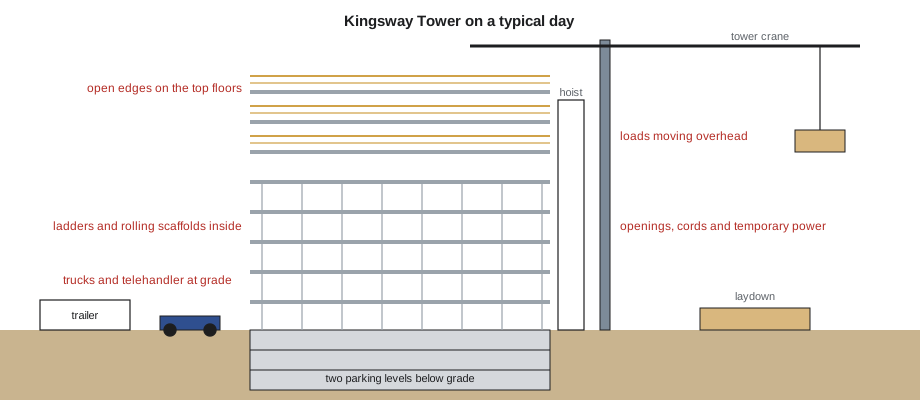
How people get hurt in construction
The Bureau of Labor Statistics counted 1,034 deaths in construction in 2024, more than in any other industry, and 389 of them, about 38 percent, were falls, slips and trips. OSHA groups the leading causes of construction deaths into the Focus Four hazards: falls, struck-by, caught-in or between, and electrocution. Together they account for most of the traumatic deaths on construction sites every year, and OSHA's construction inspections concentrate on them.
| Hazard group | Typical events | Where Maya will meet it |
|---|---|---|
| Falls | Falls from floor edges, openings, ladders, scaffolds, roofs and platforms; slips and trips on the same level | Open slab edges, floor openings for pipe sleeves, ladders and rolling scaffolds in the suites |
| Struck-by | Hit by a vehicle or mobile equipment, a falling or flying object, or a swinging load | Delivery trucks and the telehandler at grade, loads moving under the tower crane, dropped tools from upper floors |
| Caught-in or between | Caught in a trench collapse, between a machine and a wall, or in rotating parts | The excavation for the water service, pipe threading machines, core drills |
| Electrical contact | Contact with live circuits, damaged cords, temporary power or overhead lines | Temporary power panels and cords on every floor, buried services in the excavation |
| Health hazards | Silica dust, solvents, welding and soldering fumes, noise, heat and cold | Coring concrete, cutting and gluing plastic pipe, soldering copper, the noise of the floor above |
| Strains and sprains | Overexertion from lifting, carrying, twisting and awkward postures | Carrying pipe and fittings, working overhead, kneeling in tight spaces |
Behind each of these events is a chain: a hazard that was present, a control that was missing or not working, and a person who was exposed at the wrong moment. Safety work is about breaking the chain at the earliest link. The best place is removing the hazard before anyone arrives, the next best is a physical control such as a guardrail that works without anyone thinking about it, and the last resort is a person relying on their own care and equipment. Lesson 4 sets this out as the hierarchy of controls, and you will see it in every lesson.
Why new workers are at higher risk
Research across many countries has found the same thing: workers in their first months on a new job are injured at a much higher rate than experienced workers, regardless of age. Young workers and new workers share several disadvantages. They do not yet recognize hazards that an experienced worker sees instantly, such as a ladder footing on loose gravel or a load that is not balanced. They are often reluctant to ask questions because they want to make a good impression. They may be given the least pleasant tasks, such as cleanup, carrying and digging, which carry their own risks. And they may not know their rights, including the right to refuse unsafe work.
None of this means you should be fearful. It means you should expect to be trained, expect to be supervised closely at first, and expect to ask a lot of questions. A good contractor wants you to ask. Every experienced tradesperson on the site was once the new person who did not know which end of the pipe threader to stand at.
| Habit | Why it matters | What it looks like |
|---|---|---|
| Ask before you act | Most mistakes by new workers happen on tasks nobody explained | "Luis, I haven't used this core drill before. Can you show me the setup?" |
| Stop when something changes | Hazards appear when conditions change: rain, a new trade, a missing guardrail | Pausing when the cover over a floor opening has been moved, and telling the foreman |
| Report every hazard and near miss | Reports are how hazards get fixed before someone is hurt | Telling Anika about a damaged extension cord, even though nobody was shocked |
| Look after your equipment | PPE and tools protect you only if they are in good condition | Checking the harness before putting it on; tagging out a cracked ladder |
| Keep your area clean | Housekeeping prevents slips, trips, fires and falling objects | Clearing offcuts and packaging from the work area before moving on |
| Know where you are | Emergencies need fast, correct action | Knowing the muster point, the first aid station and how to call for help from your floor |
The site orientation
Before Maya can start work, she attends Stonebridge's site orientation, run by Anika Shah. OSHA's construction standards require employers to instruct each employee in recognizing and avoiding unsafe conditions and in the regulations that apply to their work, and many specific standards, such as fall protection, ladders and hazard communication, require their own training. Many contractors also expect new workers to have completed an OSHA Outreach 10-hour construction course; it is a voluntary program under federal OSHA, though a few states require it on some projects. Northbridge checks Maya's training records before she is sent to the site.
The orientation takes about an hour and Maya leaves with a sticker on her hard hat showing she has completed it. It covers the things every person on the site needs to know on day one.
| Orientation topic | What Maya learns on Kingsway Tower |
|---|---|
| Site layout and access | The single gated entrance, the pedestrian walkway away from the truck route, the hoist and stair towers |
| Site rules | Hard hat, safety boots, high-visibility vest and safety glasses at all times outside the trailers; no one under a crane load |
| Emergency procedures | The air horn signal, the muster point in the parking lot across the street, the first aid station in the Stonebridge trailer |
| Reporting | Every injury, near miss and hazard is reported to your own supervisor the same shift; Anika can be reached by radio or phone |
| High-risk work | Permits are needed for hot work, confined space entry, lockout and work near the crane; only trained workers do these tasks |
| Hazardous products | Where the safety data sheets are kept and what the HazCom labels mean |
| Housekeeping and waste | Each trade cleans up its own area daily; separate bins for metal, wood and garbage |
| Fitness for work | No one works impaired by alcohol, cannabis, drugs or fatigue; tell your supervisor if a medication affects you |
The orientation is the site's introduction. The rest of this course follows that training topic by topic.
Who is responsible for what
Under the OSH Act, every employer must provide a workplace free from recognized hazards that are causing or likely to cause death or serious harm, and must comply with OSHA's standards. On a multi-employer site like Kingsway Tower, OSHA can cite more than one employer for the same hazard: the employer that created it, the employer whose workers were exposed, the employer responsible for correcting it, and the controlling employer, here Stonebridge, which has general authority over the site. Workers must comply with the standards that apply to their own conduct. Lesson 2 looks at these responsibilities and at Maya's rights in detail.
In practice, the arrangement means that Maya always has someone to turn to. Her first contact for anything unsafe is Luis, then Dave. If they are not available, or if the hazard comes from another trade, she can go to Anika. Nobody on the site should ever tell her that a hazard is not their problem.
Housekeeping, access and the everyday hazards
The hazards that hurt the most people on a construction site are often the ordinary ones. Slips, trips and falls on the same level are among the most common injuries in construction, and they are almost always caused by poor housekeeping: cords across walkways, offcuts and packaging on the floor, mud and ice at entrances, and materials stored in access routes. On the upper floors, loose material near an edge can also be blown or kicked off and become a falling object hazard for people below.
Kingsway Tower's rule is simple: clean as you go, and leave your work area cleaner than you found it at the end of every shift. Each trade has bins on each floor, and Stonebridge's laborers empty them daily. Cords are run overhead on hooks or along walls, not across walkways. Materials are stacked away from edges and openings, on stable ground, and no higher than is safe. Walkways are kept clear and marked, and the pedestrian route at grade is separated from the truck route by fencing.
| Everyday hazard | Control on Kingsway Tower | Maya's part |
|---|---|---|
| Tripping over cords and hoses | Cords run on hooks overhead or along walls; cord covers at crossings | Route her own cords the same way and pick them up when done |
| Debris and offcuts | Bins on every floor; daily cleanup by each trade | Clean as she goes; never throw anything from a floor |
| Materials near edges | Nothing stored within 6 ft of an open edge; toe boards on guardrails | Stack pipe and fittings away from edges and openings |
| Mud, water and ice | Gravel at entrances; salt and sand in winter; mats at the hoist | Report slippery areas; wear boots with good tread |
| Poor lighting | Temporary lighting on every floor, in stairs and in the parking levels | Report burned-out lights; carry a headlamp in dark areas |
| Vehicles at grade | Separate pedestrian route; traffic control person when trucks back up | Use the walkway; make eye contact with operators; never walk behind a reversing vehicle |
Struck-by and caught-in hazards at grade
Maya's first week includes days at grade helping receive material deliveries. This is where struck-by hazards are concentrated. Delivery trucks reverse into the laydown area, the telehandler carries pallets of pipe to the hoist, and the tower crane swings loads overhead. Each of these machines has blind spots where the operator cannot see a person on foot, and each moves heavy loads that can crush.
The rules at grade are designed to keep people and machines apart. Pedestrians stay on the marked walkway. Nobody walks or stands under a suspended crane load, and the area below a lift is barricaded. When a truck reverses, a signaler guides it. When Maya needs to cross the path of a machine, she waits until she has made eye contact with the operator and received a signal to cross. She never assumes an operator has seen her, because the operator's view from the seat of a telehandler with a load on the forks is limited.
Caught-in hazards include trench collapses, which are covered in later trades courses and in the HSE stream, and rotating equipment such as pipe threading machines and core drills. Loose clothing, gloves, long hair and jewelry can be pulled into rotating parts in a fraction of a second. Luis's rule for the threading machine is that sleeves are rolled down and buttoned, hair is tied back, no jewelry is worn, and gloves are not worn near the rotating chuck. Lesson 11 returns to this, because gloves are an example of PPE that protects in one task and creates a hazard in another.
Fitness for work
A worker who is impaired, exhausted or unwell cannot react to hazards in time. Most sites, including Kingsway Tower, have a fitness-for-work policy: nobody works under the influence of alcohol, cannabis or other drugs, including prescription and over-the-counter medications that cause drowsiness. Fatigue from long hours or a second job, dehydration in summer and cold stress in winter all slow reactions in the same way.
The policy also protects workers who come forward. If Maya is taking a medication that makes her drowsy, she tells Dave so he can assign her to work that does not involve heights or machinery. If she sees a co-worker who appears impaired, she tells her supervisor. Nobody likes reporting a co-worker, but on a construction site an impaired worker endangers everyone around them, and a good policy treats impairment as a safety issue first.
Common mistakes
MistakeStaying quiet about a task you have never done because you do not want to look inexperienced.
InsteadAsk to be shown. Nobody expects a first-year apprentice to know every task, and a good supervisor wants the question.
MistakeAssuming an equipment operator has seen you.
InsteadWait for eye contact and a signal before crossing a machine's path, and stay on the pedestrian walkway.
MistakeLeaving cords, offcuts and packaging for someone else to clean up.
InsteadClean as you go and leave your area cleaner than you found it.
MistakeThinking the site orientation is all the training you need.
InsteadThe orientation covers the site; each task needs its own training and supervision.
Summary and key terms
- OSHA's Focus Four, falls, struck-by, caught-in or between, and electrocution, cause most traumatic construction deaths.
- New workers are injured at higher rates because they do not yet recognize hazards and may hesitate to ask questions.
- The site orientation introduces the site's hazards, rules, emergency procedures and reporting; task training is separate.
- On a multi-employer site, OSHA can cite the creating, exposing, correcting and controlling employers for the same hazard.
- Housekeeping prevents slips, trips, fires and falling objects; every trade cleans up its own area.
- Keep people and machines apart at grade: walkways, barricades under loads, signalers and eye contact with operators.
- Fitness for work means no one works impaired, exhausted or unwell, and the site treats impairment as a safety issue.
- Hazard
- Anything with the potential to cause injury, illness or damage.
- Controlling employer
- The employer with general supervisory authority over a multi-employer worksite, usually the general contractor.
- Site orientation
- A briefing every new person receives on the site-specific hazards, rules and emergency procedures before starting work.
- Near miss
- An event that could have caused injury or damage but did not.
- Housekeeping
- Keeping work areas clean, orderly and free of debris, cords and stored materials in access routes.
- Struck-by hazard
- The risk of being hit by a moving vehicle, machine, falling object or swinging load.
- Fitness for work
- Being physically and mentally able to work safely, free of impairment and excessive fatigue.
Practice problems
Work each problem on paper first, then reveal the answer to check.
Name two reasons new workers are injured more often than experienced workers.
Show answer
They do not yet recognize many hazards, and they may hesitate to ask questions; they may also not know their rights.
Who should Maya go to first if she sees a hazard, and who if the hazard comes from another trade?
Show answer
Luis or Dave first; Anika, the general contractor's safety coordinator, for hazards from another trade or if her own supervisors are unavailable.
Why is material kept away from open edges?
Show answer
It can fall or be kicked off and strike people below, and it can crowd workers toward the edge.
What should Maya do if a medication makes her drowsy?
Show answer
Tell her foreman so she can be assigned work that does not involve heights or machinery.
Give one example of a struck-by hazard and its control on Kingsway Tower.
Show answer
Loads under the tower crane, controlled by barricading the area below lifts and never standing under a load.
Lesson quiz · 5 questions
Score 60% or more to complete this lesson.
Create a free account to save your progress, take quizzes and earn a certificate.