
ROOF-340 · Lesson 10 of 12 · 57 min
Calculation practice
▶ Video coming soon A video version of this lesson is on the way.
On the Sunday practice test, Luca lost more marks on calculations than on anything else, and not because he could not do them. He had answered two take-off questions with plan area instead of roof area, forgotten to add the first fastener in a row, and rounded a number of bundles down instead of up. "Every one of those, you'd catch on the job," Dana said, "because the truck would be short. On the exam there's no truck. There's just an answer that's one of the four, because the person who wrote it knew exactly what mistake you'd make."
This lesson is a workbook. It gathers the calculations a roofer is expected to do into one formula sheet, then works through a set of exam-style problems from the whole program, each with the common trap that the wrong answers are built on. Work each one before reading the steps.
The formula sheet
| Calculation | Formula | Watch for |
|---|---|---|
| Slope as a ratio | rise ÷ run; 1/4 in per foot = 1 in 48 | Mixing rise in 12 and ratios |
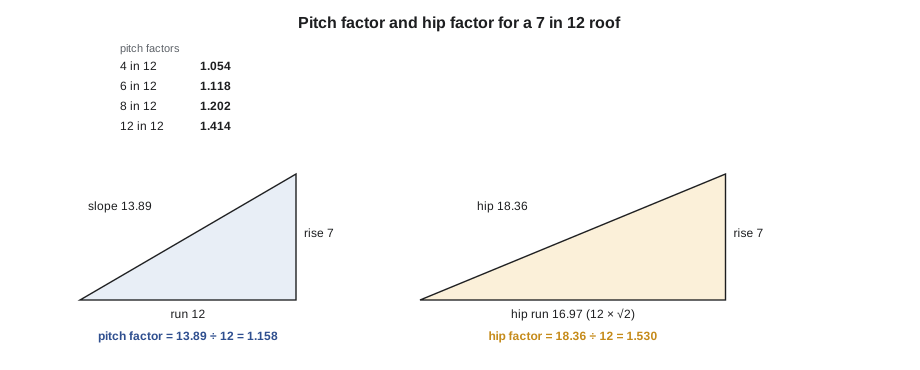
| Pitch factor | √(rise² + 144) ÷ 12, rise in inches per 12 | Using plan area for a sloped roof |
| Hip or valley factor | √(rise² + 288) ÷ 12 | Measuring hips with the common rafter factor |
| Roof area | plan area × pitch factor | Leaving out overhangs |
| Squares | roof area ÷ 100 ft² | Forgetting waste; rounding down |
| Courses | slope length ÷ exposure, rounded up | Using the shingle's full height |
| Net roll coverage | (width − side lap) × (length − end lap) | Using gross roll area |
| Fasteners in a row | length ÷ spacing + 1 | Missing the first fastener |
| Thermal movement | ΔL = α × L × ΔT | Mixing units of α and L |
| Heat loss | area × ΔT ÷ total resistance | Adding U-values instead of resistances |
| Fall clearance | lanyard + deployment + stretch + body + margin | Measuring from the roof instead of the anchor |
| Ladder base | height ÷ 4 | Using the ladder length instead of the height |
| Weight | area × load per unit area | Mixing kilograms and metric tons, or pounds and tons |
| In 100 | part ÷ whole × 100 | Dividing by the wrong whole |
Always estimate the answer before calculating. If a roof is about the size of a large house and the answer comes out at 300 squares, something is wrong. On a multiple-choice exam, a quick estimate often rules out two options before any arithmetic is done.
Slopes and areas
Worked problem
1. Converting a slope
A roof slope is 5 in 12. Express it as a ratio, a number in 100 and an angle.
Show solution
- Ratio = 12 ÷ 5 = 2.4, so 1 in 2.4.
- In 100 = 5 ÷ 12 × 100 = 41.7.
- Angle = arctan(5 ÷ 12) = 22.6°.
Answer: 1 in 2.4, 41.7 in 100, 22.6°. Trap: writing 1 in 5 or 5 in 100.
Worked problem
2. Roof area, squares and bundles
A gable house measures 34 × 28 ft on plan, including overhangs, with a 7 in 12 roof. How many squares of shingles are needed with 10 in 100 waste, and how many bundles at three bundles to the square?
Show solution
- Plan area = 34 × 28 = 952 ft².
- Pitch factor = √(49 + 144) ÷ 12 = √193 ÷ 12 = 1.158.
- Roof area = 952 × 1.158 = 1,102 ft².
- Squares = 1,102 ÷ 100 = 11.02.
- With waste = 11.02 × 1.10 = 12.12 squares.
- Bundles = 12.12 × 3 = 36.4, so 37 bundles.
Answer: About 12-1/4 squares, 37 bundles. Traps: using plan area (about 10 squares) or rounding the bundles down.
Worked problem
3. Hip length
A hip roof at 6 in 12 is 32 ft wide at the wall line. How long is each hip from the wall line to the ridge?
Show solution
- Run = 32 ÷ 2 = 16 ft.
- Hip factor = √(36 + 288) ÷ 12 = 18 ÷ 12 = 1.5.
- Hip = 16 × 1.5 = 24 ft.
Answer: 24 ft. Trap: using the common rafter factor, 1.118, which gives 17.9 ft.
Worked problem
4. Courses
A slope is 20 ft from eave to ridge. Shingles have a 5-5/8 in exposure. How many courses?
Show solution
- 240 ÷ 5.625 = 42.67.
- Round up: 43 courses.
Answer: 43 courses. Trap: dividing by the shingle's full height instead of the exposure.
Low-slope quantities
Worked problem
5. Rise of a taper
A tapered system slopes at 1/4 in per foot over a 40 ft run. What is the rise?
Show solution
- Rise = 40 × 0.25 = 10 in.
Answer: 10 in. Trap: using 1/4 in per 12 ft.
Worked problem
6. Insulation fasteners
Using the sample pattern from lesson 7 (8, 12 and 16 fasteners per 32 ft² board), how many fasteners are needed for 6,450 ft² of field, 1,600 ft² of perimeter and 320 ft² of corner?
Show solution
- Field = 6,450 ÷ 32 × 8 = 1,612.5.
- Perimeter = 1,600 ÷ 32 × 12 = 600.0.
- Corner = 320 ÷ 32 × 16 = 160.0.
- Total = 2,372.5, so 2,373.
Answer: Trap: using the field pattern for the whole roof, which undercounts.
Worked problem
7. Seam fasteners
A 100 ft seam has fasteners every 12 in. How many?
Show solution
- 100 ÷ 1 = 100 spaces.
- 100 + 1 = 101 fasteners.
Answer: 101. Trap: 100.
Worked problem
8. Adhesive
Contact adhesive covers 60 ft² per gallon. How many 5 gal pails for 4,300 ft²?
Show solution
- 4,300 ÷ 60 = 71.7 gal.
- 71.7 ÷ 5 = 14.3, so 15 pails.
Answer: 15 pails. Trap: rounding to 14.
Worked problem
9. Ballast weight
A roof of 13,000 ft² is ballasted with stone at 10 lb/ft². What is the total weight in tons?
Show solution
- 13,000 × 10 = 130,000 lb.
- 130,000 ÷ 2,000 = 65 tons.
Answer: 65 tons. Trap: dividing by 2,200 or 1,000.
Worked problem
10. Asphalt for moppings
A 70-square four-ply built-up roof has three interply moppings at 25 lb per square and a flood coat at 60 lb per square. How much asphalt?
Show solution
- 70 × 25 × 3 = 5,250 lb.
- 70 × 60 = 4,200 lb.
- Total = 9,450 lb.
Answer: Trap: counting four interply moppings for four plies; with the first ply mopped to the board counted separately, there are three between plies.
Movement, heat and safety
Worked problem
11. Thermal movement
A 10 ft aluminum coping sees a 160 °F range. α = 12.9 × 10⁻⁶ per °F. How much does it move?
Show solution
- ΔL = 12.9 × 10⁻⁶ × 120 × 160 = 0.248 in.
Answer: About 1/4 in. Trap: using 10 ft instead of 120 in and getting 0.02.
Worked problem
12. Heat loss
An 8,200 ft² roof has a total R of 24.8. How much heat does it lose with 68 °F inside and −4 °F outside?
Show solution
- Heat loss = 8,200 × 72 ÷ 24.8 = 23,806 Btu/h.
Answer: About 23,800 Btu/h. Trap: using a temperature difference of 64 by subtracting 4 from 68.
Worked problem
13. Fall clearance
Lanyard 6 ft, absorber 3.5 ft, stretch 1 ft, D-ring to feet 5 ft, margin 3 ft. The lower level is 17 ft below the anchor. Is it safe?
Show solution
- Required = 18.5 ft.
- Available = 17 ft.
Answer: No. Trap: leaving out the safety margin and saying yes.
Worked problem
14. Labor days
A crew tears off and re-roofs about 1,730 ft² a day. How many working days for 21,500 ft², and how many crew hours for a crew of eight on 8-hour days?
Show solution
- Days = 21,500 ÷ 1,730 = 12.4, so 13 days.
- Crew hours = 13 × 8 × 8 = 832.
Answer: 13 days and 832 crew hours. Production rates are samples; real ones come from a company's own job records.
Units
Many calculation errors are unit errors. On a US roof, the job mixes feet and inches, square feet and squares, gallons and pounds. Convert everything to one unit before calculating, and write the units at every step so that a wrong one shows up.
| Conversion | Value |
|---|---|
| 1 square | 100 ft² |
| 1 in | 25.4 mm |
| 1 ft | 12 in |
| 1 m² | 10.76 ft² |
| RSI to R | × 5.678 |
| 1 kg | 2.205 lb |
| 1 US gallon | 231 in³ |
| Water | 62.4 lb/ft³, 8.34 lb per gallon |
More practice problems
Worked problem
15. Eave protection courses
Overhangs are 24 in, the slope is 4 in 12, and the ice barrier must reach 24 in inside the exterior wall line. How far up the slope must it go, and how many 36 in wide courses are needed with 4 in laps?
Show solution
- Horizontal distance = 24 + 24 = 48 in.
- Up the slope = 48 × 1.054 = 50.6 in.
- First course covers 36 in; the second adds 36 − 4 = 32 in, for 68 in.
- Two courses are needed.
Answer: Two courses. Trap: measuring horizontally and forgetting the pitch factor, or measuring from the outside face of the wall.
Worked problem
16. Ponding load
A pond 16 × 10 ft averages 1-1/4 in deep. What does it weigh, and what is the load per square foot?
Show solution
- Volume = 16 × 10 × (1.25 ÷ 12) = 16.7 ft³.
- Weight = 16.7 × 62.4 = 1,040 lb.
- Load = 1,040 ÷ 160 = 6.5 lb/ft².
Answer: About 1,040 lb, or 6.5 lb/ft². Trap: using 1.25 ft instead of 1.25 in for the depth.
Worked problem
17. Net coverage and rolls
A 3.28 × 33 ft cap roll has 3 in side laps and 6 in end laps. How many rolls for 8,200 ft² of field, with 5 in 100 waste?
Show solution
- Net coverage = 3.03 × 32.5 = 98.5 ft².
- With waste = 8,200 × 1.05 = 8,610 ft².
- Rolls = 8,610 ÷ 98.5 = 87.4, so 88 rolls.
Answer: 88 rolls, which matches the Carrick Street order. Trap: using gross coverage of 108 ft² and ordering 80.
Worked problem
18. Cost per year of service
A restoration costs 46,000 dollars and is expected to add 12 years. A replacement costs 210,000 dollars and is expected to last 25 years. Which costs less per year of service? (Sample prices.)
Show solution
- Restoration = 46,000 ÷ 12 = 3,833 dollars a year.
- Replacement = 210,000 ÷ 25 = 8,400 dollars a year.
Answer: The restoration, in this example, if the roof is a good candidate for it. Trap: comparing first costs only.
Worked problem
19. Shares in 100
Of 125 exam questions, 38 are on low-slope roofing. What share is that in 100? A candidate answers 30 of them correctly. What is that in 100?
Show solution
- 38 ÷ 125 × 100 = 30.4.
- 30 ÷ 38 × 100 = 78.9.
Answer: About 30 in 100 of the exam, and about 79 in 100 of those questions. Trap: dividing 30 by 125 instead of by 38.
Worked problem
20. Ventilation
An attic floor is 1,040 ft². At 1 in 300, how much net free vent area is needed, and how much of it goes at the ridge if it is split evenly?
Show solution
- Total = 1,040 ÷ 300 = 3.47 ft² = 499 in².
- Ridge = 499 ÷ 2 = 250 in².
Answer: 3.47 ft² in all, about 250 in² at the ridge. Trap: forgetting to convert square feet to square inches before dividing by the vent's rating per foot.
Worked problem
21. Noise
A grinder measures 100 dBA. Under a 90 dBA limit with a 5 dB exchange rate, how long may it be used in a day without hearing protection?
Show solution
- Increase = 100 − 90 = 10 dB, which is 2 halvings.
- Time = 8 ÷ 2² = 2 hours.
Answer: Two hours. Trap: halving once for each decibel, or using the wrong exchange rate.
Calculation questions on a long exam are where time disappears. Do the quick ones in the first pass and flag any that need more than three or four steps. When you come back, write each step on scrap paper with its units, check the answer against your estimate, and then look for it among the options. If your answer is not among them, the most common reasons are a unit error, a missing pitch factor, a missing plus one, or rounding in the wrong direction; check those four before starting again.
Common mistakes
MistakeUsing plan area for sloped roofs.
InsteadMultiply by the pitch factor.
MistakeRounding material quantities down.
InsteadRound up to whole units you can buy.
MistakeForgetting the first fastener in a row.
InsteadFasteners = spaces + 1.
MistakeMixing millimeters and meters, or inches and feet, in one formula.
InsteadConvert first and write units at each step.
MistakeCalculating without an estimate.
InsteadEstimate first; it rules out wrong answers fast.
Summary and key terms
- Keep a one-page formula sheet and practice every formula on it.
- Areas: plan × pitch factor; hips and valleys: run × hip factor; squares with waste, rounded up.
- Quantities: net coverage after laps, fasteners = spaces + 1, adhesive and asphalt by rate × area.
- Movement, heat and safety: ΔL = αLΔT; heat loss = area × ΔT ÷ R; clearance adds every part from the anchor.
- Estimate first, write units at every step, and know the trap each wrong answer is built on.
- Formula sheet
- A personal one-page list of the formulas and conversions needed for the exam.
- Net coverage
- The area a roll or board actually covers after laps.
- Production rate
- The amount of work a crew completes per day or hour, from job records.
- Hip factor
- The multiplier for the length of a hip or valley per unit of common run.
- Unit error
- A mistake caused by mixing units within a calculation.
- Estimate
- A quick rough answer used to check a calculation.
Practice problems
Work each problem on paper first, then reveal the answer to check.
A 4 in 12 roof has 1,500 ft² of plan area. How many squares with 15 in 100 waste?
Show answer
1,500 × 1.054 × 1.15 = 1,818 ft², 18.2 squares.
A 3.28 × 33 ft roll has 4 in side laps and 6 in end laps. Net coverage?
Show answer
2.95 × 32.5 = 95.8 ft².
A 30 ft steel panel sees 130 °F. α = 6.5 × 10⁻⁶. Movement?
Show answer
0.30 in.
A 200 ft seam with fasteners at 6 in. How many?
Show answer
400 + 1 = 401.
A ladder rests 18 ft up a wall. Where is its base?
Show answer
4.5 ft out.
Lesson quiz · 5 questions
Score 60% or more to complete this lesson.
Create a free account to save your progress, take quizzes and earn a certificate.