
ROOF-340 · Lesson 12 of 12 · 18 min
Your career as a journeyperson
▶ Video coming soon A video version of this lesson is on the way.
After the dry run, while the others went to get pizza, Rory stayed behind to help Dana put the tables back. He asked her what had changed for her when she got her completion certificate, twenty-one years ago. Dana thought about it. "Nothing, the next morning," she said. "Same crew, same roof, same rain. What changed was what people expected. The apprentices started asking me why, not just how. The owner started asking me whether a job could be done, not just when. And I started noticing everything I didn't know."
Passing the final test makes a roofer a journey-level roofer, but it is the start of the second half of a career, not the end of the first. This last lesson looks at what the credential means, the paths a roofer can take after it, the responsibilities that come with it, and how to keep learning. It closes the program with Rory, Luca and Keisha's plans.
What the credential means
The certificate of completion of apprenticeship says the holder finished a registered program, with its hours and classroom training, and passed its tests. It is recognized nationally, and it is what employers, union locals and owners look for when they hire a journey-level roofer. It is not a license to work, because Ohio does not license roofers, but it is the standard proof that a roofer has learned the whole trade. NRCA ProCertification adds a national, system-by-system credential that travels with the roofer, renewed every three years. Manufacturer credentials let a crew install systems under the maker's best warranties.
The credentials that do expire are the safety and system ones: NRCA certifications every three years, manufacturer training as products change, first aid and CPR, and any respirator fit testing or equipment training the company requires. OSHA Outreach cards do not expire, but many owners and contractors require recent training.
Paths after certification
Roofing is a trade with many ways forward, and most of them start with the same thing: a few years as a skilled journeyworker on the tools, learning to run work, not just do it.
| Path | What the work is | What it builds on |
|---|---|---|
| Lead hand and foreperson | Running a crew on the roof: planning the day, safety, quality, production, training apprentices | Field skill, safety leadership, communication |
| Superintendent | Running several crews and jobs; scheduling, materials, equipment, owners and general contractors | Foreperson experience, planning, people |
| Estimator | Measuring, pricing and bidding work (ROOF-330) | Take-offs, production knowledge, numbers |
| Service and maintenance | Inspections, leak investigations, repairs, maintenance programs | Diagnosis, details, report writing |
| Sheet metal specialist | Flashings, copings, gutters, architectural metal | Layout, brake work, metals |
| Inspector or consultant | Field reviews, specifications, roof surveys, quality assurance for owners | Codes, standards, detail knowledge, writing |
| Manufacturer's representative | Technical support, inspections for warranties, training contractors | System knowledge, inspection, teaching |
| Instructor | Teaching apprentices in school or at a training center | Broad knowledge, patience, communication |
| Contractor | Owning and running a roofing company | All of the above, plus business, insurance and law |
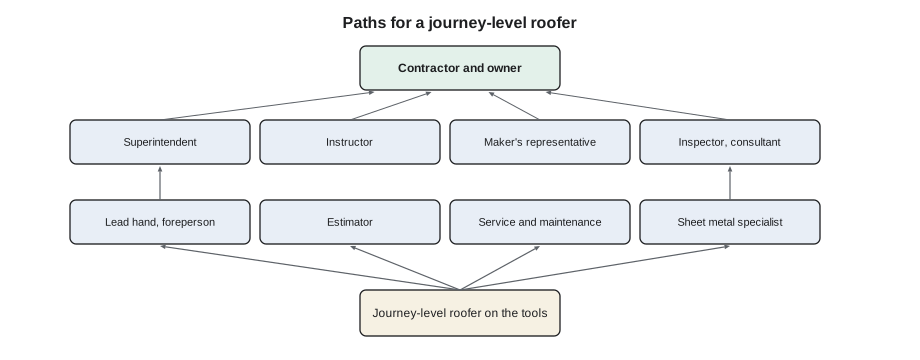
At Ridgecap the paths are visible on the staff list. Dana went from apprentice to foreperson. Theo Barnes runs the sheet metal shop. Nadine Szabo built the service program. Glen Pelham came up as a roofer and now owns the company and estimates its biggest jobs. Joanne Kirsch and Derek Asante, the makers' representatives who inspect Ridgecap's roofs, were roofers first. Martin Oyelaran, the consultant whose drawings Rory marked up, worked as a roofer through university.
Responsibilities that come with it
A journeyworker is the person apprentices learn from, whether or not anyone calls them a mentor. Apprentices learn what they see, so the journeyworker's habits on the roof, tied off or not, checking the fire watch or not, become the crew's habits. Good mentoring is deliberate: show the task and explain why, let the apprentice try it with supervision, give specific feedback, and let them do it alone when they are ready. Dana's version was shorter. "Show them, then watch them, then trust them, in that order."
A journeyworker is also expected to lead on safety: to stop unsafe work, to speak up when a plan is wrong, and to set up the job properly even when nobody is checking. As a lead hand or foreperson, a roofer takes on the legal duties of a supervisor: to make sure workers are trained and protected, that equipment is safe, and that every reasonable precaution is taken. Those duties are real, and they are the reason the safety questions on the exam matter so much.
Quality is the third responsibility. A roof is installed once and must last decades. The journeyworker is the person who knows whether the lap was rolled, the weld probed, the flashing fastened at the top, and the drain clamped evenly, and who does it right when nobody would know the difference for years.
Looking after the body that does the work
Roofing is hard on the body, and a career of forty years depends on protecting it from the first season. The common long-term injuries are to backs, shoulders and knees, from lifting, carrying and kneeling; to hearing, from saws, compressors and nailers; to skin, from sun; and to lungs, from dust and fumes. The habits that prevent them are not complicated: use hoists, conveyors and carts instead of backs; lift with help and keep loads close; wear knee pads; wear hearing protection; cover up in the sun and check the skin; and use the dust controls and respirators the job calls for. A journeyworker who works this way teaches the apprentices around them to do the same, which is the cheapest injury prevention any crew has.
Mental health is part of it too. Roofing is seasonal, physically demanding and often far from home, and construction workers face higher than average rates of stress, substance use and suicide. Crews that talk about it, look out for each other and know where to find help through the employer, the union, an employee assistance program or a crisis line are safer crews.
The business side
A roofer who wants to run a company one day needs to know that the roof is the easy part. A roofing contractor carries liability insurance, workers' compensation coverage through the Ohio Bureau of Workers' Compensation, business registration with the state, and local licenses such as the City of Columbus home improvement limited contractor license for residential work, as well as the warranties it gives, the safety program it must run and the contracts it signs. It needs to estimate accurately (ROOF-330), manage cash through a seasonal year, keep good records, and hire and keep good people. Glen Pelham tells every apprentice who asks that the best preparation for owning a company is to spend a few years as a foreperson and a few more as an estimator, because between them those jobs show where money is made and lost.
Union and open shop
Roofers work in both union and open-shop companies. In the US, union roofers belong to locals of the United Union of Roofers, Waterproofers and Allied Workers, and their apprentices train through joint apprenticeship committees of the union and contractors. Union shops have collective agreements that set wages, benefits and hiring; open-shop companies, like Ridgecap, set them directly with their workers. Both train apprentices, and the trade's standards are the same in both: the roof does not know who installed it.
Passing it on
Every journeyworker was taught by somebody. Dana learned from a foreperson named Walt who made her flash the same curb four times on her first commercial job until it was right, and who, she said, never once raised his voice. Most experienced roofers can name the person who taught them, and many say it was the most important thing that happened in their working life. The trade depends on that happening again with every new apprentice. The study group was Dana's way of passing it on; Rory wrote down that he would run one himself someday.
Keeping up
The roofing trade changes. In the years before this program was written, single-ply and cold-applied systems grew, self-adhered membranes replaced much torch work at details, white roofs and energy codes raised insulation levels and reflectivity requirements, solar arrays moved onto commercial roofs, and fall protection rules tightened. The next twenty years will bring their own changes. A roofer keeps up by:
- Taking makers' training on new systems and reading their technical bulletins.
- Following NRCA and the regional roofing contractors' associations, their manuals and their safety programs.
- Knowing when codes change and what changed for roofing; the building code, the fire code and the energy code are all updated on cycles of a few years.
- Keeping safety training current, and adding supervisor and first aid training on the way to running crews.
- Adding credentials that fit the path: NRCA ProCertification in more systems, OSHA 30, building science or construction management courses at a college, or a roofing inspector or consultant designation.
What employers look for
Glen hires journeyworkers every spring, and he told the group what he looks for after the credential. First, safety habits that he can see on the first day: tied off without being told, ladder set right, fire watch done properly. Second, the ability to read a drawing and a specification and spot what does not work before it is built. Third, the ability to explain work to an apprentice, an owner or an inspector in plain words. Fourth, reliability: showing up, finishing the job, and telling the foreperson early when something is going wrong. "I can teach somebody a new membrane in a week," he said. "I can't teach them to care whether the lap is rolled."
Those are also the things that move a journeyworker up. A roofer who is safe, reads drawings, explains well and can be trusted with a crew is the one who is offered lead hand, then foreperson, then a seat at the estimating table.
Moving to work somewhere else
Many roofers work away from home at some point, following big projects or better seasons. A journey-level roofer can work in other states, but licensing, safety training and codes change at every state and city line; some states license roofing contractors, some cities require registration, and some owners require specific certifications such as NRCA ProCertification or OSHA 30. The skill travels; the rules have to be learned again.
The plans
By the end of the night, everybody in the study group had a plan written down, because Dana would not let them leave without one.
Luca would write Ridgecap's completion test on Saturday, January 16, 2027, after a second practice test in early January, and take his practical test the following week. If he passed, he would receive his certificate of completion, Ridgecap would make him lead hand on Crew 2 in the spring, and he would take the NRCA modified bitumen systems installer certification in April.
Keisha would finish her second-year classroom hours in the winter and spend the next season on Crew 2 to fill the low-slope gaps her dry run had shown. She wanted to estimate, and Glen had offered her two evenings a month in the office.
Rory had about seven months of hours, his first year of classroom hours ahead of him over the winter, and roughly two more years before he could write the completion test. He wrote three things in the back of his notebook: keep the error log going, starting with the questions from the dry run; ask Bram for another stint on Crew 6 next summer; and learn to weld seams as well as Owen. Under them, in smaller letters, he wrote: "Show them, then watch them, then trust them."
Dana collected the plans, photocopied them and gave the copies back. "I'll check these in June," she said. "Not because I'm your mother. Because a plan nobody checks is a wish."
Common mistakes
MistakeTreating the credential as the end of learning.
InsteadKeep training current and add credentials that fit your path.
MistakeTeaching apprentices by example only.
InsteadShow and explain, then supervise, then trust, deliberately.
MistakeLeaving safety to the foreperson.
InsteadEvery journeyworker leads on safety and can stop unsafe work.
MistakeAssuming a credential from one place covers all the rules of another.
InsteadLearn the local codes, safety rules and practices wherever you work.
MistakeWaiting to be offered the next role.
InsteadTell your employer what path you want and ask what it needs.
Summary and key terms
- The certificate of completion of apprenticeship is the national proof of the whole trade; Ohio does not license roofers.
- NRCA ProCertification and maker credentials must be renewed or updated; safety training must be kept current.
- Paths include foreperson, superintendent, estimator, service, sheet metal, inspector, maker's rep, instructor and contractor.
- A journey-level roofer mentors apprentices, leads on safety, carries supervisor duties when running crews, and protects quality.
- Keep up with makers' training, associations, code changes and new credentials.
- Write a plan, and check it.
- Journeyworker
- A worker who has completed training and certification in a trade.
- Lead hand
- An experienced worker who directs part of a crew under the foreperson.
- Superintendent
- The person who manages several crews or jobs for a contractor.
- Mentoring
- Deliberately teaching an apprentice by showing, supervising and giving feedback.
- Portability
- The ability to use a credential in other provinces, states or countries.
- Continuing education
- Training taken after certification to keep up and to move forward.
Practice problems
Work each problem on paper first, then reveal the answer to check.
Name three roles a certified roofer can move into within a roofing company.
Show answer
Lead hand or foreperson, superintendent, estimator, service manager, sheet metal specialist.
How often is NRCA ProCertification renewed?
Show answer
Every three years.
Does a journey-level roofer need to learn anything new to work in another state?
Show answer
Yes, that place's codes, licensing, safety rules and practices.
What are Dana's three steps for teaching an apprentice?
Show answer
Show them, watch them, trust them.
Why does a journeyworker's safety habit matter beyond their own safety?
Show answer
Apprentices copy it, so it becomes the crew's habit.
Lesson quiz · 5 questions
Score 60% or more to complete this lesson.
Create a free account to save your progress, take quizzes and earn a certificate.