
ROOF-340 · Lesson 6 of 12 · 25 min
Review: built-up and modified bitumen
▶ Video coming soon A video version of this lesson is on the way.
This was Luca's home ground, and Dana made him teach it. He stood at the whiteboard with a marker and drew a section through the Carrick Street roof from memory: the steel deck, the self-adhered vapor retarder, two layers of polyiso, the gypsum cover board, the self-adhered base sheet, the torch-applied cap, the picture-frame band at the parapets, the base flashing, the counterflashing. Then Dana asked him the questions the exam would ask, and he got three of the first ten wrong. "I know how to do it," he said. "I don't know the numbers for why." "That's exactly what this review is for," Dana said.
Bituminous roofing is the largest single part of the low-slope questions, because built-up and modified bitumen systems still cover a large share of commercial roofs in both countries. This lesson reviews ROOF-210: assemblies and their layers, asphalt and felts, built-up roofing, kettles, cold-applied systems, SBS and APP modified bitumen, torch application and fire prevention, self-adhered sheets, attachment, surfacing, flashings and quality control.
The layers
A low-slope bituminous roof is a system of layers, and each has a job. From the bottom: the deck; a vapor retarder or air barrier where the design calls for one; insulation in one or more layers with staggered joints; a cover board; the membrane, which on a built-up roof is three or four plies of felt with asphalt between them and on a modified bitumen roof is usually a base sheet and a cap sheet; and the surfacing, which protects the membrane from sun and weather. Flashings at every edge, wall, curb and penetration tie the membrane to the rest of the building.
| Layer | Job | Common exam point |
|---|---|---|
| Vapor retarder | Slows vapor into the insulation from inside | Warm side of the insulation; sealed at laps, walls and penetrations |
| Insulation | Controls heat flow | Joints staggered between layers; boards kept dry; attached for wind |
| Cover board | Protects insulation; firm, compatible surface | Gypsum boards are primed before self-adhered or torch work as the maker requires |
| Base sheet | First ply of the membrane | Laps offset from the cap's laps |
| Cap sheet | Top ply, usually granule-surfaced | Side and end laps as the maker requires; end laps staggered |
| Surfacing | Protects against sun, weather and fire | Gravel, granules or coatings |
Asphalt and built-up roofing
Roofing asphalt for built-up roofs is graded by its softening point. ASTM D312 has four types: Type I is the softest, for flat roofs, and Type IV the hardest, for the steepest slopes; Type III is the common choice for many roofs. Asphalt is applied at its equiviscous temperature (EVT), the temperature at which it has the right thickness to spread a proper film, measured at the point of application, not at the kettle. It must be kept well below its flash point, which for roofing asphalt is at least 500 °F.
A built-up roof is made of shingled plies of felt laid in asphalt. In a four-ply roof each felt is lapped so that four layers of felt are present everywhere; starter strips at the edge give the correct number of plies from the first sheet. Interply moppings are about 25 lb per square of asphalt, and the flood coat that holds the gravel is about 60 lb per square. Gravel protects the asphalt from the sun and from fire.
Worked problem
Asphalt for a built-up repair
The Ferncliff bakery roof is 7,000 ft², or 70 squares. If it were rebuilt as a four-ply built-up roof with three interply moppings at 25 lb per square and a flood coat at 60 lb per square, how much asphalt would the membrane need, not counting waste or the first mopping to the board?
Show solution
- Interply = 70 × 25 × 3 = 5,250 lb.
- Flood coat = 70 × 60 = 4,200 lb.
- Total = 5,250 + 4,200 = 9,450 lb.
Answer: About 9,450 lb of asphalt. Mopping weights are checked on the job by test cuts, which is a common exam topic.
Kettles and hot asphalt
Kettle questions are safety questions in disguise. A kettle is run by a competent operator, set up on level ground away from building openings and air intakes, with its lid closed except when drawing asphalt and its temperature controlled so it never approaches the flash point. Under the fire code, kettles are kept at least 20 ft from buildings unless the code's conditions allow closer, with an attendant within the distance the code sets whenever they are heated, with fuel containers at least 10 ft from the burner and extinguishers within reach. Hot asphalt is carried to the roof in a pipe, a pump line or a hoisted bucket, never more than about three-quarters full, and every worker near it wears long sleeves, gloves and eye protection.
Cold-applied systems
Cold-applied systems use adhesives and cements instead of hot asphalt or flame. They are chosen where flame or fumes are a problem, as on the Ferncliff bakery near its oven stacks and air intakes. The questions are about coverage, temperature and cure: the adhesive is applied at the maker's rate, checked by a yield test (measuring how much area a known quantity covered), applied only above the maker's minimum temperature, and given time to cure before traffic. Solvent-based adhesives give off flammable vapors, so air intakes are shut down or protected and ignition sources kept away.
SBS and APP
Modified bitumen is asphalt with a polymer added. SBS (styrene-butadiene-styrene) makes the bitumen rubbery and flexible in the cold; SBS sheets can be torched, hot-mopped, cold-applied or self-adhered. APP (atactic polypropylene) makes it plastic and resistant to heat and ultraviolet light; APP sheets are usually torched and are stiffer in the cold. Reinforcements are glass fiber, polyester or both: polyester stretches and recovers, glass is stable. Cap sheets are surfaced with granules, metal foil or a smooth finish for coating.
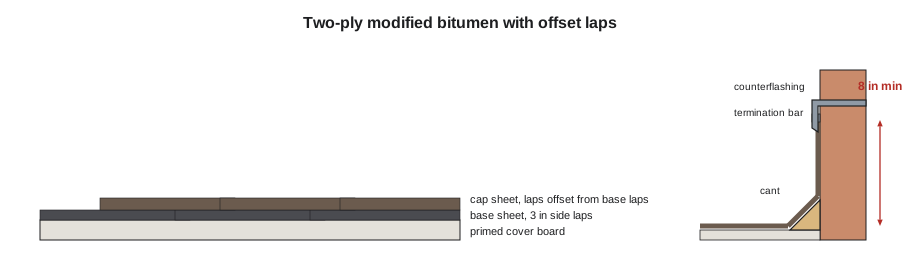
A two-ply system is laid so that the cap's laps are offset from the base sheet's laps, and end laps are staggered so that four layers never pile up in one spot. Net coverage per roll is less than the roll's area because of the laps.
Worked problem
Net coverage of a roll
A cap roll is 39-3/8 in (3.28 ft) wide and 33 ft long. Side laps are 3 in and end laps 6 in. What area does one roll cover?
Show solution
- Net width = 3.28 − 0.25 = 3.03 ft.
- Net length = 33 − 0.5 = 32.5 ft.
- Net coverage = 3.03 × 32.5 = 98.5 ft², just under a square.
Answer: About 98.5 ft², compared with 108 ft² gross. Ordering by gross area would leave the job about one roll short in every ten.
Torch application and fire prevention
Torch application is the most fire-prone work in roofing, and it is heavily tested. The torch heats the back of the roll until the bitumen flows, and a correct weld shows a small, even bead of bitumen at the lap, called bleed-out. The rules that prevent fires are the ones from lesson 3, applied at the roof:
- No flame on or next to wood, combustible insulation or other combustibles; use flameless methods (self-adhered or cold-applied sheets) at those places.
- A picture-frame band of flameless material about 3 ft wide at parapets, curbs, walls and openings, as the industry guidelines recommend.
- Never direct a torch into gaps, openings, the voids of fluted decks or under flashings.
- Propane cylinders upright and secured, hoses and regulators checked, torches never left burning unattended, and the torch shut off at the cylinder when not in use.
- A fire watch with an infrared thermometer after torching ends, for the full period, before the crew leaves.
At Cedarbrook school in July, a fire watch scan found an old fiberboard cant smoldering under a curb flashing more than an hour after torching stopped. It was at 48 °C when the air was 35 °C. That is why the fire watch exists, and why Ridgecap's crews scan under the edges of the flameless bands as well as the open roof.
Self-adhered sheets
Self-adhered base, cap and flashing sheets have a factory adhesive under a release film. They need a clean, dry, primed surface where the maker requires primer, and they need warmth: most makers give a minimum temperature for application, usually around 40 to 50 °F, and in cold weather the rolls are stored warm before use. Laps are rolled firmly, and T-joints are cut and sealed as the maker requires.
Attachment and surfacing
Base sheets and insulation are attached by mechanical fasteners, hot asphalt, adhesive or self-adhesion, in patterns that increase in the perimeter and corners for wind (lesson 7). Surfacing is chosen for weather, fire and reflectivity: gravel embedded in a flood coat on built-up roofs, factory granules on cap sheets, and coatings that reflect sun and reduce heat in the roof. Coatings are applied at a measured rate to a dry film thickness.
Worked problem
Coating rate
A coating must be applied at 3 gal per square to the Ferncliff roof's 70 squares. How many 5 gal pails are needed, with 5 in 100 extra for waste?
Show solution
- Coating = 70 × 3 = 210 gal.
- With waste = 210 × 1.05 = 220.5 gal.
- Pails = 220.5 ÷ 5 = 44.1, so 45 pails.
Answer: 45 pails.
Flashings and quality control
Bituminous base flashings are two plies, usually a base ply and a cap ply, fully adhered to a primed, solid substrate, at least 8 in up the wall, mechanically fastened at the top and covered by a counterflashing. A cant or a solid backing prevents the membrane from bridging the corner, where it would crack when the building moves. Quality control on bituminous roofs means checking the weather and the dew point before starting, probing laps with a blunt tool, taking test cuts where the specification calls for them, keeping daily records, and stopping at the hold points the specification lists for inspection.
Exam-style questions explained
Question. A test cut from a new built-up roof shows the interply moppings are far lighter than specified. What is the most likely cause? (A) The asphalt was applied below its equiviscous temperature and spread too thin, or the moppings were skimped; (B) too much gravel; (C) the felts were too heavy; (D) the deck was steel. Answer: A. Asphalt that is too cool goes on thick in some places and skips others; mopping weight is a workmanship check.
Question. Blisters appear in a new modified bitumen cap sheet within weeks. Which is the likeliest cause? (A) Moisture or air trapped between plies during installation; (B) too many granules; (C) the wrong color of cap; (D) too much slope. Answer: A. Moisture or air trapped in voids expands in the sun. Dry substrates, good bleed-out and rolled laps prevent it.
Question. Which tool is used to check the laps of a torched cap sheet? (A) A blunt probe or a trowel edge along the lap; (B) a moisture meter; (C) a hook knife; (D) a torch. Answer: A. Probing finds open laps before they leak. A hook knife is for cutting.
Question. Why is a cant installed at the base of a wall on a bituminous roof? (A) To stop the membrane bridging a sharp corner where it would crack; (B) to add insulation; (C) to hold gravel; (D) to raise the flashing height. Answer: A. Bituminous membranes cannot turn a sharp 90° corner without stress.
Cold weather and bituminous roofing
Much commercial roofing in both countries is done in cold weather, and the exam expects a roofer to know its limits. Hot asphalt cools quickly in the wind and the cold, so kettle temperatures and hauling distances are adjusted to keep it at its equiviscous temperature where it is applied, never by heating it toward its flash point. Torch-applied sheets stiffen in the cold and need warming on the roll before they will lay flat; self-adhered sheets and adhesives have minimum application temperatures and are stored warm. Frost and ice on the substrate prevent bonding and must be removed and the surface dried, not covered. Dew forms on cold boards in the morning and evening, so crews check the dew point and wait for surfaces to dry. At Carrick Street in November, Dana's crew waited until 10:15 on the frosty Tuesday morning before laying base sheet, after the sun had dried the boards.
Where asbestos may hide
Old built-up roofs, flashing cements, mastics, felts and some cants and coatings may contain asbestos. Before a tear-off or repair disturbs old bituminous materials of uncertain age, they are tested. At Ferncliff, Anjali had the flashing cement tested before the repair began; at Cedarbrook, asbestos in the flashing cement was removed by a qualified abatement contractor the week before Ridgecap started.
Common mistakes
MistakeMeasuring asphalt temperature only at the kettle.
InsteadEVT is measured where the asphalt is applied.
MistakeOrdering cap rolls by gross area.
InsteadUse net coverage after side and end laps.
MistakeTorching close to wood curbs with a heat shield.
InsteadUse flameless methods at and near combustibles.
MistakeApplying self-adhered sheets on a cold, damp board.
InsteadWork above the maker's minimum temperature on a dry, primed surface.
MistakeEnding the fire watch when the roof looks cold.
InsteadWatch and scan for the full period, including under flashing edges.
Summary and key terms
- A bituminous roof is a system: deck, vapor retarder, insulation, cover board, membrane plies, surfacing and flashings.
- Asphalt types I to IV by softening point; apply at EVT at the point of application, well below the flash point.
- Built-up roofs are shingled plies with moppings of about 25 lb per square and a flood coat with gravel.
- SBS is flexible in cold and versatile; APP resists heat and is usually torched; offset laps and stagger end laps.
- Torching needs flameless zones, a picture-frame band, careful propane handling and a full fire watch.
- Self-adhered sheets need warmth, dry primed surfaces and rolled laps; quality control uses weather checks, probing, test cuts and records.
- Equiviscous temperature
- The temperature at which asphalt has the right viscosity for application, measured where it is applied.
- Bleed-out
- The small bead of bitumen that shows at a lap when a torch weld is correct.
- Picture framing
- A band of flameless material installed around edges and details before torching the field.
- Flood coat
- The heavy top coat of asphalt on a built-up roof that holds the gravel.
- Yield test
- A check of how much area a known amount of adhesive or coating actually covered.
- Test cut
- A sample cut from a built-up roof to check the plies and asphalt weight.
Practice problems
Work each problem on paper first, then reveal the answer to check.
A 90-square roof needs three interply moppings at 25 lb per square. How much asphalt is that?
Show answer
90 × 25 × 3 = 6,750 lb.
A roll is 3.28 ft by 33 ft with 4 in side laps and 6 in end laps. What is its net coverage?
Show answer
2.95 × 32.5 = 95.8 ft².
Why are APP sheets usually torched rather than self-adhered?
Show answer
APP is stiff and heat-resistant; its common application is by torch.
Name two places where flame must not be used.
Show answer
On or next to wood curbs and nailers, and at openings or fluted deck voids.
What is checked before starting membrane work each morning?
Show answer
Weather, surface dryness and the dew point.
Lesson quiz · 5 questions
Score 60% or more to complete this lesson.
Create a free account to save your progress, take quizzes and earn a certificate.